Debt Relief for Medical Bills: Programs, Steps, And Help
A single hospital stay or emergency surgery can leave you with bills that take years to pay off, if you can pay them at all. Medical debt is one of the leading causes of financial hardship in the United States, and finding debt relief for medical bills can feel overwhelming when you're already dealing with health problems. The good news is that real options exist, from hospital charity care programs to government assistance and nonprofit organizations designed to help eliminate what you owe .
Many people don't realize that medical providers, billing departments, and third-party programs regularly reduce or forgive balances for patients who qualify. And when those options fall short, legal protections like Chapter 7 and Chapter 13 bankruptcy can wipe out medical debt entirely or restructure it into manageable payments. At Mayfield Law Firm, P.A., we've helped clients across Northeast Mississippi and South Memphis use bankruptcy as a tool to get out from under crushing medical bills and start fresh.
This guide walks you through the programs, steps, and resources available to reduce or eliminate your medical debt, so you can figure out which path makes the most sense for your situation.
What debt relief for medical bills can include
Debt relief for medical bills is not a single program or a single fix. It is a range of overlapping options , from direct hospital assistance to federal programs to legal remedies, and you may qualify for more than one at the same time. Understanding what is available before you start making calls or sending payments puts you in a much stronger position to reduce what you actually owe.
Free and low-cost programs from hospitals
Nonprofit hospitals in the United States are required by federal law to offer charity care to patients who cannot afford their bills. These programs can reduce your balance by a set percentage, cap what you owe based on your income, or write off the entire amount. For example, if your household income falls at or below 200% of the federal poverty level, many hospitals will zero out your balance entirely without requiring any repayment.
Most hospital charity care applications are free to submit, and hospitals cannot send your account to collections while your application is under active review.
Charity care goes by different names depending on the provider . You may see it called a financial assistance program, a sliding-scale discount, or a hospital discount plan. Ask for the hospital's written financial assistance policy , which they are required to provide by law, and submit your application before making any payments.
Government and nonprofit assistance programs
Medicaid is one of the most significant sources of medical debt relief available in the country. If you were uninsured or underinsured when you received care, you may be able to apply for Medicaid retroactively in some states, which can cover bills you have already incurred. Eligibility depends on your state, income, and household size.
Several nonprofit organizations also run programs specifically designed to help patients eliminate or reduce medical debt. RIP Medical Debt, for example, purchases medical debt portfolios and forgives them for qualifying individuals, meaning the debt disappears without any action required from you. Other nonprofits offer direct grants or zero-interest loans to cover outstanding balances.
Negotiation, settlement, and payment plans
Negotiating directly with a hospital billing department is more effective than most people expect. Hospitals routinely accept settlements for less than the full balance, especially on older accounts or accounts already in collections. You can request an itemized bill, dispute charges you do not recognize, and then submit a settlement offer in writing.
Payment plans are another standard option. Most providers will set up an interest-free or low-interest plan if you ask before the account moves to collections. If a collections agency already holds your debt, settlements at 40 to 60 cents on the dollar are common for medical accounts.
Bankruptcy protection
Chapter 7 bankruptcy can discharge medical bills entirely, often within four to six months of filing. Chapter 13 reorganizes your debt into a three-to-five-year repayment plan, which may allow you to pay a fraction of what you owe while keeping your assets. Both options stop collections calls, lawsuits, and wage garnishments the day you file.
Medical debt is classified as unsecured debt in bankruptcy, which means it is dischargeable just like credit card balances. If other options have not produced results or your total debt load is simply unmanageable, bankruptcy is often the most direct and legally protected path to a clean start.
Step 1. Gather facts and verify every charge
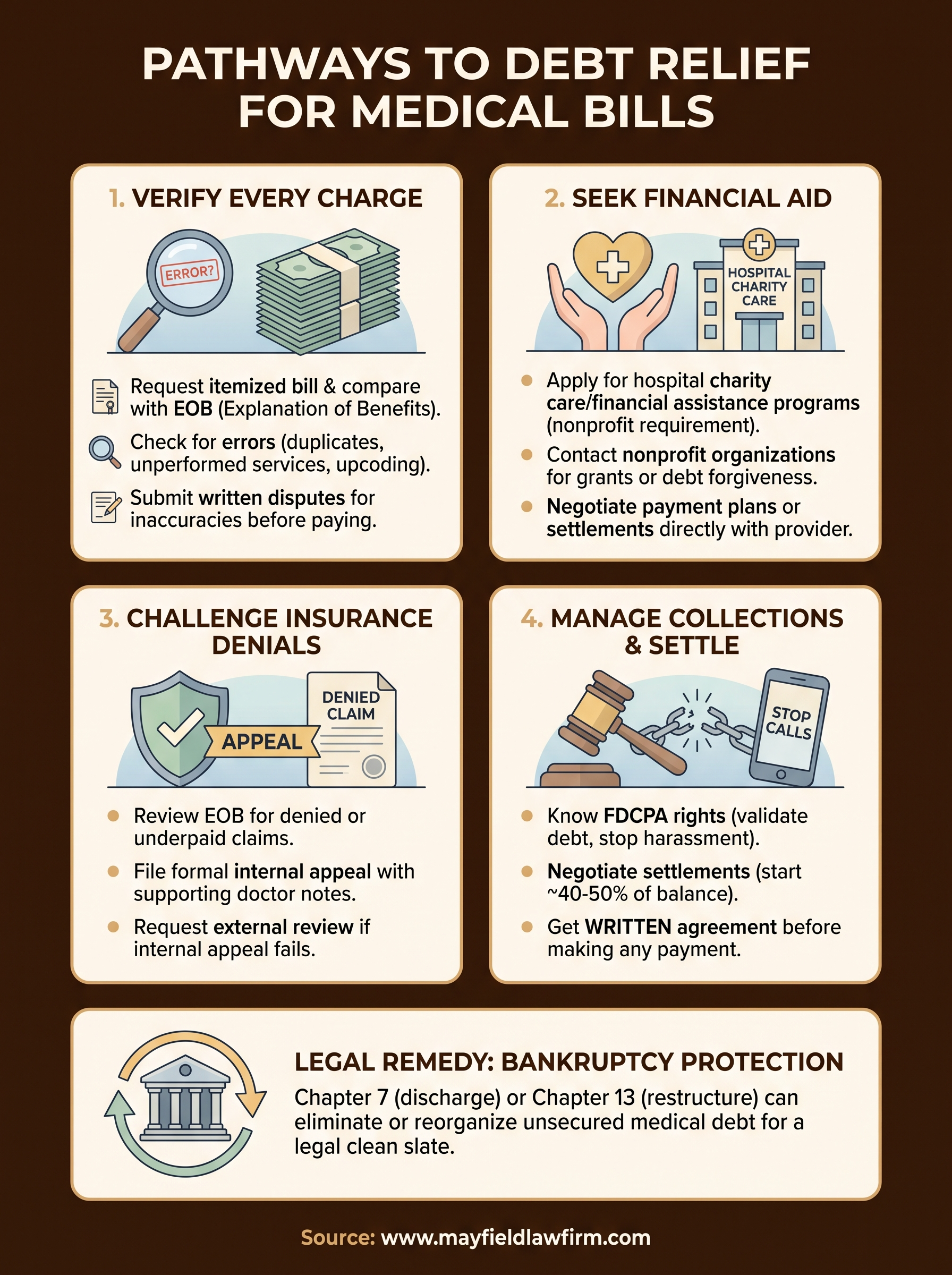
Before you negotiate anything or apply for any program, you need to know exactly what you owe and whether those charges are accurate. Billing errors in hospital statements are common , and some studies have found mistakes in the majority of medical bills reviewed. Starting your pursuit of debt relief for medical bills with a full picture of your account puts you in a far stronger position than simply accepting the balance at face value.
Request an itemized bill
Call the billing department and ask for a complete itemized statement of every charge on your account. A summary bill showing one lump sum is not enough. You want a line-by-line breakdown that lists each service, procedure, medication, and supply with its corresponding billing code. Hospitals are required to provide this upon request, and you should not make any payment until you have it in hand.
Keep a written record of every call you make, including the date, the name of the person you spoke with, and what they told you.
Once you receive the itemized bill, compare it against your explanation of benefits (EOB) from your insurance company. The EOB shows what your insurer was billed, what they paid, and what they determined you owe. Discrepancies between the two documents are a signal that something needs to be corrected before you pay anything.
Check for billing errors
Common errors to look for include duplicate charges for the same service, charges for procedures that were scheduled but never performed, incorrect dates of service, and upcoded procedure codes that reflect a more expensive service than what actually happened. Even something as small as a miscoded diagnosis can affect your total balance significantly.
Use the following checklist when reviewing your itemized bill:
- Duplicate line items: Look for the same service billed more than once
- Cancelled procedures: Verify that anything listed was actually performed
- Room and board rates: Confirm the number of nights matches your actual stay
- Unbundling: Check whether grouped procedures were split into separate charges to increase the total
- Incorrect patient information: A wrong insurance ID or policy number can cause claim denials
If you find errors, submit a written dispute to the billing department referencing the specific line item, the charge amount, and the reason you believe it is incorrect. Ask for a corrected bill before any further action is taken on your account.
Step 2. Ask the provider for financial assistance
Once you have a verified, accurate bill in hand, your next move is to contact the provider directly and ask about financial assistance programs . This step alone can eliminate a significant portion of your balance, and many patients skip it entirely because they assume they will not qualify. The truth is that nonprofit hospitals are federally required to offer some form of charity care, and for-profit systems often have their own discount programs as well.
How to find and apply for charity care
Start by calling the hospital's billing or patient financial services department and ask two specific questions: "Do you have a financial assistance program?" and "Can you send me the written financial assistance policy?" Federal law under the Affordable Care Act requires nonprofit hospitals to make this policy publicly available, so any hesitation from the billing staff is a sign you should ask again or escalate to a supervisor.
When you submit your application, the hospital will typically ask for documentation of your income and household size. Gather these items before you call so the process moves faster:
- Two to three months of pay stubs or a current benefit award letter if you receive government assistance
- Most recent federal tax return or a written statement if you did not file
- Proof of household size , such as a utility bill or lease agreement
- Bank statements for the past two to three months if requested
Submit your application before making any payment, because some hospitals require that your account remain unpaid to qualify for their full charity care discount.
What to say when you call
A short, clear script prevents the conversation from going off track. You do not need to over-explain your situation to get results. Use the following as a starting template when you reach a billing representative:
"Hi, my name is [your name] and I have an outstanding balance of [amount] from a visit on [date]. I am calling to ask about your financial assistance program. Can you walk me through the application process and tell me what documentation I need to submit?"
After you apply, follow up in writing by email or certified mail. Reference your account number and the date you submitted your application in every follow-up message. This paper trail protects you if the account is incorrectly sent to collections while your debt relief for medical bills application is still under review.
Step 3. Push insurance to pay what it should
Insurance companies deny or underpay claims more often than most policyholders realize. Before you accept any remaining balance as your final responsibility, you need to verify that your insurer processed your claim correctly and paid what your policy actually requires. Errors on the insurance side are just as common as hospital billing mistakes, and correcting them can significantly reduce what you owe as part of your broader pursuit of debt relief for medical bills .
Review your explanation of benefits
Your insurer is required to send you an explanation of benefits (EOB) after processing any claim. This document shows the total amount billed, the amount your insurer paid, any adjustments applied, and the remaining balance assigned to you. Pull the EOB for every claim tied to the bills you are working through and compare it line by line against the itemized statement from your provider.
If your insurer denied any part of a claim, the EOB will include a reason code. Write that code down, because you will need it when you file a formal appeal.
Look specifically for claims marked as not medically necessary , out-of-network denials that should have been processed as in-network, and services where your insurer applied the wrong deductible or copay amount. Each of these is grounds for a written appeal, and providers can often supply additional documentation to support your case.
File a formal appeal
Every health insurance policy sold in the United States must include an internal appeals process under the Affordable Care Act. You have the right to challenge any denial or underpayment in writing, and insurers are required to respond within a set timeframe. If your internal appeal fails, you can also request an external review by an independent organization , which is a separate right guaranteed under federal law regardless of your state.
When you write your appeal letter, keep it factual and specific. The following template gives you a clear starting point:
"I am writing to formally appeal the denial of claim [claim number] dated [date]. The service in question, [describe service], was medically necessary as documented by [provider name] on [date of service]. I am requesting a full review and reversal of this denial and ask that you respond within the timeframe required by my policy."
Attach your doctor's notes or a letter of medical necessity directly to the appeal. A written statement from your physician explaining why the treatment was required carries significant weight with insurance reviewers and increases your chances of a successful outcome.
Step 4. Handle collections and protect yourself
If your medical bill has already moved to a collections agency, you are not out of options for debt relief for medical bills . Collections agencies buy medical debt for a fraction of its face value, which means they have room to settle for significantly less than what you originally owed. Acting quickly and deliberately once a collection account appears is the single most effective way to protect your credit and reduce what you actually pay.
Know your rights under the Fair Debt Collection Practices Act
The Fair Debt Collection Practices Act (FDCPA) gives you specific legal protections that apply the moment a third-party collector contacts you about a medical bill. Collections agencies cannot call you before 8 a.m. or after 9 p.m., cannot contact you at work if you tell them to stop, and must cease all communication if you send a written request. Knowing these boundaries prevents collectors from using pressure tactics to force a payment you cannot afford.
Under the FDCPA, you have the right to request written verification of any debt within 30 days of first contact, and the collector must stop all collection activity until they provide it.
Your protections include the following key rights:
- Right to debt validation: Request written proof that the debt is yours and the amount is accurate
- Right to dispute inaccurate debts: Challenge any balance that does not match your records
- Right to cease communication: Send a written request and the collector must stop contacting you
- Right to sue for violations: Collectors who violate the FDCPA can be held liable in court
Negotiate a settlement with the collections agency
Medical debt in collections is one of the most negotiable categories of consumer debt because agencies purchase these accounts for pennies on the dollar. A reasonable opening offer is 40 to 50 percent of the stated balance, submitted in writing rather than over the phone.
Use this template when you submit a settlement offer:
"I am writing regarding account number [account number] for an original balance of [original amount]. I am prepared to offer a one-time settlement payment of [settlement amount] to resolve this account in full. Please confirm in writing that this payment will satisfy the balance and that the account will be reported as settled to all three credit bureaus."
Always get the written settlement agreement before you send any payment . A verbal agreement from a collector holds no legal weight, and without written confirmation, your payment may not close the account.
Conclusion
Debt relief for medical bills is not a single solution, but a process that starts with verifying every charge and ends with choosing the right tool for your specific situation. You may qualify for hospital charity care, succeed with an insurance appeal, or settle a collections account for less than half the original balance. Each step in this guide builds on the last , and working through them in order gives you the best chance of reducing what you actually owe.
When the debt load is simply too large to negotiate away, bankruptcy provides a legal path that no billing department or collections agency can block. Chapter 7 and Chapter 13 both treat medical bills as dischargeable unsecured debt , meaning you can eliminate or restructure them through the court process. If you want to talk through whether bankruptcy makes sense for your situation, contact Mayfield Law Firm, P.A. for a free consultation.