How Many Times Can Debt Collectors Call You Legally?
Your phone rings again, and it's the same collection agency for the third time today. You're not imagining it, and you're not being paranoid. If you're asking how many times can debt collectors call you before it crosses into harassment, you already suspect something isn't right, and you're probably correct.
Federal law actually spells this out. The FDCPA's seven-in-seven rule limits most collectors to seven calls per week about a single debt, and once they reach you, they generally have to wait seven days before calling about that same debt again. Calls outside normal hours, calls to your workplace after you've said no, or repeated calls once you've asked them to stop can all count as illegal debt collection practices , regardless of how much you actually owe.```
Below, we break down the specific call limits, what counts as harassment under the law, and what steps you can take if a collector won't quit. If the calls point to bigger financial trouble, our Southaven and Memphis bankruptcy team at Mayfield Law Firm can talk through your options at no cost to you.
Why the seven-in-seven rule matters for you
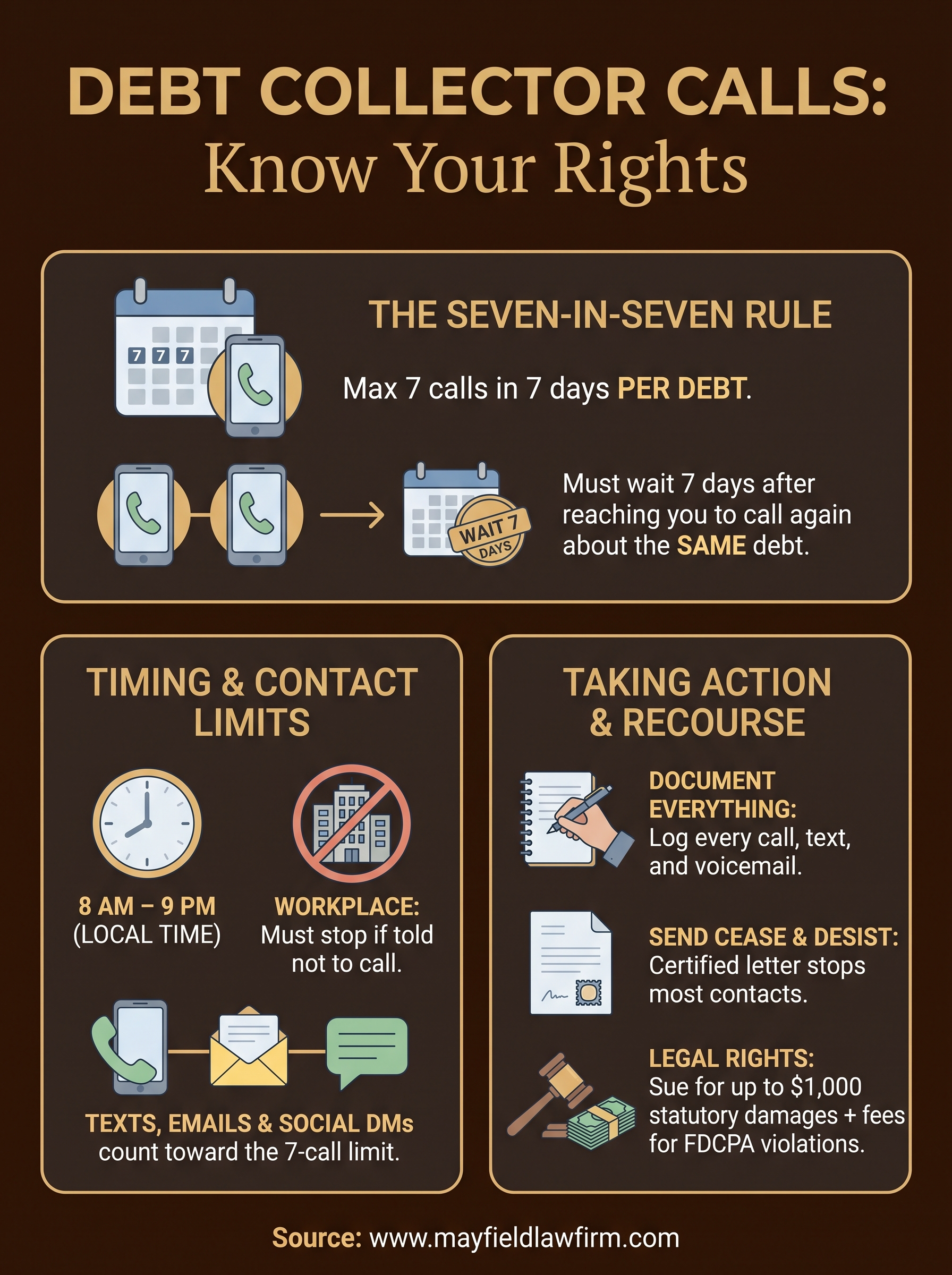
The seven-in-seven rule didn't come from a lawsuit or a court guess. It's written into federal regulation, and it gives you a concrete number to hold collectors to instead of a vague sense that "this feels like too much." Regulation F , the rule that implements the Fair Debt Collection Practices Act, caps most collectors at seven calls in a rolling seven-day period about one specific debt. Once a collector actually reaches you by phone about that debt, they have to wait another seven days before calling about it again. That's the baseline every Mississippi and Tennessee consumer should know before picking up the phone.
Where the rule actually comes from
Regulation F took effect in November 2021 through the Consumer Financial Protection Bureau , and it was the first time federal law put a hard number on collection calls instead of relying only on the FDCPA's older, vaguer ban on "harassing" contact. Before that, collectors and consumers argued endlessly over what counted as excessive. Now there's a bright line. You can read the CFPB's own explanation of the debt collection rule on its site, and it's worth bookmarking if you're dealing with a collector who won't ease up.
If a collector calls you more than seven times in a week about the same debt, they've likely broken federal law, not just your patience.
What counts as "the same debt"
Here's where people get tripped up. The seven-call limit applies per debt , not per collector or per household. If you owe money on two different accounts that both landed with the same collection agency, they can legally call you up to seven times each, meaning fourteen calls in a week isn't automatically illegal. That distinction matters when you're trying to figure out whether you have a real complaint or just an aggressive but technically compliant collector.
Why this protection exists in the first place
Congress passed the FDCPA back in 1977 because collection agencies were calling people at work, calling neighbors, and ringing phones at all hours to pressure payment. The seven-in-seven rule modernized that intent for a world where robocalls and auto-dialers make it trivially easy to place dozens of calls a day. Without a numeric cap, debt collector harassment could hide behind claims that every call was somehow reasonable. The rule takes that excuse away.
Think about what this means practically. A collector who calls you five times on Monday, twice on Tuesday, and then again on Wednesday about the same auto loan has already hit the ceiling for the week, even if none of those individual calls felt aggressive on their own. It's the pattern, not any single call, that the law is watching. That's exactly why keeping track matters so much, and why knowing the rule exists changes how you respond the next time your phone lights up with a number you don't recognize but already dread answering.
How to count calls and spot a violation
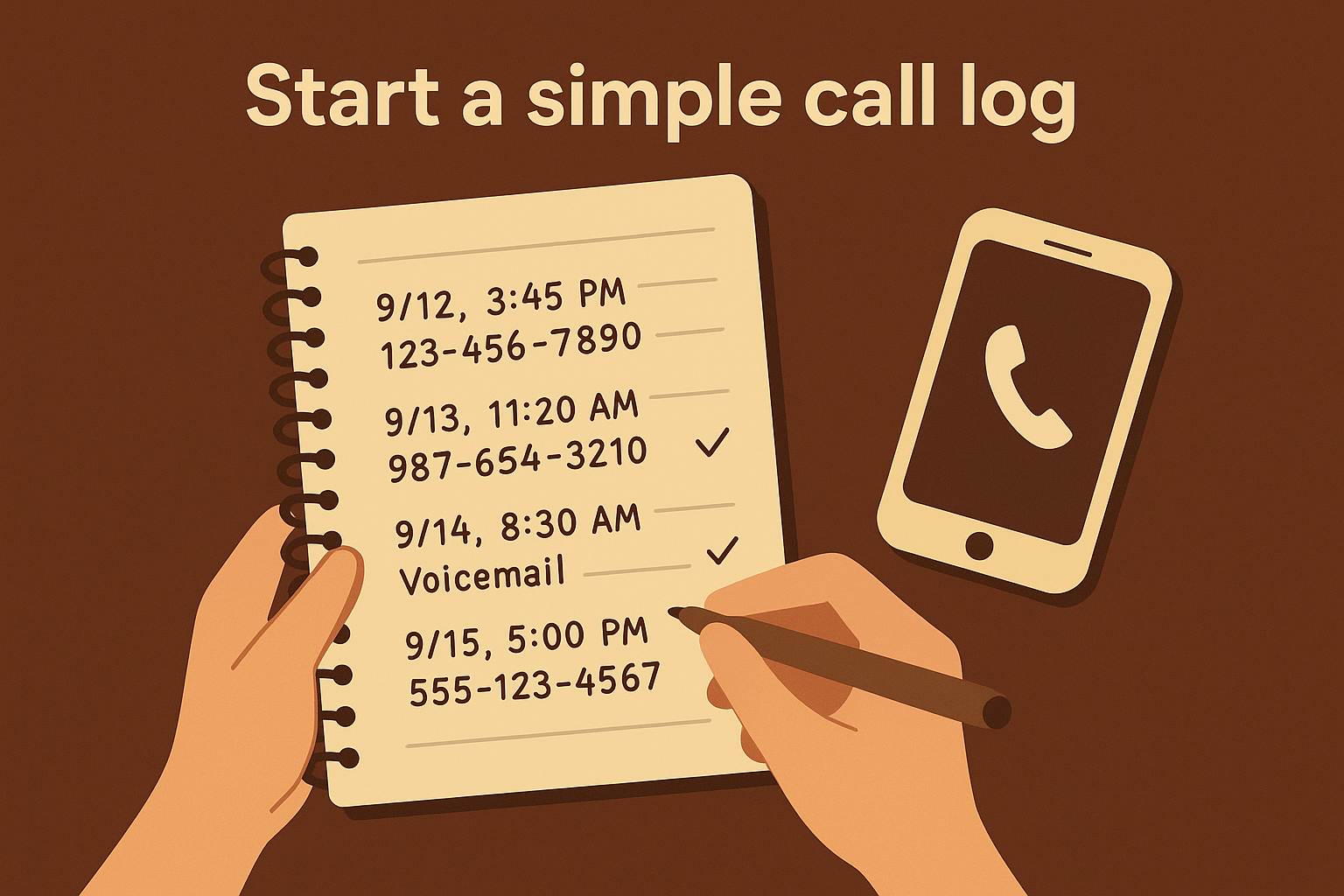
Counting calls sounds simple until you're the one doing it while frazzled and annoyed. Documentation is what turns a gut feeling into a legal claim, so start treating your phone like evidence the moment you suspect a collector is overdoing it. Write down the date, time, and number for every call tied to a specific debt, and note whether you actually answered or it went to voicemail.
Start a simple call log
Grab a notebook or open a spreadsheet and track these details every time the phone rings:
- Date and time of the call
- Phone number or caller ID shown
- Name of the agency or representative, if given
- Whether you answered or it went to voicemail
- What was said, especially threats or promises
Most phone carriers also keep call logs going back weeks, so cross-check your notes against your bill if you're missing entries. Screenshots of your call history work too, and they're hard for a collector to dispute later.
Signs the line has been crossed
Once you have a week's worth of calls logged, the math is straightforward. Seven calls or more in a rolling seven-day window about one debt is the trigger, and a call placed within seven days of you actually speaking to the collector about that same debt is another red flag. Watch for these patterns specifically:
| Situation | Likely a violation? |
|---|---|
| 8 calls in 7 days about one credit card debt | Yes |
| 6 calls in 7 days about one debt | No |
| 7 calls each for two separate debts, same agency | No |
| Call placed 3 days after you spoke about the same debt | Yes |
Once your log shows more than seven calls in a week on the same debt, you're not dealing with persistence, you're dealing with a violation.
When multiple debts complicate the count
Here's where a lot of consumers miscount. If a single collection agency is chasing two different debts you owe, maybe an old credit card and a medical bill, they get seven calls for each one. That can feel like nonstop ringing even though it's technically legal. Separating your log by account number or creditor name keeps you honest about what's actually excessive versus what just feels overwhelming.
Other rules on timing, texts, and cease requests
The seven-in-seven rule gets the most attention, but it's not the only limit collectors have to follow. Regulation F and the older FDCPA also control when collectors can call, whether they can text or email you, and what happens once you tell them to stop contacting you altogether. Knowing these extra rules matters because a collector can stay under seven calls a week and still be breaking the law in other ways.
Time-of-day and workplace limits
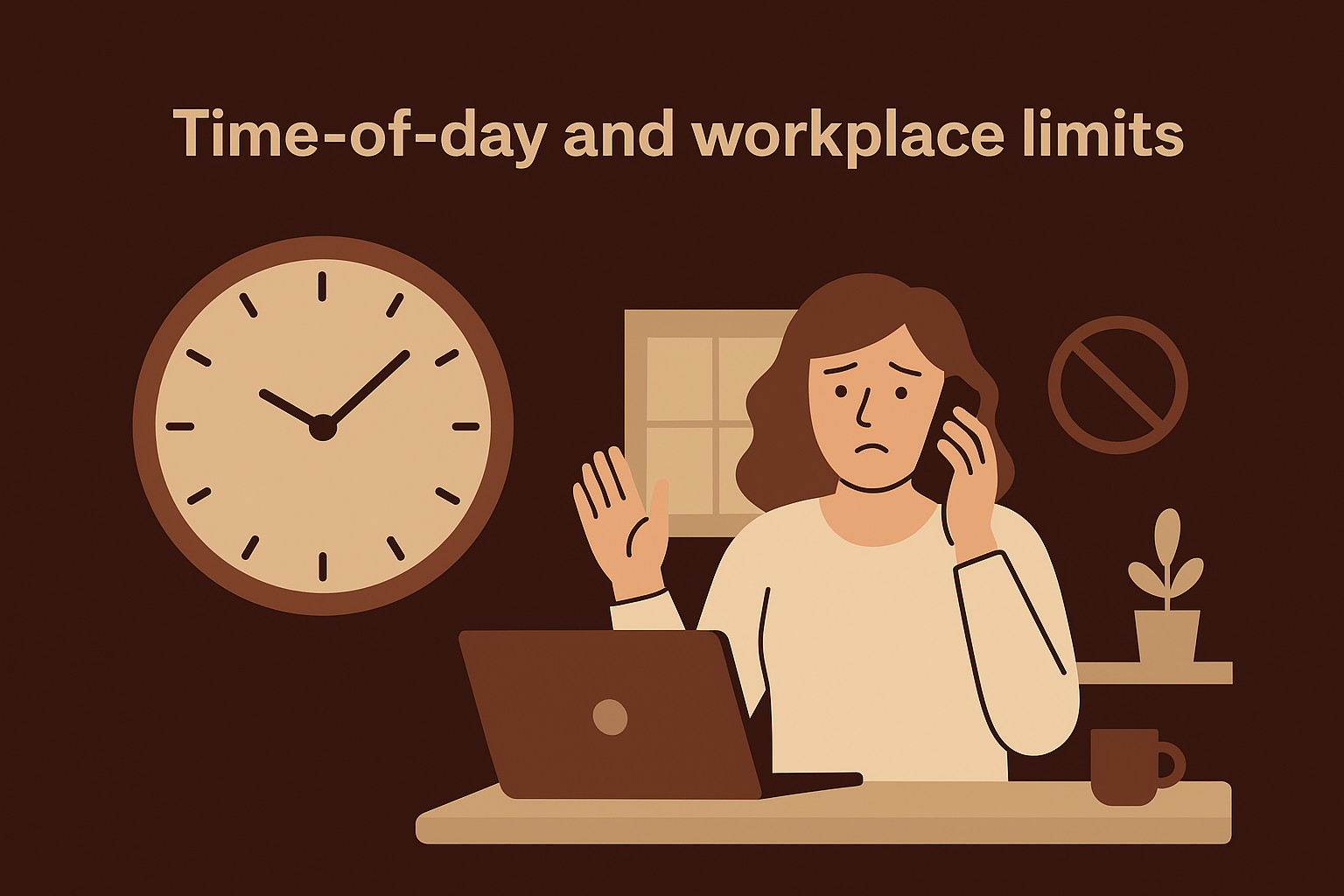
Collectors can only call you between 8 a.m. and 9 p.m. in your local time zone, and that window doesn't bend for time zone confusion on their end. Calling your workplace is also restricted once you tell the collector, verbally or in writing, that your employer doesn't allow personal calls. Watch for these situations:
- A call before 8 a.m. or after 9 p.m. your time
- Repeated calls to your job after you've said work calls aren't allowed
- Calls to family members or neighbors asking about your whereabouts, beyond one initial contact to locate you
Texts, emails, and social media count too
Since Regulation F took effect, collectors can reach you through text messages, emails, and even social media direct messages, not just phone calls. Those channels get folded into the same seven-in-seven counting , so a collector can't dodge the call cap by simply switching to texting you five times and calling you five more times about the same debt. Every text or email tied to that debt counts toward the weekly limit, and you should log them exactly like you would a phone call, including timestamps and screenshots.
Cease requests and written stop-calling letters
The strongest tool you have is a written cease-and-desist letter . Once a collector receives one, federal law says they can only contact you again to confirm they've stopped or to notify you of a specific action, like a lawsuit. Send it by certified mail so you have proof of delivery, keep a copy for your records, and don't rely on a phone call to make the request. A verbal request can slow things down temporarily, but only a written one locks in your legal protection.
A written cease request is the one letter that can legally shut down a collector's phone calls almost entirely.
Understanding these overlapping rules gives you a fuller picture than the seven-call number alone. Between timing restrictions, the expanded reach of texts and emails, and the power of a written stop request, you have more control over your phone than most people realize once a collection account lands on your credit report.
What to do when a collector breaks the rules
Once your call log shows a clear violation, you have real leverage, not just a complaint. Federal law gives you the right to sue a collector who breaks the FDCPA, and you don't need a lawyer on retainer just to get started documenting your case. Take the next steps seriously, because the paper trail you build now is what makes any later claim stick.
Report the violation to regulators
Filing a complaint costs you nothing and puts the collector's conduct on record with agencies that track patterns across companies. Send your documentation to:
- The Consumer Financial Protection Bureau , through its online complaint portal
- Your state attorney general's office in Mississippi or Tennessee
- The Federal Trade Commission, which also accepts FDCPA complaints
Government agencies won't necessarily resolve your individual situation overnight, but a documented complaint history matters if the same collector shows a pattern with other consumers too.
Know what you can recover
Here's the part most people don't realize: you can sue for damages even if the collector never got a dime from you. Under the FDCPA, you can recover up to $1,000 in statutory damages per lawsuit, plus actual damages if the harassment cost you money or caused documented emotional distress, and the collector has to pay your attorney's fees if you win.
| What you can recover | Applies when |
|---|---|
| Up to $1,000 statutory damages | Any proven FDCPA violation |
| Actual damages | You show real financial or emotional harm |
| Attorney's fees and court costs | You win or settle the case |
You don't have to owe a penny for a collector's illegal calls to cost them money in court.
Talk to an attorney before the trail goes cold
Collectors often settle FDCPA claims quietly once they see a documented call log and a lawyer's letter, because litigation costs them more than most individual claims are worth. Reach out sooner rather than later, since the FDCPA gives you only one year from the violation to file suit. Mayfield Law Firm handles cases across Southaven and Memphis where collector harassment overlaps with bigger financial pressure, and if the calls are a symptom of debt you can't manage, that conversation is worth having anyway. A free consultation costs you nothing and can tell you whether you have a claim, a bankruptcy option, or both.
Protecting Yourself From Unwanted Collector Calls
Knowing how many times can debt collectors call you turns a frustrating guessing game into something you can actually measure. Seven calls a week per debt is the line, and everything else, timing restrictions, texts, cease letters, gives you more ground to stand on than most people realize. Your call log is the single most valuable thing you can build starting today, because it's what separates a hunch from a case a regulator or attorney can act on.
Don't wait until the calls pile up to take this seriously. If a collector is already past the legal limit, document it now and report it. And if those calls are really a symptom of debt you can't pay down no matter how organized you are, that's a different problem with a different solution. Reach out to Mayfield Law Firm for a free consultation and find out where you actually stand.