
Personal Injury Lawyer Contingency Fee: Percentages & Costs
If you've been hurt in an accident and you're considering hiring a lawyer, money is probably one of your first concerns. You're already dealing with medical bills, lost wages, and the stress of recovery, the last thing you need is a massive upfront legal fee. That's where the personal injury lawyer contingency fee arrangement comes in. It's the payment structure most personal injury attorneys use, and it means you don't pay unless your case results in a recovery .
But how much does a contingency fee actually cost you? The short answer: typically between 33% and 40% of your settlement or verdict, depending on the stage your case reaches. The longer answer involves understanding what's included in that percentage, what costs come out separately, and how the final math breaks down when you receive your check.
At Mayfield Law Firm, P.A., we handle personal injury and auto accident cases across Northeast Mississippi and South Memphis on a contingency fee basis, and we believe clients deserve a clear explanation of what they're paying before they sign anything. With over 40 years of legal experience, we've walked thousands of clients through this process. This article covers exactly how contingency fees work , what percentage ranges to expect, what additional costs may apply, and how to evaluate whether a fee arrangement is fair to you.
Why contingency fees matter in injury cases
The contingency fee model exists for one practical reason: most people who get hurt in accidents don't have thousands of dollars available to pay a lawyer by the hour . Personal injury cases can take months or even years to resolve, and attorney fees on an hourly basis can run $200 to $500 per hour or more , making it financially impossible for average people to pursue legitimate claims. Contingency fees remove that barrier entirely.
Access to legal representation without upfront cost
Before contingency fees became the standard in personal injury law, hiring a lawyer was something only people with money could realistically do. That meant injured people with valid claims often had no path to recovery simply because they couldn't pay a retainer or cover hourly billing. Under a contingency arrangement, your attorney invests their own time and resources into your case, knowing they only collect a fee if they recover money on your behalf.
A personal injury lawyer contingency fee arrangement levels the playing field, giving injured people access to the same quality of legal representation that would otherwise cost thousands of dollars out of pocket.
This structure also gives attorneys a direct financial incentive to maximize your recovery , not just close the case quickly. Because their fee is a percentage of your settlement or verdict, a larger outcome benefits everyone involved. That alignment of interests matters when your lawyer is negotiating with an insurance company that has its own legal team working to minimize what you receive.
The financial risk shifts to the attorney
When you hire a personal injury lawyer on contingency, you transfer the financial risk of litigation to your attorney . If your case settles for nothing, or a jury returns a verdict against you, your attorney walks away without collecting a fee. That is a significant commitment on their part, and it means attorneys evaluate cases carefully before agreeing to take them on a contingency basis .
From your standpoint, that screening process works in your favor. If an experienced attorney agrees to represent you without upfront payment, it signals they believe your case has real merit and a reasonable chance of producing a recovery . You don't have to guess whether your claim is worth pursuing because the attorney's willingness to invest their own time and money is one of the clearest indicators you have a viable case.
How a contingency fee works step by step
Understanding the process helps you know exactly what to expect from start to finish. A personal injury lawyer contingency fee agreement follows a predictable sequence , and knowing each stage puts you in a better position to evaluate any contract before you sign.
From your first call to the fee agreement
Your attorney reviews your case during a free initial consultation to determine whether it has merit. If they agree to represent you, both parties sign a written contingency fee agreement that spells out the specific terms of your representation. A solid agreement will clearly identify:
- The fee percentage and when it applies
- How case expenses are handled
- What happens if you decide to withdraw
The fee agreement is a binding contract, so make sure you understand every term before putting your signature on it.
From case resolution to your check
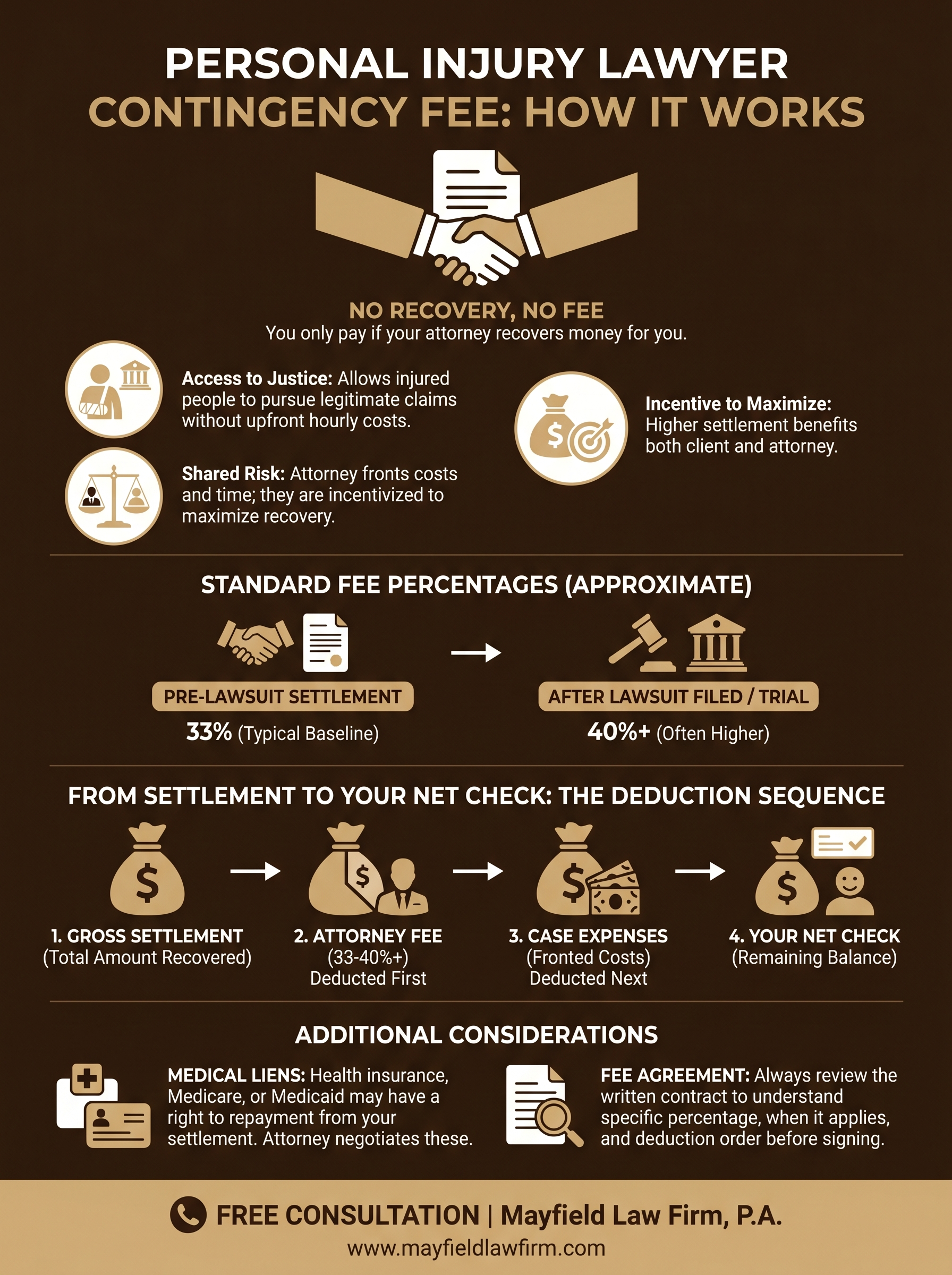
Once your case settles or a jury returns a verdict , your attorney receives the total recovery funds first. They then deduct their agreed fee percentage from the gross amount, followed by any case-related expenses covered during litigation. What remains after those deductions is your net recovery, the amount that goes into your pocket.
Here is the standard disbursement sequence:
- Defendant or insurance company pays the total settlement
- Attorney deducts their fee percentage
- Attorney deducts agreed case expenses
- You receive the remaining balance
Your attorney manages all of this through a trust account , which state bar rules govern specifically to protect client funds at every step.
Typical percentages and what changes the rate
Most personal injury lawyer contingency fee agreements start at one-third of the total recovery , which works out to roughly 33%. That number is widely recognized across the industry as the baseline, but it is not a fixed rule set by law. The actual percentage in your contract depends on several factors, and knowing them helps you evaluate whether the rate your attorney proposes is reasonable.
The standard one-third rate
A 33% fee is common when a case settles before a lawsuit is filed . At that stage, your attorney has invested time in investigating your claim and negotiating with the insurance company, but the case has not entered the formal court process. Because the workload is lower compared to full litigation, most attorneys apply the standard rate at this phase.
If your case settles early through negotiation, the standard one-third rate is typically what you should expect to see in your fee agreement.
What pushes the rate higher
Once your attorney files a lawsuit, the fee percentage often increases , typically to 40% or higher. Filing a case triggers a significantly heavier workload : depositions, written discovery, court hearings, and potential trial preparation all require considerably more attorney time and resources. Some agreements use a tiered structure that spells out the exact percentage at each stage.
Several additional factors can influence the rate you're offered:
- Case complexity : Medical malpractice and product liability cases often carry higher rates than straightforward auto accident claims
- Likelihood of recovery : Higher-risk cases may justify a higher percentage
- Jurisdiction : Local bar association guidelines in Mississippi and Tennessee may shape what attorneys in your area charge
Costs and expenses that come out of the recovery
The attorney's fee percentage is not the only deduction from your settlement. A personal injury lawyer contingency fee agreement typically covers the attorney's time, but the actual out-of-pocket costs your lawyer spends to build your case are billed separately. These expenses can meaningfully reduce your net recovery, so you need to understand them before you agree to anything.
Case expenses your attorney fronts
Your attorney will often advance the costs of litigation on your behalf, meaning they pay these bills upfront and then recover them from your settlement at the end. Common expenses include:
- Medical record retrieval fees from hospitals and providers
- Expert witness fees for accident reconstruction or medical testimony
- Court filing fees and service of process costs
- Deposition transcript costs
- Investigator fees for gathering evidence
These expenses are separate from the attorney's fee percentage, and they come out of your recovery in addition to the fee, not as part of it.
How deduction order affects your bottom line
The order in which deductions happen matters to your final check amount . Most agreements deduct the attorney's fee first from the gross settlement, and then subtract expenses from what remains. Some agreements flip that order, subtracting expenses first and then calculating the fee on the reduced amount. Ask your attorney specifically which method your agreement uses, because the difference can run into hundreds or thousands of dollars depending on the size of your settlement. Read the fee agreement carefully and make sure the deduction sequence is written out clearly before you sign.
How to estimate your net settlement check
Once you know the fee percentage and anticipated costs, you can run a quick estimate of your net recovery before you ever receive an official disbursement statement. Understanding how the numbers work gives you a realistic picture of what you'll actually take home, and it helps you catch errors in the final accounting.
A simple calculation walkthrough
Walk through a concrete example to see how the math works in a straightforward auto accident case with a $50,000 settlement , a 33% contingency fee, and $3,000 in case expenses, where the fee is deducted from the gross amount first:
| Step | Calculation | Amount |
|---|---|---|
| Gross settlement | Starting total | $50,000 |
| Attorney fee (33%) | $50,000 x 0.33 | -$16,500 |
| Case expenses | Fronted costs | -$3,000 |
| Your net check | $30,500 |
Knowing this math in advance means you won't be caught off guard when the disbursement statement arrives.
Why medical liens can reduce your check further
A personal injury lawyer contingency fee agreement and case expenses are not always the only deductions. If you received treatment through health insurance, Medicare, or Medicaid , those providers may have a legal right to recover some of what they paid from your settlement. These claims are called medical liens , and your attorney is required to resolve them before releasing your funds.
Your attorney will negotiate lien amounts on your behalf in many cases, which can reduce what you owe back to insurers and increase your final check. Always ask your lawyer early in the process which liens may apply to your specific situation so there are no surprises at disbursement.
Next steps before you sign anything
Before you commit to any attorney, read your fee agreement completely and ask questions about anything unclear. Confirm the exact contingency percentage , when it changes, how expenses are handled, and the deduction order. A legitimate attorney will answer every question without pressure.
A personal injury lawyer contingency fee arrangement is designed to work in your favor, but only when you understand the terms . Know what percentage applies at each stage, what costs come out separately, and whether any liens might reduce your final check.
If you've been injured in an accident in Northeast Mississippi or the South Memphis area and want straightforward answers about your case, contact Mayfield Law Firm, P.A. for a free consultation . With 40+ years of experience, we'll walk you through every line of your agreement so you know exactly what you're signing before you sign it.