How To File For Bankruptcy: Steps, Costs, And Forms
Filing for bankruptcy is one of the hardest decisions you'll ever face, but it's also one of the most practical tools the law gives you to regain control of your finances. If you're researching how to file for bankruptcy , you probably have bills stacking up, creditors calling, and a growing sense that something has to change. You're not alone, and you're not out of options .
The process itself involves specific legal steps, required forms, court filings, and costs that vary depending on whether you pursue Chapter 7 or Chapter 13 protection. Understanding each stage before you begin can save you time, money, and unnecessary stress. Getting the details right matters , a single mistake on your paperwork can delay your case or, worse, result in your filing being dismissed .
At Mayfield Law Firm, P.A., we've spent over 40 years helping individuals and sole proprietors across Northeast Mississippi and South Memphis navigate Chapter 7 and Chapter 13 bankruptcy filings. We've guided thousands of clients from the initial consultation through discharge, and we wrote this guide to give you a clear, honest look at what the process involves . Below, you'll find a step-by-step breakdown of the bankruptcy filing process, what it costs, and what forms you'll need to get started.
How bankruptcy works and what it can stop
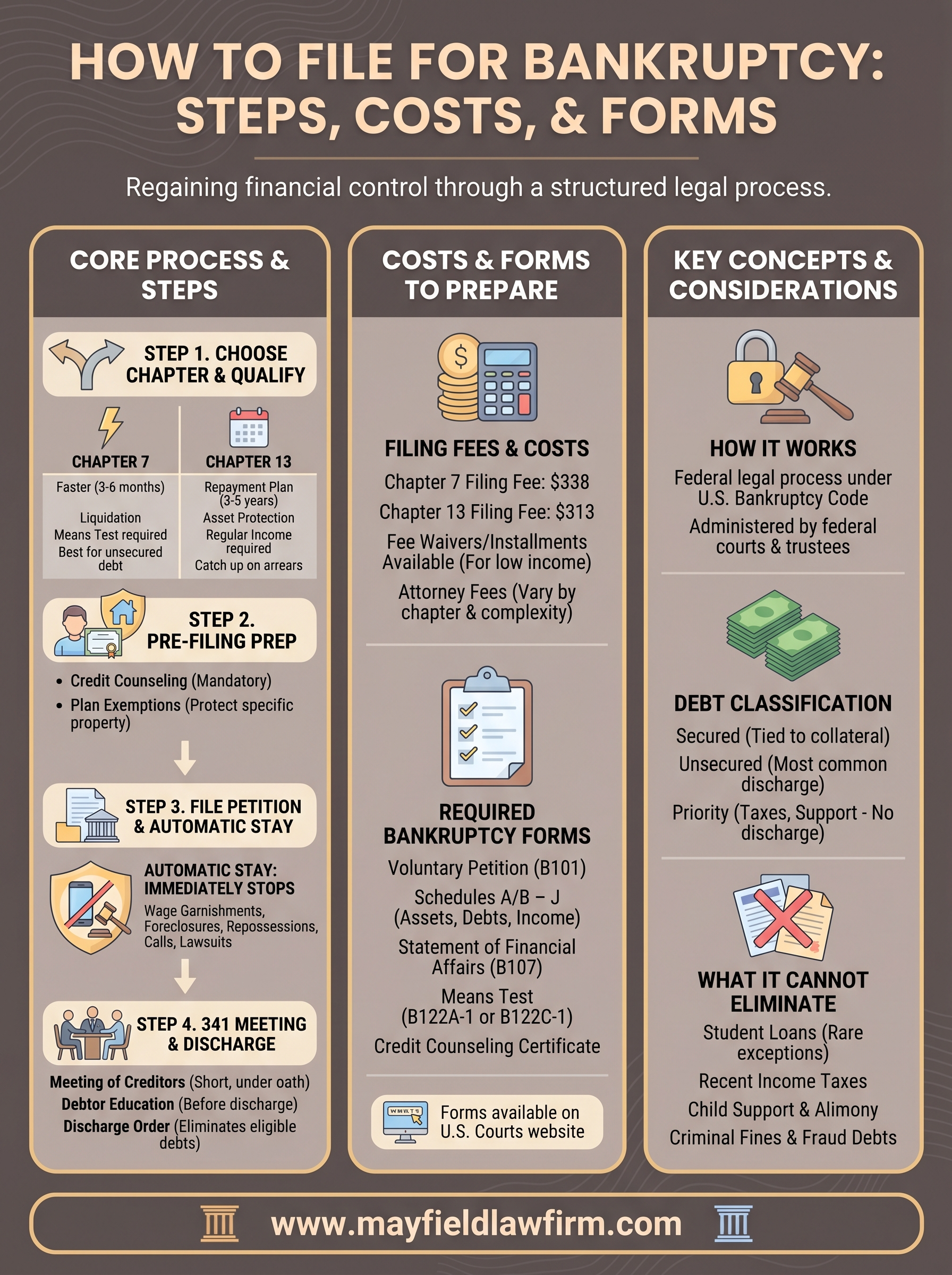
Bankruptcy is a federal legal process that lets you either eliminate most of your unsecured debts or restructure them into a manageable repayment plan. When you file a petition with the bankruptcy court, you're asking for protection under the U.S. Bankruptcy Code, which is administered by federal bankruptcy courts operating in every district in the country. The court assigns a trustee to review your case, and depending on the chapter you file under, that trustee either liquidates nonexempt assets to pay creditors or oversees your repayment plan. Understanding this structure is the foundation of knowing how to file for bankruptcy correctly.
The automatic stay: your immediate protection
The moment your bankruptcy case is filed, something called the automatic stay takes effect. This is a court order that immediately stops most collection activity against you. Creditors cannot call you, send collection letters, pursue lawsuits, garnish your wages, or repossess your property while the stay is active. It kicks in automatically, without you needing to do anything extra, and it gives you breathing room while your case moves through the court.
The automatic stay is one of the most powerful protections in bankruptcy law. It can stop a wage garnishment the same day your case is filed.
Here is a concrete list of actions the automatic stay can stop immediately:
- Wage garnishments already in progress
- Foreclosure proceedings on your home (temporarily)
- Repossession of your vehicle
- Utility shutoffs for at least 20 days after filing
- Collection lawsuits filed in state court
- Harassing phone calls and collection letters from creditors
What the automatic stay cannot stop
The automatic stay is broad, but it does not cover everything . Certain legal actions continue regardless of your filing. Criminal proceedings against you are not affected. Child support and alimony collection also continues, as does tax collection by the IRS in many situations. If a creditor has already obtained relief from the stay in a prior bankruptcy case, they may be able to move forward with collection faster in a new filing.
You also cannot use the automatic stay as a permanent shield. Secured creditors , such as your mortgage lender, can file a motion for relief from the stay if you're not making payments, and the court may grant it. The stay is a tool to pause the pressure while you complete your case, not a permanent fix on its own.
How debts are classified in bankruptcy
Bankruptcy law separates your debts into categories , and that classification determines what happens to each one. Secured debts are tied to collateral, such as your home or car. If you want to keep the collateral, you generally need to keep paying or reaffirm the debt. Unsecured debts, like credit card balances and medical bills, are not tied to any property, making them the most commonly discharged type.
Priority unsecured debts occupy a middle tier. These include recent income taxes, child support arrears, and alimony. They do not go away in bankruptcy. Non-priority unsecured debts, by contrast, are exactly what most people are trying to discharge when they file. Understanding where each of your debts falls helps you predict what your life actually looks like after your case closes.
What bankruptcy cannot eliminate
Some debts survive bankruptcy entirely , no matter which chapter you file under. Student loans are dischargeable only in rare cases where you prove undue hardship in an adversary proceeding, which is a separate lawsuit inside your bankruptcy case. Recent income taxes, criminal fines, debts from fraud, and domestic support obligations like child support and alimony are all non-dischargeable under the U.S. Bankruptcy Code. Knowing this list upfront prevents surprises at the end of your case.
Costs, forms, and information to prepare
Before you start the paperwork, you need to know what filing will cost you and what documents you must gather. Skipping this preparation step is one of the most common reasons cases get delayed or dismissed. Understanding the financial and paperwork requirements upfront gives you a realistic picture of how to file for bankruptcy without running into avoidable problems.
Filing fees and fee waivers
The court charges a filing fee that varies by chapter. Chapter 7 carries a $338 filing fee , while Chapter 13 costs $313. These fees go directly to the bankruptcy court and are separate from any attorney fees you pay. If your income falls below 150% of the federal poverty line, you can apply for a fee waiver using Official Form 103B, available on the U.S. Courts website. Alternatively, the court may allow you to pay in installments if you cannot pay the full amount at once.
If you cannot afford the filing fee upfront, ask the court clerk about the installment payment option before your petition is filed.
Attorney fees vary significantly based on complexity and location. Chapter 7 cases typically run between $1,000 and $2,500 in attorney fees. Chapter 13 cases are more involved and often cost between $3,000 and $5,000, though courts in many districts set presumptively reasonable fee caps.
Required bankruptcy forms
The federal courts use standardized official forms for all bankruptcy filings. You must complete the correct forms depending on your chapter. Below are the core forms most individual filers need:
| Form | Purpose |
|---|---|
| Voluntary Petition (B101) | Opens your bankruptcy case |
| Schedules A/B through J | Lists your assets, debts, income, and expenses |
| Statement of Financial Affairs (B107) | Summarizes your recent financial history |
| Means Test (B122A-1 or B122C-1) | Determines eligibility for Chapter 7 or confirms plan feasibility |
| Credit Counseling Certificate | Proves you completed the required pre-filing course |
All official forms are available at no cost through the U.S. Courts website.
Documents to collect before you file
Gathering your financial records before you start filling out forms saves significant time and reduces errors. You will need the following:
- Tax returns from the last two years
- Pay stubs or proof of income from the last six months
- Bank statements from the last three to six months
- A complete list of creditors with account numbers and balances
- Property deeds, vehicle titles, and recent mortgage or loan statements
- Documentation of any lawsuits, judgments, or garnishments currently active against you
Step 1. Choose Chapter 7 or Chapter 13
The chapter you file under shapes every other step in the process, from the forms you complete to the timeline you follow to what happens to your property. Choosing wrong wastes time and money, so this decision deserves serious attention before you touch a single form. Most individual filers qualify for either Chapter 7 or Chapter 13 , and the right choice depends on your income, the debts you carry, and whether you need to protect specific assets like a home or a vehicle.
Chapter 7: liquidation bankruptcy
Chapter 7 is the faster and simpler option , with most cases completing in three to six months from filing to discharge. In a Chapter 7 case, the trustee reviews your nonexempt assets and can liquidate them to pay creditors, but in practice most filers have no nonexempt assets and receive a full discharge without losing anything. To qualify, you must pass the means test , which compares your average monthly income over the last six months to the median income for a household your size in your state. If your income falls below the median, you automatically qualify. You can check current median income figures for your state through the U.S. Trustee Program.
If you pass the means test automatically, you can skip the full expense calculation portion of the means test form and move straight to filing.
This path works best when you carry primarily unsecured debt like credit cards and medical bills, your income is low enough to qualify, and you do not have significant equity in a home you need to protect through a repayment plan.
Chapter 13: repayment plan bankruptcy
Chapter 13 takes three to five years to complete because it requires you to repay a portion of your debts through a court-approved plan before receiving a discharge. You keep your assets throughout the entire process, which makes it the right choice if you have significant home equity, mortgage arrears to catch up on, or a vehicle you're behind on . Your monthly plan payment is based on your disposable income after allowed expenses, and you must show the court you have enough regular income to fund the plan reliably.
Use this comparison table to identify which chapter fits your specific circumstances :
| Factor | Chapter 7 | Chapter 13 |
|---|---|---|
| Timeline | 3 to 6 months | 3 to 5 years |
| Income requirement | Must pass means test | Must have regular income |
| Asset protection | Nonexempt assets at risk | Keep all assets |
| Best for | Unsecured debt, lower income | Home arrears, asset protection |
Picking the right chapter before you begin is one of the most critical steps in learning how to file for bankruptcy correctly. A wrong choice here forces you to start over and refile under a different chapter, costing you both time and filing fees.
Step 2. Take credit counseling and plan exemptions
Before you file a single form with the court, federal law requires you to complete a credit counseling course from an approved provider. This step is mandatory for every individual filer, regardless of which chapter you choose. Missing it means the court will dismiss your case outright, so this is not a step you can skip or delay . The second part of this step involves identifying which of your assets are protected under your state's exemption laws, a decision that directly affects what you keep when your case is over.
Complete the required credit counseling course
The U.S. Trustee Program maintains an official list of approved credit counseling agencies for every federal district. You must complete the course within 180 days before filing your bankruptcy petition. Most approved providers offer the course online or by phone, and it typically takes 60 to 90 minutes. The cost ranges from $15 to $50, and providers must offer a fee waiver if you cannot afford it.
Keep your completion certificate somewhere safe the moment you receive it, because you must attach it to your petition when you file.
Once you finish the course, the agency sends you a certificate of completion . Without that certificate, the court clerk will not accept your filing. This applies whether you are figuring out how to file for bankruptcy on your own or working alongside an attorney who is managing your paperwork.
Identify your state exemptions before you file
Exemptions are the legal provisions that protect specific property from being seized by the bankruptcy trustee. Every state sets its own exemption amounts covering categories like your home, vehicle, retirement accounts, household goods, and tools of your trade. Planning your exemptions before you file lets you structure your filing to protect as much property as possible and avoid losing assets you could have legally shielded.
Review your assets against your state's exemption list and match each item to a specific category. Use this checklist to track what you own and whether it qualifies for protection:
- Home equity : covered by the homestead exemption, which in Mississippi protects up to $75,000
- Vehicle : most states protect equity up to a defined dollar cap
- Retirement accounts : typically fully protected under federal law for 401(k)s and IRAs
- Household furnishings : usually protected up to a combined value limit
- Tools of your trade : protected up to a set dollar amount in most states
Step 3. File your case and use the automatic stay
Once you have your credit counseling certificate, your exemption plan, and your completed forms ready, you submit your petition to the bankruptcy court that serves your district. This is the step that officially opens your case and triggers the legal protections you have been preparing for. Filing incorrectly or submitting incomplete paperwork is the most common reason courts reject petitions, so reviewing every form one final time before submission is worth the extra hour it takes.
Submit your petition to the bankruptcy court
You file your petition, schedules, and supporting documents at the federal bankruptcy court clerk's office in your district. Most districts also accept electronic filing through their CM/ECF system if you have an attorney handling your case. In Mississippi, filings go to the U.S. Bankruptcy Court for the Northern or Southern District, depending on where you live. If you are learning how to file for bankruptcy without an attorney, you file as a pro se debtor and bring paper copies of every required document to the clerk's office in person.
Your filing package must include all of the following at the time of submission:
- Voluntary Petition (Form B101) with your signature and the date
- Credit counseling certificate issued within the last 180 days
- Completed Schedules A/B through J listing all assets, debts, income, and expenses
- Statement of Financial Affairs (Form B107)
- Means test form (B122A-1 for Chapter 7 or B122C-1 for Chapter 13)
- Filing fee payment , fee waiver application, or installment payment request
If you forget to attach your credit counseling certificate, the court will issue a deficiency notice and give you a short deadline to correct the omission before dismissing your case.
What happens immediately after filing
The moment the clerk accepts your petition and assigns your case a docket number , the automatic stay goes into effect. You do not need to notify your creditors yourself for the stay to apply, though your attorney or the court will send formal notice to every creditor listed in your schedules. From that point forward, any creditor who continues collection activity violates federal law and can face sanctions from the court.
Your assigned trustee will review your petition and schedule the 341 meeting of creditors , which typically takes place between 21 and 50 days after your filing date. You will receive written notice at the address listed in your petition with the exact date, time, and location.
Step 4. Finish the 341 meeting to get a discharge
The 341 meeting, formally called the meeting of creditors , is the only court appearance required in most bankruptcy cases. Despite its name, creditors rarely show up. The meeting is short, typically lasting 5 to 15 minutes , and takes place before the trustee assigned to your case, not a judge. Your job at this meeting is to confirm the accuracy of everything you submitted in your petition and schedules under oath.
What to expect at the 341 meeting
You must bring two forms of government-issued identification to the meeting, one of which must include your Social Security number. The trustee will verify your identity, place you under oath, and ask questions about your financial situation and the documents you filed. The questions are straightforward and follow a predictable pattern. Preparing honest, direct answers ahead of time is the most effective thing you can do.
The trustee is not trying to trap you. Their job is to confirm your filing is accurate, so clear and honest answers move the meeting along quickly.
Common questions the trustee asks at a 341 meeting include:
- Did you review your petition and schedules before signing them?
- Are the assets and debts listed in your schedules complete and accurate?
- Have you filed for bankruptcy before?
- Do you own any property not listed in your schedules?
- Are there any changes to your financial situation since you filed?
What happens after the meeting
Once the 341 meeting concludes, the trustee either closes it immediately or holds it open briefly while they request additional documentation. If the trustee closes the meeting without issues, your case moves toward the discharge phase . In a Chapter 7 case, the discharge typically arrives 60 to 90 days after the 341 meeting , assuming no creditor files an objection and you complete the required debtor education course on personal financial management before the discharge deadline.
Completing that second course is a step many filers miss when learning how to file for bankruptcy on their own. You must file the completion certificate with the court using Official Form 423 before your case closes, or the court will close your case without entering a discharge order. Chapter 13 filers receive their discharge only after completing all plan payments, which can take three to five years. Once the court issues the discharge order, the debts included in it are legally eliminated, and creditors can no longer attempt to collect them from you.
Final checklist before you move forward
Knowing how to file for bankruptcy is only useful if you act on it with the right preparation. Before you submit anything to the court, run through this checklist to confirm you have everything in place:
- Credit counseling certificate completed within the last 180 days
- Two years of tax returns and six months of pay stubs collected
- Means test form completed and chapter selected
- All creditors listed with accurate balances and account numbers
- Exemptions mapped to your specific assets under state law
- Filing fee paid, waived, or installment plan requested
Every step you skip creates a problem you will fix later under pressure. Bankruptcy law rewards preparation , and the filers who move through the process cleanly are the ones who treated each step seriously from the start. If you want guidance from attorneys who have handled these cases for over 40 years, contact Mayfield Law Firm, P.A. before you file.