How Long Does A Personal Injury Case Take? Timeline Factors
If you've been hurt in an accident, one of the first questions on your mind is probably how long does a personal injury case take to resolve. The honest answer is that it depends, and anyone who gives you a firm number without knowing the details of your situation is guessing. Some cases settle in a few months. Others take a year or more , especially when injuries are severe, liability is disputed, or an insurance company refuses to make a fair offer.
At Mayfield Law Firm, P.A., we've spent over 40 years handling personal injury cases across Northeast Mississippi and South Memphis . That experience has shown us exactly which factors speed a case up and which ones slow it down. The timeline isn't random, it's shaped by specific, identifiable variables that apply to every claim.
This article breaks down the typical stages of a personal injury case, explains what affects the timeline at each step, and gives you a realistic picture of what to expect . Whether you're just starting the process or already deep into negotiations, understanding these factors will help you make informed decisions about your claim.
Why personal injury case timelines vary so much
When people ask how long does a personal injury case take , they expect a single number. The reality is that no two cases move at the same pace because no two accidents are alike. The variables involved, from the nature of your injuries to the tactics of the insurance company, stack up and either compress or stretch your timeline in ways that are hard to predict without knowing the full picture of your claim.
The severity of your injuries
Your injuries are the single biggest driver of your case timeline. Attorneys and doctors follow a concept called maximum medical improvement (MMI) , which is the point at which your condition has stabilized and a doctor can accurately assess your long-term prognosis and permanent losses. You should not settle your case before reaching MMI, because accepting an offer too early means you risk leaving money on the table for future treatment costs.
Settling before you reach maximum medical improvement is one of the most costly mistakes you can make in a personal injury case.
If you suffered a minor soft tissue injury that heals in a few months, your case can move to negotiation relatively quickly. If you're dealing with a spinal cord injury, traumatic brain injury, or permanent disability , your treatment often takes a year or longer, and your case timeline extends to match.
How clear liability is
Liability refers to who is legally responsible for your accident and injuries. When liability is obvious, such as a clear at-fault driver in a rear-end collision, the case moves faster because both sides spend less time arguing over responsibility. When fault is disputed , the process slows considerably, as both parties may hire accident reconstructionists, gather witness statements, and retain expert witnesses before anyone will discuss numbers.
Cases involving multiple defendants , such as a truck accident where both the driver and the trucking company share responsibility, add further complexity. Each party often carries a separate insurer and legal team, meaning more people weigh in on every decision before your case can progress.
The insurance company's approach
Insurance companies are not neutral parties in your case. Their goal is to minimize what they pay you, and delay is a deliberate tactic they use to accomplish it. An adjuster may take weeks to respond to a demand letter, request the same documentation more than once, or challenge the legitimacy of your medical records entirely. When an insurer refuses to negotiate in good faith , filing a lawsuit often becomes the only path to fair compensation, which adds significant time to your timeline.
Your attorney's ability to recognize these delay tactics early and respond with targeted legal pressure makes a measurable difference in how quickly your case moves forward.
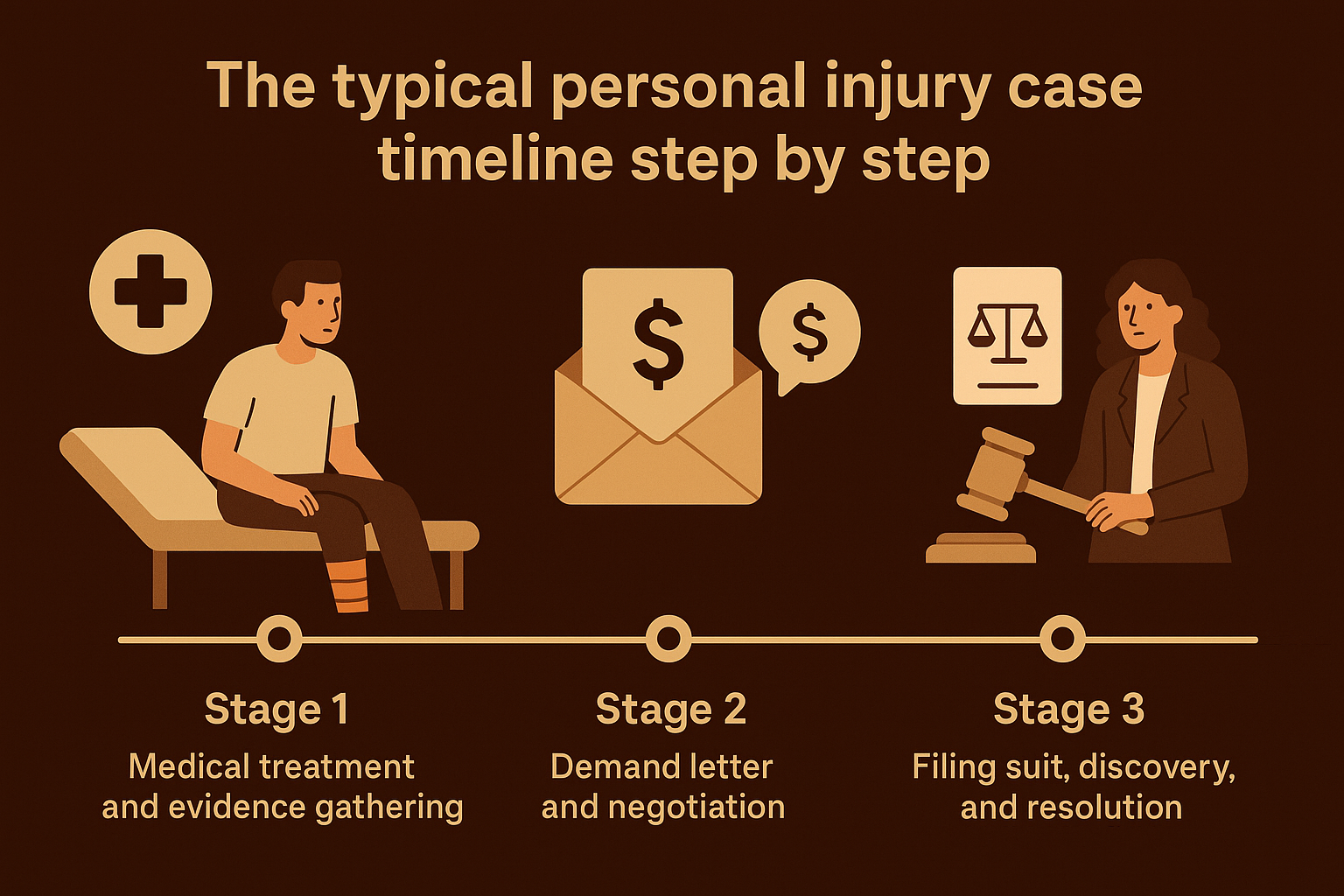
The typical personal injury case timeline step by step
Understanding how long does a personal injury case take starts with knowing the standard stages every claim moves through. Each phase has its own tasks, and delays at any point ripple forward into everything that follows.
Stage 1: Medical treatment and evidence gathering
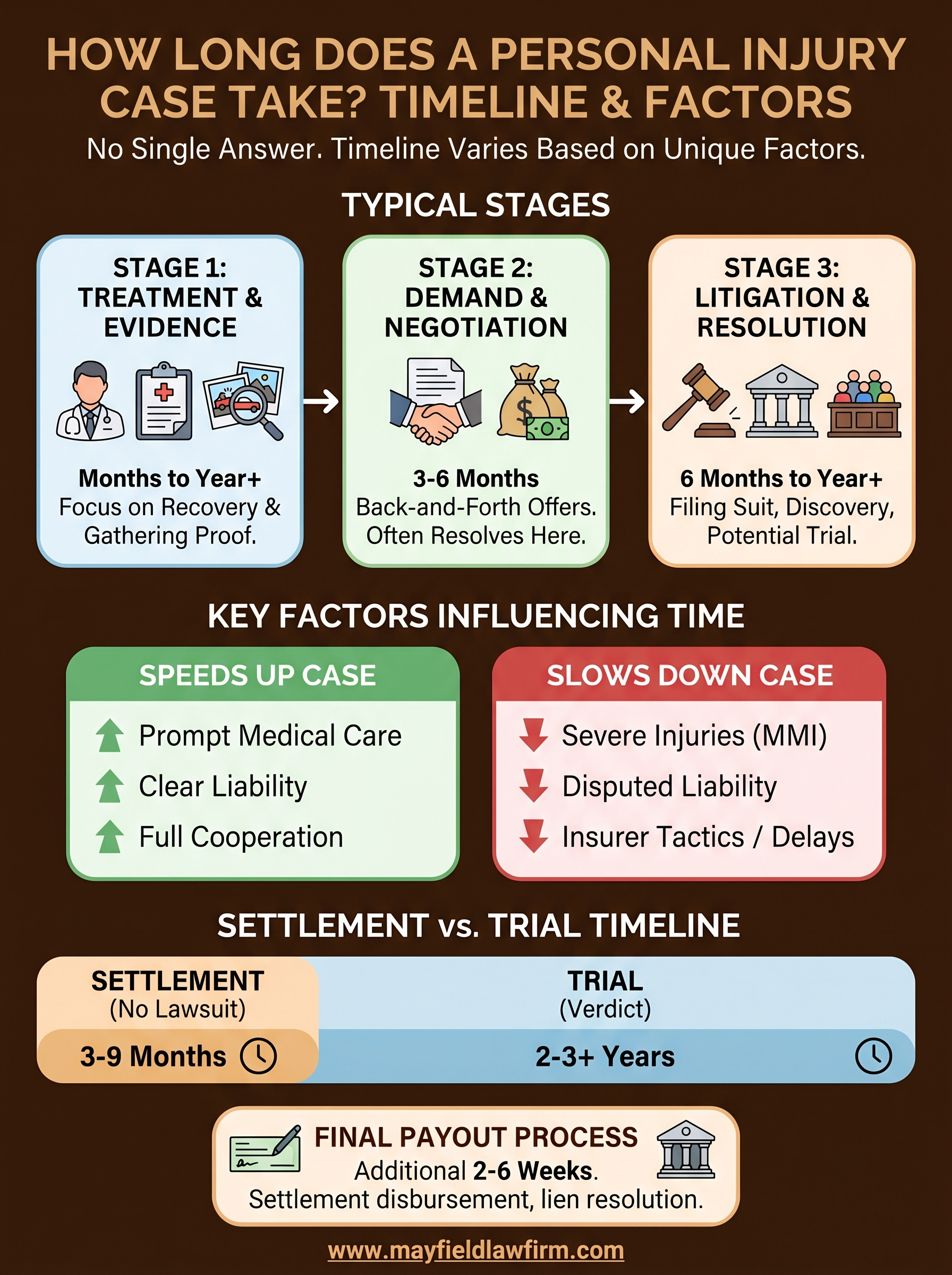
This first stage runs from the date of your accident until you reach maximum medical improvement (MMI) . Your attorney uses this time to collect police reports, medical records, witness statements, and any available video footage. This phase can last anywhere from a few months to well over a year , depending entirely on how long your recovery takes. Rushing through it to get to a settlement faster almost always results in an offer that fails to cover your actual losses.
Stage 2: Demand letter and negotiation
Once your treatment is complete, your attorney prepares a demand package that documents your injuries, treatment costs, lost wages, and pain and suffering, then sends it to the insurance company. The insurer reviews it, often for 30 to 60 days , and responds with a counteroffer. Back-and-forth negotiation follows. Many cases resolve here, typically within three to six months after the demand is sent, if both parties reach a number that fairly reflects your damages.
If the insurance company stalls or lowballs your claim repeatedly, filing a lawsuit is often the faster path to a fair result.
Stage 3: Filing suit, discovery, and resolution
When negotiations fail, your attorney files a lawsuit in civil court . This triggers a period called discovery, where both sides exchange documents, take depositions, and retain expert witnesses. Discovery alone can take six months to a year or longer. After discovery, most cases still settle before trial, but if yours proceeds to a courtroom verdict, your total timeline from accident to resolution may reach two to three years .
Key factors that speed up or slow down your case
Understanding how long does a personal injury case take requires looking at the specific circumstances that either push your case toward a faster resolution or add months to your wait. Your actions matter just as much as the other side's, and knowing what you can control gives you a real advantage throughout the process.
What moves a case forward faster
Prompt medical treatment is the single most effective thing you can do to accelerate your timeline. Seeing a doctor immediately after an accident creates a clear, dated record that links your injuries directly to the incident. Consistent follow-up care and full cooperation with your attorney when they request documents, signatures, and information also prevent unnecessary delays that compound over time.
Gaps in your medical treatment give insurance adjusters a reason to argue your injuries were not serious, which drags out negotiations considerably.
Another factor that shortens timelines is clear, documented liability . When security footage, police reports, or witness statements leave little room for dispute about who caused the accident, the other side has far less leverage to stall your claim.
What causes delays
Several factors push your case timeline further out, many of which are outside your direct control. A slow-responding insurance adjuster , a crowded court docket, or a defendant who disputes every detail of liability can stretch a case that might otherwise resolve in months into a much longer process.
Switching attorneys mid-case is another source of significant delay. Your new attorney needs time to review the entire file, re-establish communication with insurers, and get fully up to speed before moving forward. If you have concerns about how your case is being handled, raise them early rather than waiting until the file has grown large and negotiations are already deep into the back-and-forth stage.
Settlement timeline vs lawsuit and trial timeline
The path your case takes after negotiations begin determines more of the total time than almost any other factor. Most personal injury cases settle without ever going to trial , but understanding both paths helps you set realistic expectations for how long does a personal injury case take from start to finish.
Settling without filing a lawsuit
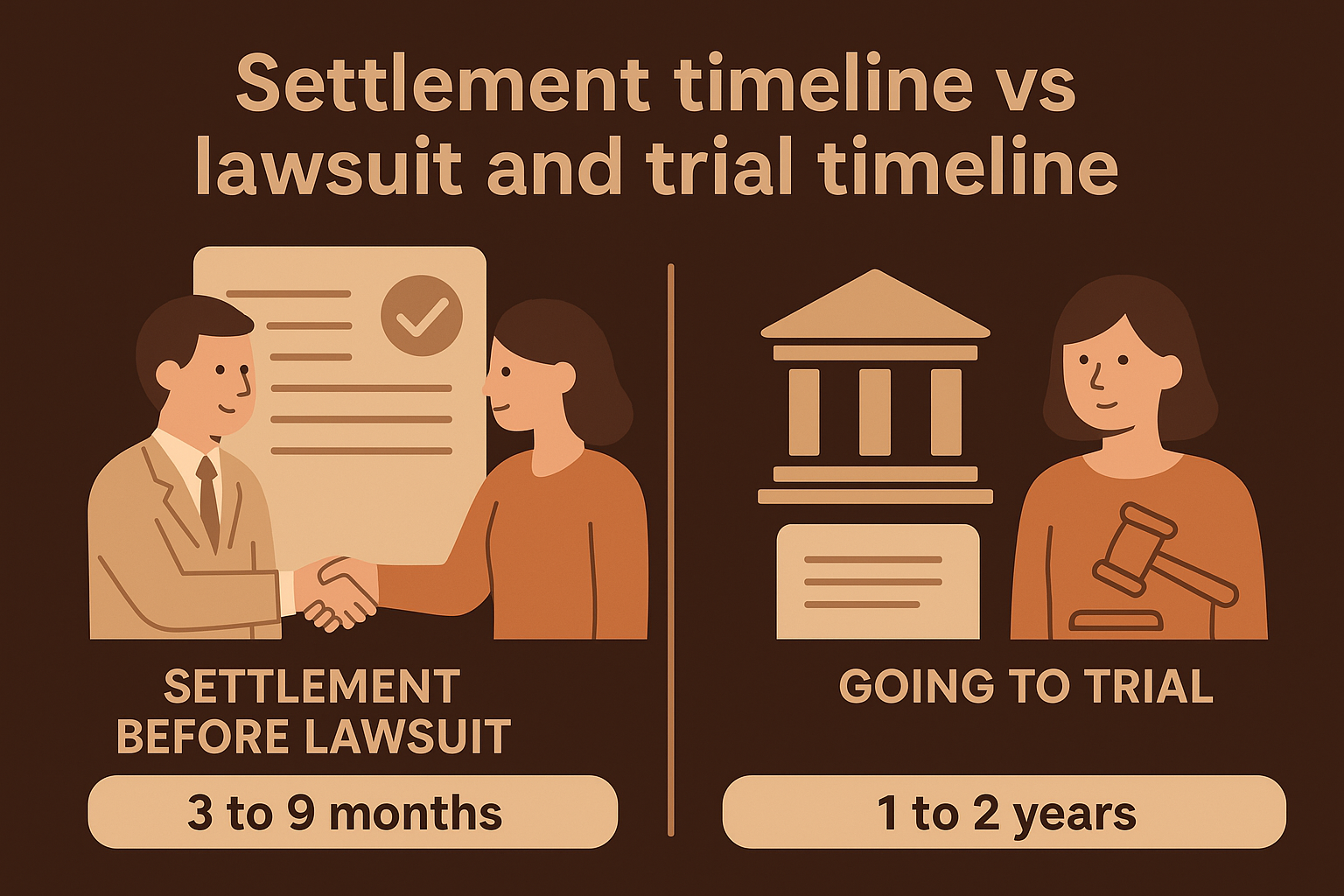
When both sides reach an agreement during the negotiation phase, your case resolves without the added time of litigation . This typically happens within three to nine months after your attorney sends the demand package, assuming your injuries were not catastrophic and liability is not heavily disputed. Settling at this stage keeps your costs lower and puts money in your hands faster.
A well-prepared demand package with strong documentation often produces a faster, higher settlement offer than a poorly organized one.
Here is a rough comparison of how the two paths differ in timing:
| Path | Typical Timeline |
|---|---|
| Settlement before lawsuit | 3 to 9 months after MMI |
| Settlement after lawsuit filed | 1 to 2 years from accident date |
| Full trial and verdict | 2 to 3+ years from accident date |
Going to trial
Filing a lawsuit does not automatically mean your case goes before a jury. In fact, the majority of lawsuits settle during the discovery phase or shortly before trial begins. However, if your case does go all the way to a verdict, the total time from your accident date to a final judgment typically runs two to three years , sometimes longer in jurisdictions with backlogged court dockets.
Trial also introduces additional costs and unpredictability , since a jury's decision is never guaranteed. Your attorney weighs the strength of your evidence , the credibility of witnesses, and the realistic settlement range before recommending whether pushing toward trial is the right move for your situation.
When you get paid and why checks can take weeks
Even after your case resolves, receiving your money takes additional time. Most people assume that a signed settlement agreement means a check arrives within days, but the actual payment process involves several steps that can add two to six weeks to the waiting period after your case closes.
The settlement disbursement process
Once you sign a settlement agreement , the insurance company typically has 30 days to issue payment, though many send the check sooner. Your attorney deposits the funds into a trust account , not directly to you. From there, the firm pays any outstanding medical liens, attorney fees, and case costs before releasing your portion.
The time between signing your settlement and receiving your check is almost always longer than clients expect, and understanding why helps reduce frustration during the final stretch of how long does a personal injury case take.
Medical liens and subrogation claims
Medical liens are one of the most common reasons disbursement slows down. If your health insurance, Medicare, or Medicaid covered any of your treatment, those programs have a legal right to be reimbursed from your settlement . Your attorney must identify every lien, negotiate them down where possible, and satisfy them before your check can be cut. This process alone can take two to four weeks after the settlement check arrives at the firm.
What you can do to speed up the final step
Staying responsive during this stage matters. Return signed documents quickly , respond to your attorney's calls and emails, and confirm your current address and banking information if a wire transfer is an option. Some firms can wire funds directly once all liens are cleared, which saves several days compared to waiting for a paper check to clear. The final payout lands faster when you stay engaged through the last step.
Next steps
How long does a personal injury case take depends on your injuries, the strength of your evidence, and how the insurance company responds. Now that you understand the full timeline, from the day of your accident through final disbursement, you can approach your claim with realistic expectations and a clear strategy for protecting your recovery at every stage.
Your next move is to get an attorney involved before the insurance company shapes the narrative . Early legal representation means your evidence gets preserved, your medical records stay organized, and you avoid the costly mistakes that extend timelines and shrink settlements. Do not wait until negotiations stall or an offer comes in too low to act.
Mayfield Law Firm, P.A. has handled personal injury cases across Northeast Mississippi and South Memphis for over 40 years . Contact us today for a free consultation and let us evaluate your claim. Talk to a personal injury attorney at Mayfield Law Firm