
How To Prove Medical Malpractice: Evidence & 4 Elements
You trusted a doctor to help you, and instead, you ended up worse than before. Now you're dealing with medical bills, lost wages, and pain that didn't have to happen. Figuring out how to prove medical malpractice can feel overwhelming when you're already struggling to recover. But here's the reality: a successful claim depends on meeting specific legal requirements , and understanding them early gives you a real advantage.
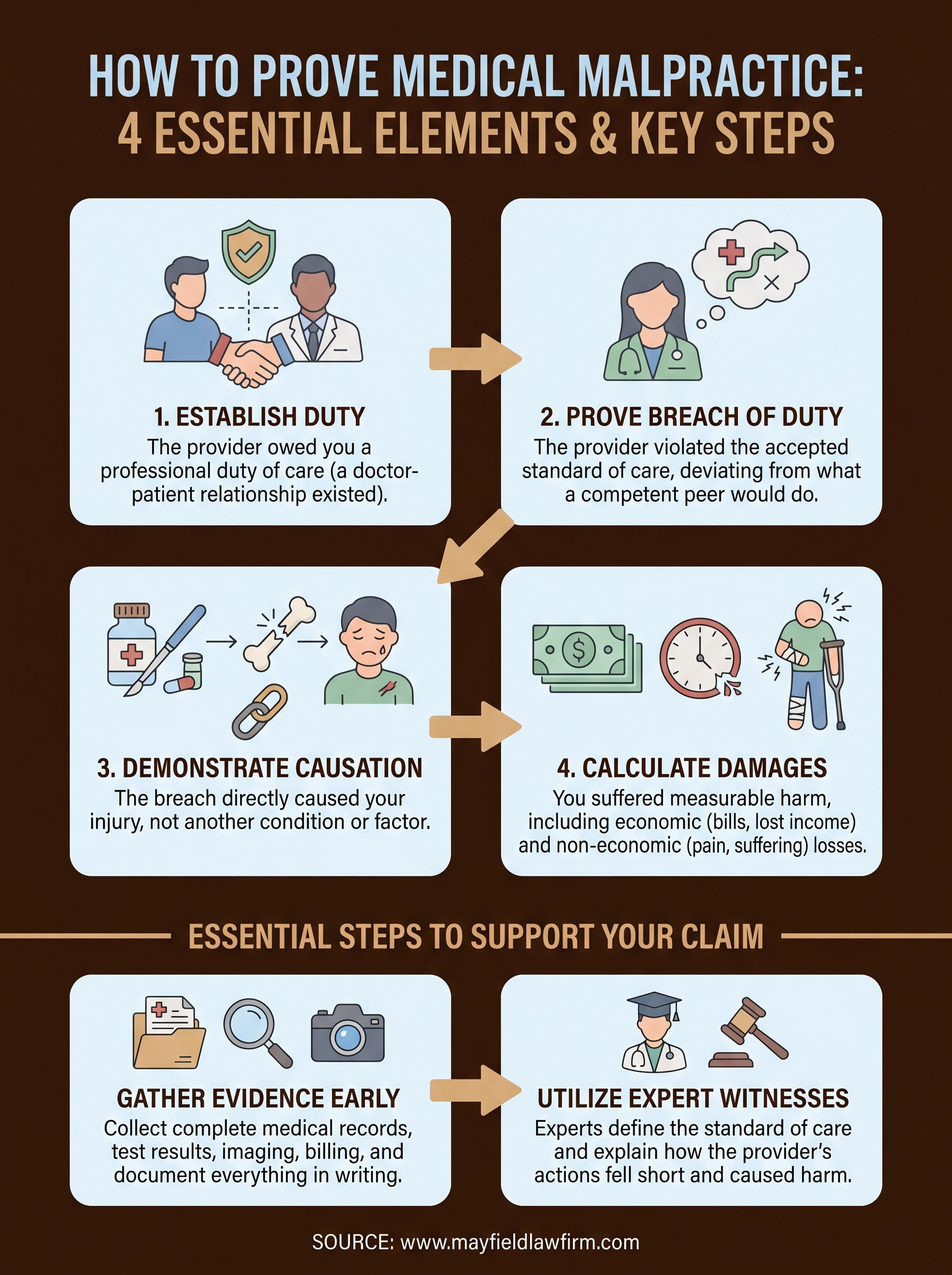
Medical malpractice cases are among the most complex personal injury claims you can file. You need more than a bad outcome or a gut feeling that something went wrong. The law requires you to establish four key elements , duty, breach, causation, and damages, and back each one with strong, credible evidence like medical records, expert testimony, and documentation of your losses.
At Mayfield Law Firm, P.A., we've spent over 40 years representing injured clients across Northeast Mississippi and South Memphis, including those harmed by medical negligence. This guide breaks down exactly what you need to prove your case, what types of evidence matter most , and how each of the four elements works. Whether you're just starting to explore your options or you've already decided to take action, the information ahead will help you understand what a winning medical malpractice claim looks like , and what steps to take next.
What counts as medical malpractice in plain English
Not every negative medical experience rises to the level of a legal claim. Medical malpractice happens when a healthcare provider deviates from the accepted standard of care , and that deviation directly causes you harm . A doctor making a difficult call that doesn't work out is not automatically negligence. The law draws a clear line between an unfortunate outcome and a preventable mistake.
The difference between a bad outcome and negligence
Understanding how to prove medical malpractice starts with this distinction: medicine involves inherent risk , and patients sometimes get worse even when providers do everything right. Negligence means the provider failed to act the way a reasonably skilled professional in the same specialty would have acted under the same circumstances. That failure, not just the result, is what the law holds accountable.
A bad outcome alone does not make a case. You need to show that a competent provider in the same situation would have acted differently.
Common examples of medical malpractice
Medical negligence takes many forms, and recognizing common patterns can help you evaluate whether your situation qualifies. These are the most frequent categories malpractice claims fall into :
- Misdiagnosis or delayed diagnosis that causes a condition to worsen or become untreatable
- Surgical errors, such as operating on the wrong site or leaving an instrument inside the body
- Prescription errors , including the wrong medication, wrong dosage, or dangerous drug interactions
- Failure to order necessary tests or act on abnormal results in a timely manner
- Birth injuries caused by improper monitoring or delivery techniques
- Anesthesia errors that lead to permanent injury or death
Each scenario involves a specific act or omission that a qualified peer in the same field would not have made. Identifying which category your situation fits into is one of the first practical steps your attorney will take when evaluating your case.
Step 1. Confirm the 4 legal elements you must prove
Before you collect a single document, you need to understand what the law actually requires you to prove . Every medical malpractice claim in Mississippi and Tennessee rests on four distinct legal elements , and you must establish all four to win your case. Missing even one means your claim will not succeed, regardless of how serious your injury is.
If you cannot prove all four elements, the case will not hold up in court, no matter how much harm you suffered.
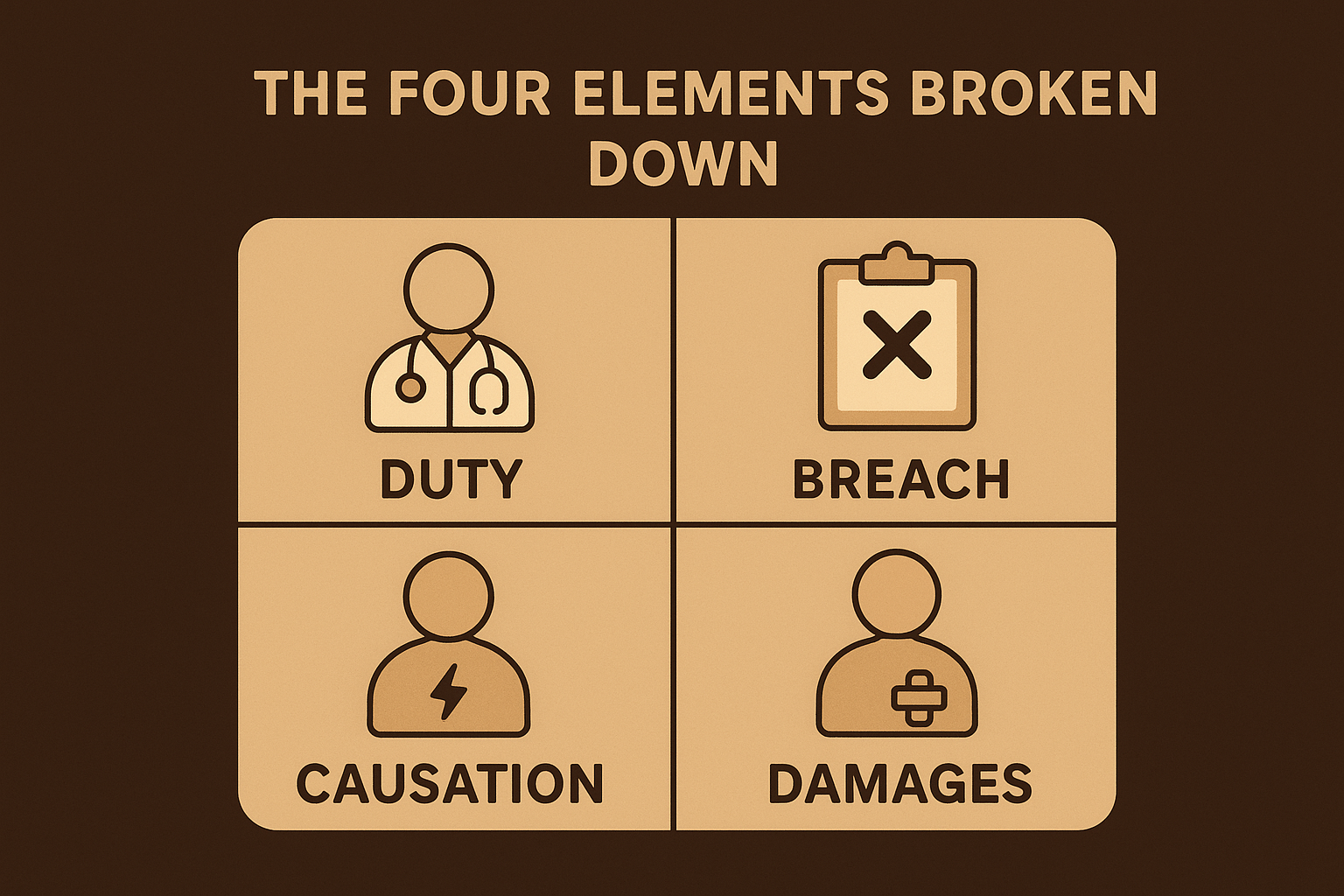
The four elements broken down
Knowing how to prove medical malpractice means knowing exactly what each element demands from your evidence and your experts. Here is a clear breakdown of all four:
| Element | What you must show |
|---|---|
| Duty | The provider owed you a professional duty of care |
| Breach | The provider violated the accepted standard of care |
| Causation | That breach directly caused your injury |
| Damages | You suffered measurable harm as a result |
Each element builds on the last. Duty and breach establish that the provider did something wrong. Causation and damages connect that wrongdoing to your specific losses, such as additional medical costs, lost income, or long-term disability. Your attorney will analyze every piece of evidence through this four-part framework from day one, which is why getting legal help early in the process matters.
Step 2. Gather medical records and other key evidence
Strong evidence is the foundation of any malpractice claim. Knowing how to prove medical malpractice means understanding that the documents you collect early will determine how far your case can go. Request your complete medical records immediately, because treatment notes, test results, and imaging studies all capture what the provider knew and when they knew it.
The sooner you request your records, the less risk there is of gaps or missing documentation.
The core documents to request right away
Your attorney will build the case around specific records. Request everything in writing and keep a copy of every request you send, because a paper trail protects you if a provider later claims records do not exist.

- Complete hospital or clinic records from the date of treatment
- Physician notes, nursing logs, and progress reports
- Lab results, imaging scans, and pathology reports
- Prescriptions and medication administration records
- Informed consent forms you signed before any procedure
Additional evidence that strengthens your claim
Medical records alone rarely tell the full story. Photographs of visible injuries and billing statements add important layers of proof. Keep a personal journal with dated entries capturing your pain levels, limitations, and daily impact, since this real-time record carries real weight when calculating damages.
- Photos of injuries, dated where possible
- Billing records and insurance correspondence
- Witness statements from family members who observed your condition
Step 3. Prove the standard of care with expert support
Establishing what a competent provider should have done requires more than your word against the doctor's. Expert witnesses are the cornerstone of how to prove medical malpractice , because courts require testimony from a qualified medical professional to define the accepted standard of care and explain exactly how the defendant fell short of it. Your attorney handles the process of finding and retaining the right expert for your case.
Without a credible expert witness, most malpractice claims will not survive a motion to dismiss.
What qualifies a medical expert witness
Your expert must practice in the same specialty as the defendant or hold recognized credentials in the relevant field. A general practitioner cannot typically testify about a neurosurgeon's standard of care. Your attorney will identify and retain a qualified expert early , giving that person enough time to review your complete medical file and prepare a thorough written opinion before any court deadlines.
Compensation for expert witnesses can be significant, so your attorney will factor expert fees into the overall cost structure of your case from the start.
What the expert's report must cover
The written expert report is a formal document your attorney submits to support your claim. A strong report addresses three specific points to satisfy legal requirements:
- The accepted standard of care for your specific diagnosis and treatment
- How the provider's actions deviated from that standard
- Why a competent professional in the same situation would have acted differently
Step 4. Prove causation and calculate your damages
Causation is often where medical malpractice cases are won or lost . Even if you prove the provider breached the standard of care, you must show that breach directly caused your specific injury , not an underlying condition or unrelated factor. Your expert witness will connect these dots through testimony and a written opinion that traces the chain of events from the provider's error to your documented harm.
Proving causation requires more than timing. You must show the breach was the direct cause, not just a contributing background factor.
Linking the breach to your injury
Your attorney will work with your expert to build a clear narrative showing the before-and-after impact of the provider's error. Concrete examples strengthen this link. For instance, if a delayed cancer diagnosis allowed a tumor to progress from Stage 1 to Stage 3, your expert must explain how earlier detection would have changed your outcome .
Calculating your damages
Knowing how to prove medical malpractice also means documenting every financial and personal loss tied to the provider's error. Courts recognize two main categories:
| Damage type | Examples |
|---|---|
| Economic | Medical bills, lost wages, future care costs |
| Non-economic | Pain and suffering, loss of enjoyment of life |
Gather all bills, pay stubs, and treatment cost estimates to support both categories.
What to do now
Proving medical malpractice requires four distinct legal elements , solid documentation, qualified expert testimony, and a clear link between the provider's error and your specific losses. Every step in this guide connects directly to building a case that can hold up in court , and the earlier you act, the stronger your position will be.
Timing matters more than most people realize. Mississippi and Tennessee both impose strict statutes of limitations on medical malpractice claims, meaning you have a limited window to file before you lose the right entirely. Waiting costs you time, evidence, and leverage.
If you believe a healthcare provider harmed you, the next step is straightforward: talk to an experienced attorney who understands how to prove medical malpractice from start to finish. Contact Mayfield Law Firm, P.A. for a free consultation. Our team has over 40 years of experience representing injured clients across Northeast Mississippi and South Memphis, and we're ready to review your case.