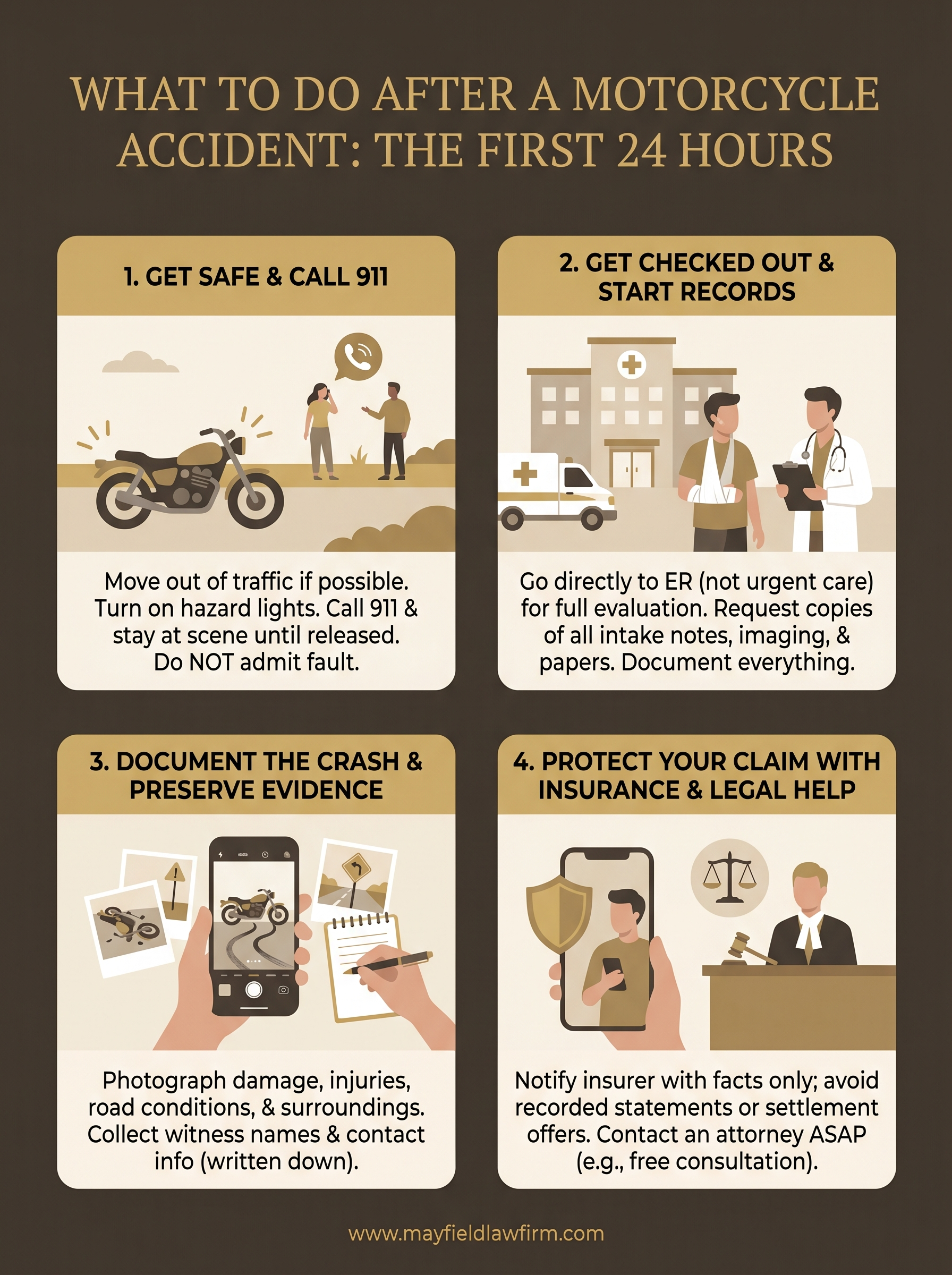
What To Do After A Motorcycle Accident: The First 24 Hours
A motorcycle accident happens fast, but the decisions you make afterward can affect your health and your legal rights for months or even years. Knowing what to do after a motorcycle accident matters because the steps you take, or skip, in those critical first hours shape everything from your medical recovery to your ability to recover fair compensation for your injuries.
The problem is that most riders have never thought through a plan for this situation. Adrenaline clouds your judgment. Pain might not show up until the next day. Insurance adjusters start calling before you've even left the emergency room. Without a clear roadmap, it's easy to make mistakes that hurt your case before you even realize you have one. At Mayfield Law Firm, P.A., we've spent over 40 years representing accident victims across Northeast Mississippi and South Memphis, and we've seen firsthand how the first 24 hours can make or break a claim. That experience is exactly why we put this guide together, to give you a step-by-step plan you can rely on when clear thinking feels impossible.
Below, we'll walk you through every action you should take after a motorcycle accident, from the moment you hit the pavement through the end of that first day. Each step is designed to protect your physical well-being and build the foundation for a strong legal case if you need one. Read it now, bookmark it, and share it with a fellow rider , because this is information you want before you ever need it.
What to focus on in the first 24 hours
After a motorcycle accident, your attention needs to go to three things above everything else : your physical safety, your medical documentation, and your legal rights. These aren't separate concerns you address one at a time. They run together, and how well you handle each one in the first 24 hours sets the tone for everything that follows. Knowing what to do after a motorcycle accident means understanding this order of priorities before the chaos hits.
Your health drives every other decision
Getting medical care is the most important thing you can do after a crash, even if you feel fine in the moment. Motorcycle accidents frequently cause injuries like traumatic brain injuries, internal bleeding, and spinal damage that don't produce obvious symptoms right away. Adrenaline masks pain, and what feels like soreness at the scene can turn into a serious diagnosis 48 hours later. Getting evaluated immediately also creates a medical record that directly ties your injuries to the crash, which becomes critical if you pursue a claim.
Delaying medical care is one of the most common ways riders unintentionally weaken their own cases.
Your legal rights depend on what you do right now
Evidence disappears fast after an accident. Skid marks get washed away, witnesses leave, surveillance footage gets overwritten, and the scene changes by the hour. At the same time, insurance companies move quickly and often try to contact you before you've had time to think clearly. Every statement you make in those early hours can be used against your claim later. Acting with purpose, rather than just reacting to whatever comes at you, matters enormously in this window.
What to avoid in the first 24 hours
Knowing what not to do is just as important as knowing what to do. Never admit fault at the scene, even if you think you contributed to the crash. Fault is a legal determination, not a gut reaction made under stress. Also, avoid giving a recorded statement to any insurance adjuster until you've spoken with an attorney. These statements are designed to lock you into a version of events before you have the full picture of your injuries or the circumstances of the crash.
Step 1. Get safe and call 911
Your first priority the moment the crash ends is getting out of danger . If you can move, get yourself and your motorcycle away from active traffic. Even a minor collision on a busy road can turn fatal if another vehicle strikes you while you're down. Turn on your hazard lights if your bike is still functional, and ask bystanders to help direct traffic away from the crash zone.
Never assume the scene is safe just because the immediate impact is over.
Call 911 and stay at the scene
Call 911 immediately , even if the damage looks minor or the other driver suggests handling things privately. A police report is one of the most important pieces of documentation you'll rely on when you pursue a claim. Officers will record the other driver's information, gather witness statements, and document the scene in ways that carry real legal weight later.
Stay at the scene until officers release you. Leaving early can raise questions about your conduct and create legal complications. While you wait, avoid moving your motorcycle unless it's actively blocking traffic, because its final position on the road can help reconstruct exactly how the accident happened.
What to tell the police
Give officers the basic facts of what happened without guessing about fault. Stick to what you directly observed. Knowing what to do after a motorcycle accident includes knowing when to limit what you say, and fault determinations belong to investigators and attorneys, not to statements made under stress at the roadside.
Step 2. Get checked out and start records
After you've secured the scene and spoken with police, go directly to an emergency room , even if you feel okay. This step is non-negotiable because knowing what to do after a motorcycle accident means understanding that delayed symptoms are common with serious injuries. Hospitals have the diagnostic tools to find what you can't feel yet.
Go to the emergency room, not urgent care
Emergency rooms can run imaging tests like CT scans and X-rays that urgent care clinics typically cannot. If you walk into an urgent care facility after a serious crash, you risk missing a diagnosis that surfaces days later. Tell the treating physician exactly how the accident happened, including your speed, the point of impact, and what protective gear you were wearing. Specificity in your intake notes creates a direct connection between the crash and your injuries that carries weight in any future claim.
Your medical records are evidence. Treat every doctor's visit after the crash as part of your legal case, not just your recovery.
Build your medical paper trail from day one
Request copies of every document from your emergency room visit before you leave, including intake notes, imaging results, and discharge instructions. Follow through on every referral and keep every scheduled appointment. Insurance companies look for gaps in treatment as a reason to argue your injuries weren't serious or weren't caused by the crash. A consistent, documented treatment history closes that argument before it starts and gives your attorney a clear record to work with when building your case.
Step 3. Document the crash and preserve evidence
Once you've called 911 and gotten initial help, start documenting the scene as thoroughly as possible. This is where knowing what to do after a motorcycle accident pays off in a real, measurable way. Evidence that exists at the scene right now will not exist tomorrow, so use your phone and work fast.
The photos you take in the next 20 minutes could be the most important evidence in your entire case.
Photograph everything you can reach
Your phone camera is one of your most powerful tools at the scene. Photograph from multiple angles and distances so the full picture is clear. Focus on the following:

- Your motorcycle : overall damage, close-ups of impact points, and any parts thrown from the bike
- The other vehicle: license plate, damage, and position on the road
- Road conditions : skid marks, debris, traffic signals, road signs, and any hazards that contributed to the crash
- Your injuries: visible cuts, bruising, road rash, and torn gear
- The surrounding area: intersections, lane markings, and any relevant surveillance cameras nearby
Collect witness information before people leave
Bystanders and other drivers leave quickly , and once they're gone, you may never find them again. Ask anyone who saw the crash for their name, phone number, and a brief description of what they witnessed. Written contact information is better than relying on memory, so type it directly into your phone or have someone write it down for you.
Step 4. Protect your claim with insurance and legal help
Once you've documented the scene and gotten medical care, report the accident to your insurance company , but do it carefully. Knowing what to do after a motorcycle accident means understanding that you control what information you share and when you share it.
Never give a recorded statement to any insurance adjuster, including your own, before speaking with an attorney.
How to handle the insurance call
Notify your insurer that an accident occurred and give only the basic facts. Do not speculate about fault, describe your injuries in detail, or accept any settlement offer on the spot. Early settlement offers are almost always lower than what your case is actually worth, and accepting one typically waives your right to pursue further compensation.
Here is a quick reference for what to include and what to leave out:
| Share this | Avoid this |
|---|---|
| Date, time, and location of the crash | Descriptions of your injuries |
| Other vehicle's make, model, and plate number | Any admission of fault or apology |
| Confirmation that a police report was filed | Settlement discussions of any kind |
When to call a motorcycle accident attorney
Contact an attorney as soon as possible after the crash, ideally within the first 24 hours. An attorney can handle insurance communications on your behalf, preserve critical evidence before it disappears, and evaluate the true value of your claim before any legal deadlines pass. At Mayfield Law Firm, P.A. , we offer free consultations for motorcycle accident victims across Northeast Mississippi and South Memphis, and you pay nothing unless we recover compensation for you.
Next steps after the first day
The first 24 hours are behind you, but the work isn't finished. Knowing what to do after a motorcycle accident also means following through once the immediate crisis is over. Keep every medical appointment, save every receipt related to your injuries, and write down your account of the crash in detail while your memory is still sharp. Document how your injuries affect your daily life, including missed work, physical limitations, and pain levels, because these details directly influence the value of your claim.
Your attorney becomes your most important resource from this point forward. Legal deadlines, called statutes of limitations , limit the window you have to file a claim, and Mississippi law gives you three years from the date of the accident. Acting quickly protects your rights. If you haven't spoken with a lawyer yet, contact Mayfield Law Firm, P.A. today for a free consultation and let us handle what comes next.