Motorcycle Accident Lawyer Near Me: Questions To Ask First
If you've been hurt in a motorcycle crash, searching for a motorcycle accident lawyer near me probably feels urgent, and it should. Motorcycle riders face some of the highest injury severity rates of any group on the road, and insurance companies know it. They also know that unrepresented riders tend to accept lower settlements. Finding the right attorney quickly matters, but hiring the first name that pops up without asking the right questions can cost you just as much as waiting too long.
Not every personal injury attorney handles motorcycle cases the same way. Motorcycle accidents involve distinct liability issues , from lane-splitting disputes to helmet law defenses, that a general practitioner may not be equipped to navigate. You need someone who understands how insurers build their arguments against riders, and who knows how to dismantle them.
At Mayfield Law Firm, P.A., we represent injured riders across Northeast Mississippi and South Memphis from our offices in Southaven and Memphis . With more than 40 years of legal experience in auto accidents and personal injury cases, we've seen what happens when clients ask the right questions before hiring, and what happens when they don't. This article walks you through exactly what to ask a motorcycle accident lawyer before you sign anything, so you can make a confident, informed decision about who handles your case.
Why hiring the right motorcycle accident lawyer matters
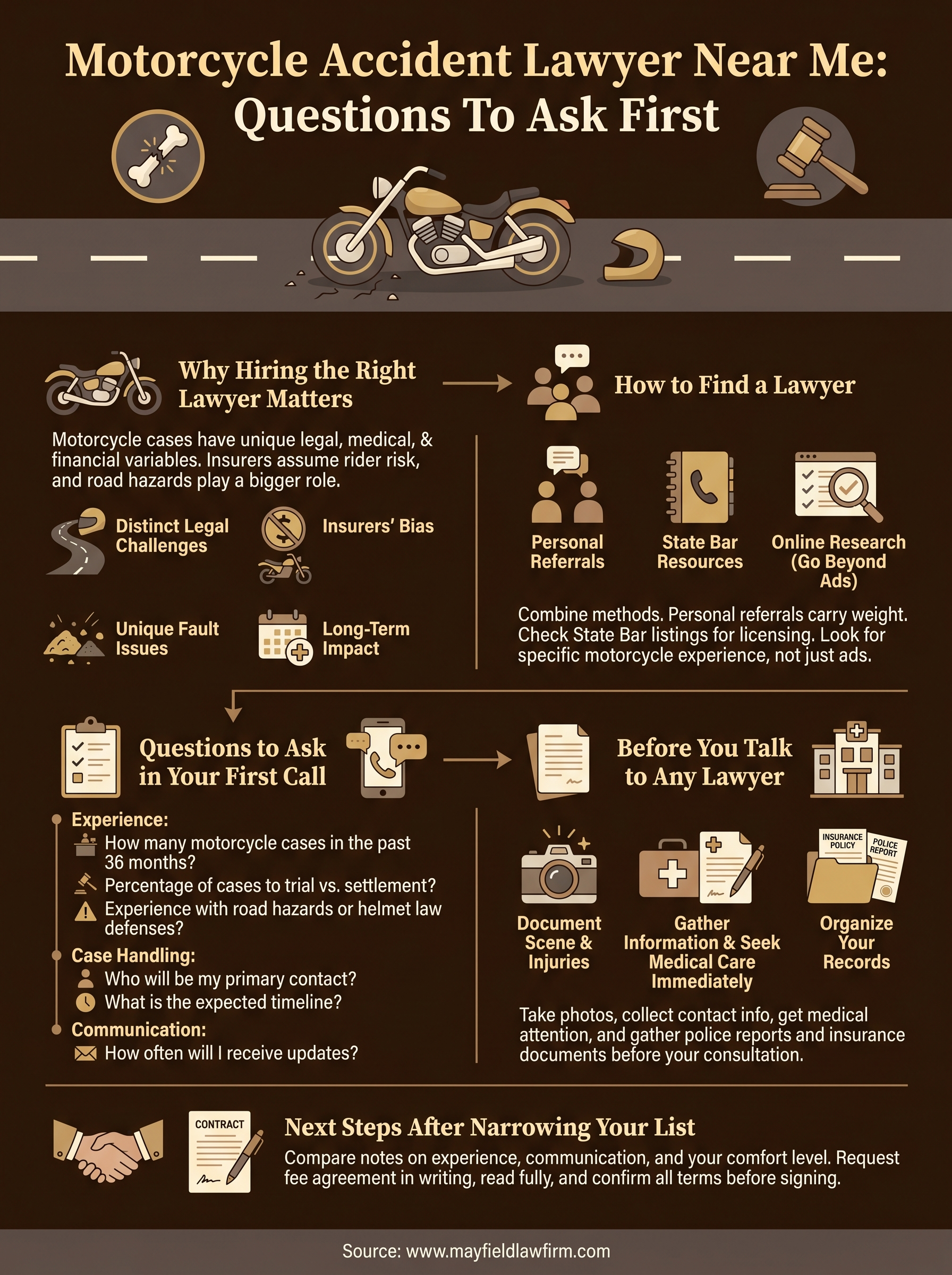
Hiring any personal injury attorney is not the same as hiring one who handles motorcycle accidents specifically . When you type "motorcycle accident lawyer near me" into a search bar, you get dozens of results. The difference between those attorneys is not always obvious from a website, but it matters enormously once your case is underway. Motorcycle crash cases carry a distinct set of legal, medical, and financial variables that separate them from standard car accident claims, and not every attorney is equipped to handle all of them.
Motorcycle cases carry unique legal challenges
Motorcycle accidents trigger legal arguments that rarely come up in typical car crash claims. Helmet laws , for example, can be used by defense attorneys to argue that your injuries were worsened by your own choices, even in states where helmets are optional for adult riders. Visibility arguments are another common tactic, where insurers claim you were difficult to see and therefore partially at fault for your own crash. An attorney unfamiliar with these arguments will not know how to anticipate or counter them before they become serious problems in your case.
Fault is also more layered in motorcycle cases because road hazards like gravel, debris, or uneven pavement play a much bigger role than in car accidents. In some situations, a government entity responsible for road maintenance can be a liable party alongside the other driver. You need a lawyer who has handled this type of case before, not one who is learning how to navigate it on your time and your money.
Insurers treat motorcycle riders differently
Insurance adjusters start most motorcycle claims with a built-in bias. The assumption, fair or not, is that riders take more risks and therefore share responsibility for any crash. That assumption shapes how quickly an adjuster moves on a claim, how low the initial offer comes in, and how aggressively the company resists paying full value when you push back.
A lawyer who understands this dynamic will build your case from day one to counter that narrative, not react to it after the insurer has already set the terms.
An experienced motorcycle accident attorney knows that medical documentation, accident reconstruction, and witness testimony need to be gathered immediately, before physical evidence disappears and memories fade. If your lawyer does not move with urgency in the first days after your crash, the insurer will use that delay against you during settlement negotiations.
The cost of choosing the wrong representation
A lawyer who takes your case without adequate motorcycle accident experience may settle too early, too low, or miss liable parties you were entitled to pursue . That means money you cannot recover once you sign a settlement agreement. In serious injury cases involving long-term disability, multiple surgeries, or significant lost income , the gap between a well-handled claim and a poorly handled one can reach six figures or more.
Choosing based on a flashy advertisement or the lowest fee percentage without asking deeper questions is a risk you take with your own financial recovery. The right attorney matches your case type, has a track record in similar cases, and gives you honest, direct answers from the very first conversation.
How to find a motorcycle accident lawyer near you
Searching "motorcycle accident lawyer near me" produces a long list, but a list is not a recommendation. The best approach is combining multiple search methods rather than relying on any single one. Each method gives you a different angle on the same question: who in your area actually handles motorcycle injury cases well, and who is simply marketing toward that niche without the track record to support it.
Ask people who have been through a similar situation
Personal referrals carry more weight than any advertisement because they come from someone who watched an attorney work under real pressure. If you know someone who hired a personal injury lawyer after a crash, ask them directly about the attorney's communication style, the timeline, and whether they felt informed throughout the process. You do not need to find someone who had a motorcycle accident specifically. Anyone who went through a serious injury claim can tell you whether their attorney was proactive, honest, and responsive, or not.
Check your state bar's referral resources
Your state bar association maintains a directory of licensed attorneys and often runs a formal lawyer referral service that can match you with attorneys practicing in your area. In Mississippi, the Mississippi Bar provides referral resources. In Tennessee, the Tennessee Bar Association offers similar tools. These directories confirm that the attorney is in good standing and currently licensed in your jurisdiction , which is a baseline you should verify before committing time to any consultation.
Confirming an attorney's license status through your state bar takes about two minutes and eliminates a lot of risk before you ever pick up the phone.
Look closer when you search online
Online results are heavily influenced by advertising budgets, not case results . When you find a firm's website, go past the homepage. Look for specific mentions of motorcycle accident cases, not just broad personal injury language. Client reviews on third-party platforms can provide useful signals, but focus on how the firm responds to negative feedback rather than the star rating alone. A lawyer who dismisses complaints publicly is showing you exactly how they handle conflict before you are even a client.
- Do they list specific motorcycle case results or verdicts?
- Do they explain the process in plain language, or just make promises?
- Is there a named attorney behind the firm, or just a brand?
Questions to ask in your first call or consult
Most attorneys offer a free initial consultation, and that conversation is your best opportunity to evaluate whether this lawyer is the right fit before you commit. When you search for a motorcycle accident lawyer near me , your goal is not just to find someone who says yes to taking your case. You want to leave the call knowing exactly how this attorney approaches motorcycle cases , what their track record looks like, and how they communicate with clients throughout the process.
Questions about their motorcycle case experience
Your first questions should focus on how often the attorney handles motorcycle accident cases specifically , not personal injury cases in general. Ask directly how many motorcycle injury cases they have handled in the past three years and what percentage of those went to trial versus settled. Ask whether they have faced helmet law or comparative fault arguments in prior cases and how those were resolved. A lawyer who hedges on these questions or gives vague answers may not have the depth of experience your case requires.
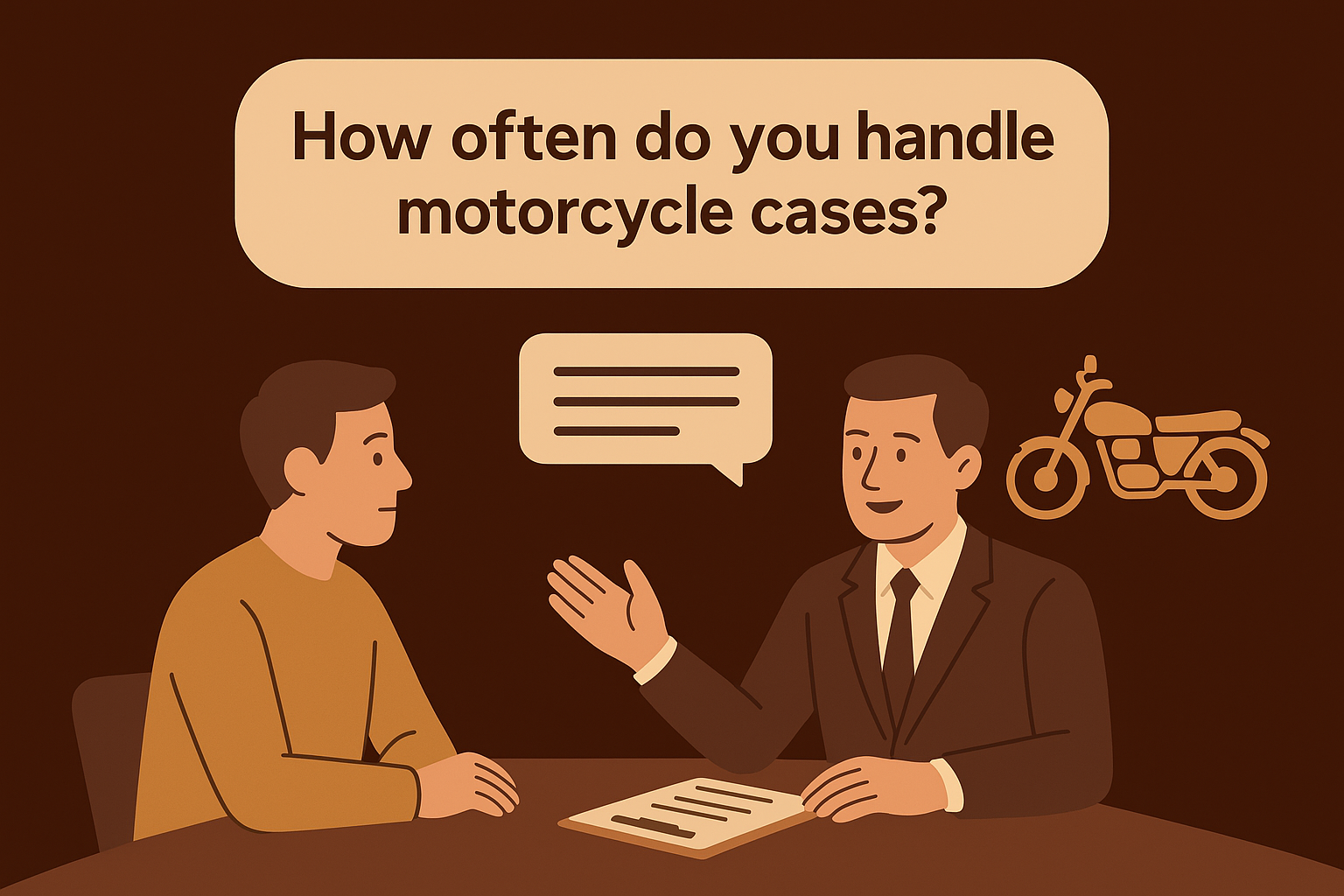
- How many motorcycle accident cases have you handled in the past 36 months?
- Have any of those cases involved road hazard liability or a government entity as a defendant?
- What was the outcome in your most recent motorcycle case that went to trial?
The specificity of an attorney's answers tells you more about their actual experience than any number they put on their website.
Questions about how they'll handle your case
Beyond experience, you need to understand the practical reality of working with this firm . Ask who will be your primary point of contact: the attorney you are speaking with, a paralegal, or a case manager you have not met yet. Ask how often you will receive updates and what the expected timeline looks like for a case with injuries similar to yours. Ask what information they need from you in the first week and how you can support the investigation on your end. These questions reveal whether the firm treats you as a client or just another file.
- Who manages day-to-day communication on my case?
- How will you notify me if the other side makes an offer?
- What is the realistic timeline from filing to resolution based on my situation?
What you should do before you talk to any lawyer
Before you start searching for a motorcycle accident lawyer near me or dialing any firm's number, you need to take several concrete steps that will directly strengthen your case. The actions you take in the first 48 to 72 hours after a crash are often the most consequential ones. Evidence disappears, witnesses forget details, and physical injuries that seem minor can reveal themselves as serious within days. Getting organized before your first attorney conversation means you walk in with facts, not just a story.
Document the crash scene and your injuries
If you are physically able to do so immediately after the accident, photograph everything at the scene. Capture the road conditions, vehicle positions, skid marks, and any debris that contributed to the crash. Take photos of your helmet, gear, and motorcycle damage from multiple angles. Injuries should also be photographed as soon as possible , because bruising and swelling often become more visible in the 24 to 48 hours following impact. These images become primary evidence in any claim you file.

The photographs you take in the first hour after a crash can be worth more to your case than any document you gather later.
Gather information and seek medical care immediately
Collect the other driver's name, insurance information, and contact details before leaving the scene if you can. Get the names and phone numbers of any witnesses who saw the collision. File a police report and request a copy as soon as it becomes available. Then go to an emergency room or urgent care facility, even if you feel fine. Delayed medical evaluation creates gaps in your injury timeline that insurers use to argue your injuries were not caused by the crash.
Organize what you have before the consultation
Before your first call with any attorney, pull together your insurance policy, the police report number, your medical records, and any written communication you have received from the other driver's insurer. Write down a clear timeline of events from the moment of the crash through your current medical status. Attorneys can work faster and give you more accurate guidance when you arrive with organized information rather than scattered recollections.
What affects the value of a motorcycle accident claim
No two motorcycle claims settle for the same amount, even when the crashes look similar on the surface. Multiple factors interact to determine what your case is actually worth , and understanding them helps you evaluate whether any settlement offer you receive reflects your real losses. When you work with a motorcycle accident lawyer near me, one of their core jobs is identifying every factor that increases the value of your claim and making sure nothing gets overlooked.
The severity of your injuries and medical costs
The nature and extent of your injuries carry the most weight in calculating a claim's value. Broken bones, traumatic brain injuries, spinal damage, and road rash requiring skin grafts all generate significant medical expenses that form the foundation of any demand. Courts and insurers calculate both current medical bills and projected future treatment costs , so injuries that require ongoing physical therapy, surgery, or long-term care push the total value considerably higher than injuries that resolve quickly.
Documenting every medical visit, prescription, and therapy session from day one protects your ability to claim the full cost of your recovery.
- Emergency room and hospitalization costs
- Follow-up appointments and specialist visits
- Physical and occupational therapy
- Estimated costs for future surgeries or ongoing treatment
Fault percentage and comparative negligence rules
Mississippi follows a pure comparative fault rule , which means any percentage of fault assigned to you directly reduces your total recovery. If an insurer or jury finds you 20 percent responsible for the crash, your compensation drops by that same 20 percent. Helmet use, speed, lane position, and road conditions are all points defense attorneys use to push more of the fault onto the rider. Your attorney's ability to counter those arguments directly protects how much you actually recover.
Lost income and long-term financial impact
Beyond medical costs, wages you lost while recovering are a compensable part of your claim. If your injuries prevent you from returning to your previous occupation permanently, or reduce your earning capacity going forward, those projected losses factor into the total demand as well. Documenting your income history, employment status, and any work restrictions your doctors impose creates a clear financial picture that supports a higher claim value and gives your attorney the evidence needed to push back against low offers.
How fees and costs work in motorcycle injury cases
Most personal injury attorneys, including those you find when searching for a motorcycle accident lawyer near me , work on a contingency fee basis . That means you pay nothing upfront, and the attorney only collects a fee if your case results in a settlement or court award. Understanding exactly how that fee is calculated, and what other costs may come out of your recovery, helps you avoid surprises when your case closes.
Contingency fees explained
A contingency fee is a percentage of your total recovery that the attorney takes as their payment. In personal injury cases, this percentage typically falls between 33 and 40 percent , with the exact figure depending on whether your case settles before trial or requires litigation. Cases that go to trial take more attorney time and carry higher risk, which is why many firms charge a higher percentage if a lawsuit is filed. Before you sign any agreement, ask the attorney to walk you through the exact percentage that applies at each stage of your case.
Reading the fee agreement in full before signing protects you from unexpected deductions that reduce your net recovery.
You should also ask whether the contingency percentage applies to the gross recovery or the net recovery after costs are deducted . The distinction matters significantly in cases with large outstanding medical bills or significant litigation expenses.
What costs you may owe beyond the attorney's fee
Attorneys advance most case costs on your behalf during the life of the claim, but those costs are separate from the contingency fee and typically get reimbursed out of your settlement. Common case expenses include:
- Court filing fees and process server charges
- Expert witness fees for accident reconstruction or medical testimony
- Medical record retrieval costs
- Deposition transcripts and court reporter fees
- Investigation and evidence preservation costs
These out-of-pocket expenses can range from a few hundred dollars in simple cases to several thousand in complex litigation. Ask the attorney for an honest estimate of anticipated costs based on the facts of your case, and confirm in writing how those costs will be handled if your case does not result in a recovery. Clarity on both the fee and the costs before you sign is the standard you should hold every attorney to.
Red flags to watch for and what to expect next
When you search for a motorcycle accident lawyer near me , not every attorney you speak with will be the right fit. Some warning signs appear early in your first conversation, and recognizing them saves you from committing to representation that may work against your recovery rather than for it.
Warning signs that should make you pause
Not every attorney who says yes to your case is actually capable of handling it well. Guaranteed outcomes are a major red flag. No attorney can promise you a specific settlement figure or guarantee a win, and any lawyer who does is telling you what you want to hear rather than giving you an honest assessment. Similarly, pressure to sign a retainer at the end of the first call , before you have had time to review the agreement or compare your options, should concern you.
An attorney who respects your case will give you time to make a clear-headed decision without rushing you into a contract.
Watch for attorneys who cannot name the specific person who will manage your file day to day, or who deflect questions about their motorcycle case history. Vague answers about fees, case costs, or communication protocols are equally concerning. You deserve direct answers before you sign anything.
- Promises of specific dollar amounts before your case is fully evaluated
- Refusal to explain how fees are calculated in writing
- No named attorney assigned to handle your case directly
- Dismissiveness toward questions about trial experience or past outcomes
What to expect after you choose a lawyer
Once you hire an attorney, the investigation phase begins immediately . Your lawyer should start gathering police reports, medical records, witness statements, and any available surveillance footage within the first week. You will likely sign medical record authorizations and provide a detailed account of the crash and your injuries in those early days.
Communication from this point forward should be consistent and predictable. Your attorney or a designated team member should update you whenever there is meaningful movement in your case, including any contact from the other driver's insurer. Expect the process to take months in most cases, with more serious injuries extending that timeline further. Knowing what a normal process looks like helps you recognize when something is off, and gives you the confidence to ask questions when it is.
Next steps after you narrow your list
Once you have spoken with two or three attorneys and asked the questions outlined in this article, compare your notes honestly. Look at how directly each lawyer answered your questions , how clearly they explained the process, and how confident you felt after each conversation. Your instincts matter here. A lawyer who gave you honest, specific answers without pressure is almost always a better choice than one who made big promises and rushed you toward signing.
From there, request the fee agreement in writing, read it fully, and confirm that every term you discussed verbally appears in the document before you sign. Searching for a motorcycle accident lawyer near me is only the first step. Choosing the right one, and starting strong, is what actually shapes your recovery. If you were hurt in a motorcycle crash in Northeast Mississippi or South Memphis, contact Mayfield Law Firm, P.A. for a free consultation today.