
How Long Does SSDI Appeal Take? Stage-by-Stage Timeline
Getting denied for Social Security Disability benefits is frustrating enough, but then you find out the appeal could take months or even years, and nobody gives you a straight answer about how long does SSDI appeal take . That uncertainty makes an already stressful situation worse, especially when you're unable to work and bills keep piling up .
The truth is, timelines vary depending on which stage of the appeal process you're in and where you live. A Reconsideration might wrap up in a few months, while a hearing before an Administrative Law Judge can stretch well past a year . Knowing what to expect at each stage helps you plan ahead and make informed decisions about your case .
At Mayfield Law Firm, P.A., we've handled SSDI appeals for clients across Northeast Mississippi and South Memphis who were told "no" the first time. Below, we break down the appeal process stage by stage, with realistic wait times , so you know exactly what's ahead.
Why SSDI appeal timelines matter
When you file an SSDI appeal, you're not just waiting on paperwork. You're waiting on income you depend on and, in many cases, healthcare coverage you can't afford to lose . Understanding where you stand in the process gives you a clear picture of what's ahead so you can plan your finances, keep your medical records up to date, and stay ready for each next step.
The financial pressure of a delayed decision
Most people who appeal an SSDI denial haven't worked for months by the time that letter arrives. An appeal can extend the waiting period by another one to three years , depending on which level you reach. That's a long window to cover rent, medication, and everyday bills with no guaranteed income coming in .
The longer your appeal takes, the more important it becomes to keep your medical treatment consistent, since gaps in records can weaken your case at later stages when evidence matters most.
You don't have to navigate those options alone, but you do need to know the financial gap exists so you can ask the right questions early. State assistance programs, nonprofit resources, and legal guidance can all help bridge that period while your case works through the system.
How knowing the timeline strengthens your appeal
Understanding how long does SSDI appeal take at each level also helps you stay actively involved rather than waiting and assuming no news means everything is fine. If you know a hearing before an Administrative Law Judge typically runs 12 to 24 months out , you can coordinate with your doctor to keep medical records current and make sure nothing critical is missing when your date arrives.
Your involvement matters more than most people realize. When you understand what's coming, you respond faster to your attorney's requests , flag problems earlier, and arrive at your hearing prepared. That kind of active participation gives your representative more to work with and reduces the chance of delays tied to missing or outdated documentation.
SSDI appeal timeline by stage
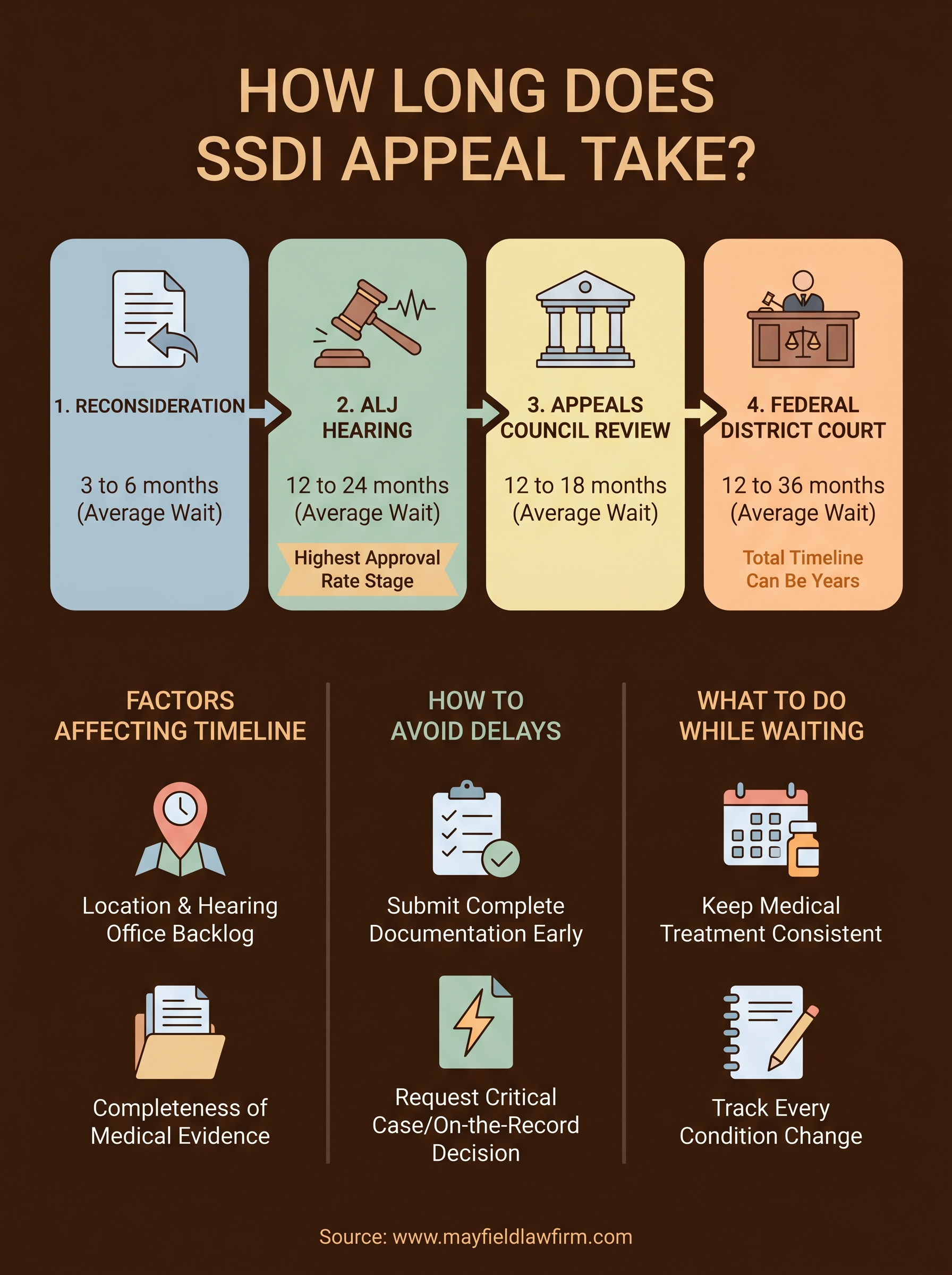
The SSDI appeals process moves through four distinct levels , each with its own average wait time. Knowing where you stand on that ladder answers the core question of how long does SSDI appeal take and sets realistic expectations for what comes next.
The four levels and their average wait times
Each stage in the table below represents a separate decision point in your case. These figures reflect national averages , and your actual wait depends on your local Social Security office workload and hearing office backlog.
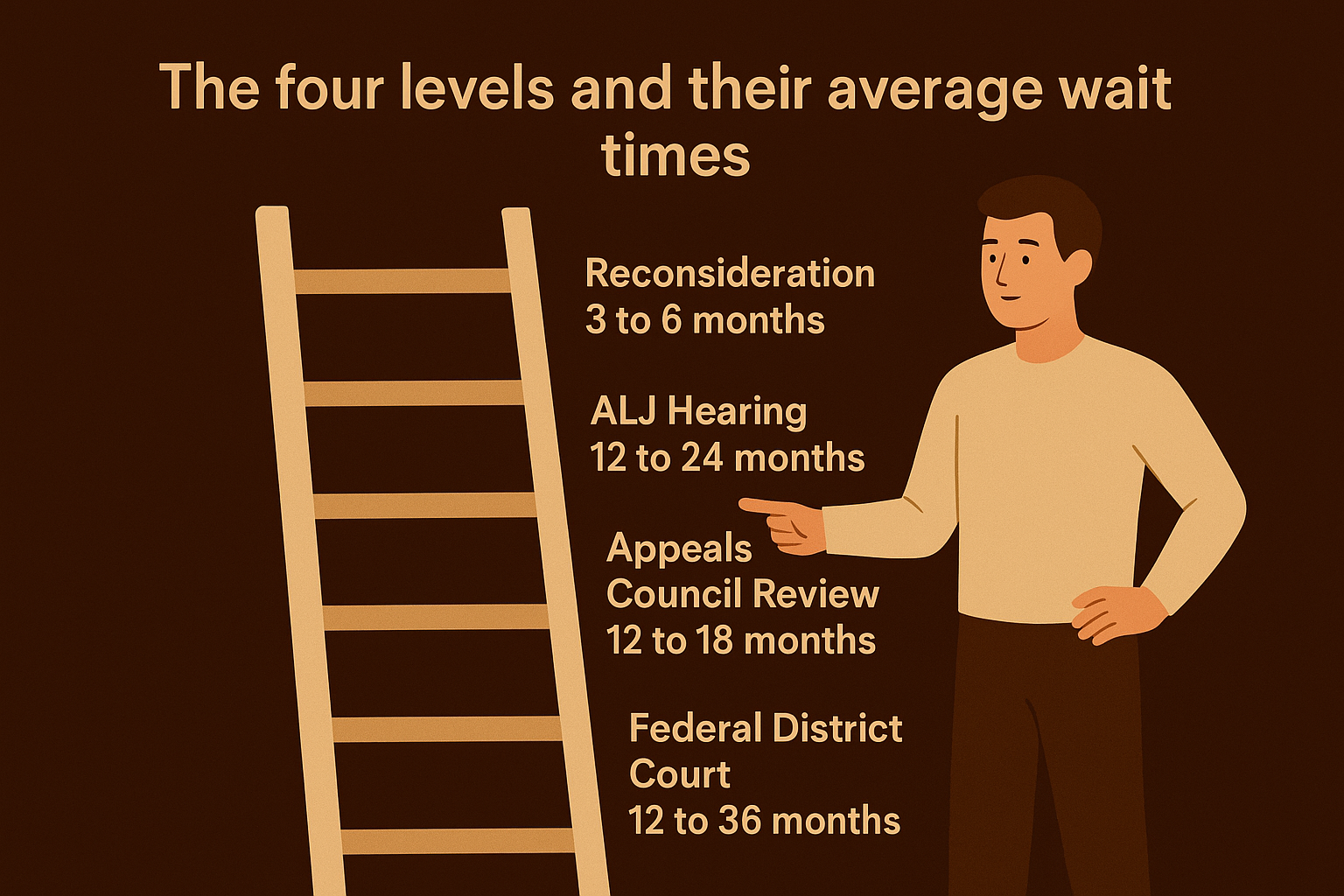
| Appeal Stage | Average Wait Time |
|---|---|
| Reconsideration | 3 to 6 months |
| ALJ Hearing | 12 to 24 months |
| Appeals Council Review | 12 to 18 months |
| Federal District Court | 12 to 36 months |
Reconsideration is the fastest stage, but it also carries the lowest approval rate, which means most cases move forward to an Administrative Law Judge hearing.
Most claimants resolve their appeals at the ALJ hearing level , which is also where having a qualified representative makes the biggest difference. If the Appeals Council or Federal Court becomes necessary, you're looking at several more years added to the total timeline, so building a strong medical record early in the process protects you from that outcome and gives you the strongest possible case when your hearing date arrives.
What affects how long an SSDI appeal takes
Several factors determine how long does SSDI appeal take beyond the national averages shown in the table above. Your specific circumstances and location play a significant role in whether your case moves faster or slower than the typical range at any given stage.
Your location and the hearing office backlog
The Social Security hearing office that handles your case carries its own backlog, and wait times vary significantly by region . Some offices schedule ALJ hearings within 12 months while others run closer to 24 months, purely based on how many cases are already in the queue. If you live in a high-volume area, that backlog directly adds time to your wait regardless of how strong your case is.
Checking with your representative about your local hearing office's current wait times gives you a more accurate picture than national averages alone.
The completeness of your medical evidence
Incomplete or outdated medical records are one of the most common reasons cases stall at every level of appeal. If your file is missing treatment notes, test results, or physician statements, the SSA will request that information before moving forward. Every back-and-forth request adds weeks or months to your timeline . Submitting thorough, current documentation from the start keeps your case moving and reduces the chance that a reviewer has to pause your file to gather what's missing.
How to avoid delays and request faster handling
You have more control over how long does SSDI appeal take than most claimants realize. The steps you take before and during each stage directly influence how quickly your case moves through the system, and a few deliberate actions early on can shave months off your wait.
Submit complete documentation from the start
Incomplete files stall cases at every level of the appeal process. Before you submit anything, confirm your file includes current treatment records, physician statements, test results, and any work history documentation the SSA requests. If your doctor hasn't documented your limitations in writing, ask them to provide a detailed medical source statement. Gaps in your records give reviewers a reason to pause your case and send follow-up requests, which adds weeks to your timeline every time it happens.
Keeping a running log of every doctor's visit, medication change, and treatment note makes it significantly easier to pull complete documentation on short notice when a deadline arrives.
Request a critical case designation or on-the-record decision
If your medical condition has severely worsened since you filed or you're facing a terminal diagnosis, you can ask the SSA to flag your case as a critical case, which moves it ahead of standard queue. Your representative can also request an on-the-record decision from the ALJ if your medical evidence is strong enough to approve without a full hearing, which can cut months from your wait.
What to do while you wait for a decision
Waiting on an SSDI appeal decision tests your patience, but the months between submission and outcome are not dead time. How long does SSDI appeal take can stretch considerably, and what you do during that window directly affects your outcome and your ability to stay financially stable until a decision arrives.
Keep your medical treatment consistent
Gaps in treatment are one of the first things reviewers and ALJs notice when they evaluate a case. If you stop seeing your doctor during your wait, the SSA may interpret that as evidence your condition improved, which weakens your claim at every stage. Every appointment, prescription refill, and follow-up visit builds a documented record that supports your disability claim when your case reaches a decision-maker.
Consistent medical treatment during your appeal shows reviewers that your limitations are ongoing, not resolved, which directly strengthens your case when it reaches a hearing.
Track every change in your condition
Your condition may worsen while your appeal moves through the system, and those changes matter . Document new symptoms, additional diagnoses, or worsening limitations as they develop. Share updates with your representative promptly so they can submit supplemental evidence before your hearing date.
Staying current with your own records means your case reflects your actual situation rather than a snapshot from months earlier. Ask your doctor to update your medical source statement any time a significant change occurs so nothing critical is missing when your file goes before a decision-maker.
Next steps
Now you know how long does SSDI appeal take at each stage and what you can do to move your case forward. The most important action you can take right now is to stop waiting passively and start building the strongest possible file before your next deadline arrives. Keep your medical treatment consistent, document every change in your condition, and respond quickly to any requests from the SSA or your representative.
Every week you delay getting the right help is a week added to an already long process. An experienced SSDI representative can identify gaps in your file, flag your case for faster handling when the situation qualifies, and prepare you for what to expect at each level. Your outcome improves when you have someone in your corner who knows the system. If you've been denied and you're ready to fight back, contact the Mayfield Law Firm, P.A. team today for a free consultation.