Lawyer for Commercial Truck Accident: What They Handle
A lawyer for commercial truck accident cases is a personal injury attorney who investigates a crash involving a tractor-trailer, delivery truck or other commercial vehicle, identifies every responsible party, and pursues compensation from the trucking company and its insurers. The work goes well beyond a standard car accident claim. It involves federal safety rules, corporate records, and insurers with deep resources. If you were hurt in a collision with a big rig, you want a lawyer who has handled these claims, moves quickly to protect evidence, and is ready to go to trial if the insurer will not pay fairly.
This guide explains why truck crashes call for that kind of lawyer, how to hire one, what the lawyer does on your case, and what to do in the first days after a wreck. It also covers the Mississippi and Tennessee deadlines and fault rules that decide how much you can recover. They differ more than most people expect.
Mayfield Law Firm, P.A. has represented injured people since 1974 from offices in Tupelo, Southaven and Memphis, and its attorneys are licensed in both Mississippi and Tennessee. The firm's truck accident work covers tractor-trailers, 18-wheelers, delivery trucks and semi-trucks. The guidance below applies whichever firm you end up choosing.
Why commercial truck crashes need a specialized lawyer
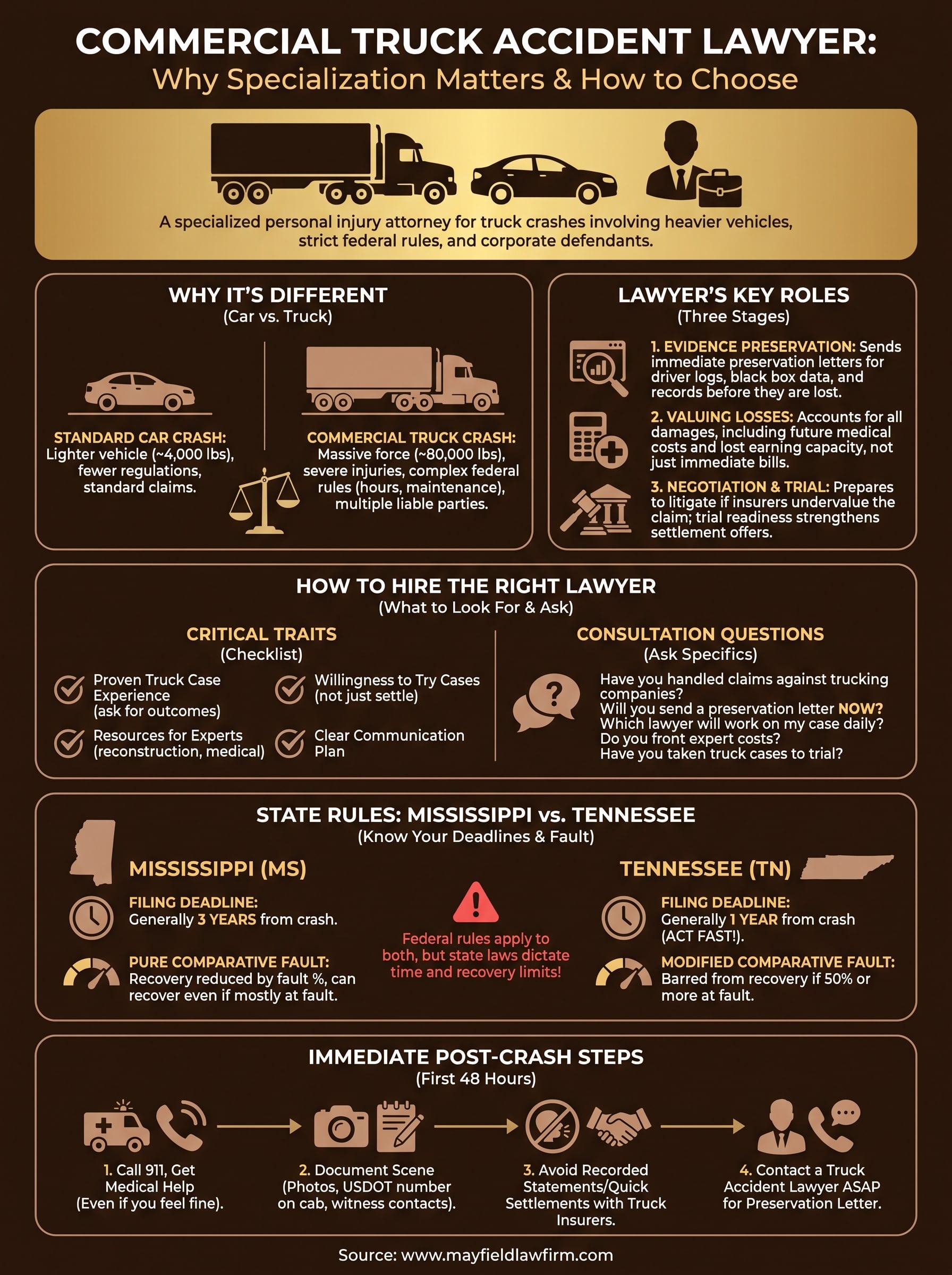
A truck crash claim is a different kind of case from a car crash claim. A lawyer who treats it the same way will miss evidence, defendants and insurance coverage. The vehicles are heavier, the rules are stricter, and the companies behind the wheel are better prepared to defend themselves than most individual drivers.
How truck claims differ from car claims
The first difference is physical force . A loaded tractor-trailer can weigh up to 80,000 pounds, while an average car weighs about 4,000. That gap explains why people in the smaller vehicle often suffer spinal cord damage, brain injuries, fractures and internal bleeding. It also explains why medical bills and lost income run far higher than in a typical car case.
The second difference is federal regulation . Interstate carriers and drivers must follow Federal Motor Carrier Safety Administration rules on hours of service, inspection and maintenance, driver qualification, and drug and alcohol testing. A driver may drive no more than 11 hours after 10 consecutive hours off duty, and may not drive past the 14th hour after coming on duty. A violation of those rules is often the clearest proof that a crash was avoidable. A lawyer who rarely sees trucking cases may not know to look for it.
Who can be liable after a truck crash
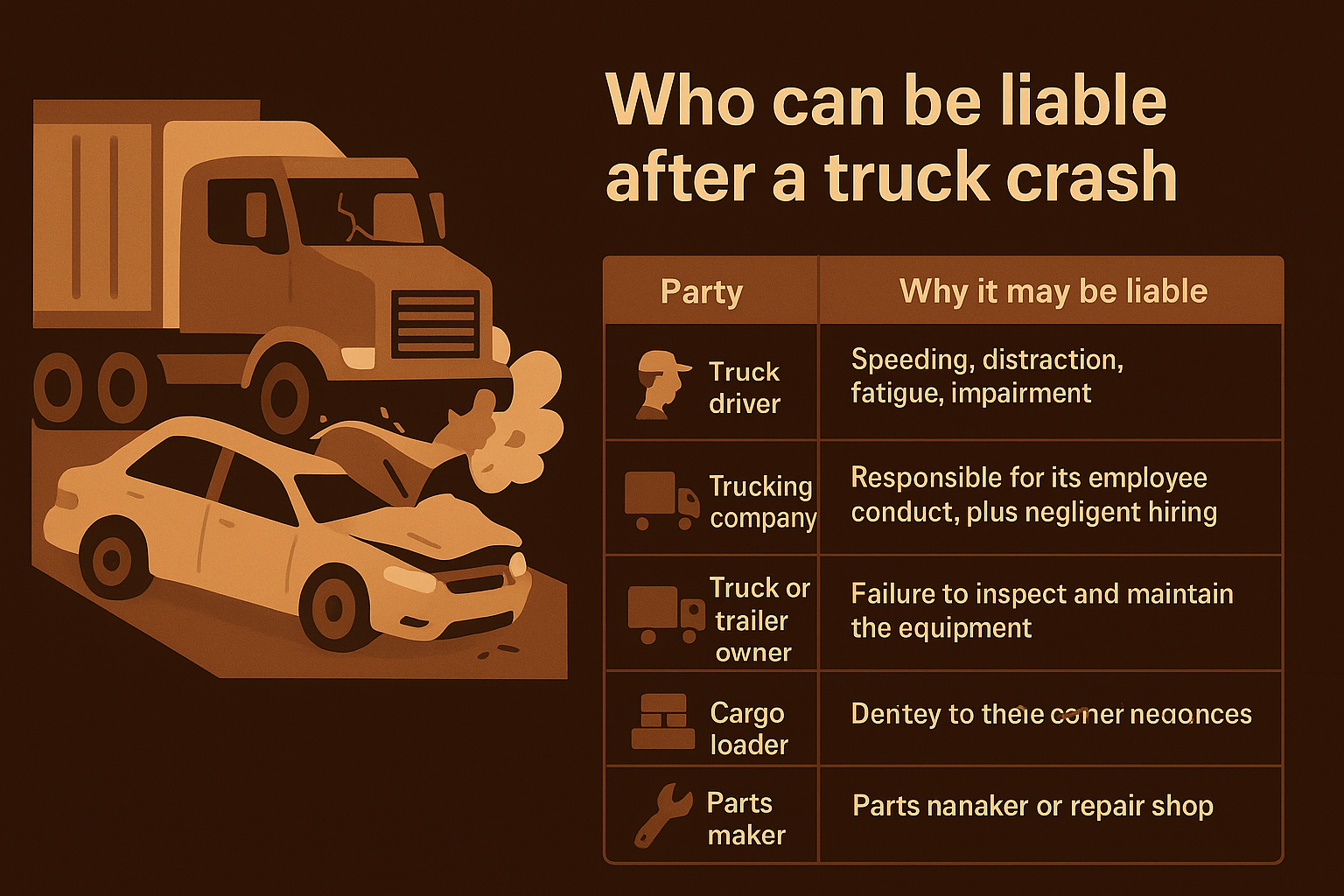
In a commercial truck case, the driver is rarely the only responsible party. The table shows the usual candidates and the evidence that connects each one to the crash.
| Party | Why it may be liable | Evidence to look for |
|---|---|---|
| Truck driver | Speeding, distraction, fatigue, impairment, unsafe lane changes | Driver logs, phone records, citations, dashcam video |
| Trucking company | Responsible for its employee's conduct, plus negligent hiring, training or dispatch pressure | Driver qualification file, dispatch records, hours-of-service violations |
| Truck or trailer owner | Failure to inspect and maintain the equipment | Maintenance and inspection records |
| Cargo loader or shipper | Overloaded, unbalanced or unsecured freight | Bills of lading, weight tickets |
| Parts maker or repair shop | Defective brakes or tires, or a faulty repair | Repair invoices, the failed part, recall history |
| Road contractor or agency | Dangerous work zone or road design | Work zone plans, crash history at the location |
When a driver is an employee acting within the job, the company is usually responsible for the driver's negligence as well. Owner-operators and leased trucks complicate the question of who the employer is, so a good lawyer reads the contracts and does not stop at the name on the cab. Fault is also generally divided among everyone responsible, so leaving out one party can cost you part of your recovery.
What is at stake in the insurance claim
Federal rules require for-hire carriers hauling non-hazardous freight to carry at least $750,000 in liability coverage , with higher minimums for some hazardous cargo. Many carry more, and several insurers can be involved when more than one party shares fault. A serious injury can use up a policy quickly, so your lawyer needs to find every available policy before talking numbers.
Carriers and their insurers also tend to move fast. Investigators and adjusters often start working on the carrier's side long before an injured person has finished treatment. An early call from an adjuster is not a courtesy. It is the start of the insurer building its defense.
A truck case is won or lost on records that most car accident lawyers never think to ask for.
How to hire a lawyer for a commercial truck accident
Hire a lawyer who can show real experience with commercial truck claims, who has the resources to bring in experts and try a case, and who is easy to reach. Start with a free consultation, and speak with at least two firms before you sign anything.
What to look for in a truck accident lawyer
A general "personal injury" label tells you little. Truck cases reward specific skills, and you can test for each of them in a short conversation.
- Truck case experience. Ask how many commercial truck claims the lawyer has handled and what the outcomes looked like. A direct answer matters more than a long list of practice areas.
- Willingness to try the case. Insurers study lawyers' track records. A firm known to litigate gets more serious offers than one known to settle fast.
- Resources for experts. Strong truck cases often need an accident reconstructionist, a trucking safety expert, medical specialists and an economist. Ask whether the firm will front those costs.
- Local knowledge. A lawyer who works in the courts where your case would be filed knows the judges, the local insurers and the venue.
- Communication. You should know who handles your file and how often you will get updates.
Questions to ask in the consultation
Bring the police report, photos and any medical paperwork you have. Then ask these questions and note how specific the answers are.
- Have you handled claims against trucking companies, and what did those cases involve?
- Will you send a preservation letter to the carrier right away?
- Which lawyer will actually work on my case day to day?
- How do you decide who is liable beyond the driver?
- Do you hire experts, and who pays for them up front?
- Have you taken truck cases to trial, and would you take mine if the offer is low?
- What deadline applies to my claim, and when should we file?
A lawyer who answers question 7 with an exact deadline for your state has done this before. A vague answer is a warning sign.
Fees, costs and what to expect
Most injury firms work on a contingency fee , which means you pay no attorney fee unless money is recovered. Ask for the percentage, whether it changes if a lawsuit is filed, and whether case costs such as expert fees, records and filing charges come out before or after the fee. Also ask whether you owe those costs if the case is lost. Get the answers in writing.
Mayfield Law Firm offers a free consultation and meets with clients in person or virtually, so a first conversation costs you nothing. Use it to compare how a firm explains your options. The best sign is a lawyer who tells you plainly what the case needs, including what could go wrong.
Ask every firm the same seven questions, and hire the one that answers with specifics.
What a truck accident lawyer does for your claim
A lawyer for a commercial truck accident builds the case in three stages: securing evidence, proving what your losses are worth, and pressing the insurers to pay, in court if needed. Each stage has its own work, and the first one has a clock on it.
Investigation and evidence preservation
The most urgent task is a preservation letter sent to the carrier, demanding that it keep the records and data tied to the crash. Federal rules require carriers to retain driver logs and supporting documents for only six months, and electronic data on the truck can be overwritten in routine use. Once records are gone, they are hard to prove were ever damaging.
Your lawyer then collects the material that shows what happened and why:
- The truck's electronic control module and event data, which can show speed, braking and engine data before impact
- Electronic logging device records and supporting documents such as fuel receipts and dispatch messages
- The driver's qualification file, training history and drug and alcohol test results
- Maintenance, inspection and repair records for the tractor and trailer
- Police reports, scene photos, witness statements and any dashcam or traffic camera video
- Cargo weight and loading documents
An accident reconstructionist often ties these together to show how the crash unfolded.
Valuing your losses
Compensation depends on the facts of your injuries, and no honest lawyer can promise a figure at the first meeting. What a lawyer can do is make sure nothing is left out, especially the future costs that insurers prefer to ignore.
| Category | Examples |
|---|---|
| Medical expenses | Ambulance, hospital, surgery, therapy, medication, future care, medical equipment |
| Lost income | Wages missed during recovery, reduced earning capacity if you cannot return to the same work |
| Property damage | Vehicle repair or replacement, personal items |
| Pain and suffering | Physical pain, emotional distress, loss of enjoyment of life, scarring or disfigurement |
| Wrongful death | Funeral costs, loss of the person's income, loss of care, guidance and companionship |
Valuing a claim usually means waiting until you reach maximum medical improvement , or at least until your doctors can describe what care you will need long term. Settling before that point is the most common way people accept less than their case is worth.
Negotiation, lawsuit and trial
With the evidence and the damages in hand, your lawyer sends a demand to the responsible insurers and negotiates. Many claims settle at this stage. If an insurer undervalues the claim or denies it, the next step is filing a lawsuit , followed by discovery, depositions and, if necessary, trial. Mayfield Law Firm handles accident cases at every stage, from treatment and settlement negotiations through trials and appeals.
The possibility of trial is not a side detail. An insurer's offer reflects its belief about your lawyer's willingness to litigate , and a firm with trial experience negotiates from a stronger position.
The evidence you can prove in month two decides what you can recover in year two.
What to do after a crash with a commercial truck
Get medical care first, document what you can, and speak to a lawyer before you give any insurer a statement. What you do in the first days shapes both your health and your claim.
At the scene and in the first 48 hours
Follow these steps as far as your injuries allow, or ask someone with you to help.
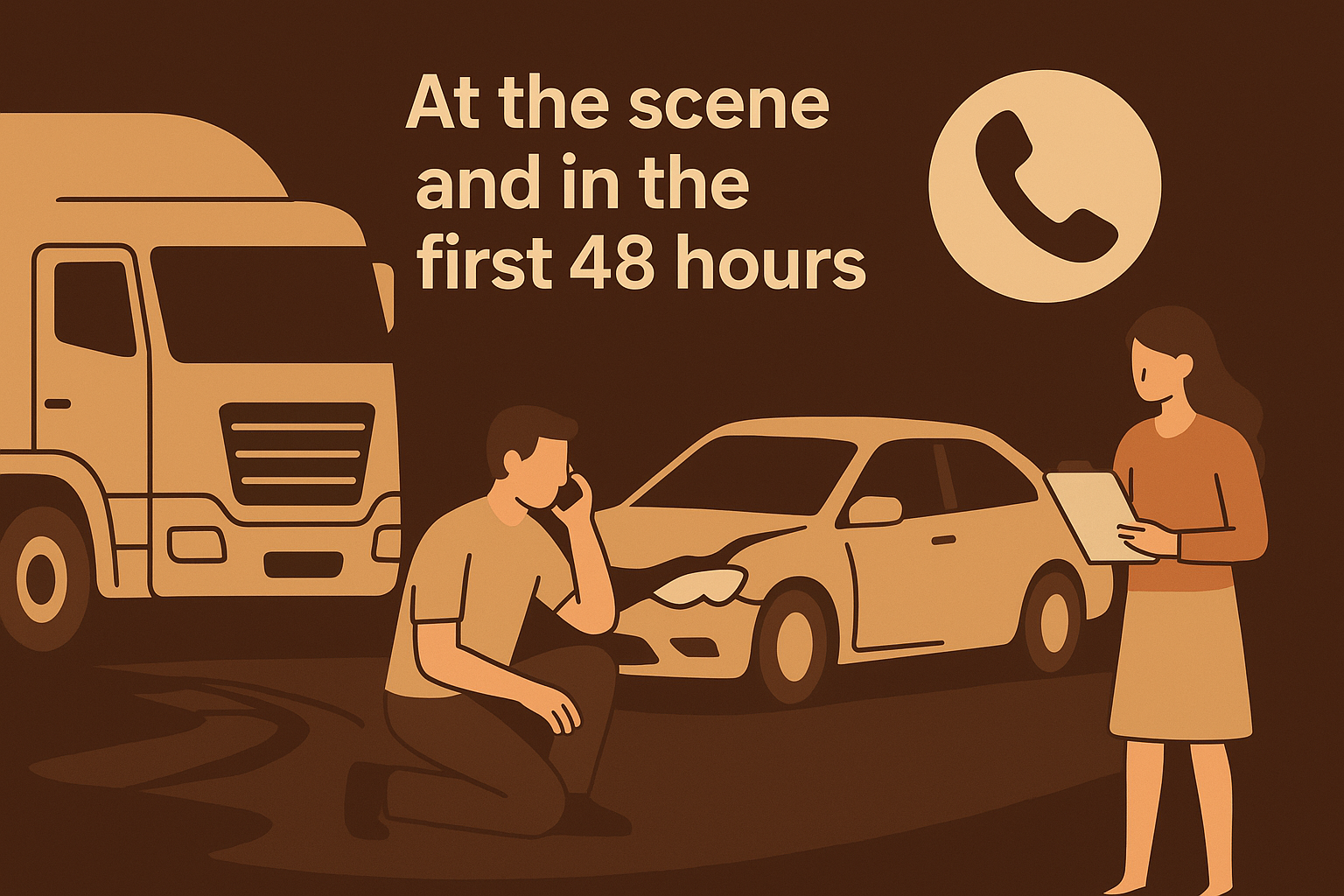
- Call 911 and request police and medical help, even if you feel fine. Adrenaline hides injuries.
- Photograph the vehicles, skid marks, road signs, the truck's company name, the license plate and the USDOT number on the cab.
- Get names and contact details for the truck driver, other drivers and any witnesses.
- Do not argue about fault or apologize. Give police the facts only.
- Accept an ambulance or go to the emergency room the same day, and follow every treatment instruction.
- Request the crash report and keep every bill, receipt and record of missed work.
- Contact a truck accident lawyer so a preservation letter can go out quickly.
Truck crashes near the I-22, US-45 and I-55 corridors and around Memphis often involve out-of-state carriers hauling regional freight. That makes the carrier's identification, and the details on the cab, especially useful for your lawyer to have.
What to avoid with insurers
Never give a recorded statement to the trucking company's insurer. Adjusters ask questions designed to get you to minimize your injuries or accept some blame. You are not required to speak with them, and your own words can be used against you later.
Be equally careful with quick settlement offers . An early check often arrives before you know your full medical needs, and signing a release ends the claim for good. Also avoid posting about the crash or your recovery on social media. A photo from a weekend outing can be used to argue that your injuries are minor. And do not skip appointments, because gaps in treatment give insurers an argument that you were not really hurt.
Your first statement to an insurer cannot be taken back, so talk to a lawyer first.
Mississippi and Tennessee rules that affect your claim
The state where the crash happened sets your filing deadline and fault rules, and Mississippi and Tennessee handle both differently. A crash in Northeast Mississippi is generally governed by Mississippi law, and a crash in Memphis by Tennessee law. Federal trucking rules apply in both states. This section is general information, and an attorney should confirm how it applies to your facts.
Filing deadlines
Missing the deadline usually ends your claim no matter how strong it is. The differences between the two states are large.
| Rule | Mississippi | Tennessee |
|---|---|---|
| Personal injury filing deadline | Generally 3 years from the crash | Generally 1 year from the crash |
| Fault system | Pure comparative fault | Modified comparative fault, barred at 50% or more |
| Claim involving a government vehicle or agency | Much shorter deadlines and notice requirements | Special rules and short deadlines |
Because Tennessee's general deadline is only one year, a Memphis crash leaves much less time to investigate and negotiate. Do not treat the longer Mississippi period as a reason to wait. Evidence disappears long before a deadline passes, and a case filed early is rarely a weaker case.
How shared fault reduces your recovery
Trucking defendants regularly argue that the injured driver was partly to blame. Under pure comparative fault, Mississippi reduces your recovery by your percentage of fault, and you can still recover when you are mostly at fault. Tennessee uses a modified rule and bars recovery once your fault reaches 50 percent.
Here is how that works on a claim with $200,000 in total damages:
| Your share of fault | Mississippi recovery | Tennessee recovery |
|---|---|---|
| 20% | $160,000 | $160,000 |
| 50% | $100,000 | $0 |
| 60% | $80,000 | $0 |
At 20 percent, both states reduce the claim the same way. At 50 percent, the same crash pays $100,000 in Mississippi and nothing in Tennessee. That is why a lawyer fights over fault percentages early, using the truck's data, the driver's logs and reconstruction work to push your share down.
One fault percentage can be the difference between full recovery and none, depending on which side of the state line you were on.
Getting the right help after a truck crash
A lawyer for a commercial truck accident earns the role by doing what a car accident lawyer usually does not: preserving trucking records fast, finding every liable party, valuing future losses, and standing ready to try the case. Hire based on proven truck case experience, ask specific questions, get fee terms in writing, and keep your state's deadline in front of you.
Do not wait for the carrier's insurer to define your claim. You can have a conversation about your options at no cost. If you were hurt in a collision with a commercial truck in Northeast Mississippi or the Memphis area, schedule a free consultation with Mayfield Law Firm and get your questions answered before evidence is lost.