What To Do After A Truck Accident: Steps To Protect Claim
A collision with a commercial truck can leave you shaken, injured, and unsure of your next move. Knowing what to do after a truck accident , in the minutes, hours, and days that follow, directly affects your ability to recover physically and financially. The steps you take at the scene and shortly after can either strengthen or undermine a future injury claim , and most people don't realize how quickly critical evidence can disappear.
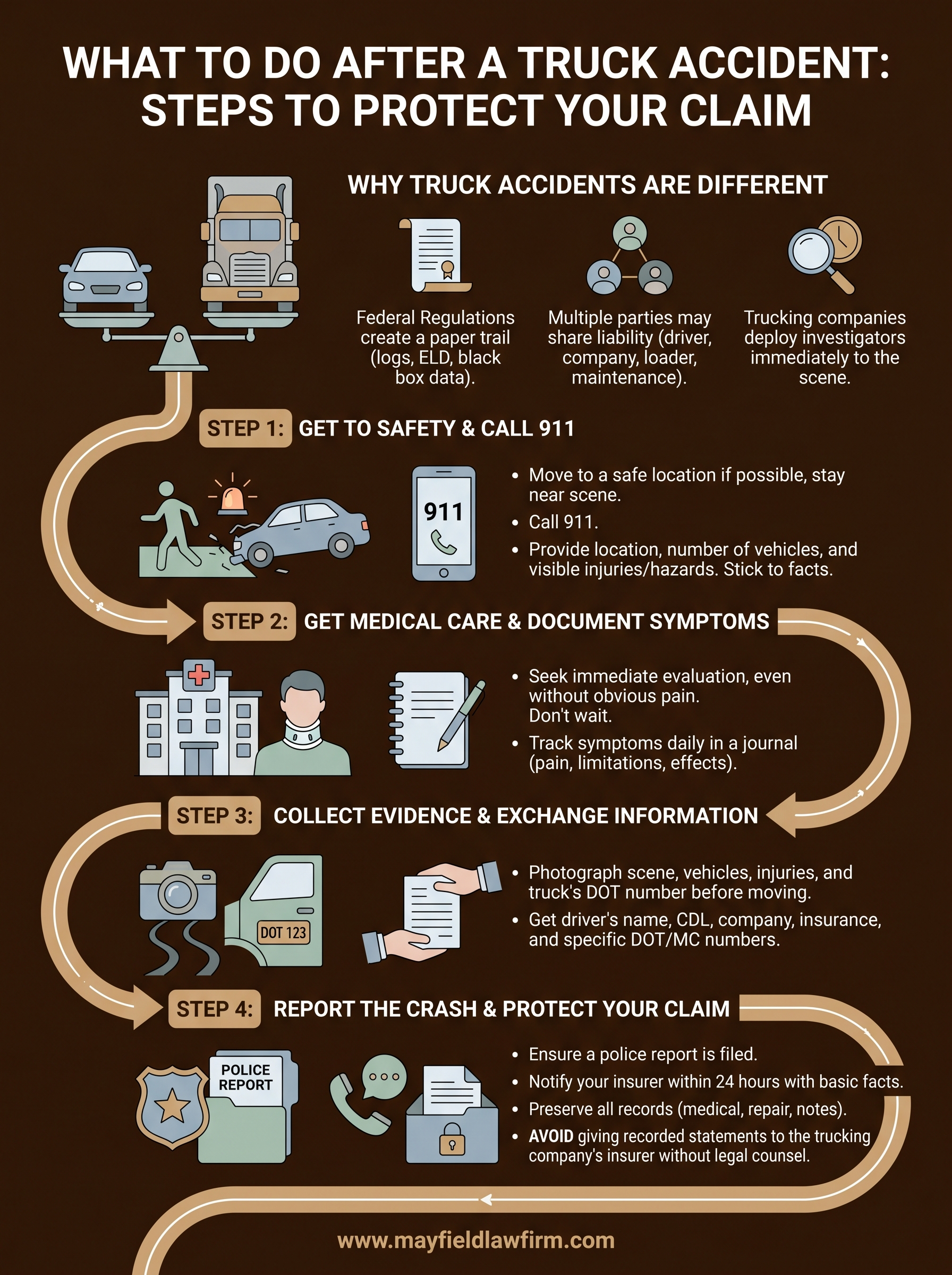
Truck accidents differ from typical car crashes in significant ways. Multiple parties may share liability, including the driver, the trucking company, and maintenance providers. Federal regulations govern the industry, and trucking companies often dispatch their own investigators to the scene within hours. Without the right actions on your end, you're already at a disadvantage before you've even spoken to an attorney .
At Mayfield Law Firm, P.A., we've spent over 40 years representing accident victims across Northeast Mississippi and South Memphis. Our team handles truck and auto accident cases from the initial consultation through settlement negotiations , trials, and appeals. This guide walks you through each step you should take after a truck accident, so you can focus on healing while protecting your legal rights .
Why truck accidents demand a different checklist
When a passenger car hits another passenger car, the investigation usually involves two drivers, two insurance companies, and one set of state traffic laws. Commercial truck accidents are far more complicated. A fully loaded 18-wheeler can weigh up to 80,000 pounds, and the legal, regulatory, and insurance landscape surrounding that vehicle involves layers that simply don't exist in a standard car crash case. Understanding why the situation is different is the foundation for knowing what to do after a truck accident .
Federal regulations create records you can use
The trucking industry operates under rules set by the Federal Motor Carrier Safety Administration (FMCSA) , which governs how long drivers can operate before resting, how vehicles must be maintained, and what records carriers are required to keep. These regulations produce a paper trail that can directly support your claim.
Key records that may be available after a truck accident include:
- Driver logs and hours-of-service records (showing whether the driver exceeded legal driving limits)
- Electronic logging device (ELD) data (GPS and trip information stored onboard)
- Vehicle inspection and maintenance reports
- Drug and alcohol testing results
- Black box data (recording speed, braking, and other inputs at the moment of impact)
The problem is that some of these records can be purged in as little as six months , and carriers are not always motivated to preserve them voluntarily. If you wait too long to pursue your case, critical evidence may simply no longer exist.
Acting quickly after a truck accident is often the difference between having evidence and losing it entirely.
Multiple parties can share liability
In a car accident, fault typically points to one or both drivers. In a truck accident, responsibility can spread across several different parties , which changes how a claim is investigated and negotiated. Common parties who may share fault include:
- The truck driver (speeding, distracted driving, hours-of-service violations)
- The trucking company (negligent hiring, inadequate training, pressure to skip rest breaks)
- The cargo loader (improperly secured or overloaded freight)
- The maintenance provider (brake failure or tire blowouts from poor upkeep)
- The truck or parts manufacturer (defective components)
Identifying every liable party matters because each one may carry separate insurance coverage , which directly affects how much compensation you can recover.
Trucking companies deploy investigators immediately
One of the most important facts to understand is that large trucking companies and their insurers treat a major accident as a legal event from the moment it happens . They often dispatch accident reconstruction specialists, lawyers, and claims adjusters to the scene within hours. Their goal is to document the scene in ways that protect the company's financial interests.
By the time you feel ready to start asking questions, the other side may have already photographed the scene, interviewed witnesses, and begun building a defense . This imbalance is exactly why your checklist needs to start at the scene, not days later when you feel well enough to think it through. The steps that follow walk you through each action in order, beginning with the first moments after impact.
Step 1. Get to safety and call 911
Your first priority after any truck accident is staying alive and avoiding further injury . The size and weight of commercial trucks mean secondary collisions, fuel spills, and cargo hazards are all real risks at the scene. Before you think about evidence or insurance, get yourself and anyone else out of immediate danger .
Move to a safe location
If you can move without worsening an injury, pull your vehicle off the active lane of traffic and onto the shoulder or a nearby parking area. Turn on your hazard lights immediately. If your vehicle is disabled in the road, exit through the passenger side to avoid oncoming traffic, then move well away from the crash zone. Do not stand directly behind or beside either vehicle, since fuel leaks and fire are more common in truck accidents than in standard car crashes.
Stay near the scene, but at a safe distance from both vehicles . Leaving the accident entirely is illegal in most states and can seriously damage your credibility if you later file a claim.
Call 911 even if the damage looks minor. A police report is one of the most important documents in any truck accident claim.
What to tell the 911 dispatcher
When you call 911, give the dispatcher your exact location first so emergency services can respond without delay. Stay calm and provide the following information:
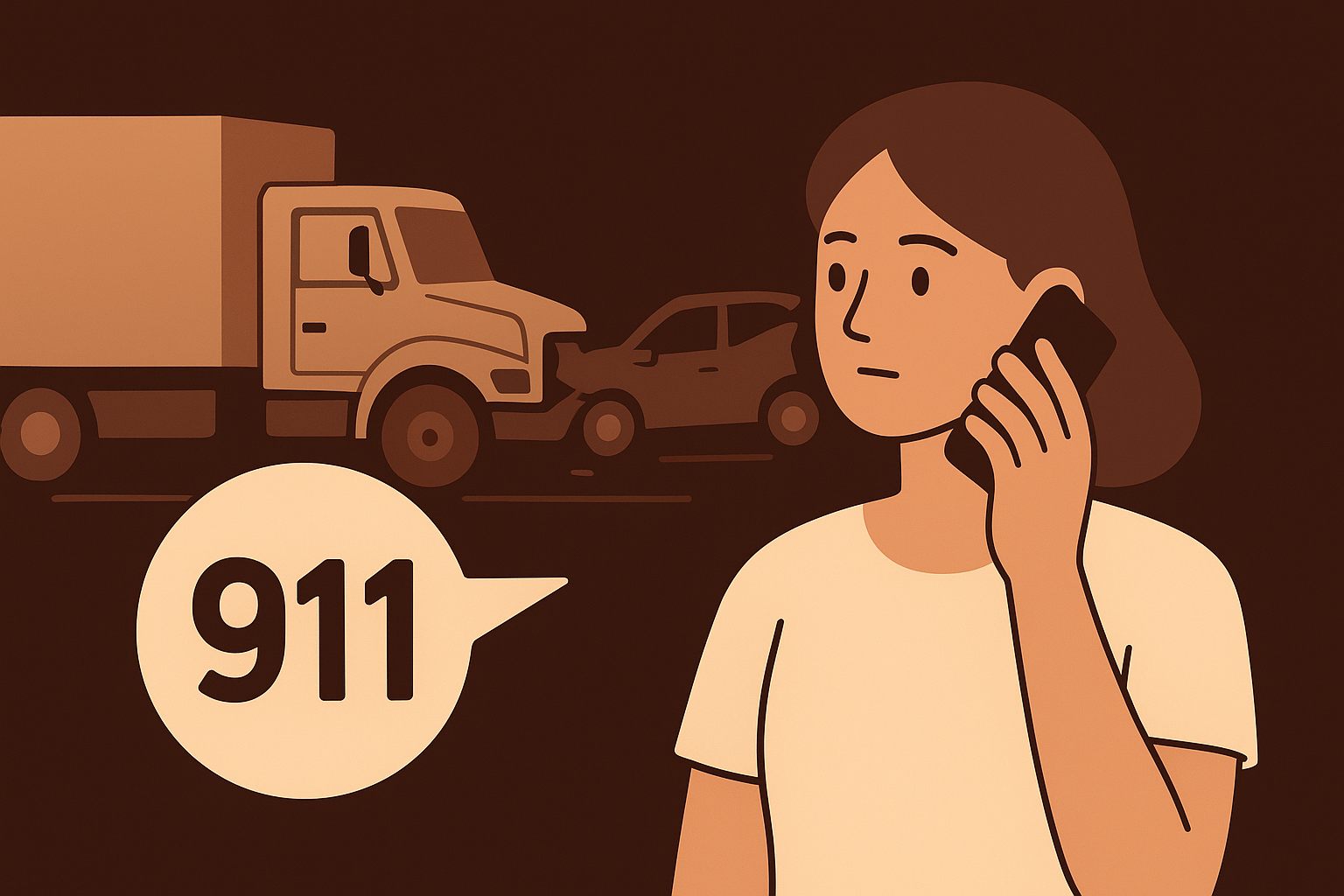
- Your location : highway name, mile marker, nearby cross street, or recognizable landmark
- Number of vehicles involved and whether a commercial truck is one of them
- Visible injuries : describe what you observe, even if you are unsure how serious they are
- Immediate hazards : fuel spills, fire, blocked lanes, or cargo spread across the road
Do not speculate about fault or describe the accident in detail to the dispatcher. Your words can be recorded and may appear later in the official record. Stick to facts about location, injuries, and hazards, and stay on the line until emergency services arrive or the dispatcher releases you . Knowing what to do after a truck accident starts with this call, because everything that follows depends on having official responders documented at the scene.
Step 2. Get medical care and document symptoms
Even if you walked away from the crash without obvious injuries, getting a medical evaluation the same day is one of the most important steps in knowing what to do after a truck accident. Adrenaline masks pain, and conditions like internal bleeding, traumatic brain injury, and soft tissue damage often don't produce visible symptoms for hours or even days. Delaying medical care gives insurance adjusters a direct argument that the crash did not cause your injuries , which can significantly reduce or eliminate the compensation you can recover.
Seek evaluation immediately
Don't wait to see how you feel the next morning. Go to an emergency room or urgent care clinic directly from the scene , or ask emergency medical technicians to evaluate you on-site before you leave. Tell the medical provider the exact mechanism of your injury, including that a commercial truck was involved. This detail matters because the impact forces in truck accidents are far greater than those in standard car crashes , and providers need to screen for injuries that might not be immediately visible. If you receive a referral to a specialist, follow through without delay since gaps in your care history work against your claim.
Common truck accident injuries with delayed presentation include:
- Whiplash and cervical spine injuries
- Concussion and traumatic brain injury (TBI)
- Internal organ damage or internal bleeding
- Herniated or bulging discs
- Post-traumatic stress disorder (PTSD)
Track your symptoms in writing
Starting the day of the accident, keep a daily symptom journal and continue writing in it until your doctor confirms you have reached maximum medical improvement. Insurance companies scrutinize any gap between the accident date and when symptoms were first reported, and a consistent written record removes doubt about when problems began and how they progressed .
Each daily entry should include:
- Date and time of the entry
- Physical symptoms : location, severity on a 1-10 scale, and duration
- Emotional or cognitive changes : sleep disruption, anxiety, or difficulty concentrating
- Activities you could not perform due to injury, such as working, driving, or household tasks
- Medications taken and whether they provided relief
Your medical records and symptom journal together form the foundation of your injury claim. Gaps in either one become leverage for the defense.
Step 3. Collect evidence and exchange information
The scene of a truck accident contains physical evidence that starts disappearing the moment the crash happens . Skid marks fade, debris gets cleared by highway crews, witnesses leave, and weather alters road conditions within hours. Understanding what to do after a truck accident means treating the scene as a primary documentation opportunity from the moment you are safely away from immediate danger. Pull out your phone and begin recording everything around you before anything is moved.
What to photograph at the scene
Your phone camera is one of the most useful tools available to you right now. Start photographing immediately , before anything is moved, and work through the entire area systematically. Capture wide shots first to establish the full scope of the scene, then move in for close-up detail shots of specific damage points and road markings.
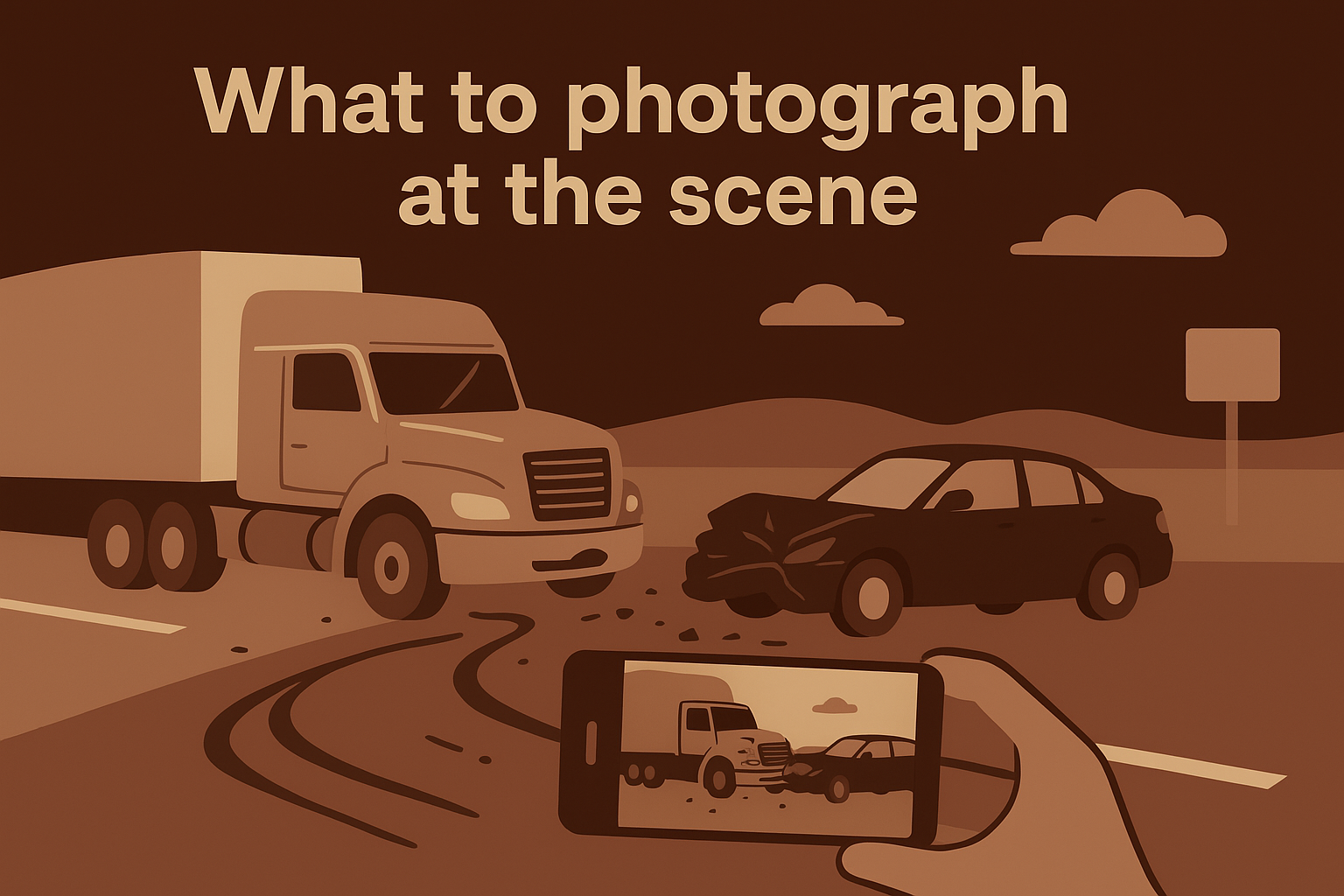
Document the following in your photos and video:
- Both vehicles : all four sides, the point of impact, undercarriage if accessible, and skid marks leading up to either vehicle
- Road conditions : lane markings, signage, traffic signals, debris, and any cargo that spilled from the trailer
- Your visible injuries : cuts, bruising, swelling, or blood, photographed before medical treatment covers or cleans them
- Truck identifiers : the company name and logo on the cab or trailer, the DOT number on the truck door, and the license plates on both the cab and trailer
Photograph the truck's DOT number before anything else. That number unlocks the carrier's complete federal safety record through the FMCSA database.
Information to exchange with the truck driver
Beyond photos, you need to collect specific identifying details directly from the driver. Do not rely on memory alone since stress and adrenaline affect recall , and details like policy numbers or CDL numbers are easy to misremember. Open your phone's notes app or write on paper so nothing slips through.
Collect the following from the driver before anyone leaves the scene:
| Information | Where to find it |
|---|---|
| Driver's full name | Driver's license |
| Commercial driver's license (CDL) number | Driver's license |
| Trucking company name and address | Truck door or cab paperwork |
| DOT and MC numbers | Truck door panel |
| Insurance carrier and policy number | Cab documents or driver records |
| Dispatcher or employer contact | Driver provides verbally |
Step 4. Report the crash and protect your claim
Reporting the crash correctly and limiting what you say in the hours and days that follow are two of the most overlooked parts of knowing what to do after a truck accident. Official reports create a legal record of the event, and what you say to insurance representatives during that window can directly reduce your settlement offer if you're not careful. Act deliberately in this phase.
File a police report and notify your insurer
The responding officers will typically generate a police report at the scene, but confirm a report is being filed before you leave . Ask the officer for the report number and find out how to obtain a copy once it is finalized. In Mississippi and Tennessee, you can usually request your report through the local law enforcement agency that responded.
Notify your own auto insurance carrier within 24 hours of the crash, even when the commercial truck driver was clearly at fault. Most policies require timely notification as a condition of coverage. When you call, give basic facts: the date, location, and vehicles involved. Do not speculate about fault, describe your injuries in detail, or estimate repair costs during that first call.
Never give a recorded statement to the trucking company's insurer without first speaking to an attorney. Adjusters are trained to use your own words against you.
Preserve everything connected to the crash
Your job in the days after the accident is to build and protect a paper trail that supports your claim. Gather and store every document, communication, and receipt in one place, either a physical folder or a dedicated folder on your phone or computer.
Items to preserve immediately include:
- The police report number and a copy once available
- All medical records, bills, and referrals from the day of the crash forward
- Written notes of any conversations with the trucking company, their insurer, or your own carrier, including the date, time, and name of the person you spoke with
- Repair estimates and photos of vehicle damage from the body shop
Keeping this record complete protects you from disputes over what happened and when.
Next steps after you leave the scene
Knowing what to do after a truck accident does not stop when you drive away from the crash site. The days that follow require the same focus: attend every medical appointment, continue your symptom journal, and avoid posting anything about the accident on social media since insurance adjusters actively monitor those accounts. Keep all documents organized and respond to your own insurer promptly, but do not give any recorded statements to the trucking company's representatives without legal counsel present.
Trucking companies have experienced legal teams working immediately , and you deserve the same level of preparation on your side. An attorney can send a spoliation letter to preserve driver logs and black box data before they are destroyed, identify every liable party, and handle negotiations while you recover. If you were injured in a truck accident in Northeast Mississippi or South Memphis, contact Mayfield Law Firm, P.A. for a free consultation today.