7 Tips for Choosing a Slip and Fall Injury Attorney Near Me
Finding a slip and fall injury attorney near me comes down to four checks: the lawyer is licensed in the state where you fell, has real premises liability experience, offers a free consultation, and works on a written contingency fee, so you pay nothing unless you recover money. If you fell in Tupelo or Southaven, the Mississippi rules on fault and deadlines matter most. If you fell in Memphis, start with the deadline tip, because Tennessee gives you far less time to sue. If cost is your worry, start with the fee tip.
You are probably hurt, behind on work, and already hearing from the property's insurance adjuster. Every law firm website promises the same things, so it is hard to tell them apart. Slip and fall claims are also harder than many injury cases. You do not just prove you were hurt. You prove the owner knew, or should have known, about the hazard and failed to fix it.
The seven tips below give you a way to compare any firm in Northeast Mississippi or South Memphis. Each tip has what to look for, why it matters, and questions to ask. Mayfield Law Firm, P.A. has represented injured people in this region since 1974 and appears as an example where it helps. This is general information, not legal advice about your case.
1. Choose a lawyer licensed where you fell
The right lawyer is licensed in the state where your fall happened and is close enough that meeting in person is realistic. Near the Mississippi and Tennessee line, that requirement is easy to overlook and costly to miss.
What to look for
Start with the map. Look for a firm with an office within a reasonable drive and attorneys licensed in the state where the property sits. Mayfield Law Firm, P.A. shows what that looks like in this region. Its attorneys are licensed in both Mississippi and Tennessee , with three offices:
- Tupelo: 106 West Franklin Street, Tupelo, MS 38804 (downtown)
- Southaven: 910 E. Goodman Rd, Suite A, Southaven, MS 38671
- Memphis: 200 Jefferson Ave, Suite 713, Memphis, TN 38103
A firm with several offices also shows it serves clients across a wider area, not just one neighborhood. Check each firm's contact page for the same details.
Why it matters
Your state's law follows the fall, not your home address. If you live in Southaven and slip in a Memphis grocery store, Tennessee law governs your claim, including its much shorter filing deadline. A lawyer who is not licensed there cannot file your lawsuit in that state's courts.
A local lawyer also knows the area's courts and the defense firms that insurers tend to hire. That shapes how they negotiate. Local knowledge shows up in small decisions, such as how to word a demand letter or when to push for a filing.
The state where you fell, not the state where you live, decides which rules apply to your claim.
Questions to ask
Ask these before you share your full story with any firm.
- Are you licensed in the state where I fell?
- Which office is closest to me, and can we meet by video if driving hurts?
- Will the attorney I meet be the one handling my case?
2. Look for real premises liability experience
A good slip and fall injury attorney near you should be able to explain, in plain language, how premises liability claims are proven and how many they have handled. General personal injury experience helps, but fall cases turn on details that car crash cases do not.
What to look for
Ask how the lawyer would prove each element of your claim. A strong answer follows the same path every time:
- You were lawfully on the property, usually as a customer or invited guest.
- A hazard existed, such as a wet floor, broken step, or ice.
- The owner created it, knew about it, or should have known about it.
- The hazard caused your fall.
- You suffered documented losses.
Mayfield Law Firm's founding attorney, Kenneth Mayfield, has more than 40 years in civil litigation , and the firm has advocated for clients since 1974. Years alone do not prove premises experience, so ask about the cases themselves.
Why it matters
People ask how hard it is to win a slip and fall lawsuit. The honest answer is that it depends on proof, and the hardest part is usually the third element. Mississippi courts generally ask whether the owner caused the hazard, knew about it, or let it sit long enough that they should have found it.
Your visitor status matters too. Customers get the highest level of protection, while trespassers get very little. Defendants also argue that a hazard was obvious, such as a visible puddle. An attorney who has handled these defenses spots them before the insurer raises them.
A fall is not a winning case until someone can show the owner knew, or should have known, about the hazard.
Questions to ask
Experience claims are easy to make, so ask for specifics.
- How many fall or premises cases have you handled, and how many went to trial?
- How would you prove the owner knew about my hazard?
- What defenses do you expect from the property's insurer?
3. Use the free consultation as an interview
A free consultation should cost you nothing and commit you to nothing, and you should leave it knowing whether the lawyer wants your case and why. Treat it as an interview of the lawyer, not just a pitch to you.
What to look for
Look for a firm that offers a free consultation with an actual attorney, not only an intake worker, and that offers flexible meeting options. Mayfield Law Firm, P.A. offers a free consultation and welcomes both in-person and virtual meetings, which helps if you are on crutches or cannot drive.
Bring what you have, even if it is incomplete:
- Photos or video of the spot where you fell
- Any incident report or the manager's name
- Medical records, bills, and discharge papers
- Pay stubs or a note from your employer about missed work
- Names and numbers of witnesses
- The shoes you wore, if you still have them
Why it matters
People often ask what not to tell a personal injury lawyer. The answer is that you should not hold anything back. Your conversation with your attorney is confidential and privileged . Prior injuries, phone use at the time of the fall, or the shoes you wore will come out in discovery, and the lawyer should hear the bad facts from you first.
What you should keep to yourself is everything said to the other side. Do not give the property's insurer a recorded statement before talking to a lawyer. Do not post about the fall or your recovery on social media. Adjusters look for anything that suggests you were careless or less hurt than you claim.
Tell your lawyer everything, and tell the insurance adjuster nothing until your lawyer says to.
Questions to ask
Use the meeting to test how the firm works.
- Based on what I have told you, what are the weak points in my case?
- Who will work on my file day to day?
- How often will I get updates, and by what method?
4. Get the no-win-no-fee terms in writing
A contingency fee means the firm is paid only if you recover money, usually as a percentage of the settlement or verdict. Get the percentage, the cost rules, and the repayment terms in a written agreement before you sign.
What to look for
Look for a clear percentage, a statement of whether the fee is figured before or after costs , and a rule on what happens if the case is lost. Contingency fee agreements should be in writing. Mayfield Law Firm, for example, states a 29% fee on settled car accident cases. It is a useful model of a number stated up front, but slip and fall terms vary by firm and case, so ask for the exact rate on yours.
The table shows how the fee changes what you keep. It uses a hypothetical $50,000 settlement, $1,500 in case costs, and $6,000 repaid to medical providers or a health insurer. The rates are illustrations, not quotes.
| Fee rate | Fee on $50,000 | You keep after costs and medical repayments |
|---|---|---|
| 29% | $14,500 | $28,000 |
| 33⅓% | $16,667 | $25,833 |
| 40% | $20,000 | $22,500 |
Why it matters
No-win-no-fee does not always mean no expenses. Firms usually advance filing fees, records charges, and expert costs , then recover them from the result. Ask whether you owe those costs if the case loses, because policies differ.
Fee rates often rise once a lawsuit is filed or a trial begins, so ask for the rate at each stage. Also expect medical repayment claims. Hospitals and health insurers often want reimbursement from your settlement, and a good lawyer will negotiate those amounts down. Net recovery , not the headline settlement, is the number that counts.
Compare firms on what you keep, not on the percentage alone.
Questions to ask
Put these answers in the written agreement.
- What is your percentage before suit, after suit, and at trial?
- Is the fee calculated before or after costs are deducted?
- Do I owe anything for costs if we recover nothing?
5. Hire before your deadline gets close
The legal deadline to sue after a fall is three years in Mississippi in most cases and one year in Tennessee. Evidence disappears much faster than either deadline, so call a lawyer in the first weeks.
What to look for
A good attorney states your deadline in the first conversation and asks where the fall happened and who owns the property. Ownership changes the clock. Here are the common deadlines, which you should confirm with a lawyer because exceptions exist:
| Situation | Typical deadline |
|---|---|
| Ordinary premises claim, Mississippi | 3 years from the fall |
| Ordinary premises claim, Tennessee | 1 year from the fall |
| Fall on Mississippi government property | Written notice of claim at least 90 days before suing, and a 1-year limit |
| Fall on Tennessee government property | Shorter rules apply, generally about 12 months |
| Fatal fall in Mississippi, negligence | 3 years from the date of death |
| Fatal fall in Mississippi, intentional acts | 1 year from the date of death |
Why it matters
People ask how long they can wait to sue. Legally, you may have years. Practically, waiting costs you evidence . Store video is often overwritten within days or weeks, the hazard gets fixed, and employees who saw the fall leave their jobs.
Government property is the biggest trap. A fall on a city sidewalk, school, or public building usually triggers notice requirements and short limits that private-property claims do not have. If you miss the deadline, the court will generally dismiss the claim no matter how strong it was.
A strong claim filed late is a claim that is lost.
Questions to ask
Make the lawyer commit to dates.
- What is my filing deadline, and how did you calculate it?
- Does the fact that the owner is a city, county, or school change it?
- What do you need from me in the next two weeks to protect my claim?
6. Ask how the lawyer will secure evidence
A capable firm moves in the first days to preserve proof, usually by sending the property owner a written demand to keep video, logs, and records. Ask for the plan, not just the promise to investigate.
What to look for
Look for a lawyer who talks about preservation letters and specific records, not vague "building a case." The evidence that most often decides fall claims includes:
- Surveillance video from before and after the fall
- Incident reports and employee statements
- Cleaning, inspection, and maintenance logs
- Weather records, which matter for rain and ice
- Photos showing lighting, floor surface, and warning signs
- Witness contact details and statements
Some cases also need an outside expert, such as an engineer for a defective staircase or handrail.
Why it matters
You have a role in the first 48 hours. Photograph the hazard from a distance and up close, then report the fall to a manager and ask for a copy of the report. Get medical care promptly, even if the pain seems minor, because a gap in treatment gives the insurer an argument.
If you did not report the fall right away, you can still bring a claim. It simply means other evidence has to carry more weight , such as witness accounts and medical records tying the injury to the fall. A lawyer who hears this early can often recover more than you expect.
Evidence that exists today may be gone in a month, so the first call to a lawyer is also a call to protect proof.
Questions to ask
Ask for process, not slogans.
- Will you send a preservation letter, and how soon?
- What records will you request from the property owner?
- Do you work with investigators or experts, and who pays for them?
7. Expect an honest case valuation and a trial plan
A trustworthy lawyer explains what your claim could include and what could reduce it, without promising a number. Be wary of anyone who names a settlement figure at the first meeting.
What to look for
Ask the lawyer to walk through the damages that may apply:
- Past and future medical expenses
- Lost wages and reduced earning ability
- Pain and suffering
- Permanent impairment or scarring
- Loss of enjoyment of life
People often ask how much most slip and fall settlements are. No honest average exists, because a sprained wrist and a hip fracture are different cases. Insurance limits, medical costs, and how long recovery takes push the value up or down. A firm should also tell you that cases take months and sometimes more than a year.
Why it matters
Fault sharing can cut your recovery. Mississippi reduces damages by your share of fault. Tennessee does the same but bars recovery if your fault is 50% or more. The table uses a hypothetical $50,000 in damages and one defendant:
| Your share of fault | Mississippi recovery | Tennessee recovery |
|---|---|---|
| 0% | $50,000 | $50,000 |
| 20% | $40,000 | $40,000 |
| 50% | $25,000 | $0 |
| 60% | $20,000 | $0 |
Insurers also pay more when they believe your lawyer will try the case. Ask whether the firm has taken cases through settlement negotiations, trials, and appeals , as Mayfield Law Firm describes for its auto accident clients. A lawyer who never goes to court has less leverage at the negotiating table.
The best valuation is an honest range with its risks explained, not a number meant to win your signature.
Questions to ask
Finish with the hard questions.
- What could lower the value of my claim?
- If the insurer offers too little, are you prepared to file suit and try the case?
- How will you tell me when an offer is worth taking?
Making your choice
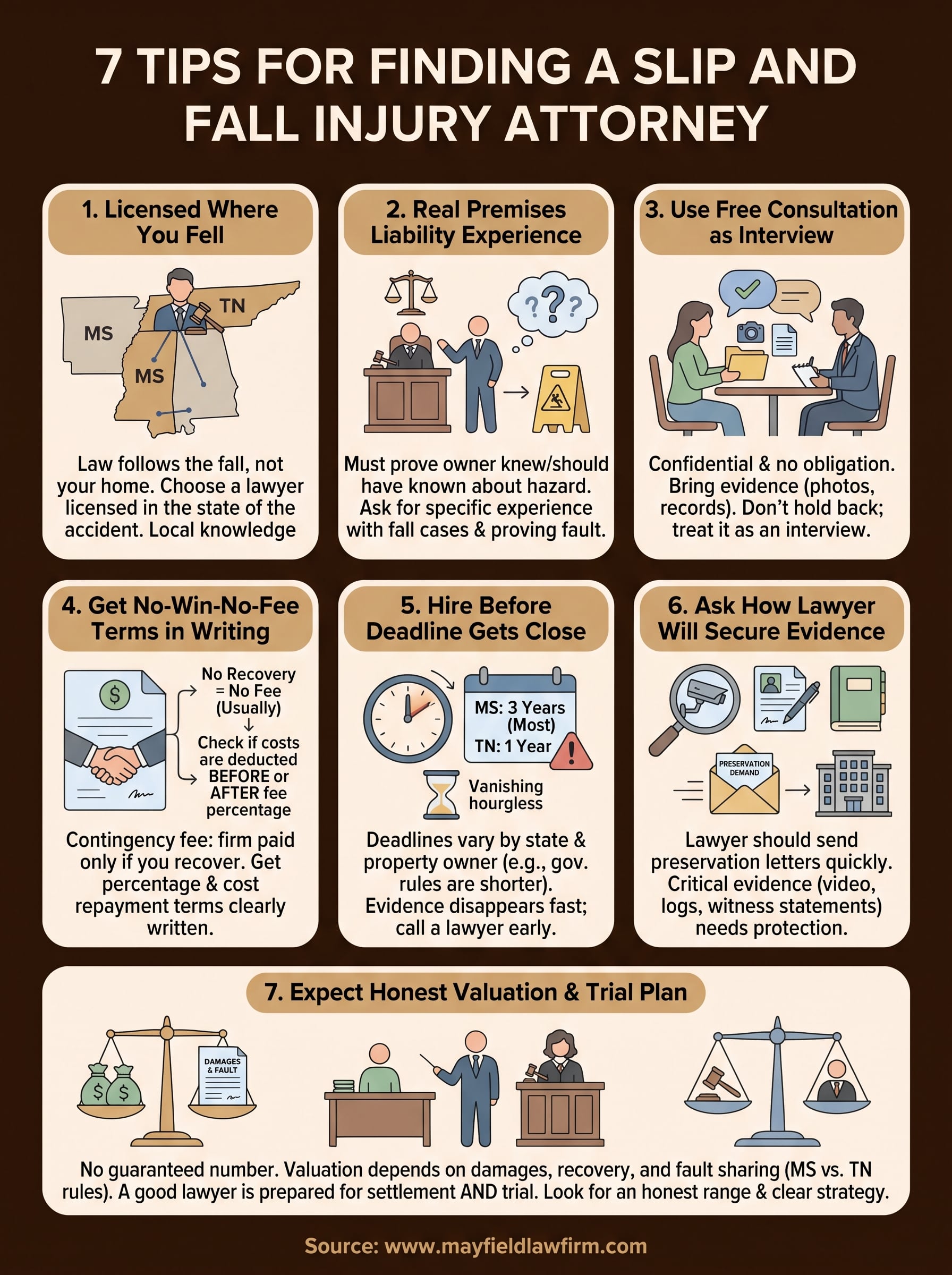
Pick the lawyer who is licensed where you fell, knows premises liability, gives a free consultation, puts fee terms in writing, watches your deadline, protects evidence early, and gives you an honest valuation. If a firm falls short on one of those, keep looking. Nearly every firm in the area will take your call for free, so compare at least two before signing.
If you were hurt on someone else's property in Northeast Mississippi or South Memphis, you can schedule a free personal injury consultation with Mayfield Law Firm to talk through your fall and your options. Bring your photos, bills, and questions. You will leave knowing where your claim stands and what to do next.