
What To Do After A Slip And Fall Accident: 10 Steps
A slip and fall can happen in seconds, a wet grocery store floor, an uneven sidewalk, a poorly lit stairwell. But the decisions you make in the minutes, hours, and days afterward can shape your recovery and your ability to hold the responsible party accountable. Knowing what to do after a slip and fall accident is critical because mistakes early on, like failing to report the incident or skipping medical care, can weaken or even destroy a valid claim .
At Mayfield Law Firm, P.A., we've spent over 40 years representing injured clients across Northeast Mississippi and South Memphis. We've seen firsthand how the steps someone takes (or doesn't take) right after a fall directly affect the outcome of their case . Property owners and their insurance companies look for any reason to deny or minimize your claim, and gaps in documentation give them exactly that .
This guide walks you through 10 specific steps to protect your health, preserve evidence, and put yourself in the strongest possible position to recover fair compensation. Whether your fall happened at a store, a friend's property, or a public space, these actions apply across the board . Follow them in order, starting as soon as you're able after the accident.
What matters most in the first 24 hours
The first 24 hours after a slip and fall are the most critical window you have. Evidence gets cleaned up, witnesses forget details, and the property owner or their insurer may already be building a defense. Acting quickly and deliberately in this period gives you the strongest foundation for your claim and the best chance of recovering what you're owed.
Evidence disappears faster than you think
Wet floors get mopped. Broken handrails get repaired. Security camera footage gets overwritten, sometimes within 24 to 72 hours depending on the recording system. Physical hazards that caused your fall can vanish before you even consider documenting them. This is why understanding what to do after a slip and fall accident in those first hours matters so much. Take photos and gather witness contact information before you leave the scene if you're physically able.

Once a property owner repairs the hazard or the footage gets deleted, that evidence is gone permanently and cannot be recovered later.
Here's what tends to disappear the fastest:
- Spill or liquid on the floor (cleaned within minutes)
- Loose mats or broken fixtures (repaired within hours)
- Security or surveillance footage (overwritten within 24 to 72 hours)
- Eyewitness memory (fades significantly within 48 hours)
Your body may not show all injuries right away
Adrenaline after an accident masks pain and swelling that may not surface until hours or even a full day later. Many people walk away from a fall feeling fine, only to wake up the next morning with a severe back injury, torn ligament, or concussion . Do not use how you feel at the scene as a reliable measure of your injury.
Skipping or delaying medical evaluation also hands the insurance company a ready-made argument: that your injuries weren't serious or weren't caused by the fall. Get evaluated by a doctor within 24 hours , even if you believe you're okay. Your health and your claim both depend on it.
Steps 1–3: Check injuries and get medical care
Your first priority after a fall is your physical condition. Before you think about documentation or legal steps, check your body for pain, numbness, or obvious injury . These three steps form the foundation of what to do after a slip and fall accident and set everything else in motion.
Step 1: Stay still and assess before you move
Do not jump up immediately. Moving too quickly after a fall can worsen a spinal, neck, or joint injury that you haven't fully felt yet. Take a breath, scan your body for pain, and only stand up slowly if you feel stable doing so. If anything feels wrong, stay where you are and ask someone nearby for help.
Step 2: Call 911 if you have any serious symptoms
If you feel sharp pain, dizziness, numbness, or visible bone or head injury , call 911 immediately. An ambulance report also creates an official medical record tied directly to the scene and date of your fall.
That official record becomes one of the most valuable pieces of evidence in your claim later.
Step 3: See a doctor within 24 hours, no exceptions
Even if you feel fine, visit a doctor or urgent care clinic the same day or the morning after . Get a written diagnosis and make sure the provider notes the fall as the cause.
Steps 4–6: Report it and document the hazard
Once you've addressed your immediate medical needs , your next job is to create a paper trail the property owner can't erase. These three steps are central to knowing what to do after a slip and fall accident and preserving the evidence that supports your claim.
Step 4: Report the fall to the property owner or manager
Tell the property owner, manager, or supervisor about the fall before you leave the premises . Ask them to complete a written incident report, then request a signed copy for your own records. If they refuse, write down the name of the person you spoke with and the exact time you made the report.
A verbal report you can't prove means nothing later, so push for written confirmation every time.
Step 5: Photograph the hazard and surrounding area
Pull out your phone and photograph the scene right away : the hazard, any missing or insufficient warning signs, and your visible injuries. Take both wide shots and close-ups. Document each of these specifically :
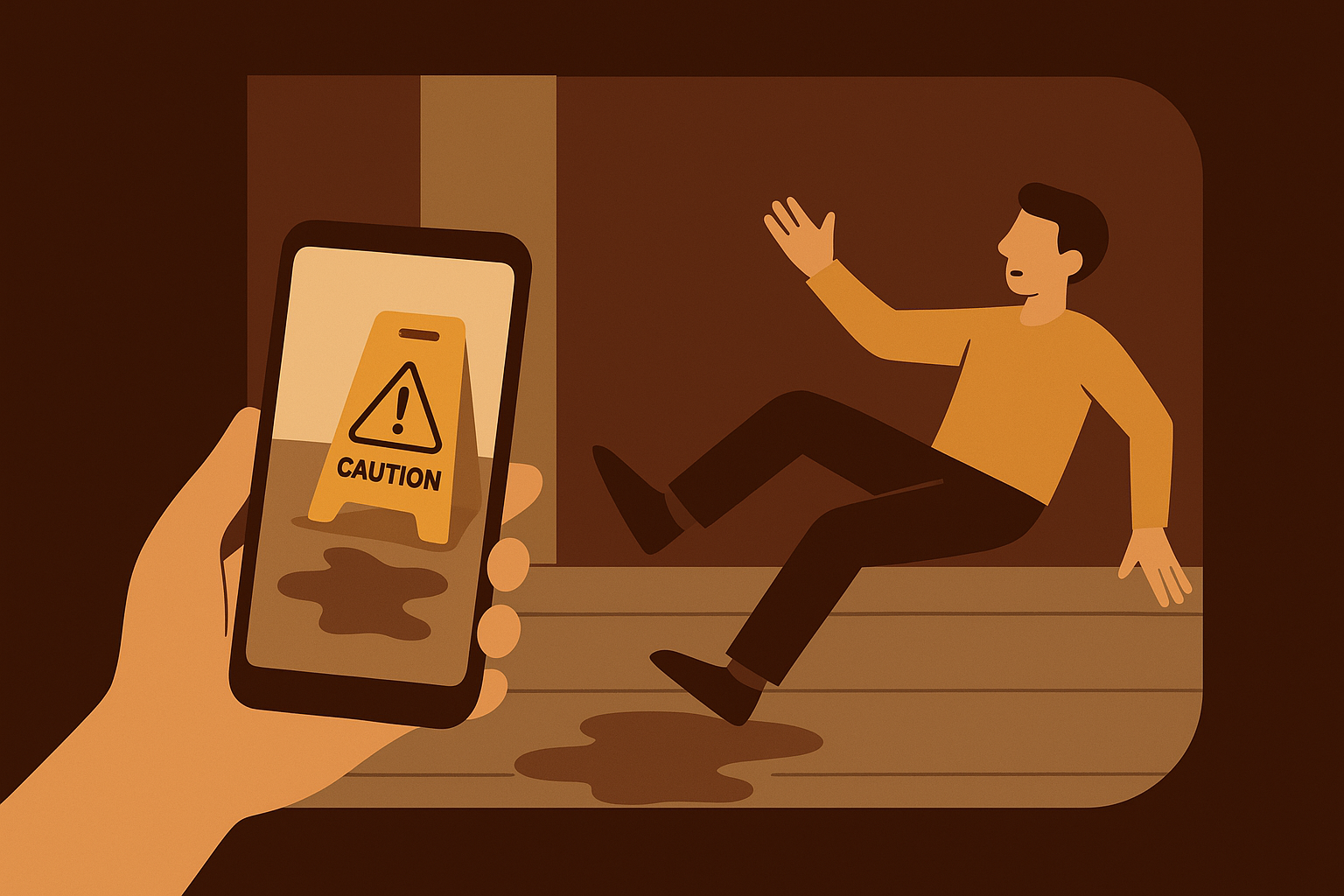
- The exact hazard (spill, broken step, torn carpet, uneven surface)
- The full surrounding area and lighting conditions
- Your injuries before any treatment
- Your clothing and footwear
Step 6: Collect witness contact information
Ask anyone nearby for their full name and phone number . Write it down immediately rather than relying on memory.
Witness accounts can directly counter what the property owner claims happened and carry real weight with insurance adjusters and juries alike.
Steps 7–8: Protect your claim and your privacy
Once you've reported the fall and gathered evidence, your next job shifts to protecting what you've built . Insurance adjusters move fast, and a single misstep in how you communicate or what you post online can undermine a claim that was otherwise solid . These two steps are easy to overlook but matter more than most people realize when figuring out what to do after a slip and fall accident.
Step 7: Decline recorded statements without your attorney present
The property owner's insurance company may call you within 24 to 48 hours asking for a recorded statement. Decline politely but firmly. Insurance adjusters are trained to ask questions that produce answers they can use against you later , even when the conversation feels routine or friendly.
You have no legal obligation to give a recorded statement to the opposing party's insurer before you have legal representation.
Step 8: Restrict your social media immediately
Set all your accounts to private right away and stop posting about the accident, your injuries, or your activities. Defense attorneys routinely search social media for photos or comments that contradict your injury claims . A single post showing you active or pain-free can be used to minimize your settlement significantly.
Steps 9–10: Track costs and get legal help
The final two steps in knowing what to do after a slip and fall accident determine how much compensation you can actually recover. Without a clear record of your losses and qualified legal representation , you risk leaving money on the table or accepting a settlement that doesn't cover your full damages.
Step 9: Keep a written record of every expense
Start a dedicated folder, physical or digital, and log every cost tied to the fall. Medical bills, prescription receipts, physical therapy co-pays, and transportation costs all count toward your damages. Also document lost wages if your injuries kept you from working.
Track these items from day one:
- Emergency room, urgent care, and follow-up visit bills
- Prescription and over-the-counter medication costs
- Lost income with dates and pay stubs
- Out-of-pocket expenses like crutches or bandages
Step 10: Contact a personal injury attorney
An attorney evaluates your case, handles communication with the insurance company, and fights for full compensation you may not know you're entitled to. Most personal injury lawyers, including those at Mayfield Law Firm, P.A., work on a contingency basis, meaning you pay nothing unless you win .
The sooner you involve an attorney, the better protected your evidence and your rights will be.
Next Steps
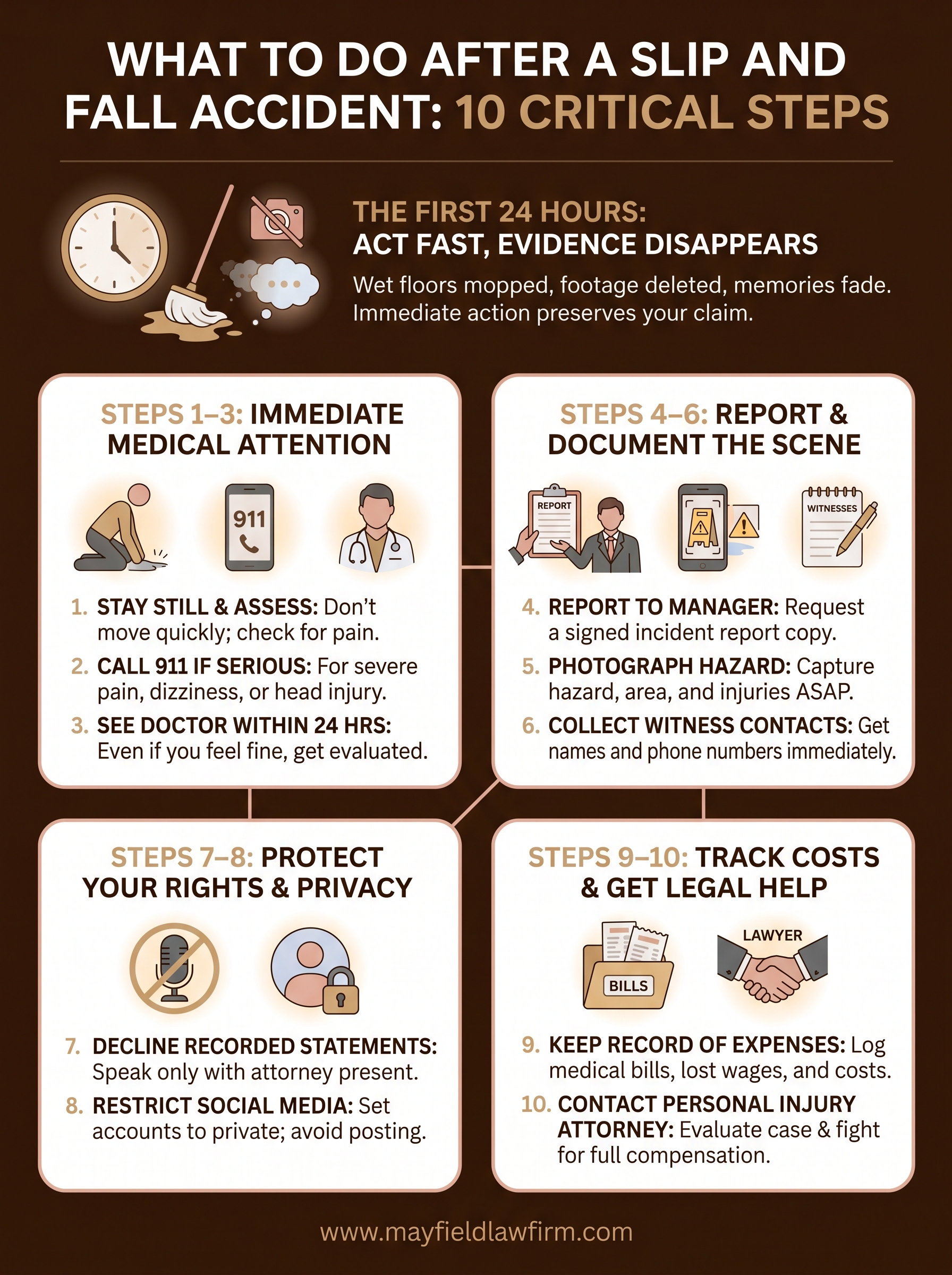
Knowing what to do after a slip and fall accident gives you real leverage when it matters most. Follow these 10 steps in order, and you'll have the medical records, documented evidence, and legal support you need to pursue fair compensation. Most claims fail not because the injury wasn't real, but because the injured person didn't act fast enough or didn't know what to preserve.
Your window to act is short. Evidence disappears, deadlines pass , and insurance companies move quickly to protect their clients, not yours. The stronger your documentation from day one, the harder it becomes for the property owner's insurer to minimize what you're owed. Every step in this guide exists for one reason : to keep that leverage in your hands.
Ready to talk through your situation with an experienced attorney? Contact Mayfield Law Firm, P.A. for a free consultation and find out exactly where your case stands.