
Slip and Fall Personal Injury Lawyer: What They Do for You
You slipped on a wet floor, a broken step, or a cracked sidewalk, and now you're stuck with medical bills and a property owner who won't return your calls. A slip and fall personal injury lawyer handles exactly this kind of case, and if you're searching for one, you probably already suspect the property owner or their insurance company isn't going to make this easy on you.
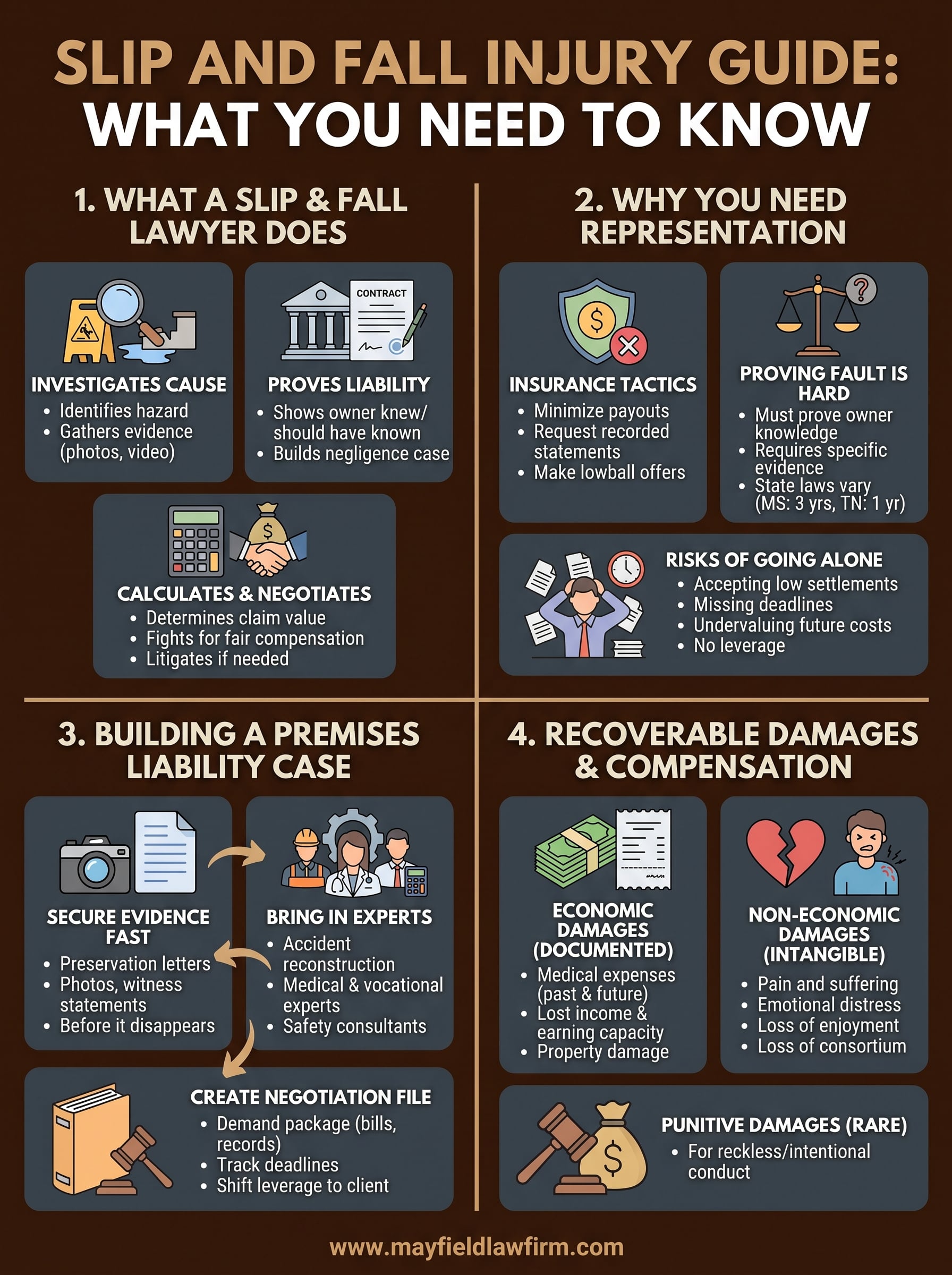
Here's the direct answer: a slip and fall attorney investigates what caused your fall, proves the property owner knew about the hazard (or should have), calculates what your claim is actually worth, and negotiates or litigates to get you paid. That's the job, start to finish, and it's worth knowing what to expect before you sign with anyone.
In this article, we'll walk through what these lawyers actually do for clients, how they build a premises liability case , what kind of compensation you can pursue, and when it makes sense to call one instead of handling an insurance claim yourself. If you're in Northeast Mississippi or South Memphis, our team at Mayfield Law Firm offers a free consultation to look at your situation and tell you straight where you stand, and it helps to know what happens at a free injury case review before you call.
Why you need a slip and fall lawyer on your side
Insurance adjusters have one job: pay out as little as possible. The moment you report a fall, the property owner's insurance company opens a file and starts building a defense, not a settlement offer. They'll ask for a recorded statement , hoping you say something that sounds like it was your fault for not watching where you stepped. They'll offer a quick check before you know the full extent of your injuries, betting you'll take it out of financial stress. None of this is illegal, it's just how the business works, and it's exactly why you need someone on your side who knows the playbook.
An insurance company's first offer is almost never its best offer.
Proving fault isn't as simple as it sounds
Mississippi and Tennessee both require you to show the property owner knew, or reasonably should have known, about the hazard that caused your fall. That's the legal heart of any premises liability case , and it's harder to prove than most people expect. A wet floor sign that fell over five minutes before you walked by might not count as negligence. A broken step that's been reported three times in maintenance logs almost certainly does. A slip and fall personal injury lawyer knows what it takes to prove negligence in a fall case, from surveillance footage to incident reports to prior complaint records, and how to get access to that evidence before it disappears.
Deadlines you can't afford to miss
Every state sets a statute of limitations on personal injury claims, and missing it means losing your right to sue no matter how strong your case is. Mississippi gives you three years from the date of the fall to file an injury lawsuit. Tennessee cuts that down to a strict one-year injury filing deadline. If your accident happened in a Memphis parking lot but you live in Mississippi, figuring out which deadline applies isn't always obvious, and that's a mistake you don't want to make on your own.
| State | Statute of limitations for personal injury | Notes |
|---|---|---|
| Mississippi | 3 years | Runs from the date of the injury |
| Tennessee | 1 year | Shorter deadline, easy to miss |
Source: Mississippi Code Title 15; Tennessee Code Title 28 statutes on limitation of actions.
What you risk by going it alone
Handling a claim without a lawyer feels manageable until the insurance company sends a lowball offer wrapped in confusing legal language. Without representation, you're negotiating against people who do this every single day, while you're trying to recover from an injury and keep up with bills. Here's what typically goes wrong when people try to settle on their own:
- They accept a settlement before knowing the full cost of future medical treatment.
- They miss the filing deadline because they didn't know which state's law applied.
- They give a recorded statement that gets used against them later.
- They underestimate lost wages, especially if the injury affects long-term earning capacity.
- They have no leverage to push back when the insurer denies the claim outright.
Without a lawyer, you're also on your own when it comes to identifying every liable party. A store owner might not be the only one responsible. A cleaning contractor, a property management company, or even a manufacturer of a defective floor mat could share liability, and finding that out requires investigation most people don't have the time or resources to do themselves.
A good slip and fall personal injury lawyer doesn't just react to what the insurance company offers, they build a case designed to make settling for less than you deserve the harder option for the other side. That shift in leverage is often the single biggest difference between a fair settlement and a check that barely covers your first hospital bill.
How a slip and fall lawyer builds your case
Building a strong premises liability case starts the moment you hire an attorney, not the moment you decide to settle. A slip and fall personal injury lawyer works backward from the outcome you need, then gathers every piece of proof that supports it. That process usually moves through a few distinct stages, each one designed to close off the excuses an insurance company will try to use against you.
Securing evidence while it still exists
Businesses often overwrite surveillance footage within days or weeks, so speed matters. Your lawyer sends a preservation letter demanding the property owner keep any video, incident reports, and maintenance records tied to the date of your fall. Photographs of the hazard, witness statements taken while memories are fresh, and copies of prior complaint logs all get pulled together early, which is why the steps you take right after a slip and fall matter so much. Losing even one of these pieces can weaken an otherwise solid claim.
A case is only as strong as the evidence collected before it disappears.
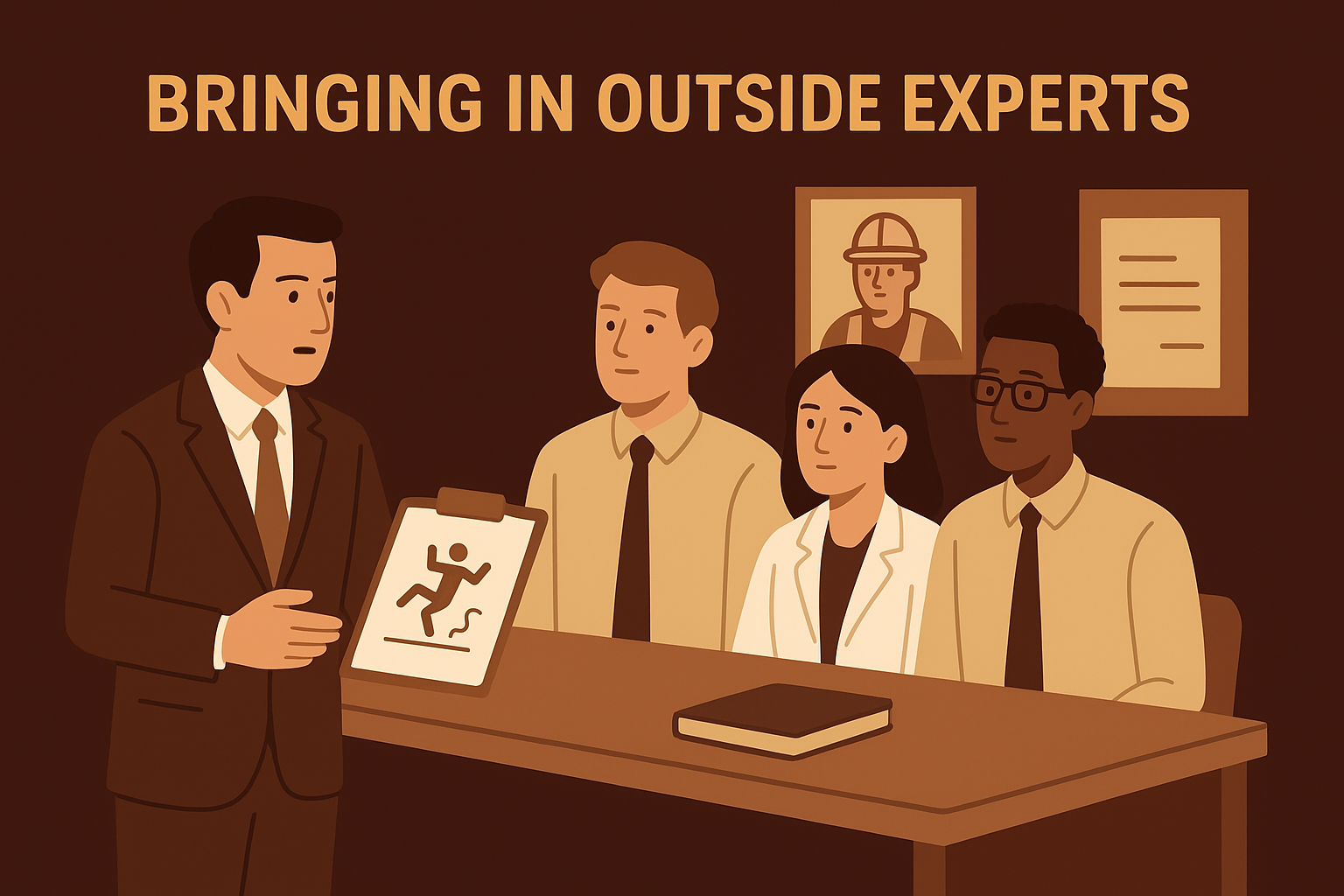
Bringing in outside experts
Expert input often separates a mediocre settlement from a full one. A liability lawyer for slip and fall cases will bring in specialists when the facts call for it, and each one adds weight the insurance company can't easily dismiss:
- Accident reconstruction experts who explain exactly how the hazard caused the fall
- Medical experts who document injury severity and connect it directly to the accident
- Vocational experts who calculate lost earning capacity when an injury affects your ability to work
- Engineers or safety consultants who testify about code violations, like a missing handrail or unmarked step
Experts cost money upfront, but their testimony often increases a settlement far more than it costs, which is why most firms front these expenses and recover them from the final award.
Building the negotiation file
Once the evidence is in hand, your lawyer compiles a demand package that lays out liability, injuries, and damages in a format the insurance company can't easily argue with. This file typically includes medical records, bills, wage loss documentation, and a written narrative connecting the hazard to your injuries. Insurance adjusters respond differently when they're looking at a organized, well-supported claim instead of a handwritten letter, and that difference shows up in the settlement number.
Throughout this process, your attorney also tracks every deadline and procedural requirement so nothing falls through the cracks while you focus on recovery. Mayfield Law Firm handles this entire process for clients across Northeast Mississippi and South Memphis, starting with a free consultation to review the facts of your fall and outline what building your case would actually look like.
What compensation you can recover after a fall
Most people underestimate what a slip and fall claim is actually worth because they only think about the emergency room bill, and the ranges these cases actually settle for tell a different story. A slip and fall personal injury lawyer looks at the full financial picture, including costs that haven't happened yet, and builds a claim around all of it. Compensation generally falls into a few categories, and knowing them helps you understand why a fair settlement often looks much bigger than what an insurance adjuster first offers.
Economic damages you can document
Economic damages cover the costs you can put a number on. These include your emergency care, follow-up treatment, physical therapy, and any future surgeries a doctor says you'll likely need. Lost wages count too, whether that means missed shifts during recovery or a permanent reduction in earning capacity if the injury limits what work you can do going forward. Property damage, like a broken phone or damaged glasses from the fall, also gets included, even though it's usually a small piece of the total.
| Damage type | Examples | How it's calculated |
|---|---|---|
| Medical expenses | ER visits, surgery, physical therapy, medication | Billed amounts plus projected future care |
| Lost income | Missed work, reduced earning capacity | Pay stubs, tax records, vocational expert reports |
| Pain and suffering | Physical pain, emotional distress | Multiplier or per diem method tied to severity |
| Property damage | Broken glasses, damaged devices | Replacement or repair cost |
Non-economic damages for what a bill can't capture
Pain and suffering fall under non-economic damages, valued by the multiplier or per diem method, and they're often the largest part of a strong claim. A shattered hip or a herniated disc doesn't just cost money to treat, it changes how you move, sleep, and spend time with family for months or years afterward. Emotional distress, loss of enjoyment of life, and in some cases loss of consortium for a spouse all factor into this category. Insurance companies tend to lowball this piece specifically because it's harder to prove, which is exactly why documentation matters so much here.
The biggest mistake in a slip and fall claim is settling before you know the true cost of what you lost.
When punitive damages come into play
Punitive damages are rare and only apply when the property owner's conduct goes beyond ordinary negligence, into something reckless or intentional. Think of a landlord who ignored repeated written warnings about a collapsing staircase for months. Courts award these damages to punish that behavior, not to compensate you directly, so don't expect them in a typical case.
A thorough personal injury claim accounts for every one of these categories before your lawyer even starts negotiating. That's the difference between accepting whatever number the insurance company suggests and knowing what your case is genuinely worth before you sign anything.
Common causes and injuries in slip and fall accidents
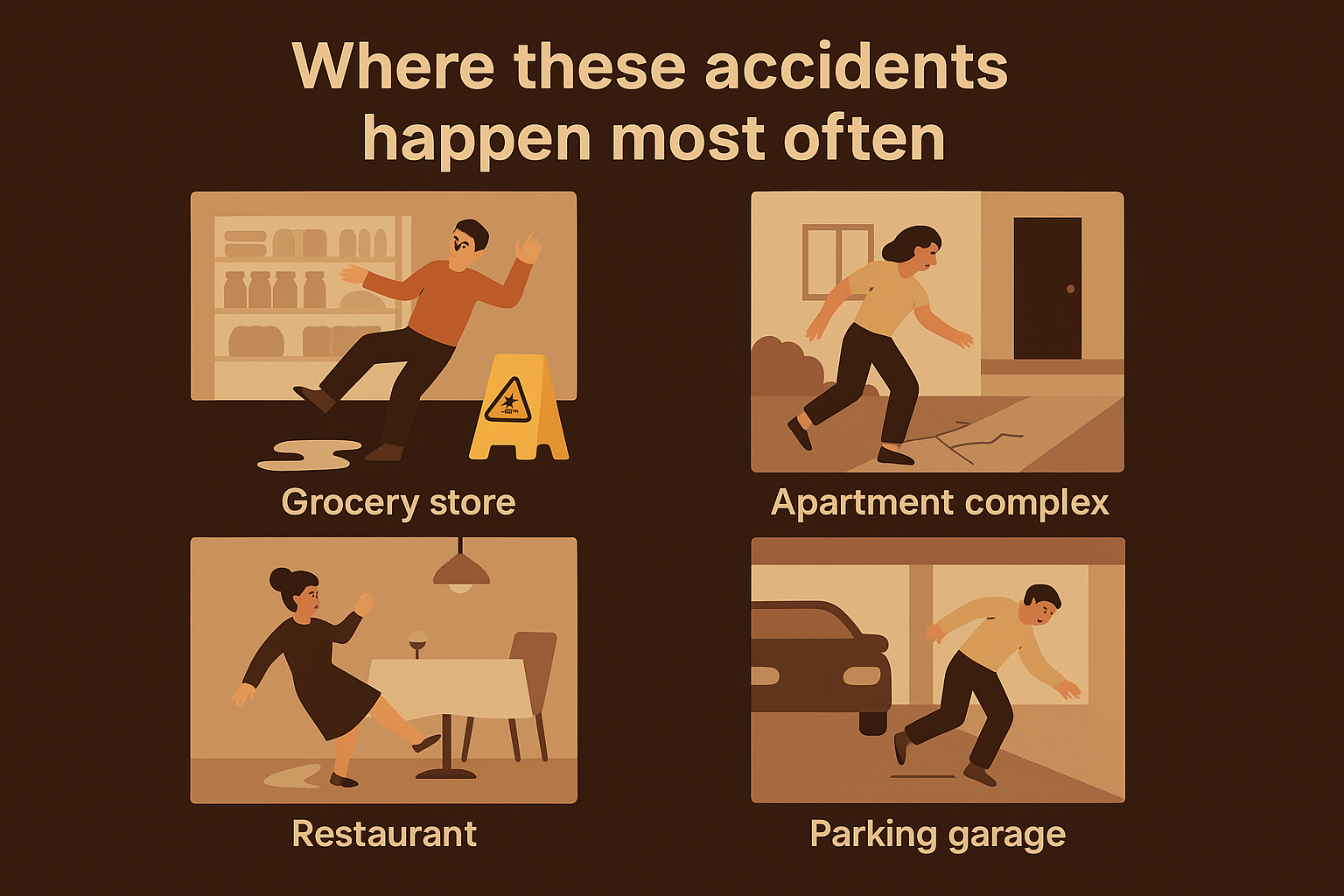
Slip and fall accidents don't happen randomly, they happen in the same handful of places over and over, which is exactly why property owners are expected to catch these hazards before someone gets hurt. Grocery stores, apartment complexes, restaurants, and parking garages account for a huge share of the calls a slip and fall injury lawyer takes, because these are spaces with heavy foot traffic and constant opportunities for spills, debris, or maintenance to fall behind. Recognizing the pattern matters because it's often the first clue pointing to negligence rather than bad luck.
Where these accidents happen most often
Certain hazards show up again and again in claims across Mississippi and Tennessee, and most of them trace back to something a property owner failed to fix, mark, or warn people about:
- Wet or freshly mopped floors without a warning sign
- Uneven sidewalks or parking lots with cracks, potholes, or crumbling asphalt
- Poor lighting in stairwells, hallways, or parking structures
- Loose flooring, torn carpet, or unsecured mats that shift underfoot
- Cluttered walkways blocked by boxes, cords, or merchandise
- Snow and ice left untreated on entrances and steps
Building codes generally require handrails, adequate lighting, and safe walking surfaces, and when an owner ignores those standards, it strengthens the case that they should have known about the risk.
Injuries that range from minor to life-changing
The injuries that follow a fall vary widely depending on age, the surface, and how the person landed. Younger clients sometimes walk away with a sprain, while older clients often face fractures that require surgery and months of rehabilitation.
| Injury type | Typical severity | Common long-term impact |
|---|---|---|
| Sprains and strains | Mild to moderate | Weeks of limited mobility |
| Fractures (hip, wrist, ankle) | Moderate to severe | Surgery, physical therapy, permanent hardware |
| Herniated discs | Moderate to severe | Chronic pain, nerve damage |
| Traumatic brain injury | Severe | Cognitive changes, ongoing care |
| Spinal cord injury | Severe | Partial or full paralysis |
A fall that looks minor at the scene can still turn into a fracture or head injury that shows up days later.
Why the cause matters to your claim
Understanding exactly what caused your fall shapes the entire direction of your case. A wet floor with no warning sign points to a straightforward negligence claim, while a fall caused by a defective floor mat might pull a product manufacturer into the picture alongside the property owner. Every detail about the hazard, from how long it existed to whether it violated a building code, feeds directly into how a premises liability case gets argued and valued.
How to choose the right slip and fall lawyer
Choosing a slip and fall personal injury lawyer matters just as much as deciding to hire one in the first place. Not every attorney who advertises personal injury work actually tries premises liability cases, which is why it pays to know how to find the best slip and fall lawyer near you before negotiations stall and the insurance company refuses to budge. You want someone who has handled cases like yours in front of local judges and adjusters, not someone learning the process on your file.
Hire the lawyer who's ready to go to trial, even if you never end up needing one.
Questions to ask before you hire
A short phone call tells you more than a website ever will. Before signing anything, put these questions to any injury lawyer you're considering:
- How many slip and fall cases have you handled in the past few years, and how many went to trial?
- Who will actually work on my file day to day, you or a paralegal?
- What's your track record with cases involving injuries like mine?
- How do you communicate updates, and how fast can I expect a response?
- Do you front the cost of expert witnesses and investigation?
Straightforward answers to these questions usually signal a firm that's confident in its process. Vague answers or pressure to sign immediately are worth treating as a warning sign.
What local experience actually buys you
Experience in the specific courts and counties where your case will be filed carries real weight. A personal injury attorney in Memphis, TN who regularly practices in Northeast Mississippi or South Memphis already knows which judges expect what, how local insurance adjusters typically respond to demand packages, and which building codes apply to the property where you fell. Local knowledge also speeds up the investigation, since your attorney likely already has relationships with the experts and investigators needed to build your file quickly.
Fee structures and free consultations
Most reputable slip and fall injury lawyers work on contingency, meaning you pay nothing upfront and the fee percentage comes out of your settlement only if you win. That arrangement removes the financial barrier to getting quality representation right after an accident, which matters when you're already dealing with medical bills. A free consultation lets you get a straight answer about whether your case is worth pursuing before you commit to anything.
| What to check | Why it matters |
|---|---|
| Contingency fee percentage | Confirms what you'll actually keep from a settlement |
| Case handling (attorney vs. staff) | Determines who's actually building your case |
| Trial experience | Shows the firm won't fold under pressure to settle low |
| Local court familiarity | Speeds up filing and negotiation timelines |
Mayfield Law Firm offers exactly this kind of free consultation for anyone who fell in Northeast Mississippi or South Memphis, with no fee unless we recover compensation for you.
Moving forward after your accident
A fall that wrecks your knee or your back doesn't have to wreck your finances too. The right slip and fall personal injury lawyer handles the evidence gathering, the deadlines, and the negotiating, so you can focus on getting better instead of fighting an insurance adjuster between doctor visits. Every case is different, but the pattern holds: property owners rarely pay fairly until someone forces them to, and that someone is usually a lawyer who's prepared to take the case to trial.
You don't have to figure out what your claim is worth on your own, and you shouldn't guess at deadlines that could cost you your entire case. Talk to someone who's handled these claims across Northeast Mississippi and South Memphis before you sign anything or accept a check. Contact Mayfield Law Firm in Tupelo, Southaven, or Memphis for a free consultation and find out exactly where you stand.