What Is a Personal Injury Claim? A Complete Explanation
Getting hurt because of someone else's carelessness leaves you with medical bills, lost wages, and a stack of confusing paperwork. Before you sign anything or talk to an insurance adjuster, you need to understand what is a personal injury claim and how it actually works. Most people confuse it with a lawsuit, but the two aren't the same thing, and knowing the difference can save you time, money, and frustration.
A personal injury claim is a formal request for compensation you make against the person or company responsible for your injury, usually filed with an insurance company rather than a court. It covers everything from car accidents and workplace injuries to medical malpractice and wrongful death. If the insurer refuses to offer a fair settlement, the claim can turn into a lawsuit , but many cases resolve long before reaching a courtroom.
In this article, we'll break down how a claim gets started, what types of incidents qualify, what damages you can recover, and how the process moves from initial filing to settlement or trial. If you're in Northeast Mississippi or South Memphis and dealing with an injury right now, this explanation gives you the groundwork to protect your rights.
Why it matters to understand your legal rights
Insurance companies aren't in the business of handing out money. Every adjuster who calls you after an accident has one job: close the file for as little as possible. If you don't understand your legal rights , you'll accept the first number they offer, sign a release, and lose your chance to ask for more later, even if your medical bills keep piling up for months. Knowing what you're entitled to before you talk to anyone from the insurance side puts you in a much stronger position.
The first offer from an insurance company is rarely the last word, but once you sign a release, it usually is.
Deadlines you can't afford to miss
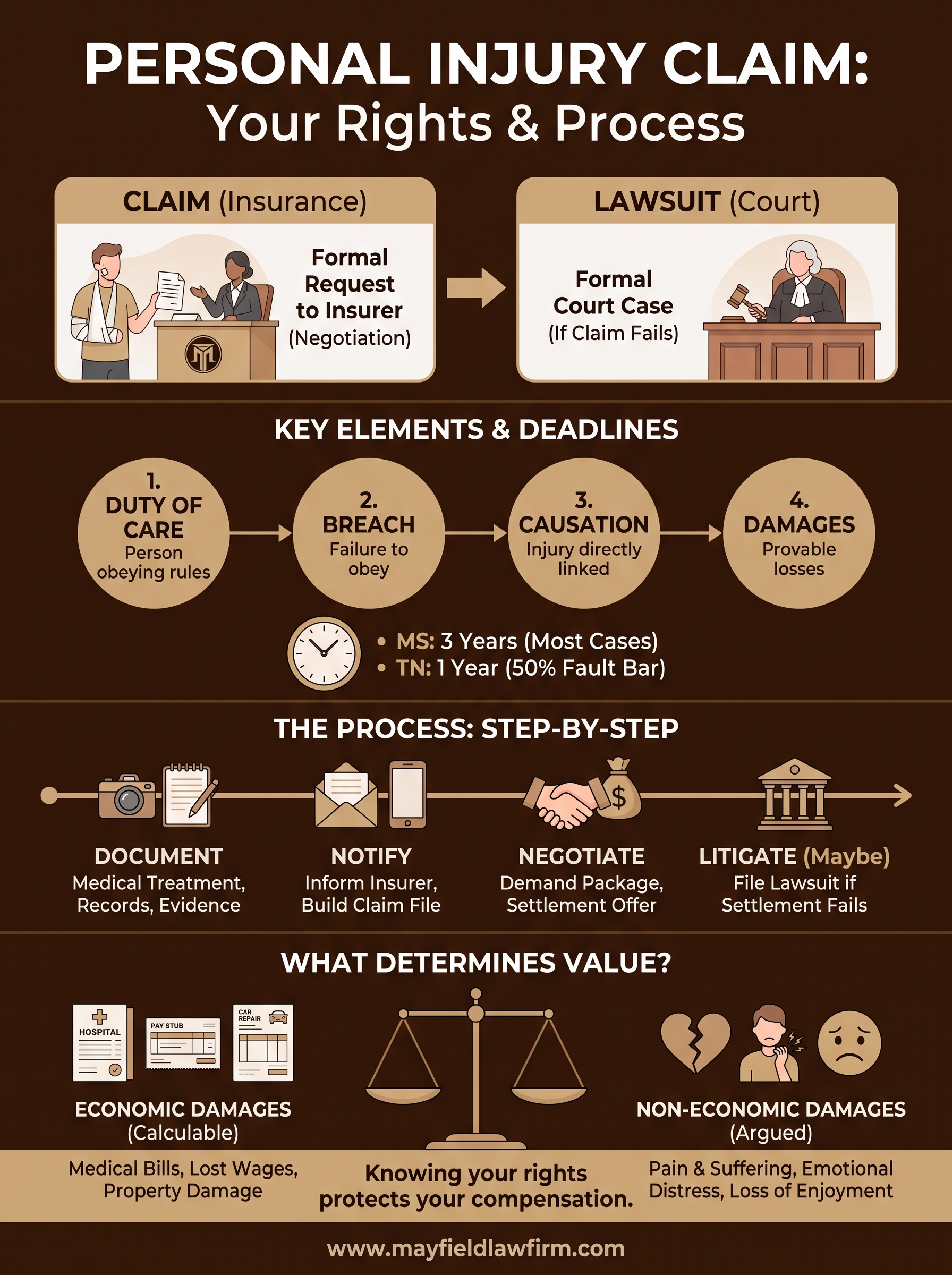
Every state sets a statute of limitations , a legal deadline for filing a personal injury lawsuit. In Mississippi, you generally have three years from the date of injury to file suit, while Tennessee gives you just one year in most personal injury cases. Miss that window and you lose your right to sue, no matter how strong your case is. Waiting to "see how you feel" or hoping the insurance company will do right by you can cost you your entire claim.
- Mississippi: three years for most personal injury claims
- Tennessee: one year for most personal injury claims
- Medical malpractice and wrongful death cases often carry different, shorter deadlines
- Claims involving government entities (city buses, county vehicles) may require notice within 90 to 180 days
What you stand to lose without legal knowledge
Adjusters count on injured people not knowing the full value of their claim. Lost wages, future medical care, pain and suffering, and diminished earning capacity all belong in a fair settlement, yet most claimants only think to ask for their emergency room bill. Recognizing these categories before negotiations start changes the entire conversation, because you're no longer just accepting whatever number lands in your inbox.
How local knowledge changes the outcome
Laws differ from state to state, and that matters more than most people realize when you're filing across a state line. A resident of Southaven who gets hurt in Memphis, or a Memphis worker injured on a job site in Mississippi, faces two different sets of rules depending on where the incident happened and where the case gets filed. Mississippi follows a pure comparative negligence rule, meaning you can recover damages even if you're 99% at fault, though your payout shrinks accordingly. Tennessee uses modified comparative fault, cutting you off from recovery entirely if you're 50% or more responsible. That single distinction can mean the difference between a five-figure settlement and nothing at all.
| Factor | Mississippi | Tennessee |
|---|---|---|
| Statute of limitations | 3 years | 1 year |
| Fault rule | Pure comparative negligence | Modified comparative fault (50% bar) |
| Government claim notice | Varies, often 90 days | Often 60-120 days |
Protecting yourself starts with recognizing that insurance companies and opposing attorneys already know these rules cold. Going into a claim without that same knowledge puts you at a disadvantage from the first phone call. That's why understanding your rights isn't a formality, it's the foundation everything else in your claim gets built on.
How to file a personal injury claim step by step
Filing a personal injury claim isn't complicated once you understand the sequence, but skipping a step can weaken your case before it starts. The process runs from the moment you're hurt through documentation, notification, negotiation, and, if needed, litigation. Each stage builds the record you'll need to prove your damages and hold the responsible party accountable.
Documenting the incident and injuries
Before you do anything else, get medical treatment and start a paper trail. Medical records created close to the date of injury carry far more weight than ones filed weeks later, and gaps in treatment give insurers an excuse to argue your injuries weren't serious.
- Seek treatment immediately, even if injuries seem minor
- Take photos of the scene, vehicle damage, or hazard that caused the injury
- Get names and contact information for witnesses
- Request a copy of the police or incident report
- Keep every receipt tied to medical care, medication, or property damage
Notifying insurance and building your claim
Once you've documented the basics, notify the at-fault party's insurance company and, if applicable, your own carrier. This is where your claim file officially opens. Provide facts, not opinions, and avoid giving a recorded statement until you know what you're entitled to.
A claim only moves forward once every piece of documentation lines up with the story you're telling the insurer.
From there, you or your attorney compiles a demand package: medical records, bills, lost wage statements, and an explanation of how the injury has affected your life. That package sets the opening number for negotiations.
Negotiating a settlement or heading to court
Most claims settle through back-and-forth negotiation between your attorney and the insurance adjuster, without ever reaching a courtroom. If the insurer won't offer a reasonable amount, the next move is filing a lawsuit within your state's statute of limitations, which shifts the case into formal litigation with discovery, depositions, and possibly a trial. Understanding this sequence before you start protects you from rushing into a settlement that doesn't cover your actual losses.
What qualifies as a personal injury case
Not every bad day turns into a valid personal injury case. To qualify, someone else's negligence, recklessness, or intentional act has to be the reason you got hurt, and you need actual damages, medical bills, lost income, or pain and suffering, to back it up. Slipping on your own wet floor at home isn't a case. Slipping on a wet floor at a grocery store that ignored a spill for an hour usually is.
If someone else's carelessness caused your injury and you have the bills to prove it, you likely have a case worth evaluating.
Common types of incidents that qualify
Most claims fall into a handful of recognizable categories, and recognizing which one fits your situation helps you understand what evidence you'll need to gather.
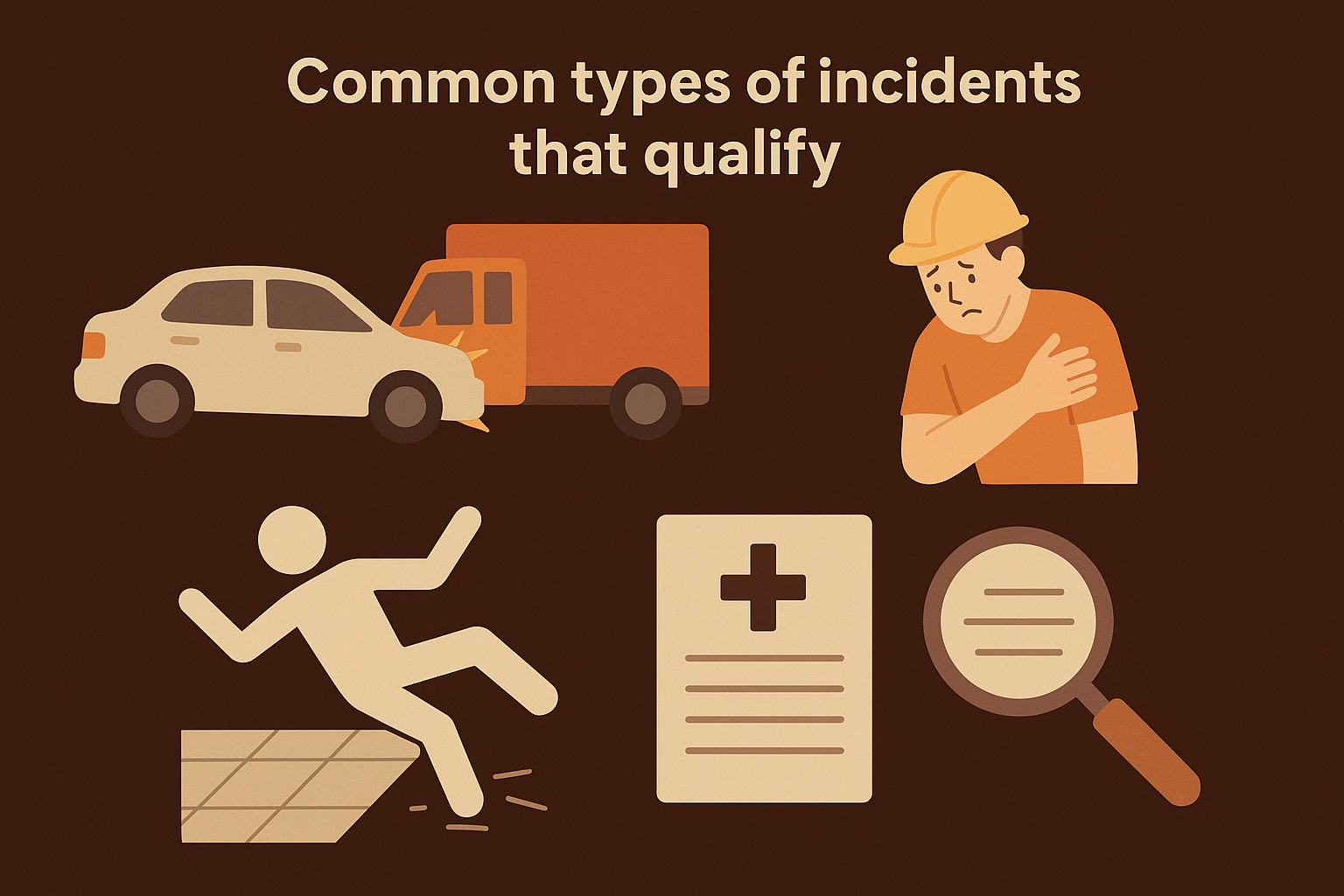
- Car, truck, and motorcycle accidents caused by another driver's negligence
- Workplace injuries outside the scope of workers' compensation, such as third-party equipment failures
- Slip and fall or trip and fall incidents on poorly maintained property
- Medical malpractice, including surgical errors and misdiagnosis
- Wrongful death caused by another party's negligent or reckless conduct
- Mass tort cases involving defective drugs, products, or medical devices
The four elements every case must prove
Beyond the type of incident, every personal injury case has to satisfy four legal elements before an insurer or court takes it seriously. Duty of care means the at-fault party owed you some standard of safety, like a driver obeying traffic laws or a store keeping aisles clear. Breach means they failed that duty. Causation ties that failure directly to your injury, and damages means you actually suffered a measurable loss.
Skipping any one of these elements sinks a claim fast, which is why insurance adjusters look for gaps in causation before anything else. A driver who ran a red light clearly breached a duty, but if your injury happened three weeks later from an unrelated fall, causation falls apart. Building a case means lining up evidence for each element, not just proving that something bad happened to you. That's the standard every claim gets measured against, whether it settles quietly or ends up in front of a jury.
Personal injury claim vs. lawsuit: what's the difference
A lot of clients walk into our office thinking a claim and a lawsuit are the same thing, and that confusion costs people leverage during negotiations. A personal injury claim is an out-of-court request for compensation, handled directly with an insurance company. A lawsuit is a formal court case, filed only after the claim process breaks down or the insurer refuses to pay a fair amount. Every lawsuit starts as a claim, but most claims never become lawsuits.
A claim asks an insurer to pay you fairly; a lawsuit asks a judge or jury to make them.
Where each process actually happens
The claim stage runs through paperwork, phone calls, and demand letters between you (or your attorney) and the insurance adjuster. Nothing gets filed with a court, and there's no judge overseeing deadlines. A lawsuit, on the other hand, puts your case in front of the civil court system, with a complaint filed against the defendant, formal deadlines for responses, and rules of procedure that control every step from that point forward.
| Feature | Personal Injury Claim | Lawsuit |
|---|---|---|
| Where it happens | Insurance company | Civil court |
| Formality | Negotiation, no filing required | Formal complaint filed |
| Timeline | Weeks to months | Often 1-2 years or more |
| Outcome | Settlement agreement | Settlement, verdict, or dismissal |
| Governed by | Insurance policy terms | State civil procedure rules |
Why most cases never reach a courtroom
Lawsuits cost more, take longer, and carry more risk for both sides, so insurers have a real incentive to settle claims before litigation starts. Once a lawsuit gets filed, the case enters discovery, where both sides exchange evidence, take depositions, and sometimes attend mediation before ever seeing a jury. Filing suit doesn't mean you're headed to trial; it usually means you're applying pressure to get a fair settlement offer, and it also stops the statute of limitations clock from running out while negotiations continue.
What determines how much your claim is worth
No two claims settle for the same number, even when the injuries look similar on paper. Insurance adjusters run your case through a formula that weighs medical costs , lost income, and how the injury changed your daily life, then argue down every category they can. Understanding what actually drives value helps you spot a lowball offer before you accept it.
A settlement offer means nothing until you know what your specific damages actually add up to.
Economic damages you can calculate
Economic damages are the easiest to prove because they come with paper trails. Adjusters can't argue with a hospital invoice or a pay stub the way they can argue with pain and suffering.
- Past and future medical bills, including surgery, physical therapy, and medication
- Lost wages from time missed at work
- Reduced earning capacity if the injury affects your ability to work long-term
- Property damage, such as vehicle repair costs
- Out-of-pocket expenses like mileage to appointments or home modifications
Non-economic damages that get argued over
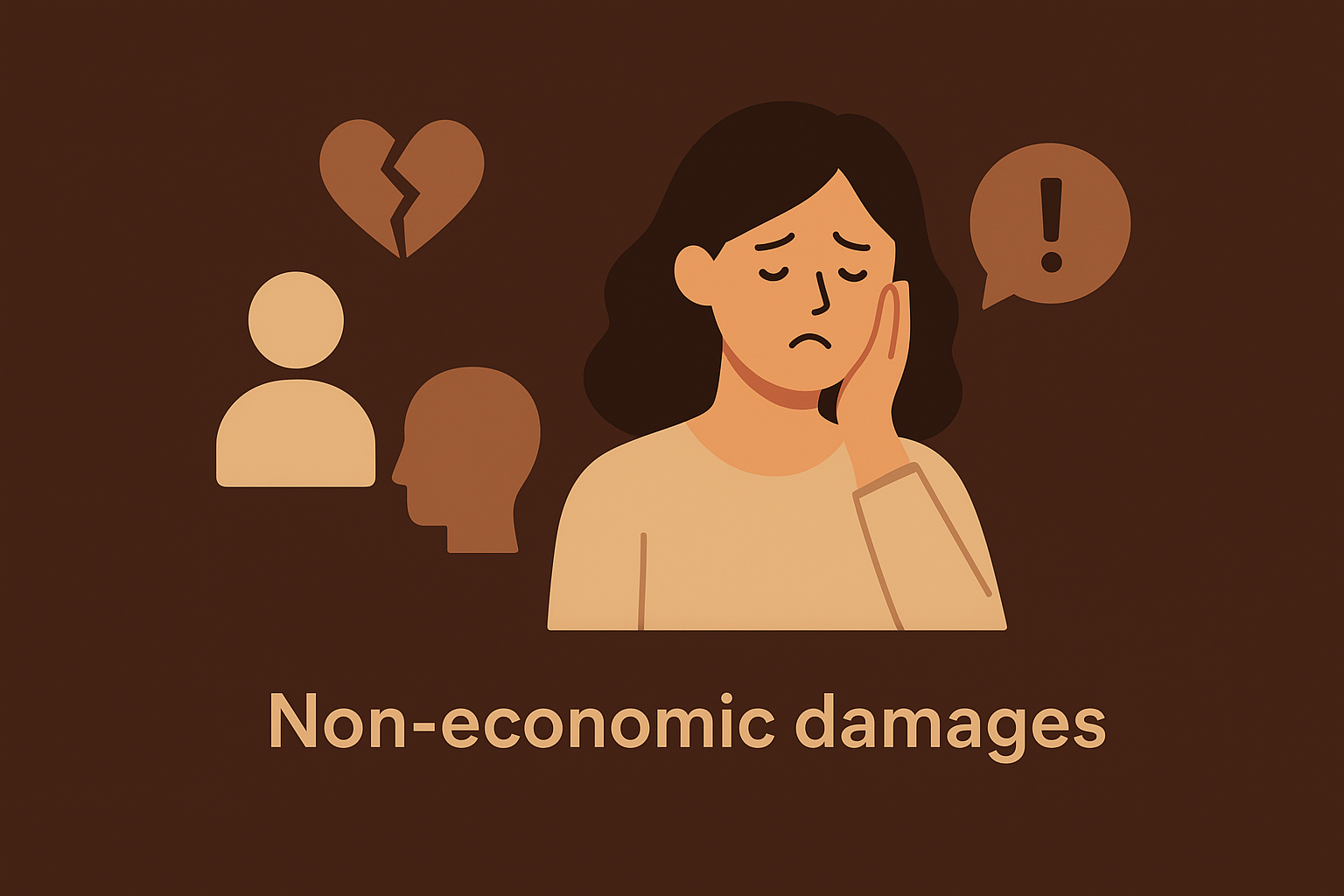
This is where negotiations get contentious, because non-economic damages don't come with a receipt. Pain and suffering, emotional distress, loss of enjoyment of life, and scarring or disfigurement all belong in a fair settlement, but insurers routinely try to minimize or dismiss them entirely. Attorneys often calculate these damages using a multiplier applied to your economic damages, typically between 1.5 and 5 depending on the injury's severity, though catastrophic cases can go higher.
Factors that can shrink or grow your payout
Several variables push your claim's value up or down before you ever see a number. Comparative fault plays a major role, since Mississippi's pure comparative negligence rule and Tennessee's 50% bar directly affect how much you can recover if you share any blame. The at-fault party's insurance policy limits also cap what's available, no matter how strong your case is. Documentation quality matters just as much: a claim backed by consistent medical treatment, clear photos, and witness statements consistently settles higher than one with gaps and guesswork. Finally, the reputation of the attorney handling negotiations affects the offer, because adjusters know which firms actually file suit when talks stall.
Moving forward after your injury
Understanding what a personal injury claim is puts you ahead of most people dealing with an accident for the first time. You now know how the process moves from documentation to demand letter to negotiation, what qualifies as a valid case, and how a claim differs from a lawsuit. That knowledge matters because insurance adjusters count on injured people not knowing their rights, and every gap in your understanding shows up as a lower settlement offer.
You don't have to figure out the rest alone. Deadlines are tight, comparative fault rules punish mistakes, and the value of your claim depends on details most people miss without legal training. Getting an experienced set of eyes on your case before you sign anything from an insurer protects the compensation you're owed. If you're dealing with an injury in Northeast Mississippi or South Memphis, schedule a free consultation with Mayfield Law Firm and find out what your claim is really worth.