
Mississippi Personal Injury Statute Of Limitations Explained
If you've been hurt in an accident in Mississippi, one of the most critical facts you need to know is the mississippi personal injury statute of limitations , the legal deadline for filing your lawsuit. Miss it, and you lose your right to seek compensation , no matter how strong your case is. That's not a technicality. It's the law.
Mississippi generally gives injured people three years from the date of injury to file a personal injury claim. But that timeline isn't always straightforward. Certain circumstances, like the discovery rule, claims involving minors, or lawsuits against government entities, can shorten or extend that window in ways many people don't expect.
At Mayfield Law Firm, P.A., we've spent over 40 years representing accident and injury victims across Northeast Mississippi and the Memphis area . We've seen too many people assume they had more time than they actually did. This article breaks down exactly how Mississippi's statute of limitations works, the exceptions that may apply to your situation, and the steps you should take to protect your claim before time runs out.
What the Mississippi deadline is and when it starts
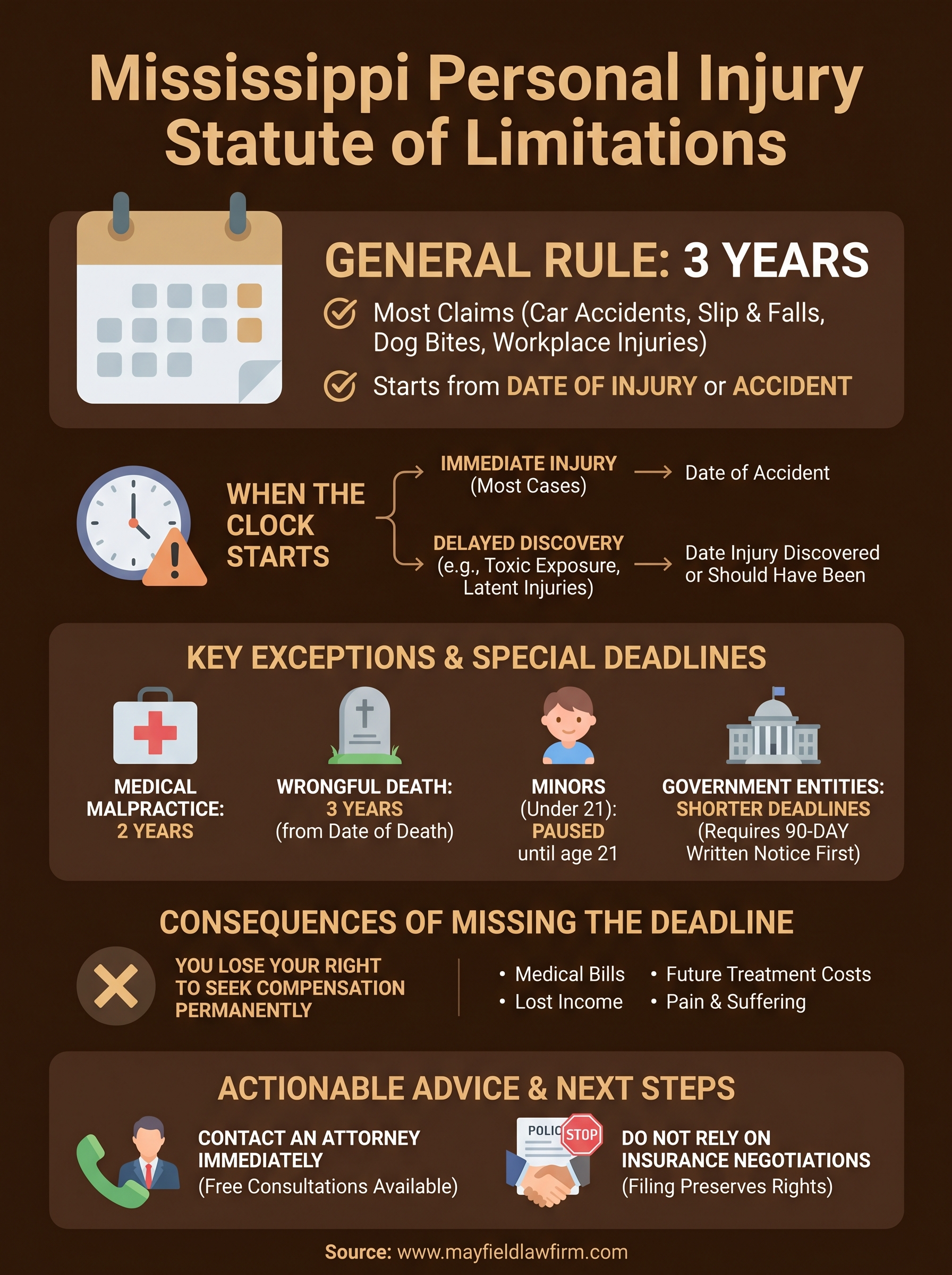
Under Mississippi law, most personal injury claims carry a three-year statute of limitations . That means you have three years from the date your injury occurred to file a lawsuit in civil court. This rule applies to the most common injury claims, including car accidents, slip and falls, dog bites, and workplace injuries. If you do not file within that window, the court will almost certainly dismiss your case, and you give up any legal right to recover damages.
The three-year rule under Mississippi law
Mississippi Code § 15-1-49 establishes the general three-year deadline for personal injury lawsuits. This statute covers a broad range of claims where no other specific deadline applies. Car accident injuries, premises liability cases, and most negligence claims all fall under this three-year window. Understanding the mississippi personal injury statute of limitations starts with knowing this baseline rule, because it governs the vast majority of injury cases.
If a shorter deadline applies to your specific claim, you could lose your right to sue in as little as one year.
Some injury types carry their own specific deadlines that override the general three-year rule. Medical malpractice claims have a two-year filing deadline under Mississippi law. Wrongful death claims also follow a three-year timeline, but that clock runs from the date of death, not the date of the underlying injury. Knowing which rule applies to your situation is not optional; it is the difference between having a case and losing it entirely.
When the clock starts ticking
In most cases, the three-year clock starts on the date of the accident or injury . If you were rear-ended on June 18, 2026, you generally have until June 18, 2029 , to file your lawsuit. That seems straightforward, but the starting date is not always obvious.

Some injuries are not immediately apparent after an accident. For these situations, Mississippi courts apply the discovery rule , which starts the clock on the date you discovered, or reasonably should have discovered, that you were hurt and that someone else's negligence caused it. This rule most often applies in cases involving toxic exposure, medical errors, or latent physical injuries that develop gradually over time, where you simply had no way to know you had a claim right after the harmful event occurred.
Why Mississippi deadlines matter
The statute of limitations is not a suggestion. Courts enforce it strictly , and once your deadline passes, the defendant's attorney will file a motion to dismiss your case. The judge will grant it. It does not matter how serious your injuries are, how clear the other party's fault is, or how much you lost in medical bills and wages. A missed deadline ends your case permanently , with no second chances and no ability to refile.
What you lose when time runs out
When you miss the mississippi personal injury statute of limitations, you lose far more than a court filing opportunity. You lose your legal right to recover compensation for every loss tied to your injury, including medical expenses, future treatment costs, lost income, and pain and suffering. The negligent party walks away without accountability, and you are left absorbing all the financial consequences of someone else's wrongdoing.
Missing the filing deadline is one of the few mistakes in a personal injury case that no lawyer can fix after the fact.
Insurance companies know exactly how these deadlines work. Adjusters track your deadline carefully , sometimes dragging out settlement negotiations until your window closes so they can deny your claim without paying anything. If you are waiting to see if an offer improves, you could unknowingly let the deadline pass while assuming you still have time. Filing your lawsuit preserves your legal rights and keeps real pressure on the other side to negotiate in good faith throughout the entire process.
How to calculate your filing deadline
Knowing the general rule is one thing; knowing exactly when your personal deadline falls is another. To calculate your filing date under the mississippi personal injury statute of limitations, you need two key pieces of information: the date your injury occurred (or was discovered) and the specific limitation period that applies to your type of claim. Once you have both, the math is straightforward, but given what is at stake, verify the result rather than assume.
Identify your start date
Your start date is almost always the date the accident or injury happened . Pull together any documentation that confirms that date, including a police report, emergency room records, or an incident report from the location where you were hurt. If your injury developed gradually or was not immediately apparent, your start date shifts to the date you knew, or reasonably should have known, that someone else's conduct caused your harm.
Common records to gather as early as possible:
- Police or accident reports listing the exact incident date
- Medical records from your first emergency or urgent care visit
- Photographs or videos with timestamps from the scene
Match your claim to the correct deadline
Different claims carry different time limits , so match your specific situation to the right rule before you count forward. Most personal injury and accident claims give you three years from your start date . Medical malpractice claims reduce that window to two years. Claims involving government defendants may require formal written notice within 90 days, which is a step that must happen long before you ever file a lawsuit.
Confirm your exact deadline with an attorney, because one miscalculation can permanently end your right to compensation.
Key exceptions that change the time limit
The three-year rule is a starting point, not a final answer for every case. Several specific circumstances in Mississippi law can either shorten or extend the deadline that applies to your claim. Understanding these exceptions is just as important as knowing the general mississippi personal injury statute of limitations, because the wrong assumption about your deadline can cost you your entire case.
The discovery rule and delayed injuries
Some injuries do not reveal themselves right away. Mississippi courts apply the discovery rule when a victim could not reasonably have known about the injury or its cause at the time it occurred. In these situations, the three-year clock starts from the date you discovered the harm and its connection to someone else's conduct, rather than from the date of the underlying event. This exception most commonly appears in toxic exposure cases, certain medical malpractice situations, and injuries from defective products where the damage develops gradually.
The discovery rule protects injured people, but courts apply it narrowly, so you cannot simply claim you did not know and assume the clock resets automatically.
Minors and claims against government defendants
Mississippi law tolls, or pauses, the statute of limitations for injured minors until they turn 21. A child hurt in an accident does not necessarily lose the right to sue just because a parent failed to file in time, though filing sooner is always the better approach. Government defendants operate under a completely different and much shorter timeline : before you can sue a city, county, or state agency in Mississippi, you must file a formal written notice of claim with the appropriate government body, often within 90 days of your injury. Skipping that notice step eliminates your right to recover, regardless of how much time remains on the general filing clock.

What to do if you are close to the deadline
Running low on time does not mean your case is over, but it does mean every day counts . If your filing window under the mississippi personal injury statute of limitations is days or weeks away, you need to stop waiting and start acting. Delaying even 24 hours at this stage can be the difference between preserving your right to recover and losing it permanently.
Contact an attorney the same day
Call a personal injury attorney today, not next week . An experienced lawyer can quickly assess your claim, identify the correct deadline, and begin preparing your filing immediately. Most firms, including ours, offer free initial consultations , so there is no cost barrier to getting legal guidance right now. When you call, have your accident date, medical records, and any documentation from the incident ready so the attorney can move as fast as possible on your behalf.
The closer you are to the deadline, the less room there is for any delays in gathering documents or filing paperwork correctly.
Do not rely on insurance negotiations
Many people assume that because they are talking with an insurance adjuster, their claim is protected. It is not. An ongoing settlement discussion does not pause your legal filing deadline. Insurance companies have no obligation to resolve your claim before your window closes, and some adjusters count on exactly that outcome . Even if negotiations are moving forward, your attorney should still file your lawsuit before the deadline expires to lock in your legal rights and keep the process moving on your terms.
Your next steps
The mississippi personal injury statute of limitations gives most injured people three years to act, but that window closes faster than most expect. Exceptions, short government notice requirements, and delayed discovery situations all create variations that can catch you off guard if you wait too long to get legal advice. The core lesson from everything covered in this article is simple: time is the one resource in a personal injury case that you cannot recover once it runs out.
Your best move right now is to confirm your exact filing deadline with a qualified attorney before you do anything else. At Mayfield Law Firm, P.A., we offer free consultations, and we have helped injury victims across Northeast Mississippi and the Memphis area protect their rights for over 40 years. Do not wait until the last minute to find out where you stand. Contact our personal injury team today and get the answers you need.