What Is a Mass Tort Lawsuit? Process, Examples & Payouts
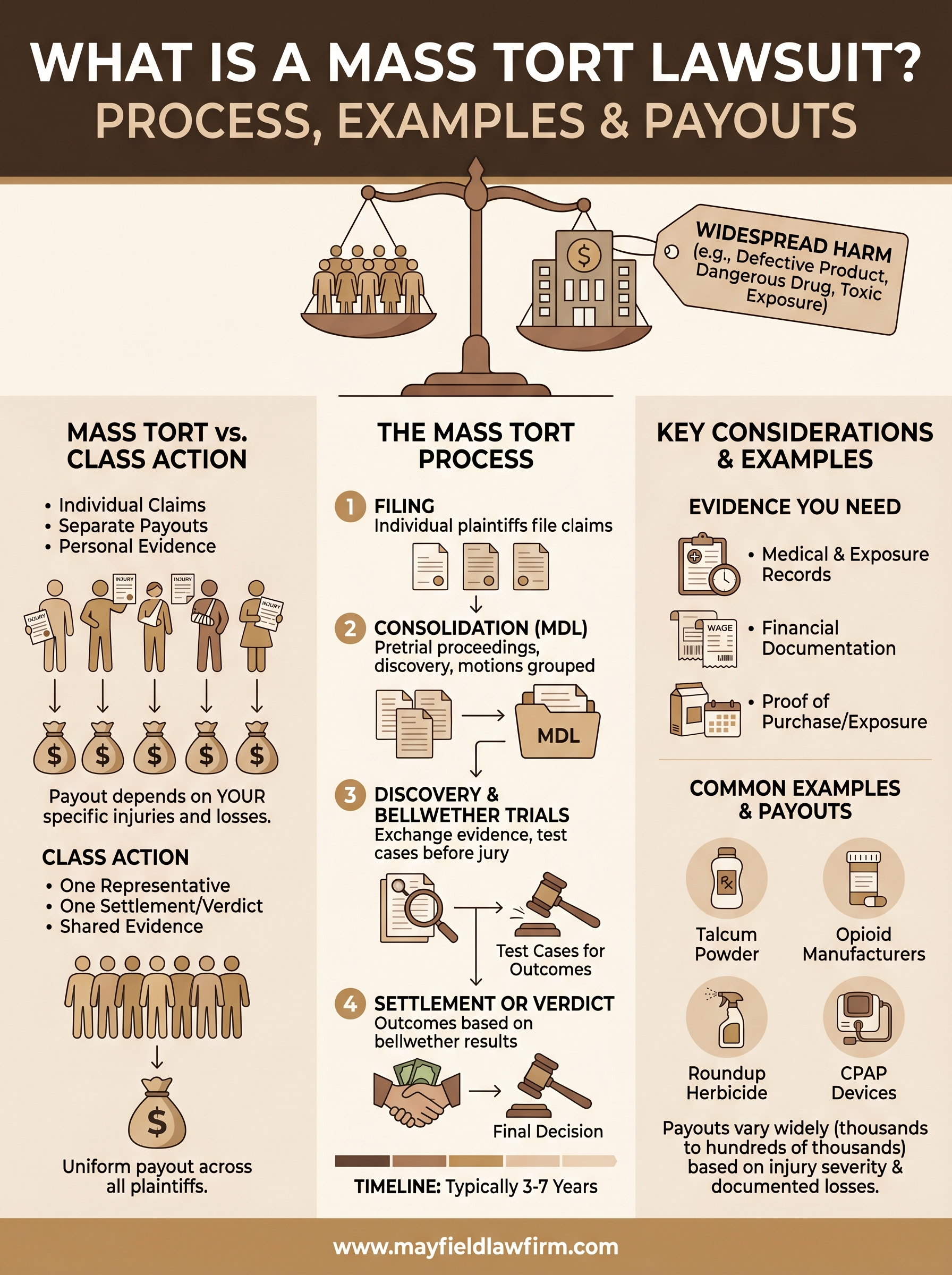
A mass tort lawsuit is a type of civil action where many individual plaintiffs bring claims against one or a few defendants, typically a corporation, for causing widespread harm through a defective product, dangerous drug, or toxic exposure. Unlike a single personal injury case, a mass tort consolidates hundreds or even thousands of claims to move them through the legal system more efficiently while still treating each plaintiff's injuries as unique.
If you've been harmed by a product or substance that also injured many others, understanding how mass torts work is a practical first step. At Mayfield Law Firm, P.A., we represent clients across Northeast Mississippi and South Memphis in personal injury and mass tort litigation , and we've seen firsthand how confusing the process can feel from the outside. This article breaks down how mass tort lawsuits differ from class actions, walks through the legal process from start to finish , and covers real examples and potential payouts so you know what to expect.
Why mass torts matter
When a company puts a defective product or dangerous drug on the market, one injured person filing a lawsuit rarely moves the needle. A single claim may be settled quietly for less than it's worth, and the company faces little pressure to change its behavior. Mass torts shift that balance by bringing collective legal pressure while still protecting your right to an individual recovery based on your specific injuries and losses.
Your claim stays yours
One of the most important things to understand about mass torts is that your case does not get folded into a single group recovery. You and every other plaintiff still have individual claims with separate evidence, different injury levels, and distinct compensation amounts. This matters because your damages, such as medical bills, lost wages, and pain and suffering, may be far greater than another plaintiff's, and a mass tort structure allows that difference to show up in your final settlement or verdict .
In a mass tort, you are not just a number. Your specific injuries, medical history, and financial losses directly affect what you recover.
Why corporations take mass torts seriously
Companies face a very different legal situation when hundreds or thousands of claims move together through the court system. The combined discovery process forces defendants to produce internal documents, communications, and test data they might otherwise manage to limit in a single-plaintiff case. That shared evidence pool often reveals whether a manufacturer knew about risks and failed to warn consumers , which can increase liability significantly. For you as a plaintiff, that means the case you bring carries more weight and more investigative resources behind it than you could access on your own. This is also why understanding what is a mass tort lawsuit before you file puts you in a stronger position from day one.
Mass tort vs class action lawsuits
People often confuse mass torts with class action lawsuits because both involve multiple plaintiffs and a shared defendant. The core difference is how your individual injuries get handled throughout the legal process.
How class actions work differently
In a class action, one representative plaintiff speaks for the entire group, and one settlement or verdict distributes compensation across every class member. Your payout is often the same as everyone else's, regardless of how serious your injuries were. The court treats the harm as uniform across all plaintiffs , which is not always accurate.
| Feature | Class Action | Mass Tort |
|---|---|---|
| Individual claims | No | Yes |
| Separate payouts | No | Yes |
| Personal evidence | Shared | Individual |
Why mass torts give you more control
When you think about what is a mass tort lawsuit versus a class action, the defining factor is personal accountability for your losses . Your attorney builds the case around your specific medical records and documented damages .
Your payout in a mass tort depends on your injuries, not the average outcome across every plaintiff.
That distinction matters if your injuries are more severe than the average plaintiff's. You also retain direct input on settlement decisions , which is rarely the case in a class action where one lead plaintiff negotiates on behalf of the entire group.
How the mass tort process works
Once you understand what is a mass tort lawsuit, the next step is knowing how the legal process actually unfolds. Mass torts typically move through federal or state court and can take several years to resolve, but each phase has a clear purpose.
Filing and consolidation
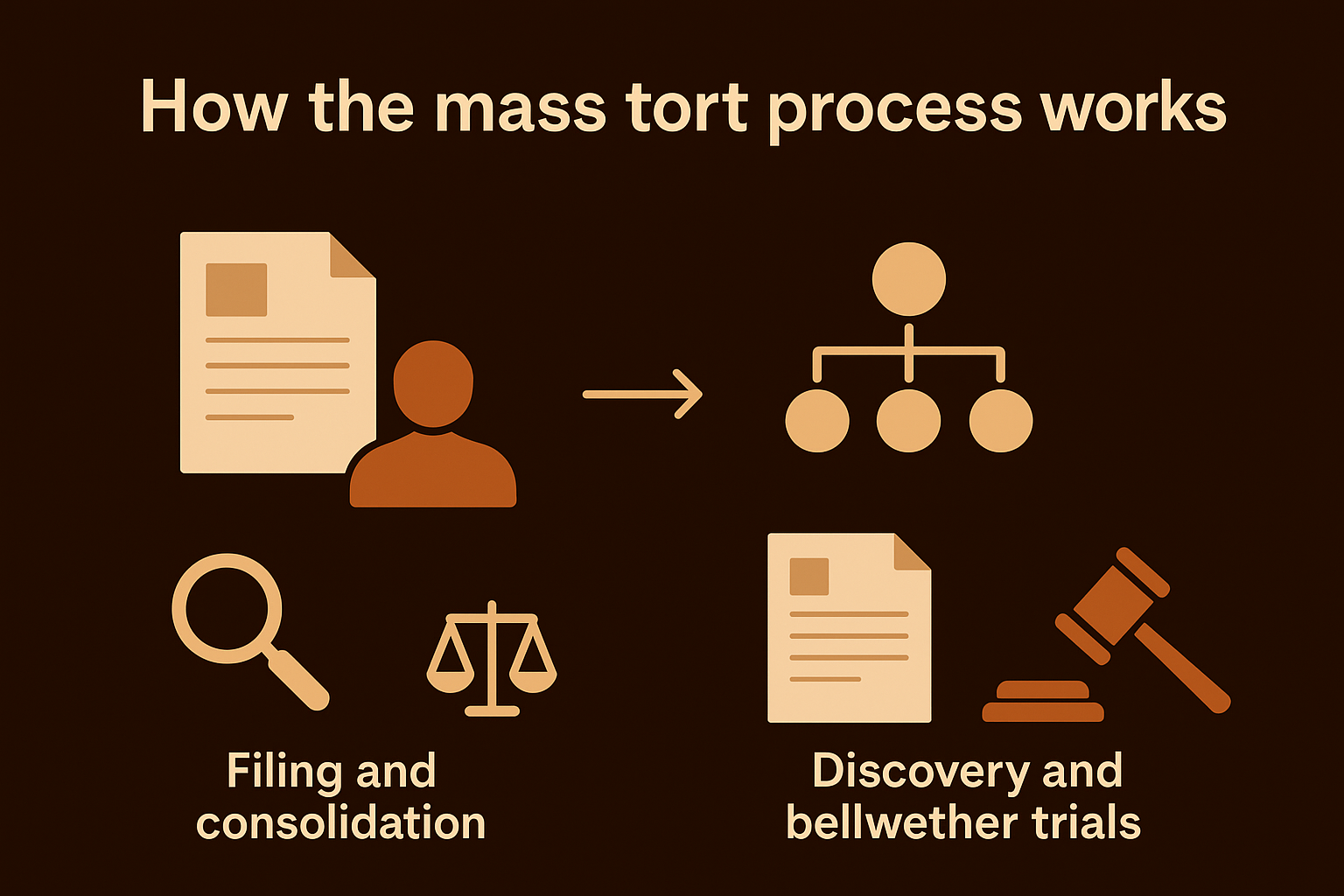
You file your claim as an individual plaintiff , and the court then groups it with similar cases through a process called Multi-District Litigation (MDL) . MDL does not merge your case into one verdict. Instead, it consolidates pretrial proceedings, such as discovery and motions, so that attorneys and courts avoid duplicating the same work thousands of times.
Consolidation speeds up the pretrial phase without stripping away your right to an individual outcome.
Discovery and bellwether trials
During discovery, both sides exchange evidence, documents, and expert testimony . The court then selects a small number of cases, called bellwether trials, to go before a jury first. These early verdicts give both sides a realistic picture of how juries respond to the core evidence. Most mass torts settle after bellwether results come in, because defendants and plaintiffs can gauge likely outcomes without putting every case through a full trial.
Evidence you need for a mass tort claim
When you research what is a mass tort lawsuit, one thing becomes clear: strong individual evidence separates a well-compensated claim from a weak one. Because your payout depends on your specific damages, the documentation you gather early directly shapes what you recover.
Medical and exposure records
Your medical records are the foundation of any mass tort claim. You need documentation connecting your diagnosis or injury to the product or substance at issue, including:
- Treatment history and physician notes establishing both the harm and its source
- Prescriptions or test results linking your condition to the defendant's product
- Dates of exposure that place you within the affected period
The cleaner your paper trail between exposure and injury, the harder it is for the defense to dispute your claim.
Financial documentation
Beyond medical records, you need proof of purchase or exposure showing you used the specific product in question. You should also compile wage loss statements, out-of-pocket expense receipts, and records of ongoing care costs to document the full financial impact on your life. Organizing these materials early with your attorney puts you in a measurably stronger position before discovery begins.
Payouts, timelines, and common mass tort examples
When people ask what is a mass tort lawsuit, they usually want to know two things: how long it takes and how much they might recover . Both answers depend heavily on the strength of your individual claim and the scale of the litigation.
What settlements typically look like
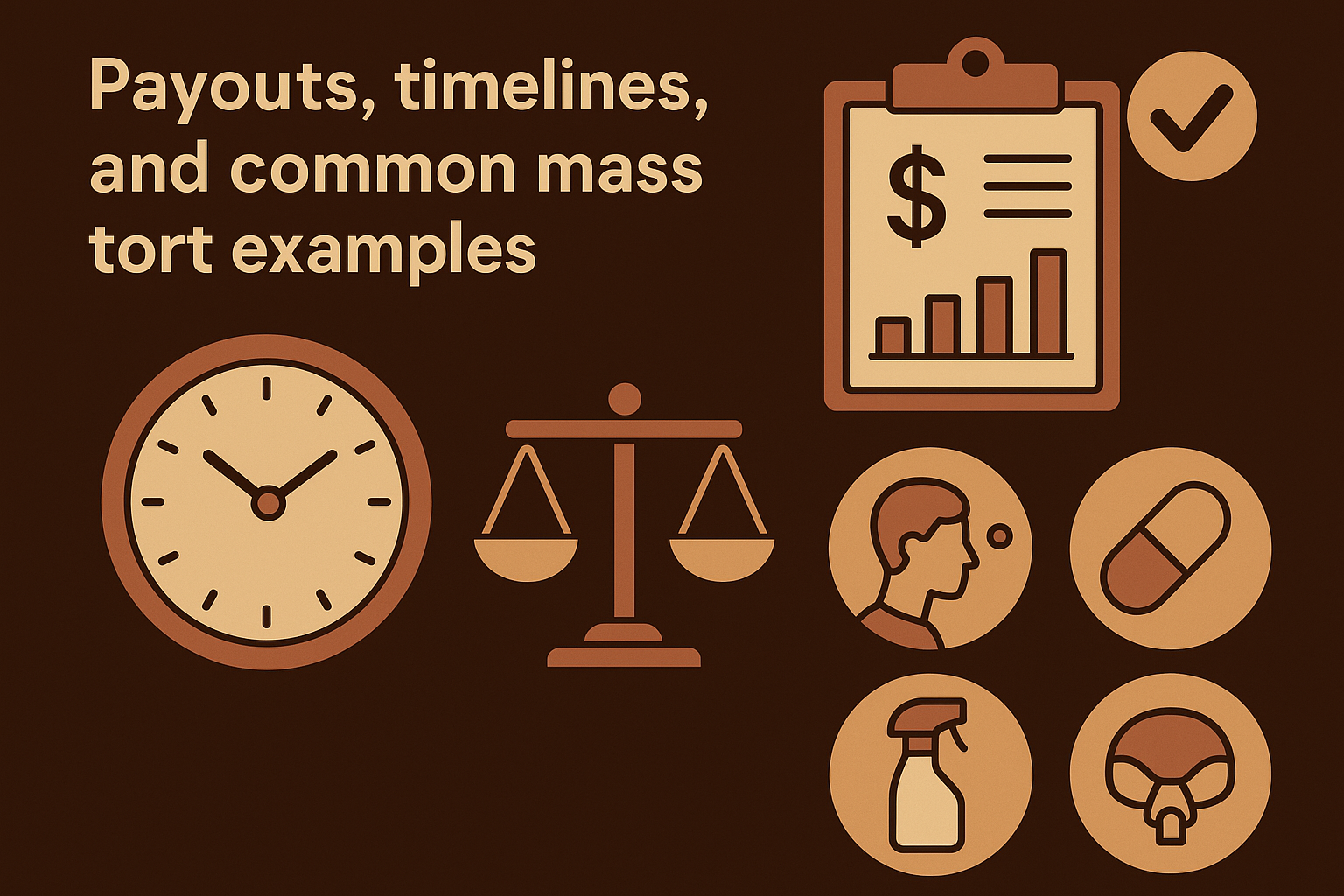
Payouts in mass torts vary widely based on injury severity, documented losses, and the defendant's total liability exposure . Plaintiffs with serious, well-documented injuries receive significantly more than those with minor harm. Settlements can range from thousands to hundreds of thousands of dollars per plaintiff, and verdicts from bellwether trials often set the benchmark.
Your specific medical history and financial losses carry more weight in your payout calculation than the overall settlement pool size.
How long mass torts take
Most mass torts resolve within three to seven years from filing through settlement. Complex litigation involving extensive discovery or multiple bellwether trials runs longer.
Recognizable mass tort cases
Several high-profile cases show how these lawsuits develop across different industries and product types :
- Talcum powder litigation involving ovarian cancer diagnoses
- Opioid manufacturer lawsuits tied to addiction and overdose injuries
- Roundup herbicide claims linked to non-Hodgkin's lymphoma
- CPAP device recalls connected to respiratory injuries
What to do next
Now that you understand what is a mass tort lawsuit, the most important move is acting before statutes of limitations cut off your right to file. These deadlines vary by state and claim type, and missing them means losing your ability to recover anything, regardless of how strong your case is. If you've used a product or been exposed to a substance that has harmed others at scale, treat your situation as time-sensitive from this moment forward .
Start by gathering your medical records, purchase documentation, and any evidence that links your injury to the product or substance in question. Then speak with an attorney who handles mass tort litigation and can evaluate your individual claim on its own merits. At Mayfield Law Firm, P.A., we offer free consultations and represent clients across Northeast Mississippi and South Memphis. Reach out today to find out whether your situation qualifies and what your next step should be.