How Does Bankruptcy Work? Types, Process, and Consequences
If you're staring at collection notices and wondering how does bankruptcy work , you're not alone. Every year, thousands of people in Mississippi and Tennessee reach the same breaking point: more debt than income, creditors calling daily, and no clear way out. Bankruptcy exists precisely for this situation, but most people only understand it through movies or rumors, which usually get the details wrong.
Here's the short answer: bankruptcy is a federal legal process that either wipes out qualifying debts or reorganizes them into a manageable repayment plan , depending on which chapter you file. The court reviews your income, assets, and debts, then applies specific rules to determine what you keep, what you owe, and how long the process takes.
In this article, we'll walk through the two most common types individuals use, Chapter 7 and Chapter 13, explain the step-by-step filing process from petition to discharge, and cover the real consequences, including credit impact and what happens to your car, house, or other property. We handle bankruptcy filings daily at our Southaven and Memphis offices, so we're breaking this down the way we explain it to clients sitting across the desk from us.
Why understanding the bankruptcy process matters
Most people we meet at our Southaven and Memphis offices wait far too long before calling a lawyer. They assume bankruptcy means losing everything, so they avoid it until a wage garnishment notice or a lawsuit summons forces the issue. By then, options that were available six months earlier, like stopping a car repossession or saving a house from foreclosure, may already be gone. Understanding how the bankruptcy process actually works isn't just academic. It determines whether you keep your car, whether creditors can keep calling, and whether you walk away with a clean slate or a repayment plan that fits your budget.
Bankruptcy law comes from federal statute, specifically Title 11 of the U.S. Bankruptcy Code, and it's administered through federal courts , not state courts. That matters because the rules are consistent nationwide, but the exemptions that protect your property (your home, car, tools of trade) often depend on state law, and Mississippi and Tennessee apply different limits. A lawyer who knows how these two systems interact can often protect assets that someone filing on their own would lose. This isn't guesswork or a form you fill out online. Every case gets filed with the U.S. Bankruptcy Court, reviewed by a trustee, and in some cases scrutinized by creditors who have the right to object.
The single biggest mistake in bankruptcy isn't filing too soon, it's filing without understanding what you stand to lose or protect.
What happens when people don't understand the process
We see the same avoidable mistakes repeatedly, and they almost always trace back to someone not understanding how filing for bankruptcy actually works before they started:
- They file Chapter 7 when Chapter 13 would have let them keep a house that's behind on payments.
- They fail to claim a valid property exemption, so the trustee sells an asset that could have been protected.
- They wait until a lawsuit turns into a judgment lien, which is far harder to remove after the fact.
- They try to handle the petition themselves, miss a deadline, and get their case dismissed without a discharge.
- They assume all debts disappear, then get blindsided when student loans or recent tax debt survive the filing.
Each of these mistakes is preventable with the right guidance before the petition ever gets filed.
Timing changes what you're eligible for
When you file matters almost as much as whether you file. The moment a bankruptcy petition hits the court, an automatic stay goes into effect, immediately halting most collection calls, wage garnishments, and even scheduled foreclosure sales. But that protection only kicks in once the case is filed, so every week you wait is a week creditors can keep pursuing you. Income timing matters too. Chapter 7 eligibility depends on a means test that looks at your average income over the prior six months, so a recent job loss or reduced hours can shift you from ineligible to qualified almost overnight.
Finally, understanding the process protects you from creditors who count on your confusion. Debt collectors know that people who don't understand their rights are easier to pressure into payment plans that don't actually solve the underlying problem. Knowing what bankruptcy can do, and what it can't, puts you back in control of the conversation instead of reacting to whoever calls last. The next sections walk through exactly what filing looks like, chapter by chapter, so you know what to expect before you ever sit down with an attorney.
How the bankruptcy filing process works step by step
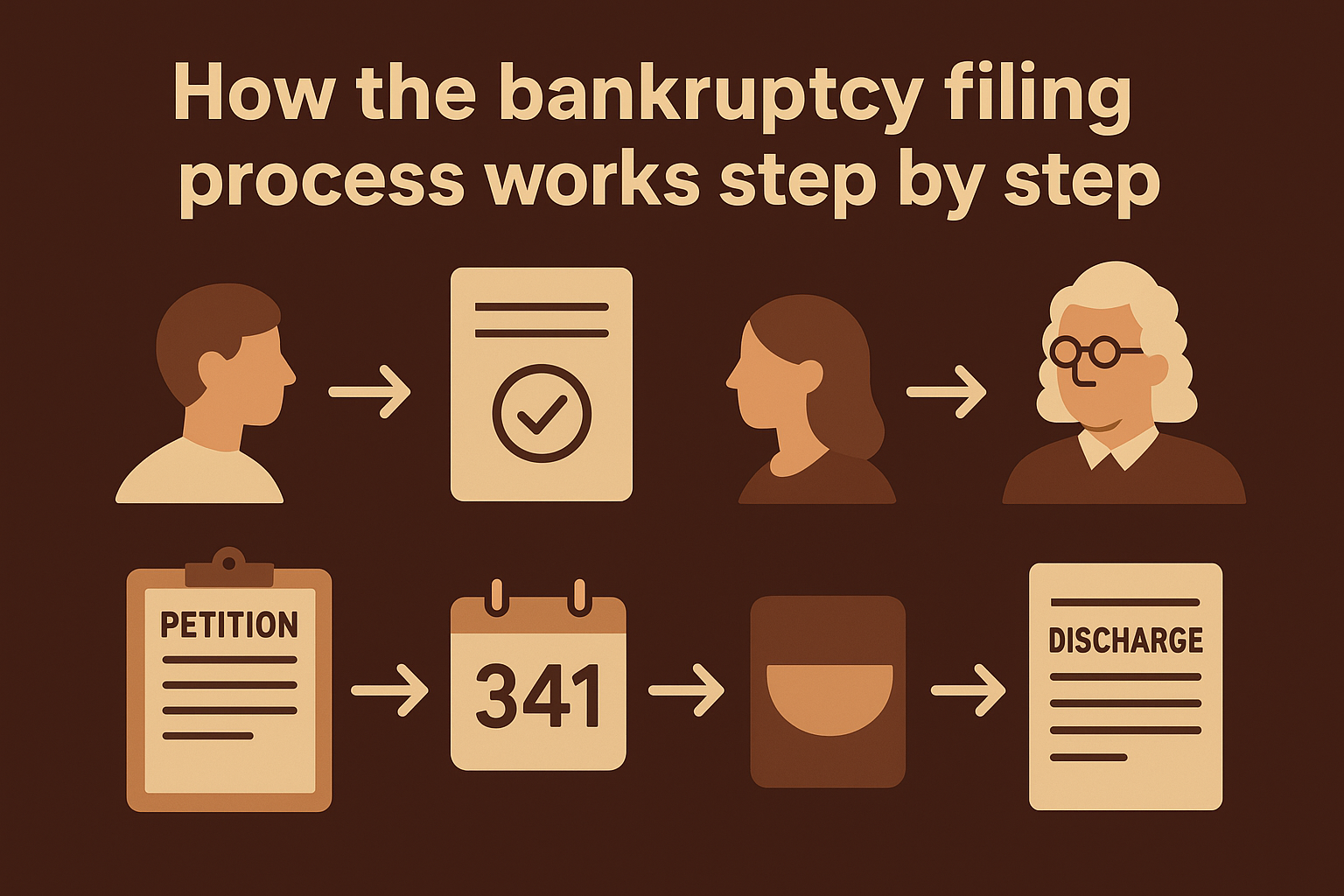
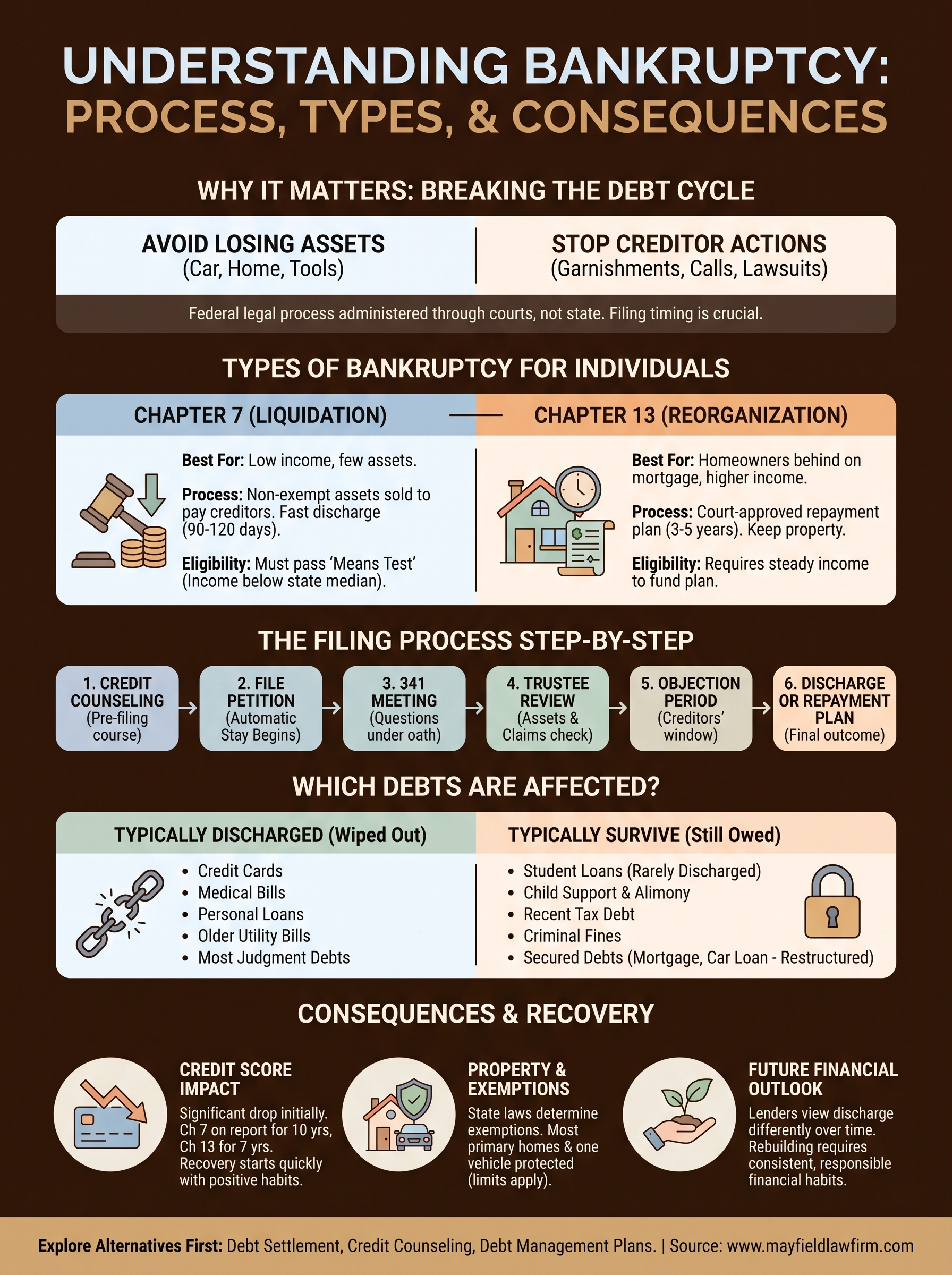
Filing for bankruptcy isn't a single event, it's a sequence of legal steps that typically runs anywhere from four months to five years, depending on the chapter you choose. Knowing the sequence ahead of time removes most of the anxiety, because you stop wondering what happens next and start preparing for it. Below is the path most individual filers follow in Mississippi and Tennessee courts.
The core steps from petition to discharge
- Credit counseling. Federal law requires a certified credit counseling course, usually completed online in under an hour, within 180 days before you file.
- Filing the petition. Your attorney submits the petition along with schedules listing every debt, asset, income source, and expense. This is the moment the automatic stay takes effect.
- 341 meeting of creditors. About 20 to 40 days after filing, you meet with the assigned trustee (not a judge) to answer questions under oath about your finances. Most meetings last under 10 minutes.
- Trustee review. The trustee checks your paperwork against your actual financial records, verifies exemptions, and in Chapter 7 cases, determines whether any non-exempt assets should be liquidated.
- Objection period. Creditors have a limited window to object to specific debts being discharged, usually 60 days after the 341 meeting.
- Discharge or repayment plan. Chapter 7 cases typically end in discharge within 90 to 120 days of filing. Chapter 13 cases involve a court-approved repayment plan lasting three to five years before discharge.
Bankruptcy isn't one big court battle, it's a paperwork-driven process with a handful of scheduled checkpoints most people clear in minutes, not hours.
What the court actually looks at
The trustee and court focus on three things: whether your paperwork accurately reflects your financial reality, whether you qualify for the chapter you filed under, and whether any assets fall outside your state's exemption limits. Debt relief through bankruptcy only works when the schedules are complete and honest. Leaving off a creditor, undervaluing an asset, or forgetting a bank account isn't a minor oversight, it can get your case dismissed or, in rare cases, flagged for fraud.
Where documentation makes or breaks a case
Most delays happen because someone shows up to their initial consultation without pay stubs, tax returns, or a full list of debts. Gathering these documents before you ever file speeds up everything downstream. We ask clients at both our Southaven and Memphis offices to bring six months of pay stubs, two years of tax returns, and a full list of creditors to the first meeting, because that single step often cuts weeks off the timeline.
Chapter 7 vs Chapter 13: choosing the right path
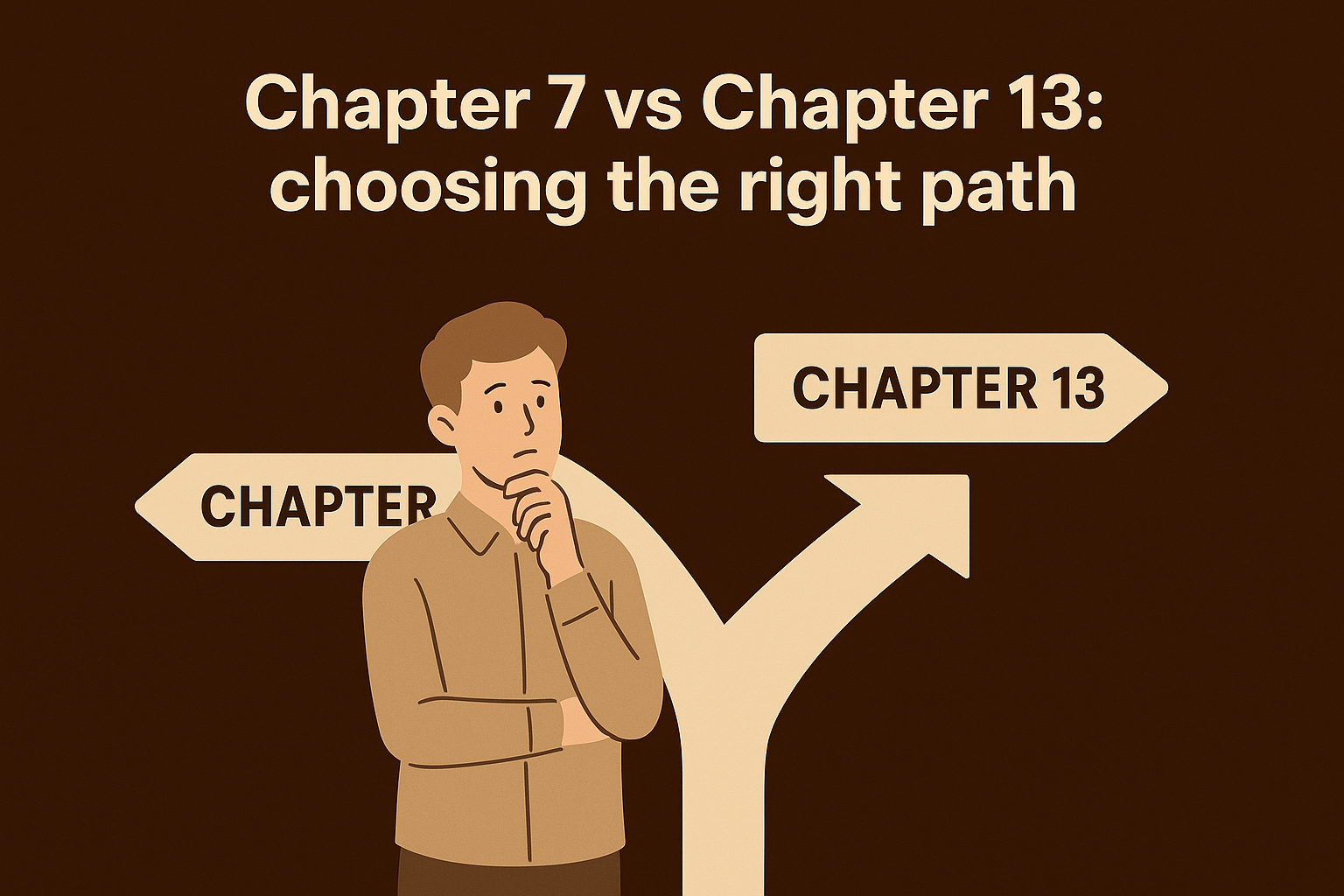
Once you decide bankruptcy is the right move, the next question is which chapter fits your situation. Chapter 7 bankruptcy liquidates non-exempt assets to pay creditors, then discharges most remaining debt within a few months. Chapter 13 bankruptcy instead reorganizes your debt into a court-approved repayment plan that stretches three to five years, letting you keep property you'd otherwise risk losing. Neither chapter is universally better. The right choice depends on your income, your assets, and what you're trying to protect.
| Feature | Chapter 7 | Chapter 13 |
|---|---|---|
| Typical timeline | 90 to 120 days | 3 to 5 years |
| Eligibility | Must pass the means test | Requires steady income |
| Property | Non-exempt assets may be sold | Keep property, pay through plan |
| Best for | Low income, few assets | Behind on mortgage or car loan |
| Debt outcome | Qualifying debts discharged | Discharge after plan completion |
Chapter 7 clears debt fast but can cost you property; Chapter 13 protects property but takes years to finish.
Chapter 7: liquidation and a fast discharge
Chapter 7 works best for people with limited income and few assets worth protecting. The trustee sells anything that isn't covered by a state exemption, then distributes proceeds to creditors before the court discharges what's left. Most filers in Mississippi and Tennessee keep their car and home because state exemptions cover typical equity amounts, but higher-value property or a second vehicle can be at risk. If you're renting, have modest savings, and no real estate equity to worry about, Chapter 7 eligibility often makes this the faster, cheaper path.
Chapter 13: reorganization for people with steady income
Chapter 13 suits homeowners behind on a mortgage, people facing car repossession, or anyone earning too much to pass the Chapter 7 means test. Instead of losing property, you propose a repayment plan that catches up missed payments over time while your regular income covers ongoing bills. The court and trustee review the plan for fairness, and once you complete every payment, remaining eligible debt gets discharged just like Chapter 7.
Which chapter fits your situation
Think through these questions before assuming either chapter is off the table:
- Are you behind on a house or car payment you want to keep?
- Does your income exceed your state's median for your household size?
- Do you own property worth more than your state's exemption limits?
- Can you commit to a fixed payment for three to five years?
An honest answer to each usually points toward one chapter over the other, and an attorney can confirm it with actual numbers from your case.
Which debts bankruptcy can and cannot erase
Bankruptcy doesn't erase every debt on your list, and knowing the difference before you file saves you from a nasty surprise at discharge. The court sorts your debts into two buckets: dischargeable, meaning the judge wipes them out completely, and non-dischargeable, meaning you still owe them after the case closes. Understanding which debts qualify shapes whether bankruptcy actually solves your problem or just clears out the easy stuff while leaving the hardest bills standing.
Debts bankruptcy typically wipes out
Most unsecured consumer debt falls squarely into the dischargeable category, which is why bankruptcy works so well for people drowning in credit cards and medical bills. Common examples include:
- Credit card balances
- Medical bills and hospital debt
- Personal loans from banks or online lenders
- Older utility bills
- Most judgment debts from lawsuits over unpaid bills
- Certain older tax debts that meet specific age and filing requirements
These debts have no collateral attached, so the creditor's only recourse was ever a lawsuit, and bankruptcy cuts that option off entirely once the discharge is entered.
Debts that survive bankruptcy
Other obligations follow you out of court no matter which chapter you file. Student loan debt almost never gets discharged unless you prove undue hardship through a separate, difficult legal process. Child support, alimony, most recent tax debt, and criminal fines also survive, and secured debts like a mortgage or car loan stick around too, though bankruptcy can restructure how you pay them.
Bankruptcy clears the debt that was crushing you, not necessarily every debt you owe.
| Debt Type | Discharged? |
|---|---|
| Credit cards | Usually yes |
| Medical bills | Usually yes |
| Student loans | Rarely |
| Child support/alimony | No |
| Recent tax debt | Rarely |
| Mortgage/car loan | Restructured, not erased |
Gray areas worth flagging early
Several debts sit in a middle zone that trips up filers who assume the rules are simple. Older tax debt can discharge if it meets a strict timing test, generally three years since it was due and two years since you filed the return, but recent tax debt almost never qualifies. Purchases made on credit shortly before filing, especially luxury items or cash advances, can get flagged as fraudulent and excluded from discharge. Zeroing in on these gray areas with an attorney before you file, rather than after a creditor objects, is exactly how you avoid a discharge that leaves your biggest debts untouched.
How bankruptcy affects your credit, assets, and future
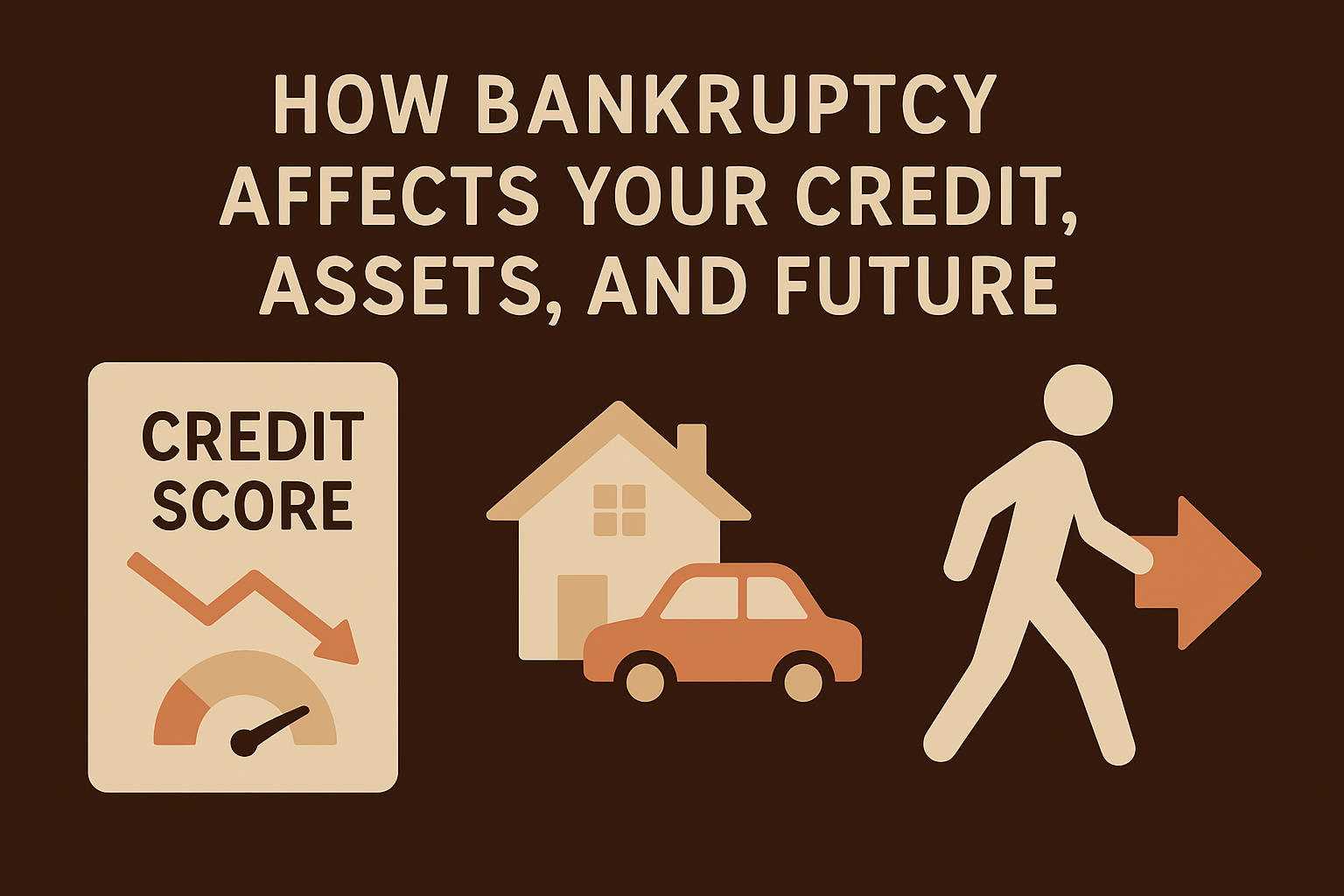
Filing for bankruptcy changes three things at once: your credit report, what happens to your property, and how lenders view you for years afterward. None of these effects are as permanent as most people fear, but pretending they don't exist sets you up for a rough surprise. Knowing what actually happens to your credit score and your assets lets you plan the recovery instead of just surviving the filing.
What happens to your credit score
Expect your score to drop when the bankruptcy first appears on your report, but the size of that drop depends on where your score started. Someone with a 750 score watching payments already spiral into collections often loses less than they'd lose by continuing to miss payments for another year. A Chapter 7 stays on your credit report for up to 10 years, while Chapter 13 drops off after seven, according to the Consumer Financial Protection Bureau. What surprises most clients is how fast recovery starts. Secured credit cards and small installment loans, used responsibly, can rebuild a workable score within 18 to 24 months.
Bankruptcy stays on your report for years, but it stops being the reason lenders say no long before it falls off.
What happens to your property
Most filers keep their house and car because state exemption laws in Mississippi and Tennessee cover typical equity amounts for a primary residence and one vehicle. Trustees only sell property that exceeds those limits, and even then, only in Chapter 7 cases where liquidation applies. A quick reference:
| Asset | Typical outcome |
|---|---|
| Primary home with modest equity | Protected by homestead exemption |
| One vehicle under exemption limit | Protected |
| Retirement accounts (401k, IRA) | Protected under federal law |
| Second home or investment property | Often sold to pay creditors |
| Luxury items, extra vehicles | Often sold to pay creditors |
What your financial future looks like after discharge
Lenders don't treat every bankruptcy the same way once time passes. Mortgage lenders often require a two-year waiting period after Chapter 7 discharge for conventional loans, sometimes less for FHA loans, while auto lenders may approve you within months at a higher interest rate. Rebuilding your financial future comes down to consistent habits afterward: on-time payments, low credit utilization, and avoiding new debt you can't cover. Discharge closes the chapter on old obligations, but the fresh start only works if you use it deliberately rather than repeating the same borrowing patterns that led here.
Alternatives to explore before filing for bankruptcy
Bankruptcy isn't the only way out of overwhelming debt, and a good attorney will tell you when a lighter-touch option makes more sense. Debt relief options outside of court can work well if your income covers your bills but the debt load itself is the problem, not a lack of cash flow. Before you file a petition, it's worth ruling out these paths, because some of them solve the problem without touching your credit report the way a bankruptcy filing does.
Negotiating directly with creditors
Creditors often prefer a partial payoff to a bankruptcy discharge that pays them nothing, which gives you real leverage. Debt settlement involves negotiating a lump-sum payment for less than you owe, usually 40 to 60 cents on the dollar, in exchange for the creditor closing the account. This works best on unsecured debt like credit cards, and it avoids the years-long process a Chapter 13 plan requires. The tradeoff is that settled debt can generate a 1099 for forgiven amounts over $600, and your credit still takes a hit while accounts sit unpaid during negotiations.
Credit counseling and debt management plans
A nonprofit credit counseling agency can set up a debt management plan that consolidates your unsecured debt into one monthly payment, often at a reduced interest rate negotiated with creditors. These plans typically run three to five years, similar to Chapter 13, but without a bankruptcy filing on your record. The Federal Trade Commission recommends verifying that any agency you use is a legitimate nonprofit before signing up, since fee-based scams target people already struggling.
If your income can cover a reduced payment plan, that plan almost always beats bankruptcy for protecting your credit long term.
Other options worth considering
A few other routes fit specific situations:
- Debt consolidation loans roll multiple balances into one lower-interest payment, if your credit still qualifies.
- Selling non-essential assets can generate enough cash to settle smaller debts without formal negotiation.
- Family loans or hardship programs through your mortgage servicer or medical provider sometimes buy enough time to avoid filing.
When alternatives stop making sense
These options fall apart once a lawsuit turns into a judgment, wages are already being garnished, or your total debt exceeds what any repayment plan could realistically cover. At that point, an attorney can tell you plainly whether more negotiation just delays the inevitable or whether bankruptcy is genuinely the faster, cheaper path to a fresh start.
Finding the right path forward for your finances
Bankruptcy works by giving you a legal reset, not a shortcut. Whether you qualify for a fast Chapter 7 discharge or need Chapter 13's structured repayment plan, the process follows the same core path: file, disclose everything honestly, and let the court sort out what's dischargeable. Understanding the bankruptcy process before you file protects the assets you can't afford to lose and keeps creditors from pressuring you into a worse deal than the law actually requires.
No two financial situations look identical, and the difference between chapters, exemptions, and alternatives often comes down to details a form can't capture. That's where a real conversation with someone who's handled hundreds of these cases matters more than another article or forum post. If collection calls, a wage garnishment, or a looming lawsuit have you weighing your options, talk to our team at Mayfield Law Firm for a free consultation before you decide anything.