
Motorcycle Accident Attorney: What They Do and When to Hire One
You laid the bike down or got hit by a driver who never saw you, and now you're staring at hospital bills, a wrecked motorcycle, and an insurance adjuster who keeps lowballing your claim. A motorcycle accident attorney lawyer handles exactly this kind of mess, and knowing what one actually does can save you from settling for far less than your case is worth.
At its core, this type of attorney investigates your crash, deals with insurance companies on your behalf, and builds a case for the medical costs, lost wages, and pain you've endured. Motorcycle claims get treated differently than car accidents because of the bias many adjusters and juries hold against riders, so you need someone who knows how to counter that from day one.
This article breaks down what a motorcycle accident lawyer actually does day to day, the specific situations where hiring one makes financial sense, and how to tell when your case has moved past what you can handle alone. We'll also cover the free consultation process, so you walk in knowing what to ask and what to expect before you sign anything.
Why hiring a motorcycle accident attorney matters
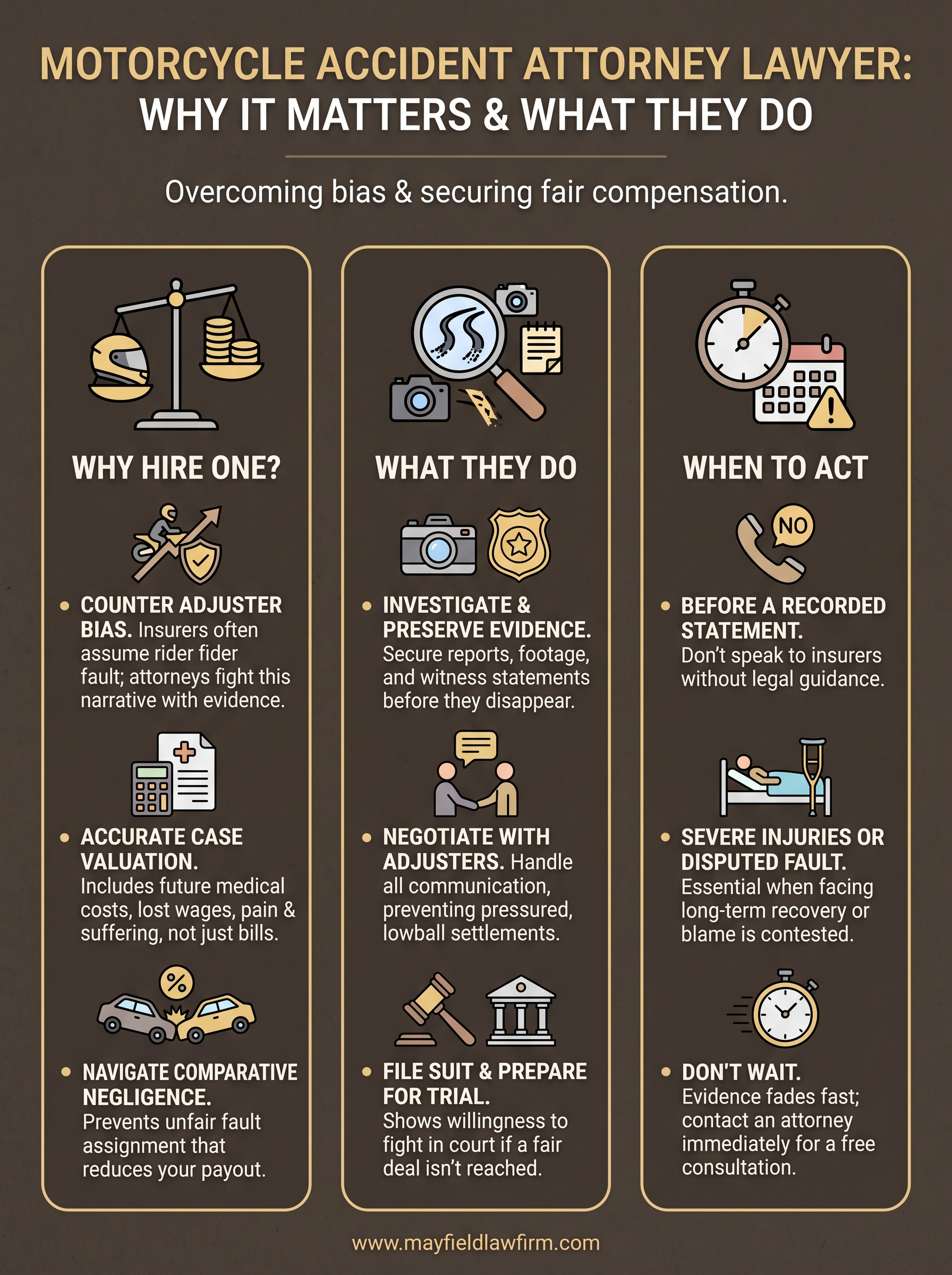
Riders face a steeper uphill fight than drivers do when a claim lands on an adjuster's desk. Insurance companies train their adjusters to assume motorcyclists caused their own crashes, and that bias shows up in every lowball offer they send. Studies on jury attitudes toward motorcyclists back this up, and you can read more about how bias affects injury claims through resources like the National Highway Traffic Safety Administration. Without someone pushing back on that narrative, you're negotiating against a company whose entire strategy depends on you not knowing your rights.
You don't know what your case is actually worth
Most people guess at their settlement value based on medical bills alone, but that number ignores lost future wages, reduced earning capacity, and the pain that doesn't show up on an X-ray. A motorcycle accident lawyer calculates all of it, then documents each figure with medical records, wage statements, and expert opinions so the number holds up under scrutiny. Insurers count on claimants settling fast and cheap before they realize what they left on the table.
An attorney's job is to make sure the settlement reflects what you actually lost, not just what the insurance company hopes you'll accept.
Comparative negligence laws can gut your settlement
Texas follows a modified comparative negligence rule, meaning your compensation drops by whatever percentage of fault gets assigned to you. If an adjuster pins even 30% of the blame on you for lane-splitting or speeding, your payout shrinks by that same 30%, and if they push your share past 50%, you get nothing. Fighting that fault assignment requires evidence: crash reconstruction, witness statements, and sometimes expert testimony. A motorcycle injury attorney knows how to gather that proof before the insurance company locks in a fault percentage that isn't fair.
The math usually favors hiring a lawyer
Skeptics ask why they should give up a third of their settlement in attorney fees. Fair question, and the answer comes down to net results, not percentages. Studies from the Insurance Research Council have shown that represented claimants walk away with significantly more money even after fees, because attorneys catch damages that unrepresented claimants miss entirely and resist settling for the first offer.
| Without an attorney | With an attorney |
|---|---|
| Quick settlement, often below actual costs | Full valuation including future medical and lost wages |
| No pushback on fault percentage | Evidence gathered to fight unfair blame |
| Limited negotiating leverage | Willingness to file suit if needed |
| Paperwork errors that delay or void claims | Deadlines and filings handled correctly |
Everything above assumes the insurance company plays fair, and they rarely do when there's no lawyer on the other side of the table. Hiring representation early, ideally before you give a recorded statement, keeps you from making mistakes that a claims adjuster will use against you later.
How to choose the right motorcycle accident attorney
Picking the wrong lawyer costs you more than a bad settlement, it costs you months of frustration while your case sits untouched. A motorcycle accident attorney lawyer should specialize in this niche, not treat your case as a side project between slip-and-fall claims. The right fit combines specific experience, a track record you can verify, and a communication style that matches what you need.
Look for motorcycle-specific experience
General personal injury firms handle car wrecks all day, but motorcycle cases require knowledge of bike dynamics, road debris hazards, and the bias jurors bring into a courtroom. Ask any candidate how many motorcycle cases they've closed in the past year and what the outcomes looked like. A firm that can't answer specifically probably hasn't handled enough of these cases to know the difference between a car crash and a bike crash in front of a jury.
Choose an attorney who treats your motorcycle case as a specialty, not an afterthought.
Ask about fees, trial experience, and communication
Most firms work on contingency, meaning you pay nothing unless they win, but the percentage and what counts as "costs" varies. Confirm these details before signing anything:
- What percentage do they take, and does it change if the case goes to trial?
- Have they actually tried a motorcycle case in front of a jury, or do they settle everything?
- Who will handle your case day to day, the attorney or a paralegal?
- How fast do they typically respond to client calls and emails?
Without clear answers here, you're gambling on a relationship that could last a year or longer.
Check reviews and local court familiarity
Read client reviews on Google and legal directories, but weigh them against how the firm handles cases in your specific courts. A motorcycle injury lawyer who knows the local judges and opposing insurance defense attorneys in your county has an edge that out-of-town firms simply don't. Verify their standing through your state bar association's attorney lookup tool before you commit to anything.
What a motorcycle accident attorney does for your case
A motorcycle accident lawyer handles the parts of your claim that take specialized knowledge and time you don't have while recovering from injuries. From the day you sign a retainer, the work shifts from you fighting the insurance company alone to a team building a case designed to hold up in negotiations or, if needed, in front of a jury. Understanding the specific tasks involved helps you set expectations for what your attorney should actually be doing on your behalf.
Investigating the crash and preserving evidence
Every strong claim starts with evidence collected before it disappears. Skid marks fade, surveillance footage gets overwritten, and witnesses forget details within weeks. A motorcycle accident attorney moves fast to secure police reports, pull traffic camera footage, photograph the scene and the bike's damage, and interview witnesses while their memory is still sharp. Some cases require an accident reconstruction expert to establish exactly how the crash happened, especially when fault is disputed.
Negotiating with insurance adjusters
Communication with the insurance company runs through your attorney once you're represented, which stops adjusters from pressuring you into a quick, low settlement. Firms typically handle:
- All recorded statements and written correspondence with the adjuster
- Demand letters that lay out medical costs, lost wages, and pain and suffering with supporting documentation
- Counteroffers when the initial settlement falls short of actual damages
- Deadlines tied to Texas's statute of limitations, so your claim doesn't expire
A lawyer's real value shows up in the negotiation room, where documented evidence beats a rushed lowball offer every time.
Filing suit and preparing for trial
Insurance companies negotiate harder when they know a firm will actually file suit and take a case to trial. If a fair settlement doesn't materialize, your attorney files the lawsuit, manages discovery, and prepares witnesses, all while keeping settlement talks open in case the other side comes back with a reasonable number before trial starts.
Common motorcycle accident claims and injuries they handle
Riders end up in a lawyer's office for a handful of recurring reasons, and recognizing your situation in these patterns helps you understand what kind of case you actually have. A motorcycle accident attorney lawyer sees the same fact patterns repeat: left-turn collisions, lane-change crashes, and road hazard wrecks caused by debris or poor maintenance. Each type carries different evidence requirements and different arguments about who bears the fault.
Types of crashes attorneys see most
Left-turn accidents top the list, where a driver turns across an intersection and misjudges a motorcycle's speed or simply doesn't see it. Lane-change crashes happen when a car merges into a rider's blind spot, often because drivers don't check mirrors for anything smaller than another car. Road hazard cases involve potholes, gravel, or debris that a car would roll over without incident but that can throw a rider off the bike entirely. Rear-end collisions and cases involving left-turn violations at intersections round out the most common claims a motorcycle injury attorney handles.
Injuries that drive the size of a claim
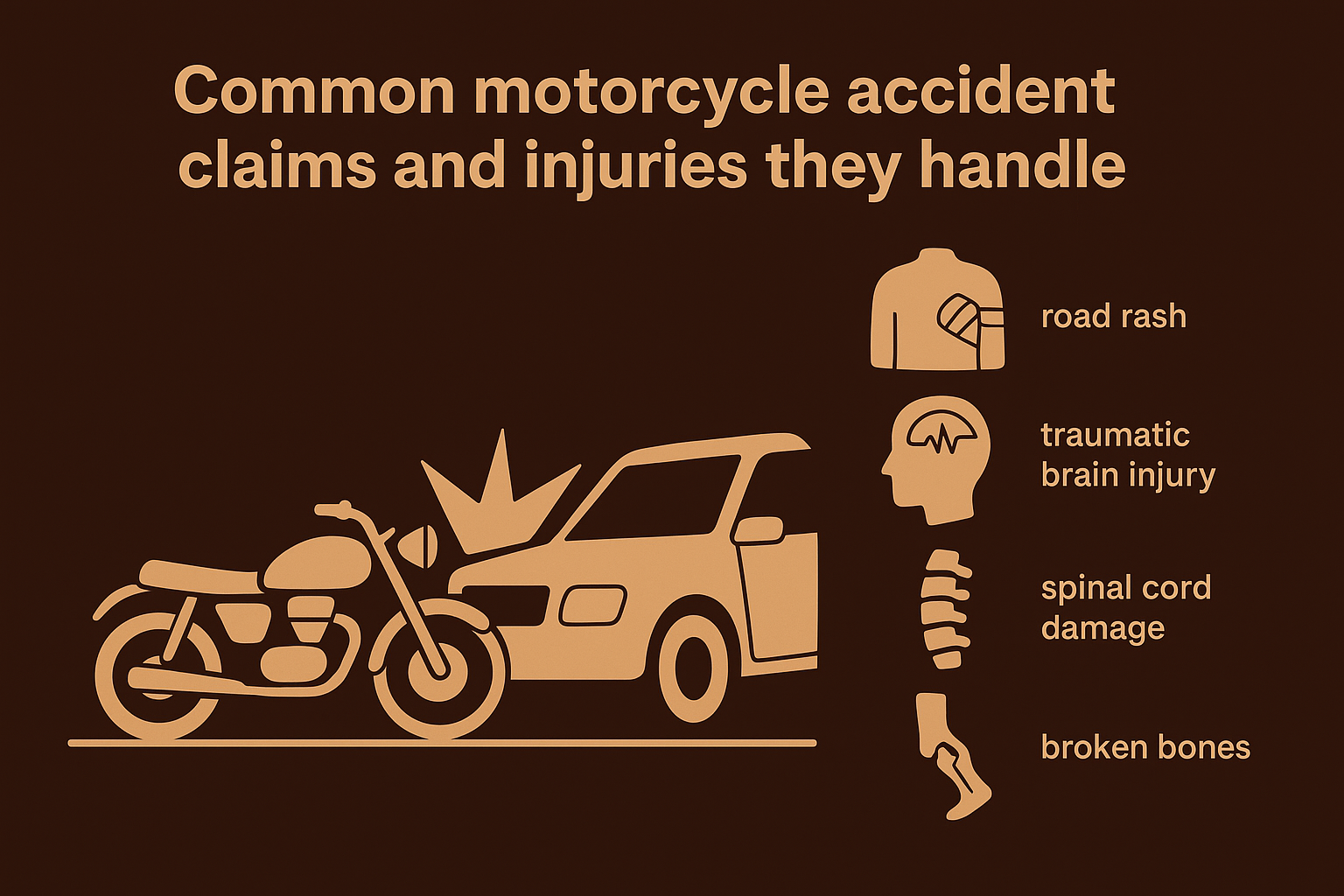
Injury severity shapes settlement value more than almost any other factor, since medical costs and long-term care needs scale directly with the harm caused. Common injuries include:
- Road rash and severe lacerations requiring skin grafts
- Traumatic brain injuries, even with helmet use
- Spinal cord damage leading to partial or full paralysis
- Broken bones, particularly in the legs, pelvis, and collarbone
- Lower-extremity injuries requiring amputation in severe crashes
The injury on the police report rarely tells the full story of what a rider will deal with for years afterward.
Severe cases, especially those involving spinal injuries or traumatic brain injuries, often require testimony from medical experts to project future care costs, and that documentation is exactly what separates a fair settlement from one that runs out before treatment ends. Wrongful death claims also fall under this umbrella when a crash proves fatal, and those cases carry their own legal deadlines and standing requirements that a family needs to understand quickly.
When to contact an attorney after a motorcycle crash
Timing matters more than most riders realize. Waiting even a few weeks to call a motorcycle accident lawyer can cost you evidence, witnesses, and leverage you'll never get back. The best rule is simple: reach out before you talk to any insurance adjuster in detail, and definitely before you sign anything they hand you.
Call before you give a recorded statement
Insurance companies move fast because speed favors them. Adjusters often call within 24 to 48 hours of a crash, hoping to lock in a statement before you've talked to anyone else or fully understood your injuries. A motorcycle accident attorney lawyer can sit in on that call, or handle it entirely, so nothing you say gets twisted into an admission of fault later. Once you've given a recorded statement without guidance, undoing the damage becomes much harder.
The safest move after any crash is to talk to a lawyer before you talk to the insurance company.
Red flags that mean you need representation now
Some situations make hiring an attorney urgent rather than optional. Watch for these signs:
- The other driver's insurer disputes fault or blames you for the crash
- Your injuries required hospitalization, surgery, or ongoing physical therapy
- The adjuster offers a settlement within days of the crash
- You're missing work and losing income with no clear return date
- The at-fault driver was uninsured or underinsured
- A family member died in the crash
Any one of these should push you toward a free consultation immediately, not after you've tried negotiating alone.
Don't wait until the deadline is close
Texas gives you two years from the crash date to file a personal injury lawsuit, but that deadline sneaks up faster than people expect once medical treatment, work, and daily life get in the way. Filing early also gives your attorney time to build the case properly instead of scrambling before a court deadline. Waiting rarely helps your claim and almost always weakens it, since evidence disappears and memories fade with every month that passes.
Moving forward after your accident
A motorcycle crash changes your finances, your health, and your daily routine all at once, and no one should navigate that alone against an insurance company built to minimize payouts. A motorcycle accident attorney lawyer levels that fight by investigating your crash, calculating what your case truly costs, and pushing back on unfair blame before it locks in. The sooner you bring someone into your corner, the more evidence and leverage you keep on your side.
Don't wait for an adjuster's phone call to decide your next move. Reach out for a free consultation and let an experienced team walk through your options before you sign anything or say something you'll regret. If you're ready to talk through what happened and what your case might be worth, schedule a free consultation with Mayfield Law Firm today and get answers instead of guesswork.