Uninsured Motorist Coverage for Hit and Run in Mississippi
Uninsured motorist coverage hit and run protection works like this: when a driver hits you and flees, your own insurer treats that driver as uninsured. Your uninsured motorist (UM) bodily injury coverage can then pay your medical bills, lost wages and pain and suffering, provided you carry the coverage and meet your policy's conditions. Damage to your vehicle is a different matter. UM usually does not repair your car. Collision coverage does, or a UM property damage add-on where your policy includes one.
Uninsured motorist coverage is the part of your auto policy that pays you when the at-fault driver has no insurance or cannot be identified. A hit-and-run driver is the second case. This article covers why the coverage matters, how to file a claim with your own insurer, the conditions that decide whether you get paid, and how UM compares with collision coverage. It also covers parked-car hits, premium increases and when to bring in a lawyer. Policies differ by state, and we focus here on Mississippi.
Mayfield Law Firm, P.A. has represented car accident clients from Tupelo, Southaven and Memphis since 1974. Hit-and-run claims are often decided by policy fine print, so we explain it here in plain terms.
Why uninsured motorist coverage matters after a hit-and-run
Why your insurer treats a fleeing driver as uninsured
Your own insurer steps in because nobody else can pay. A driver who flees leaves no name and no liability policy to claim against. Most policies and state laws define an "uninsured motor vehicle" to include a hit-and-run vehicle, so your UM coverage becomes the source of payment . Mississippi law requires insurers to offer UM coverage, but you can reject it in writing. Do not assume you have it. Look for "uninsured motorist" on your declarations page.
Without UM, you would rely on your health insurance and savings, and the driver might never be found. Even a driver who is found later is often uninsured. UM covers both situations , which makes it one of the most useful coverages on a policy.
When the at-fault driver disappears, your own policy is the only insurer left to pay.
What it pays and what it does not
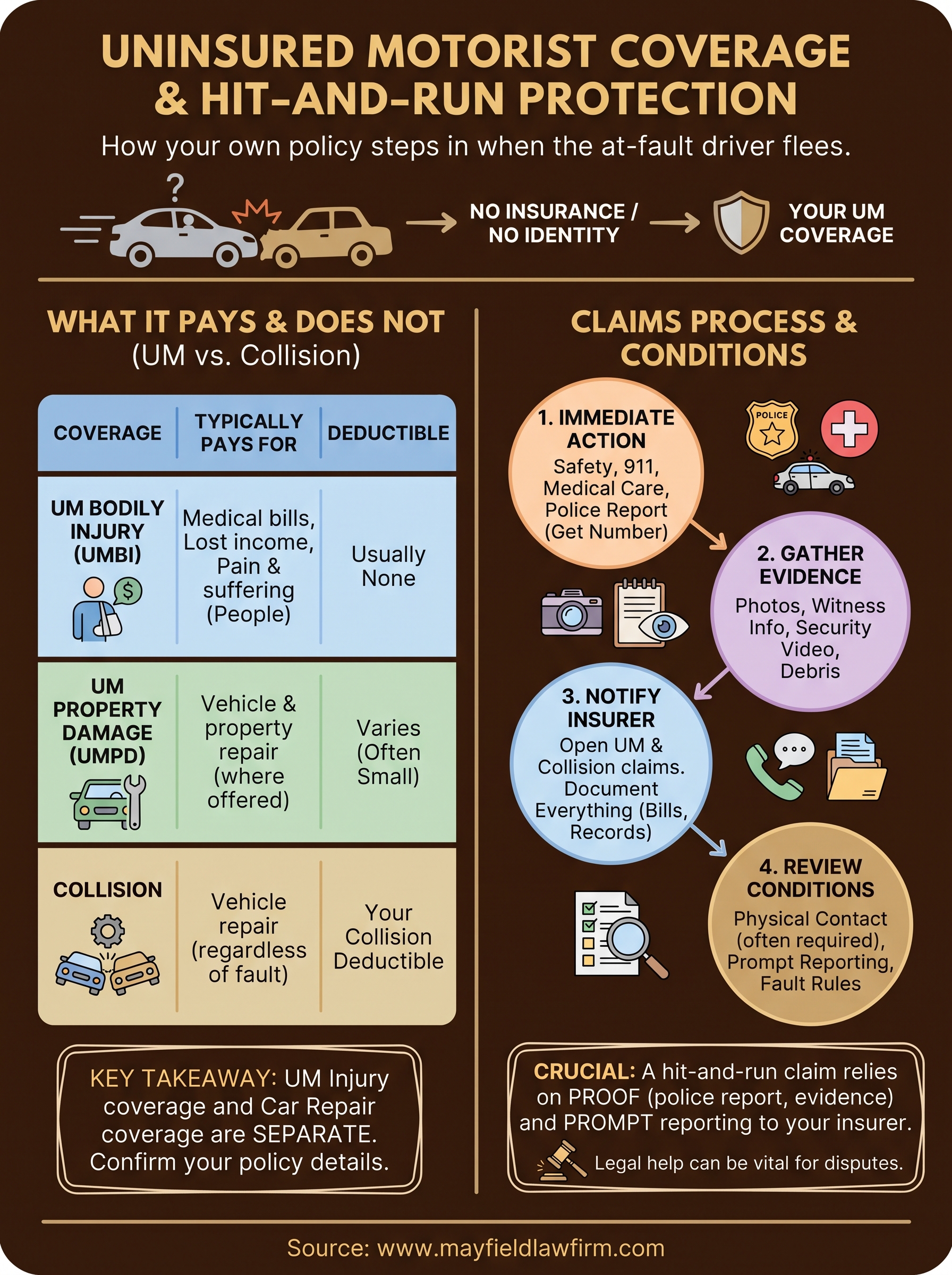
UM bodily injury covers people. Vehicle damage falls under other coverages. The table shows how the pieces fit together.
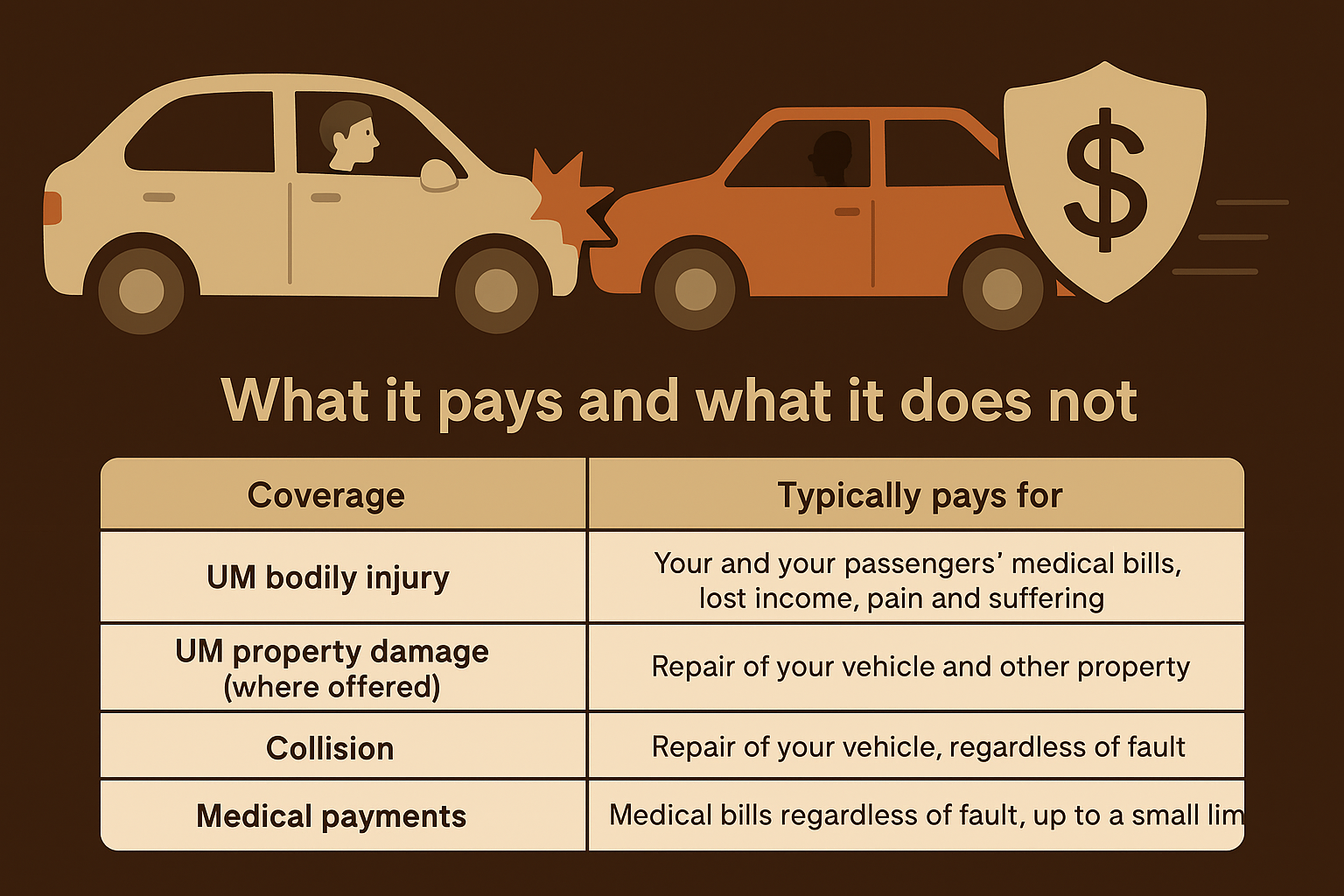
| Coverage | Typically pays for | Deductible |
|---|---|---|
| UM bodily injury | Your and your passengers' medical bills, lost income, pain and suffering | Usually none |
| UM property damage (where offered) | Repair of your vehicle and other property | Varies, often small |
| Collision | Repair of your vehicle, regardless of fault | Your collision deductible |
| Medical payments | Medical bills regardless of fault, up to a small limit | None |
This split explains why people say UM "doesn't fully cover" a hit-and-run. UM injury coverage and car repair coverage are separate , and you need to confirm which of them your policy includes.
How to file a hit-and-run claim with your own insurer
Steps to take in the first days
A strong UM claim starts at the scene and continues through treatment. Work through these steps in order:
- Get to safety, call 911 and get medical care. Treatment records tie your injuries to the crash.
- Report the crash to the police and keep the report number.
- Photograph the damage, any paint transfer, debris and the road. Note a partial plate or vehicle description, and get witness names and numbers.
- Ask nearby businesses about security video right away, since they often overwrite it quickly.
- Notify your insurer and ask it to open a UM claim. Open a collision claim separately for the car.
- Keep every bill, pay stub and treatment record. Follow your doctor's plan.
- Give an adjuster facts only. Do not guess about fault or say you feel fine before a doctor has examined you.
Your insurer is paying this claim from its own funds , so expect close review. Being cooperative and well documented helps you.
A worked example
Say a driver sideswipes you and flees. You carry UM bodily injury limits of $25,000 and collision with a $500 deductible. Your medical bills reach $18,000 and you lose $3,000 in wages, so your economic losses are $21,000 before any pain and suffering. Your car repair is $6,000.
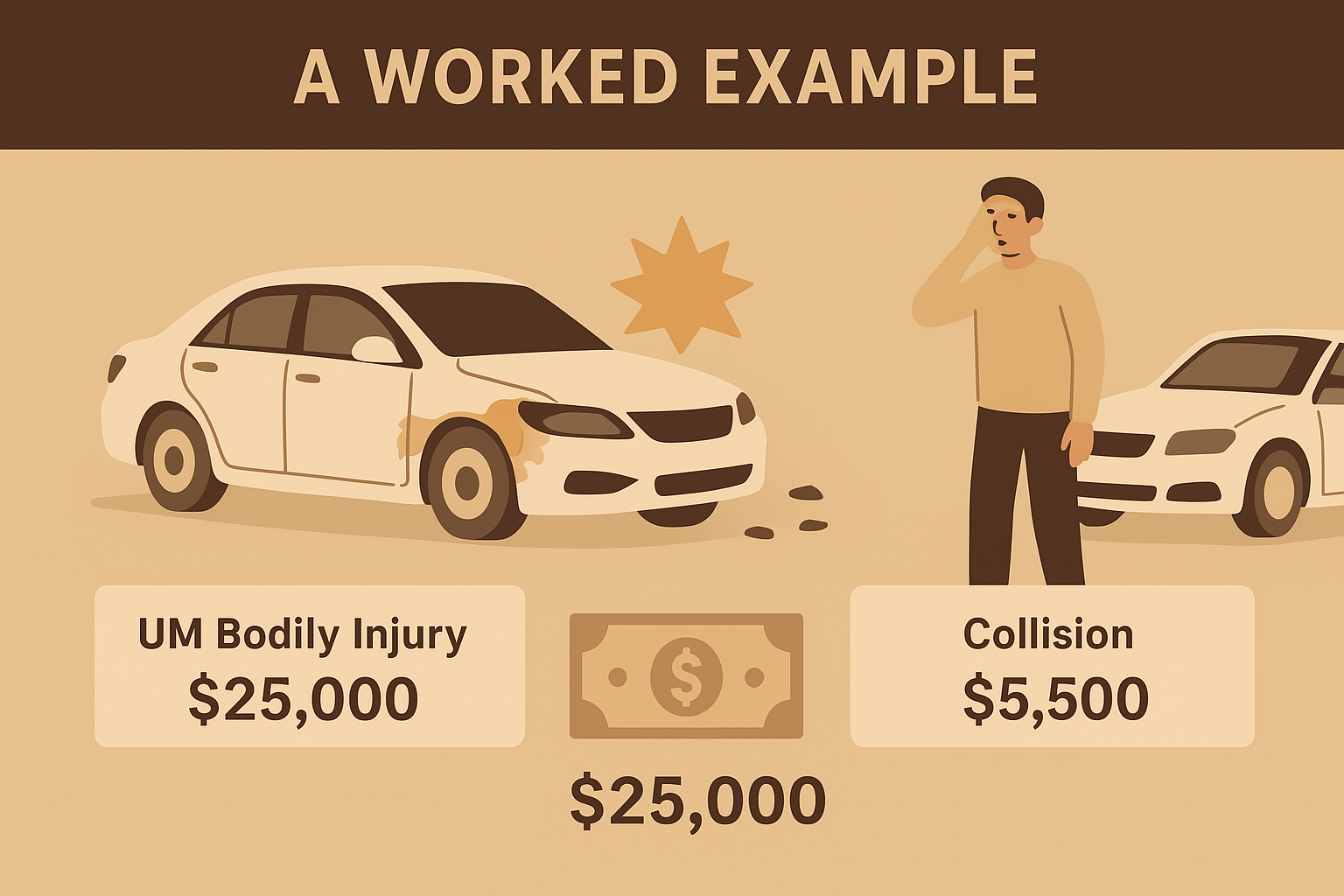
- UM bodily injury: your losses exceed $21,000, but payment is capped at the $25,000 limit, with no deductible.
- Collision: $6,000 minus the $500 deductible leaves $5,500.
Your total recovery from the policy is at most $25,000 for injuries and $5,500 for the car . This hypothetical shows why your UM limit matters as much as having the coverage .
Your UM limit, not your actual losses, sets the ceiling on what the policy pays for injuries.
Conditions that decide whether your claim is paid
Proof that the other driver existed and fled
Insurers want proof that an unidentified driver caused the crash. Many policies require physical contact between the vehicles. Others accept an independent witness when your car was forced off the road without contact, often called a phantom vehicle case. Those are the hardest claims to win, so witness names matter.
Prompt reporting is a condition too. Policies commonly require you to notify the police and your insurer quickly. A late report gives the insurer a reason to deny , even when your injuries are real. Read the "uninsured motor vehicle" definition and the notice clause in your own policy.
Fault, limits and deadlines
UM generally pays what you would be legally entitled to recover from the fleeing driver. Some states, such as Maryland, say UM pays only when the other driver is entirely at fault. Mississippi applies comparative fault instead, which reduces your recovery by your own percentage of blame. Expect an adjuster to look for any way you contributed.
Policy limits cap the payment. Deadlines also matter. Your policy may set short notice requirements, and Mississippi's general deadline for filing an injury lawsuit is three years. Do not wait that long. Evidence disappears quickly , and a delay gives the insurer room to argue.
A hit-and-run claim is won on proof: a police report, a witness or physical evidence, and records that tie your injuries to the crash.
Collision, premiums and when to get legal help
Collision or uninsured motorist coverage: which do you need
You need both, because they cover different losses. Collision fixes your car but pays nothing toward medical bills. UM injury coverage pays for you and your passengers but often leaves the car unpaid. Having collision does not replace UM , and the reverse is also true.
Parked cars and rate increases
If someone hits your parked car and leaves, no one is injured, so UM bodily injury does not apply. Collision, or UM property damage if you have it, pays after the deductible. If the driver is identified later, your insurer may recover its payout from that driver's insurer, and you may get your deductible back.
A hit-and-run claim is not your fault, and a not-at-fault claim often affects premiums less than an at-fault one. Insurers and states vary, so ask yours directly. Skipping the claim to protect your rate usually costs more than it saves.
When a lawyer helps
A UM claim is a claim against your own insurer, which may undervalue it or dispute the facts. A lawyer can gather evidence, handle the adjuster and push back on a low offer. Our firm handles car accident cases on a contingency fee basis and offers a free consultation, so you can review your policy and options before you decide anything.
What to do next after a hit-and-run
Uninsured motorist coverage is how you get paid when the at-fault driver vanishes. UM bodily injury covers your medical bills, lost income and pain and suffering up to your limit. Collision or UM property damage handles the vehicle. Your claim depends on prompt reports, solid evidence and the exact wording of your policy.
Pull out your declarations page, confirm your UM limits and write down what you remember while it is fresh. If an insurer disputes your claim or offers less than your losses, talk with a Mayfield Law Firm attorney about your hit-and-run claim. Your first consultation is free.