Fled the Scene? How to Find a Hit and Run Driver in 4 Steps
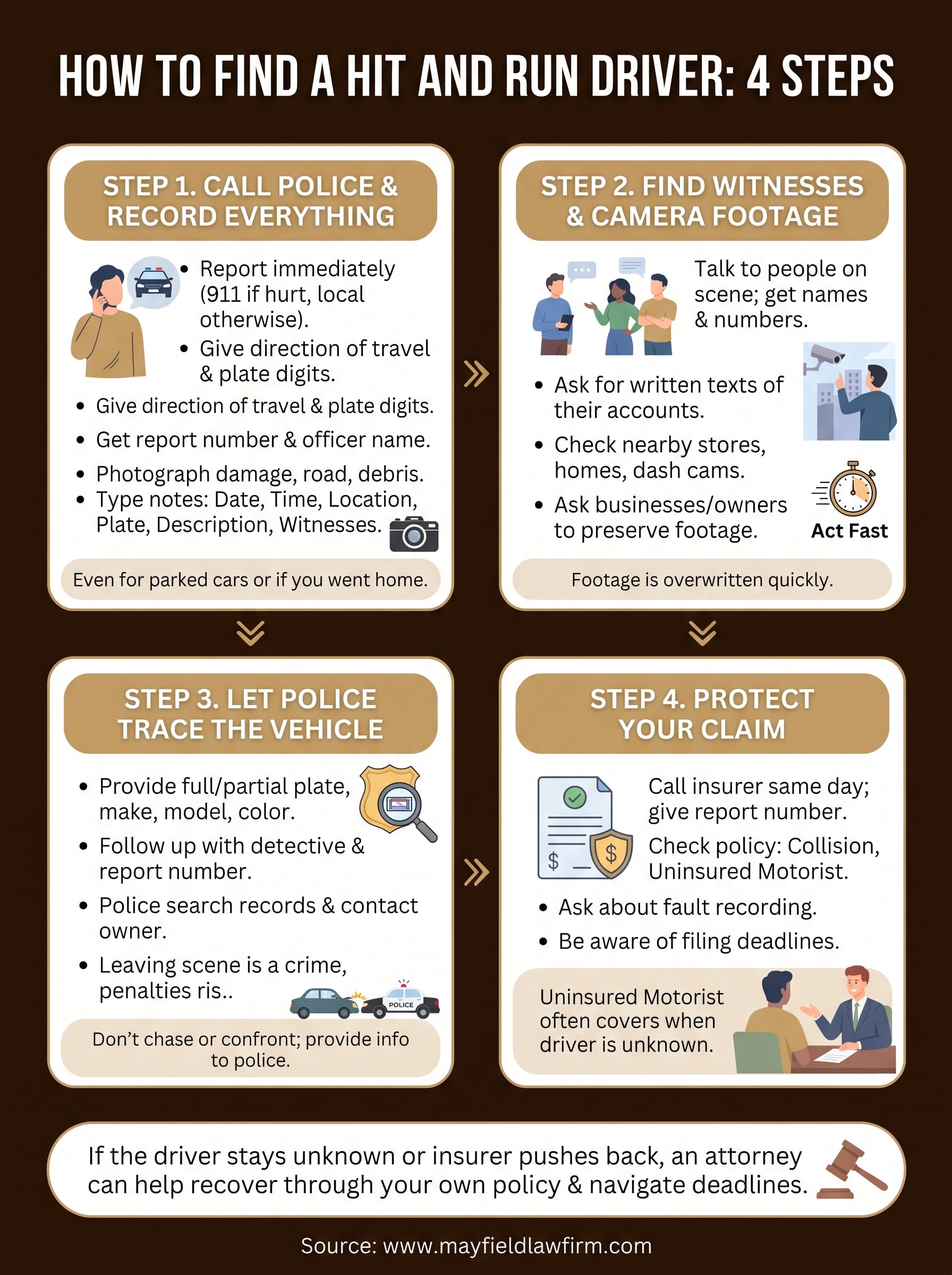
Knowing how to find a hit and run driver comes down to four moves. Call the police right away, collect every identifying detail while it is fresh, locate cameras and witnesses before they disappear, and tell your insurer the same day. Do these in order and you give police the best chance of tracing the car. If the driver never turns up, your own insurance and an attorney can still help you recover.
The hard part is that a hit and run leaves you with very little. You have a damaged car, a rush of adrenaline, and a vehicle that is already around the corner. Most people never see a full plate. A report with no plate, no description, and no footage rarely gives police anything to work with.
This guide walks through the four steps in the order you should take them, then covers what to do if the driver stays unknown. It comes from Mayfield Law Firm, P.A., which has advocated for clients since 1974 and represents car accident clients from offices in Tupelo, Southaven, and Memphis.
Why the first hours decide whether you find the driver
What your odds really look like
Your odds depend on evidence, not luck. A full license plate or clear video usually gives police a direct line to the registered owner. With neither, a report often stalls, and nobody can honestly promise otherwise.
There is no fixed timeline either. When a plate exists, police may identify the owner within days. When it does not, the case can sit for weeks or go cold, so what you collect in the first hours matters more than anything you do later.
A hit and run is solved by the details you capture before they disappear.
What counts as identifying evidence
Investigators work from small details, and even a partial plate paired with a vehicle description can narrow a search. Record as many of these as you can:
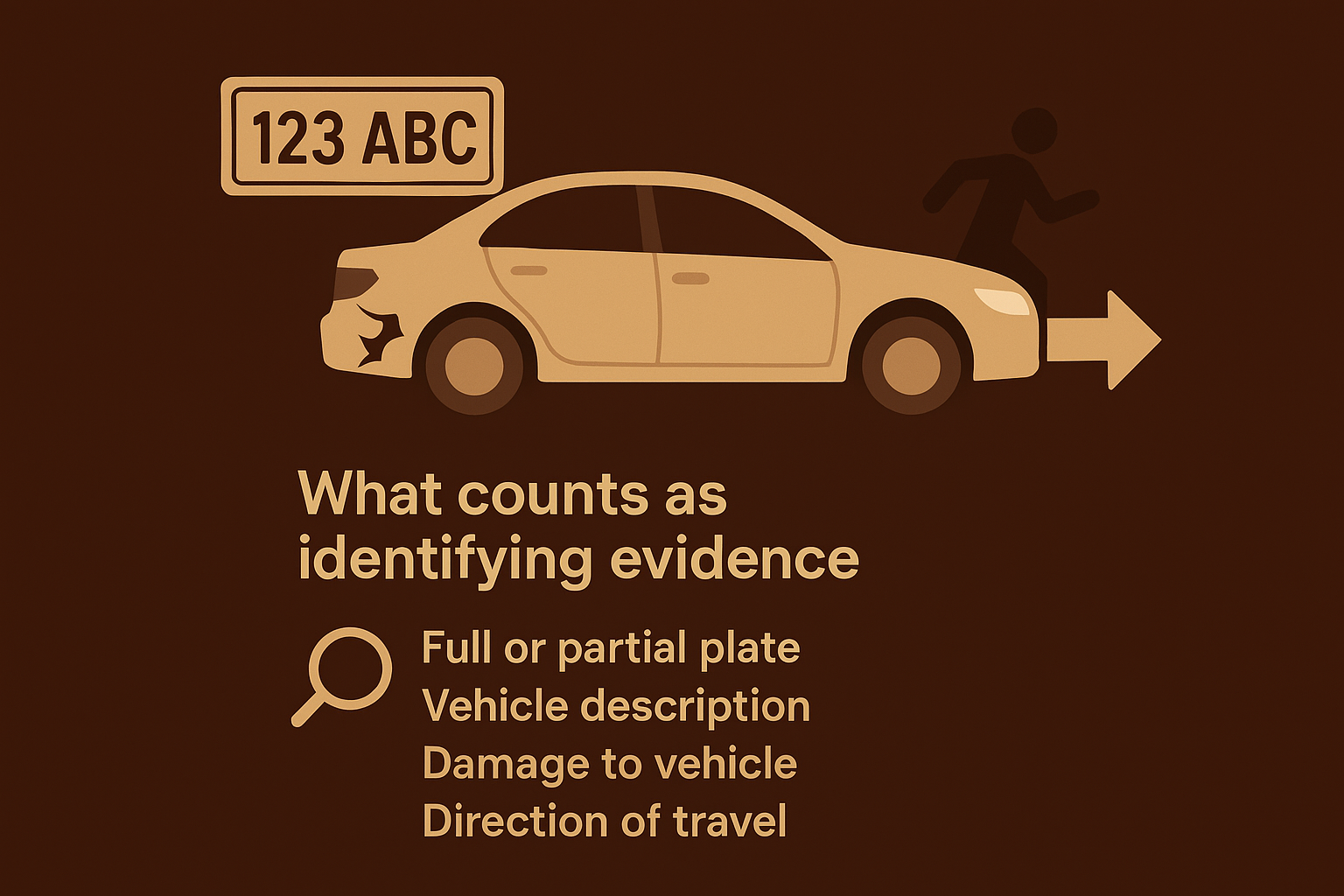
- A full or partial plate, and the state if you saw it
- The make, model, and color of the vehicle
- Damage it should now have, such as a missing mirror or a dented fender on the side that hit you
- The direction it drove away and the time
- Anything distinctive, such as stickers, a roof rack, tinted windows, or a broken light
- A description of the driver and any passengers
- Paint chips and debris left on the road
Stay put and stay safe while you gather these. Never chase the car. Chasing puts you and others at risk, and a call to police with the direction of travel does far more good.
Step 1. Call the police and record everything
Report the crash right away
Call 911 if anyone is hurt. Otherwise call the local police department, the county sheriff, or the Highway Patrol and ask for an officer. Give the direction of travel and any plate digits immediately, because patrol units can watch for the vehicle. Before you leave, get the report number and the officer's name.
Late is better than never. If you went home first, or you found your parked car damaged with no one around, file a report anyway. A driver who hits an unattended vehicle is generally required to stop and leave contact information, so driving off is also a hit and run. Insurers usually expect a report, and a hit and run insurance claim without a police report is much harder to support.
Report it the same day, even if all you can tell the officer is which way the car went.
Capture the scene before it changes
Photograph the damage to your car, the road, skid marks, debris, and nearby street signs from several angles. Shoot a short video as you walk the scene. Then type your notes into your phone while memory is fresh. Copy this template:
 Date and time:
Exact location (street and nearest cross street):
Their direction of travel:
Plate (full or partial, and state):
Make, model, color, and likely damage:
Driver and passenger description:
Witness names and phone numbers:
Police agency and report number:
Step 2. Find witnesses and camera footage
Talk to witnesses and neighbors
Start with the people who were there. Ask anyone nearby what they saw and get names and phone numbers before they leave. A witness who only remembers a color and a pickup bed still helps. Ask each one to text you what they remember that day, because written accounts hold up better than memory. If nobody stayed, knock on doors along the block or leave a note with your number.
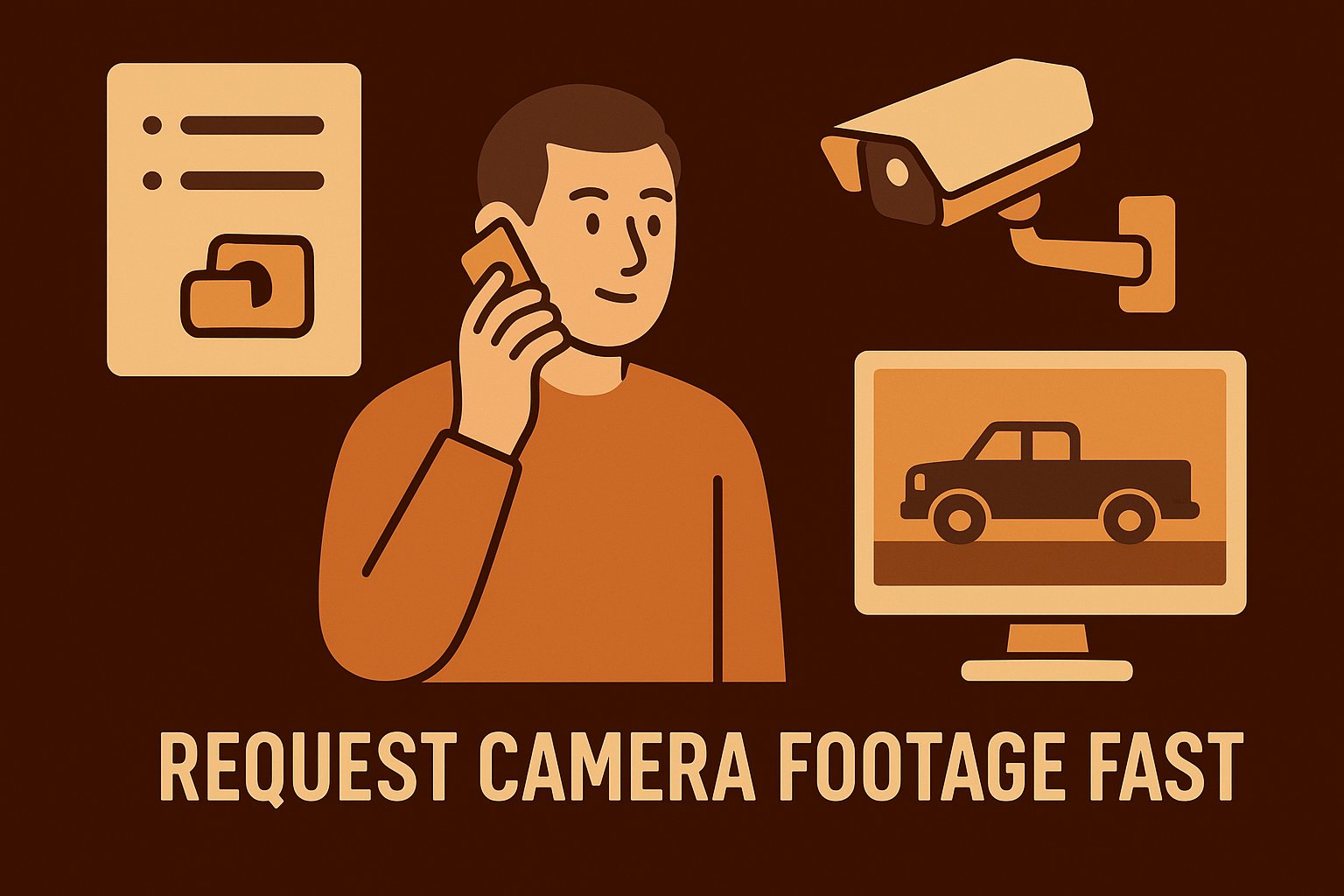
Request camera footage fast
Cameras often give the best lead, and footage gets overwritten on a schedule. Some systems keep it for only a few days. Check these sources within the first 24 hours:
| Source | What to do |
|---|---|
| Nearby stores, gas stations, restaurants | Ask a manager to save the clip for your time window and give them the police report number |
| Home doorbell and security cameras | Ask the owner to save the video and send you a copy |
| Your own dash cam or vehicle camera | Back up the file before it loops over |
| Traffic and city cameras | Ask the officer to request it, since private citizens usually cannot |
Many businesses will not hand video to a private person, but they will often release it to an officer. Ask them to preserve it and pass their contact details to the detective on your case. If police are slow, an attorney can send a preservation letter on your behalf.
Ask for footage to be saved on day one, because getting it later is a gamble.
Step 3. Turn the clues into a name through proper channels
Let police trace the vehicle
Police can search registration records using a full plate, or a partial plate combined with make, model, and color. Give the officer every digit you remember and say which ones you are unsure about. Follow up every few days with your report number and ask for the name of the detective assigned.
When police identify an owner, they contact that person, ask who was driving, and check the car for damage that matches yours. Yes, officers can come to the owner's door. Leaving the scene of a crash is a crime in both Mississippi and Tennessee, and penalties rise when someone was hurt.
Your job is to hand police a vehicle they can trace, and their job is to find the person.
What not to do on your own
Do not confront anyone, and do not rely on people-search sites to hunt down an owner. The federal Driver's Privacy Protection Act limits who can obtain motor vehicle records, so those sites rarely give reliable answers. A social media post asking for witnesses is fine if it describes the car and the place, but never name or accuse someone you are not sure about. If you think you know who it is, give that to police. An attorney can use legal tools such as preservation letters and, in a filed lawsuit, subpoenas for records and footage.
Step 4. Protect your claim if the driver stays unknown
Call your insurer the same day
Tell your insurer it was a hit and run and give the police report number. Your own policy often pays when the driver cannot be found. Mississippi insurers must offer uninsured motorist coverage, and drivers can decline it in writing, so check your declarations page to see what you carry.
| Coverage | What it can pay | Watch for |
|---|---|---|
| Collision | Repairs to your car, minus your deductible | The deductible applies |
| Uninsured motorist bodily injury | Medical bills, lost income, and pain and suffering | Police report or notice requirements in the policy wording |
| Medical payments | Medical bills regardless of fault | Limits set by your policy |
Here is how it works in practice. If repairs cost $5,200 and your collision deductible is $500, collision coverage pays $4,700 and you pay $500. Whether a claim raises your rates depends on the insurer, so ask whether it will be recorded as not at fault .
Know the deadlines and when a lawyer helps
Mississippi generally gives you three years to file a personal injury lawsuit, while Tennessee gives you only one, so a crash in Memphis runs on a much shorter clock. Policy notice deadlines can be shorter still, which is why you call your insurer first.
Is it worth suing a hit and run driver? Only if the driver is identified and has insurance or assets to collect from. Otherwise your recovery runs through an uninsured motorist claim against your own insurer, and those claims can be contested. Mayfield Law Firm handles car accident cases on a contingency fee basis , with an attorney fee of 29% on cases that settle, and offers a free consultation.
If the driver is never found, your own policy is usually where the money comes from.
What to do next
Finding a hit and run driver depends on speed and detail. Report the crash, record everything you remember, secure witnesses and footage, let police trace the vehicle, and notify your insurer. Even if the driver stays unknown, you may still have coverage and deadlines that matter.
If you are dealing with injuries or an insurer that is pushing back, talk to Mayfield Law Firm about your hit and run. You can meet in person at the Tupelo, Southaven, or Memphis office, or virtually.