
8 Ways to Verify a Top Rated Medical Malpractice Attorney
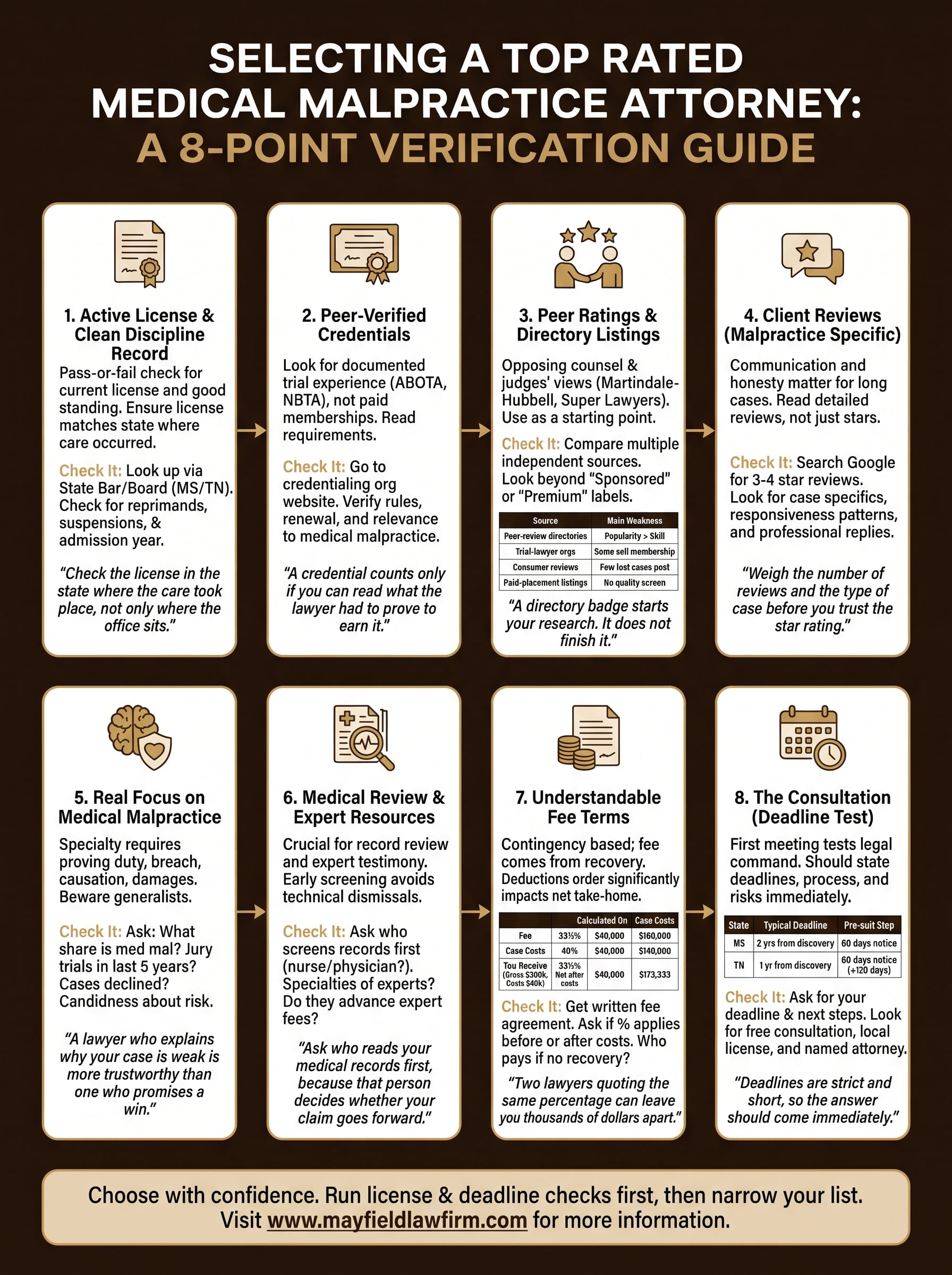
A top rated medical malpractice attorney is a licensed lawyer with a clean discipline record, credentials that peers verify, a practice built around medical injury, real trial experience, access to medical experts, clear fee terms, and a first consultation that gives straight answers. If your case involves a birth injury or a surgical error, weigh trial record and expert resources first. If cost worries you most, start with fee terms. If time is short, start with the license and deadline checks.
The trouble is that no honest, universal ranking exists. Many "best lawyer" pages blend editorial picks with paid placement, and a star rating tells you little about how a lawyer handles a claim that turns on expert testimony. You end up comparing badges that were built to look alike.
This article gives you eight checks you can run on any attorney in your area, in the order that saves the most time. Mayfield Law Firm, P.A. represents injured clients from offices in Tupelo, Southaven, and Memphis, and these are the same checks we would tell a family to run on us.
1. Active license and a clean discipline record
What it tells you
A current license with no serious discipline is the one pass-or-fail check on this list. Every state bar publishes a lookup that shows whether a lawyer is in good standing. A lawyer who has been suspended or sanctioned is not top rated by any definition, whatever badge sits on their website.
Licensing also depends on where your care happened. Mississippi law governs care delivered in Mississippi , and Tennessee law governs care delivered in Tennessee. Many North Mississippi patients are treated at Memphis hospitals, so this matters more than it first appears. A lawyer licensed in only one of the two states may need local co-counsel, which adds cost and a second set of hands on your file.
Check the license in the state where the care took place, not only where the office sits.
How to check it
Use the Mississippi Bar's member directory or the Tennessee Board of Professional Responsibility's attorney search, and read any public discipline orders that come up. It takes about two minutes per lawyer. Look for these four things:
- License status shows active and in good standing
- No public reprimand, suspension, or probation
- Year of admission, which shows true years in practice
- A license in each state where your care took place
2. Credentials that peers actually verify
What it tells you
Credentials matter when someone independent tested the lawyer before awarding them. Trial-advocacy memberships and board certifications usually require documented jury experience and peer references. A badge a lawyer could buy tells you nothing.
Not every credential is equal, and not every state offers the same ones. Some states run formal specialty certification in personal injury trial law, and others do not. Organizations such as the American Board of Trial Advocates and the National Board of Trial Advocacy screen on trial experience. Some "top attorney" societies, by contrast, charge membership fees, so read the requirements before you give the logo any weight.
A credential counts only if you can read what the lawyer had to prove to earn it.
How to check it
Go to the credentialing organization's own website, not the lawyer's page. Confirm the name appears in the member or certified list, then read the eligibility rules . Ask the lawyer directly:
- What did you have to demonstrate to earn this?
- Is it renewed, and when was it last renewed?
- Is it tied to medical malpractice or to injury law generally?
- Does the state bar or only a private group issue it?
3. Peer ratings and directory listings
What it tells you
Peer ratings tell you how other lawyers regard someone, which is useful because opposing counsel and judges see the work up close. Directories such as Martindale-Hubbell, Super Lawyers, and Best Lawyers draw on peer nomination or evaluation. That makes them stronger evidence than a self-written profile.

Still, directories mix editorial ratings with paid advertising, and the two often sit side by side. Labels such as "Sponsored" or "Premium" mean the lawyer paid for the position , not that the lawyer earned it. Treat a directory as a source of names to investigate, never as the final ranking.
A directory badge starts your research. It does not finish it.
How to check it
Compare how each source builds its list. Then look for the same lawyer in two or three independent places.
| Source type | What it measures | Main weakness |
|---|---|---|
| Peer-review directories | Nominations and evaluations by other lawyers | Popularity can outweigh skill |
| Trial-lawyer organizations | Documented trial experience | Some groups sell membership |
| Consumer review sites | Client experience and communication | Few clients of lost cases post |
| Paid-placement listings | Willingness to advertise | No quality screen at all |
A lawyer who appears in several independent peer sources, and not only in paid slots , has passed a real filter.
4. Client reviews that mention malpractice cases
What it tells you
Reviews show how a firm treats people, which no credential can. In a medical malpractice claim you will wait months or years for an answer, so communication and honesty matter as much as courtroom skill. Patterns across many reviews are far more reliable than any single story.
Read the volume and the content, not just the stars. A 4.7 from 400 reviews says more than a 5.0 from 12. Look for reviews from clients with serious injury or wrongful death claims, because a review about a fender bender says little about how a firm handles a hospital defendant.
Weigh the number of reviews and the type of case before you trust the star rating.
How to check it
Search the firm on Google, then read the three-star and four-star reviews first, where the specific details usually live. Check whether the firm replies, and how. Watch for these signals:
- Reviews that name a case type like yours
- Repeated praise or complaints about returned calls
- Reviews spread over several years, not posted in a burst
- Replies that stay professional and respect client privacy
Keep in mind that clients whose cases did not succeed rarely post. Confidentiality also limits what a firm can say publicly.
5. A real focus on medical malpractice
What it tells you
Medical malpractice is a specialty, and a lawyer who lists it as one line among twelve practice areas may rarely try these cases. The cases are hard because you must prove four elements: a duty of care, a breach of the standard of care, causation, and damages . Each usually needs a qualified medical expert behind it.
Win rates deserve honesty too. Published studies of jury trials generally find that defendants win most of them, which is why lawyers screen cases carefully. Caps on noneconomic damages, which in Mississippi and Tennessee are set by statute and worth confirming with the lawyer, also shape which cases are worth bringing. A focused lawyer can tell you frankly whether your claim is viable .
A lawyer who explains why your case is weak is more trustworthy than one who promises a win.
How to check it
Ask for numbers, then compare the answers across your shortlist:
- What share of your practice is medical negligence?
- How many malpractice cases have you taken to a jury in the last five years?
- How many cases do you decline, and why?
- Can you describe results with context, including what the case involved?
Be wary of any result quoted without the injury, the defendant type, or the year. Past results do not guarantee future outcomes , and a good lawyer will say so unprompted.
6. Medical review and expert resources
What it tells you
Malpractice cases are won on expert testimony, so a top lawyer needs a reliable network of physicians and nurses who will review records and testify. Without one, the lawyer cannot even evaluate your claim properly. Records often run to thousands of pages, and someone with clinical training has to read them.
Both states also screen claims early. Mississippi generally requires the attorney to certify that a qualified expert was consulted before filing, and Tennessee requires a certificate of good faith and written pre-suit notice. A firm that does this routinely moves faster and avoids dismissals on technical grounds .
Ask who reads your medical records first, because that person decides whether your claim goes forward.
How to check it
Put the question plainly during the consultation and listen for specifics rather than slogans:
- Does a nurse or physician screen records before an outside expert is hired?
- Which specialties have you retained experts in?
- Do you advance expert fees, and who repays them if the case fails?
- How long does a typical record review take?
A confident answer names the process. A vague answer about "great connections" is a signal to keep looking.
7. Fee terms you can read and understand
What it tells you
Nearly all plaintiff medical malpractice lawyers work on contingency , so the fee comes out of any recovery and nothing is billed up front. Fees commonly run from one-third to 40 percent. Because expert fees and records are expensive, the firm usually advances those case costs, and the agreement should state who bears them if you lose.
The detail that changes your take-home pay is the order of deductions. Take a $300,000 settlement with $40,000 in case costs. If the fee is taken on the gross amount and costs are repaid afterward, you see very different totals than if costs come off first.
| Fee | Fee calculated on | Attorney fee | Case costs | You receive before liens |
|---|---|---|---|---|
| 33⅓% | Gross $300,000 | $100,000 | $40,000 | $160,000 |
| 40% | Gross $300,000 | $120,000 | $40,000 | $140,000 |
| 33⅓% | Net after costs ($260,000) | $86,667 | $40,000 | $173,333 |
Two lawyers quoting the same percentage can leave you thousands of dollars apart.
How to check it
Ask for the fee agreement in writing before you sign anything, and read it with these questions in mind:
- Is the percentage applied before or after costs?
- Does the percentage rise if the case goes to trial?
- Who pays costs if there is no recovery?
- How are medical liens and insurer reimbursements handled?
Medical bills, health insurer claims, and Medicaid or Medicare reimbursement can reduce your net, so ask for an estimated take-home example using your own numbers.
8. A consultation that tests the lawyer
What it tells you
The first meeting is your best verification tool, because a lawyer cannot fake fluency in the law that governs your claim. A top-rated attorney will state your deadlines, explain the process, and be candid about risk. Deadlines are strict and short , so the answer should come immediately.
| State | Typical filing deadline | Outer limit | Pre-suit step |
|---|---|---|---|
| Mississippi | Two years from when the harm was or should have been discovered | Generally seven years from the act | 60 days' written notice to the provider |
| Tennessee | One year from when the harm was or should have been discovered | Generally three years from the act | 60 days' written notice, which can add 120 days |
Exceptions exist, including for minors and foreign objects left in the body, so treat the table as orientation, not legal advice. Do not wait to see a lawyer until you have finished your shortlist.
How to check it
Treat the meeting as an interview. Ask the lawyer to state your deadline, name who handles the file, and describe the next three steps. Mayfield Law Firm, P.A. offers a free consultation, welcomes in-person and virtual meetings, and has attorneys licensed in Mississippi and Tennessee. The firm has been advocating for clients since 1974. Those facts are worth asking any firm to match:
- Free initial consultation, in person or virtual
- Licenses in the state where your care happened
- Offices you can reach without a long drive
- A named attorney, not just an intake coordinator
Leave the room without signing if the answers feel rehearsed. You can compare two or three firms in a week.
Choosing with confidence
The best medical malpractice lawyer for you is not the one with the most badges. It is the one who passes all eight checks: an active license, verifiable credentials, independent peer recognition, honest reviews, a real malpractice focus, medical expert resources, fee terms you understand, and a consultation that shows command of your deadlines.
Run the license and deadline checks first, because they cost nothing and time matters most. Then narrow your list to two or three firms and meet them. If you were harmed in Northeast Mississippi or the Memphis area, you can schedule a free consultation with Mayfield Law Firm and put these questions to us directly.