
Medical Malpractice Contingency Lawyers: What They Are & How They Work
You suspect a doctor or hospital made a mistake that hurt you, and now you're staring at medical bills you can't pay while wondering how you'd ever afford a lawyer on top of it. That's exactly the situation medical malpractice contingency lawyers exist to solve. You don't pay a retainer, you don't pay hourly fees, and you don't pay anything at all unless your attorney wins your case or settles it in your favor.
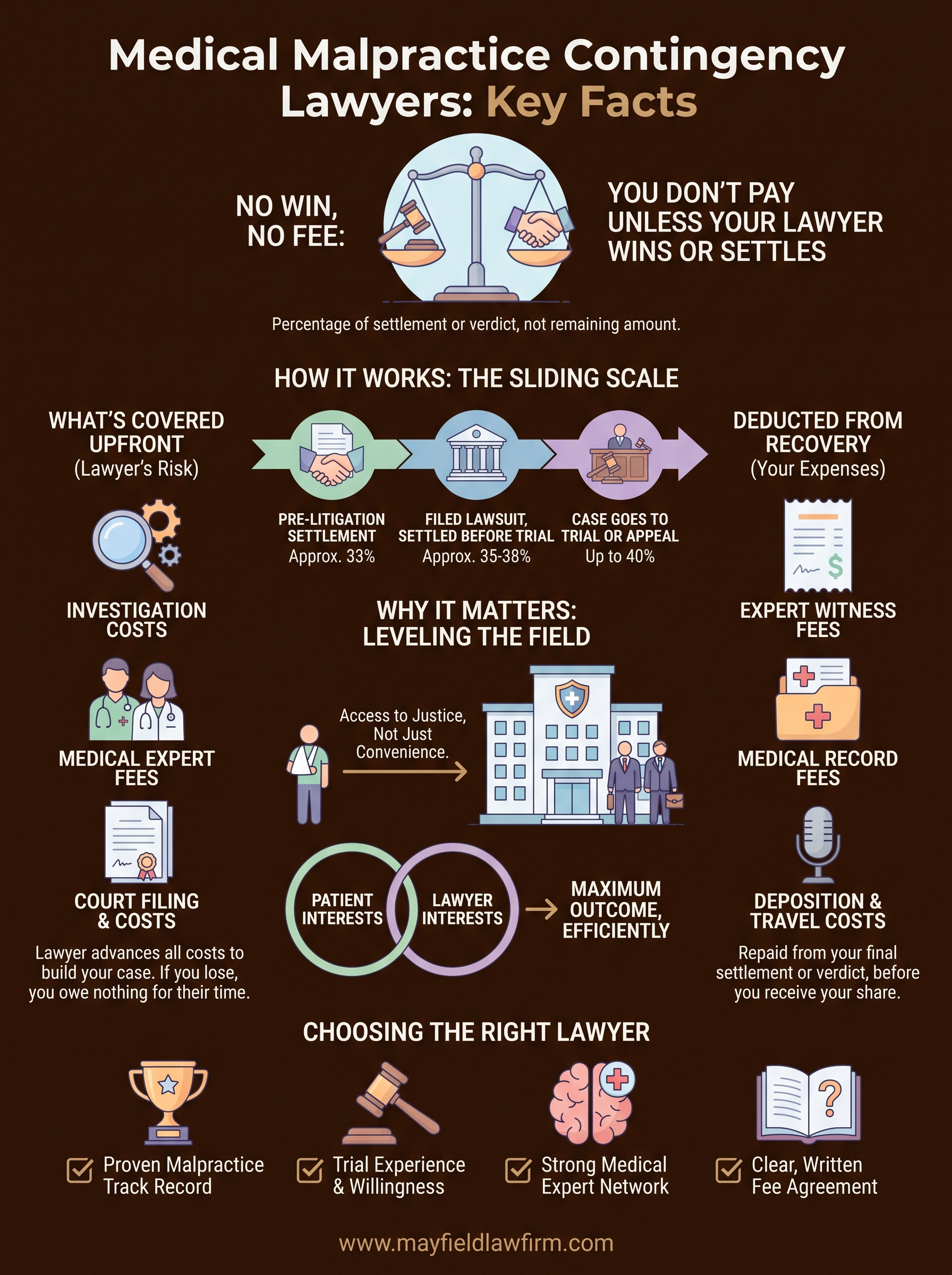
Here's how it actually works: your lawyer covers the upfront costs of investigating your claim, hiring medical experts, and building your case. If you win, the firm takes an agreed percentage of the settlement or verdict , typically between 33% and 40%. If you lose, you owe nothing for their time. This arrangement lets injured patients pursue serious claims against hospitals and insurers with deep pockets, without risking money they don't have.
Below, we'll break down what contingency fees actually cover, how percentages are calculated, what happens if your case doesn't succeed, and what to ask before you sign an agreement. At Mayfield Law Firm, we've handled malpractice claims across Mississippi and Tennessee on exactly this basis, and we'll walk you through what to expect.
Why a contingency fee arrangement matters after medical malpractice
Medical malpractice cases cost far more to build than a typical injury claim. You need medical records from every provider involved, at least one qualified expert witness to establish the standard of care, and often a second expert to testify on causation and damages. These costs can run into tens of thousands of dollars before a case ever reaches a courtroom. Without a contingency fee structure , most injured patients simply couldn't front that money while also dealing with medical bills, lost wages, and recovery.
Leveling the playing field against hospitals and insurers
Hospitals and their insurance carriers have teams of lawyers and unlimited resources to fight claims. A no win no fee malpractice attorney puts you on more even footing, because your lawyer has just as much incentive as you do to build the strongest possible case. The firm isn't billing by the hour, so there's no financial upside to dragging out litigation or padding invoices. Everyone's interests point in the same direction: winning the case for the maximum amount, as efficiently as possible.
A contingency fee means your lawyer only gets paid when you do, which aligns their effort with your outcome.
What patients avoid by not paying hourly
Compare what a contingency arrangement spares you against what a traditional hourly billing model would demand:
| Cost Type | Hourly Billing Model | Contingency Fee Model |
|---|---|---|
| Attorney's time | Billed monthly, regardless of outcome | No charge unless you win |
| Expert witness fees | Paid by client upfront | Advanced by the firm |
| Filing and court costs | Paid by client as incurred | Advanced by the firm |
| Risk if case is lost | Client owes fees and costs | Client typically owes nothing |
This is why contingency-fee malpractice lawyers exist in the first place. Medical negligence claims are inherently risky. Even strong cases can take a year or more to resolve, and outcomes are never guaranteed. Shifting that financial risk onto the law firm, rather than the injured patient, is what makes it possible for ordinary people to hold hospitals and doctors accountable.
Access to justice, not just convenience
Some people assume contingency fees are simply a matter of convenience, a way to avoid writing a check upfront. In reality, they're often the only reason a malpractice claim gets filed at all. Consider a patient recovering from a botched surgery who can't work and is already behind on rent. That person has no capacity to pay a retainer, let alone fund an expert witness. Under a medical malpractice lawyer contingency fee arrangement, the firm absorbs that risk instead. If the firm believes in the case enough to take it on, that's a meaningful signal about its merit, since no lawyer wants to invest thousands of dollars and hundreds of hours into a claim they don't expect to win.
How contingency fee agreements work in malpractice cases
A contingency fee agreement is a written contract you sign before your lawyer starts working the case. It spells out the percentage the firm takes, what happens at different stages of litigation, and how expenses get repaid. Mississippi and Tennessee both require these agreements in writing, and a reputable firm will walk through every line with you before you sign anything.
The sliding scale most firms use
Most malpractice attorneys use a sliding percentage tied to how far the case progresses. A claim resolved early through settlement negotiations might carry a lower percentage than one that goes to trial or appeal, since trial work demands far more time and risk. A typical structure looks like this:
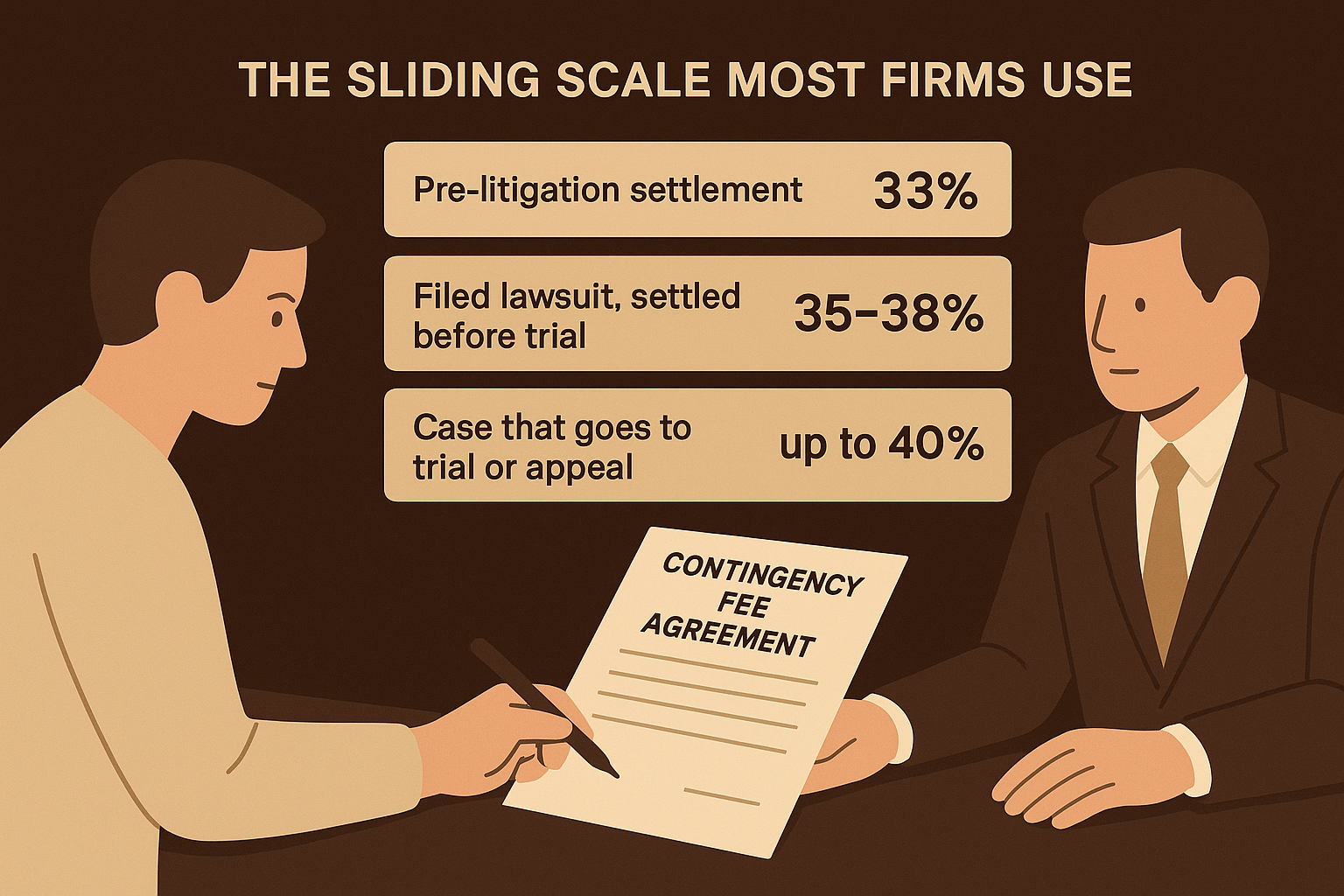
- Pre-litigation settlement : around 33% of the recovery
- Filed lawsuit, settled before trial : around 35-38%
- Case that goes to trial or appeal : up to 40%
Every firm sets its own numbers, so ask for the exact breakdown in writing rather than assuming a standard rate applies.
The percentage you owe should never be a surprise. It's written into your agreement before your case even starts.
When the fee gets calculated
Fees come out of the gross settlement or verdict, not what's left after expenses in most agreements, though some firms calculate the fee net of costs. This distinction matters, because it changes how much money actually lands in your pocket. Reviewing this detail before signing is one of the simplest ways to avoid confusion later.
No recovery, no fee
Understanding the flip side matters just as much. If your medical malpractice claim doesn't result in a settlement or verdict, you owe the firm nothing for its time under a true contingency arrangement. Some agreements still hold you responsible for advanced case expenses if you lose, so ask this question directly during your consultation. A firm that hesitates to answer it clearly is worth reconsidering, since transparency on this point is standard practice among medical malpractice contingency lawyers who've been doing this work for years.
What costs and fees to expect beyond the lawyer's percentage
Beyond the attorney's cut, every malpractice case racks up out-of-pocket expenses that get repaid from your settlement before you see a dime. These aren't hidden fees exactly, but they're often glossed over during the initial consultation, and they can add up to thousands of dollars in a complex case. Knowing what to expect keeps you from being surprised when your final settlement statement lands.
Case expenses that get deducted from your recovery
Common costs in a malpractice claim include:

- Expert witness fees , often the largest expense since malpractice cases typically require two or more specialists
- Medical record retrieval fees charged by hospitals and providers
- Court filing fees and costs for deposition transcripts
- Investigator or paralegal support used to track down witnesses or documentation
- Travel costs if experts or witnesses need to appear from out of state
A well-run firm advances these costs and deducts them from your settlement, not your bank account, while the case is pending.
How expenses get repaid
Expense reimbursement usually happens in one of two ways: some firms subtract costs before calculating the attorney's percentage, while others calculate the percentage first and subtract costs afterward. The difference sounds minor, but it can shift your net recovery by thousands of dollars on a six-figure settlement. Ask your medical malpractice attorney directly which method their fee agreement uses, and get the answer in writing.
Ask how expenses are calculated before you sign anything. The order of operations in your fee agreement can change what you actually take home.
Requesting an itemized expense report before finalizing your settlement is standard practice, and any firm working on a genuine no win no fee basis should provide one without hesitation. Signing off on a settlement without seeing that breakdown means signing off blind on how much of your own recovery you're keeping.
How to choose the right contingency-fee malpractice lawyer
Finding the right attorney matters as much as the fee structure itself. Not every personal injury lawyer handles medical malpractice, and this specialty demands deep familiarity with medical records, standard-of-care arguments, and expert witness networks. Look for medical malpractice contingency lawyers who can point to specific results in cases similar to yours, not just a general injury practice that occasionally takes on a malpractice claim.
What to look for in a track record
Before hiring anyone, check these markers of experience:
- Case history : Has the firm handled malpractice claims specifically, not just car accidents or slip-and-falls?
- Trial experience : Will they actually take a case to trial if the hospital's insurer won't offer a fair settlement?
- Expert network : Do they have established relationships with medical experts who can testify credibly?
- Local court familiarity : Do they know the judges and procedures in Mississippi and Tennessee courts?
Questions worth asking in your consultation
Getting straight answers during your free consultation tells you a lot about how a firm operates. Ask directly what percentage they take at each stage, how expenses are handled if you lose, and who specifically will manage your case day to day. A firm juggling hundreds of cases with little communication isn't the same as one that assigns a dedicated attorney to walk you through every step.
The right lawyer explains your fee agreement in plain language and answers hard questions without hesitation.
Weigh comfort alongside credentials
Personal fit shouldn't get overlooked either. You'll likely work with this firm for a year or more, sharing sensitive medical details and financial pressures along the way. Choose someone who returns calls, explains developments without jargon, and treats your case like it matters, not just another file on a busy desk. A no win no fee malpractice attorney who combines strong credentials with genuine attentiveness gives you the best shot at both a fair settlement and a manageable process.
Making sense of your legal options
A contingency fee arrangement exists for one reason: to make sure the cost of a lawyer never stops you from holding a negligent doctor or hospital accountable. You've seen how the percentages work, what expenses come out of your settlement, and what questions separate a firm worth hiring from one that isn't. None of that should feel overwhelming once you understand the mechanics, and none of it should cost you anything to ask about upfront.
Getting hurt by someone else's medical mistake is stressful enough without wondering how you'll pay to fight back. Medical malpractice contingency lawyers remove that barrier so you can focus on recovery instead of legal bills. If you're dealing with a possible malpractice claim in Mississippi or Tennessee, schedule a free consultation with Mayfield Law Firm and find out exactly where you stand, with no upfront cost and nothing owed unless we win.