Personal Injury Attorney for Medical Malpractice: What To Do
When a doctor, surgeon, or other medical professional causes harm through negligence, the aftermath can be physically devastating and financially overwhelming. You trusted someone with your health, and they failed you. Hiring a personal injury attorney for medical malpractice is often the most effective step you can take to hold that provider accountable and recover the compensation you're owed. But knowing where to start, what to expect, and how to protect your claim from the beginning makes a real difference in the outcome.
Medical malpractice cases are among the most complex personal injury claims. They involve medical records, expert testimony, strict filing deadlines, and insurance companies that fight hard to minimize payouts. Without experienced legal representation, critical mistakes early in the process can weaken or even destroy a valid case. That's why understanding your rights and responsibilities matters, before you sign anything or speak with an insurance adjuster.
At Mayfield Law Firm, P.A., we represent injured clients across Northeast Mississippi and South Memphis in personal injury and medical malpractice cases. With over 40 years of legal experience , our team handles these claims from the initial consultation through settlement negotiations, trial, or appeal. This article walks you through what medical malpractice actually involves, the steps you should take after suffering harm from a medical provider, and how to find the right attorney to fight for your case.
When a personal injury case becomes medical malpractice
Not every negative medical outcome qualifies as malpractice. Personal injury law covers a wide range of accidents and injuries, but medical malpractice is a specific subset that applies when a healthcare provider's negligence directly causes harm. Understanding that distinction matters, because the legal standards, evidence requirements, and procedural rules are different from a standard car accident or slip-and-fall claim.
The difference between a bad outcome and negligence
Medicine involves risk. Surgeries fail, treatments don't work, and complications develop even when a provider does everything correctly. Medical malpractice only exists when a provider departs from the accepted standard of care that a reasonably competent professional in the same field would have followed under similar circumstances. If your surgeon performed a procedure correctly and you still experienced a complication, that is a bad outcome. If your surgeon operated on the wrong body part, failed to review your allergies, or left a surgical instrument inside you, that crosses into actionable negligence .
The key question is not whether something went wrong, but whether the provider acted the way a competent professional in that specialty would have acted.
The standard of care is determined by what other qualified medical professionals would have done in the same situation. This is why expert witnesses play such a large role in these cases. An attorney building your claim will typically bring in a medical expert from the same specialty to testify about what the correct course of treatment should have been and how your provider fell short.
Common types of medical malpractice claims
Medical negligence takes many forms. Misdiagnosis and delayed diagnosis are among the most common, where a provider fails to identify a condition in time for effective treatment, leading to worsened health outcomes. Surgical errors, anesthesia mistakes, medication errors, and birth injuries also generate a significant share of claims. If any of these situations apply to you, it is worth speaking with a personal injury attorney for medical malpractice to evaluate what happened.

Some situations people overlook as potential malpractice claims include:
- A doctor dismissing symptoms that later turn out to be a serious condition
- A pharmacist dispensing the wrong drug or dosage
- A hospital failing to follow infection control protocols
- A specialist not communicating critical findings to your primary care physician
- An emergency room provider failing to order necessary diagnostic tests
Each of these scenarios can cause lasting physical harm and significant financial damage through additional medical bills, lost income, and long-term care needs. Recognizing them as potential legal claims is the first step toward protecting your rights.
What you must prove in a medical malpractice claim
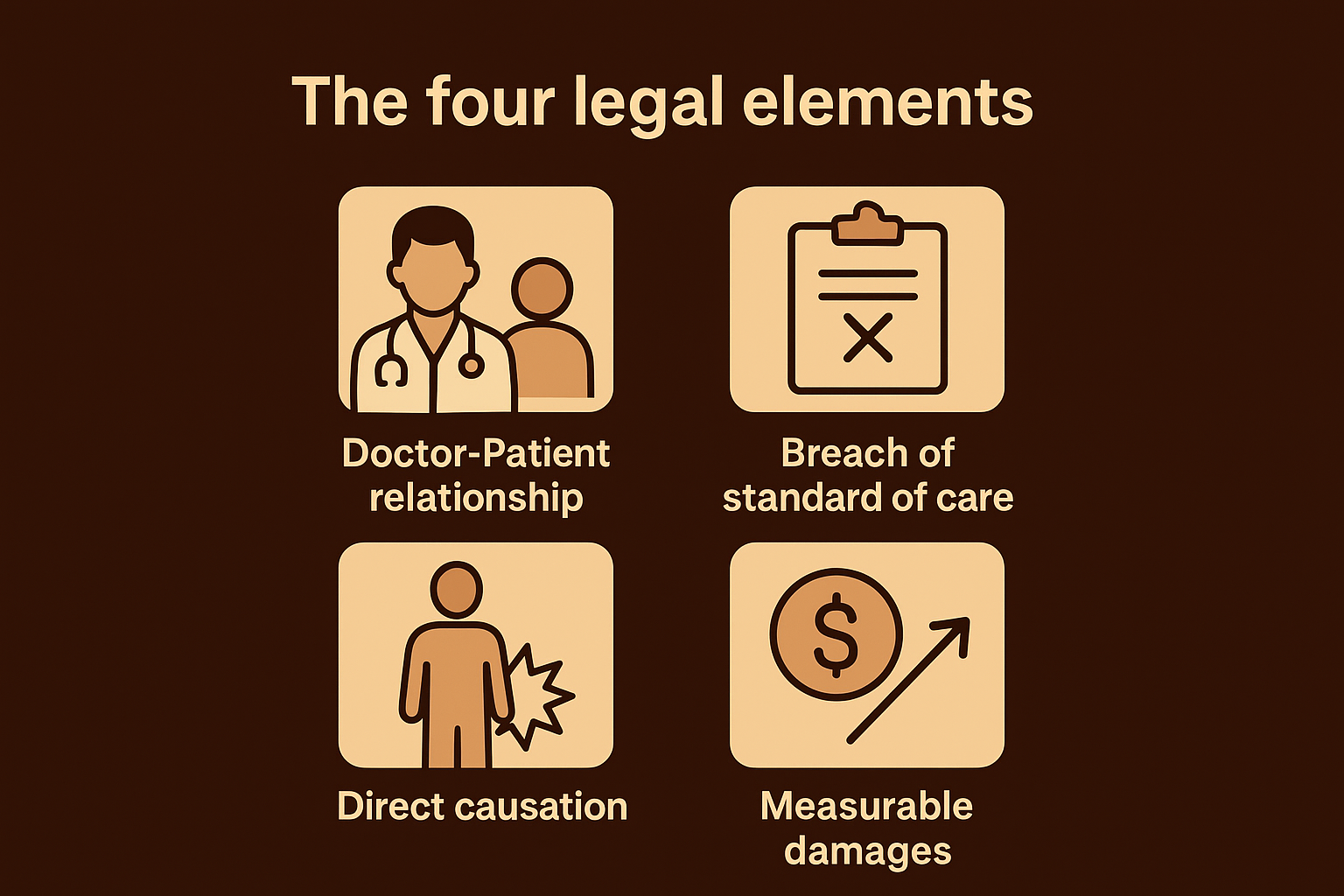
To win a medical malpractice claim, you need to establish four specific legal elements . These are not optional checkboxes. If you cannot prove all four, your case will not succeed regardless of how serious your injury was. Understanding them upfront helps you assess your situation clearly and work more effectively with your attorney.
The four legal elements
Every valid medical malpractice claim rests on the same foundation. You must show that a doctor-patient relationship existed , which establishes that the provider owed you a duty of care. You must then prove that the provider breached the standard of care by acting in a way that a competent professional in that field would not have. Third, you must show that the breach directly caused your injury . Finally, you need to demonstrate measurable damages , such as additional medical costs, lost wages, or lasting physical harm.
Proving all four elements requires solid documentation and, in most cases, testimony from a qualified medical expert.
Why causation is the hardest element
Causation trips up many otherwise strong cases. Insurance companies and defense attorneys frequently argue that your injury or worsening condition was caused by your underlying illness rather than any error made by the provider. For example, if you had cancer and your doctor delayed your diagnosis by three months, the defense may claim your outcome would have been the same either way. Your attorney needs a credible medical expert who can directly link the provider's specific failure to the harm you actually suffered.
This is exactly why working with a personal injury attorney for medical malpractice from the start gives you a significant advantage. An experienced attorney knows which experts carry weight, how to frame the causation argument, and how to counter the insurance company's tactics before they gain traction in your case.
What to do after you suspect medical negligence
If something feels wrong after a medical procedure or treatment, acting quickly matters more than most people realize. The steps you take in the first days and weeks after a suspected error can directly affect the strength of your case and your ability to recover compensation. Waiting, or making the wrong move early, gives insurance companies and defense attorneys time to build a narrative that works against you.
Get your medical records immediately
You have a legal right to request your complete medical records, and you should do this as soon as possible . Request everything: physician notes, test results, imaging, surgical reports, and discharge paperwork. These records form the foundation of your claim and give your attorney the raw material needed to identify where the standard of care was breached.
Medical records can be altered or go missing, so securing your own copies early protects your ability to build an accurate account of what happened.
Do not rely on your provider to hold onto these documents indefinitely. Request them in writing and keep copies in a secure location. If you received treatment at multiple facilities , request records from each one separately to make sure nothing is overlooked.
Stop communicating with the provider's insurance company
Insurance adjusters often contact patients quickly after a medical error, sometimes before you have even spoken with an attorney. Do not give recorded statements, accept early settlement offers, or sign anything without legal counsel. These conversations are designed to minimize the insurer's payout , not to help you recover what you deserve.
Consulting a personal injury attorney for medical malpractice at this stage is the most protective move you can make. An attorney can handle all communications on your behalf , shield you from tactics that could weaken your claim, and start building your case while the evidence is still fresh.
How a medical malpractice attorney can help
Medical malpractice cases involve layers of complexity that most people are not equipped to handle alone. A personal injury attorney for medical malpractice brings the legal knowledge, investigative resources, and courtroom experience needed to turn your evidence into a compelling case. From the moment you hire an attorney, you gain a legal advocate who works to protect your interests at every stage of the process.
Gathering evidence and retaining expert witnesses
Your attorney will collect and review your full medical history, secure records before they can be altered, and identify the exact point where the standard of care broke down. Expert witnesses are central to this process , and an experienced attorney already has relationships with qualified medical professionals who can review your case and provide credible testimony. Without this foundation, even a clear-cut error becomes difficult to prove in court.
The quality of the expert your attorney selects often determines whether a case settles favorably or goes to trial.
Your attorney also handles the procedural requirements specific to malpractice claims, including filing the proper notices and meeting any pre-suit expert certification rules that Mississippi and Tennessee require before a lawsuit can move forward.
Negotiating settlements and taking cases to trial
Insurance companies rarely offer fair compensation without pressure , and that pressure comes from having an attorney who is prepared to litigate. Your attorney will negotiate directly with the defense and their insurers, using the evidence and expert opinions already in place to support your demand. If the insurer refuses a reasonable settlement, your attorney takes the case to trial and presents your claim before a judge or jury.
You do not need to navigate any part of this process on your own. Having the right legal representation means you can focus on your recovery while your attorney handles the legal fight.
Deadlines and special rules in Mississippi and Tennessee
Filing deadlines in medical malpractice cases are strict, and missing them typically ends your right to recover compensation entirely. Both Mississippi and Tennessee impose specific statutes of limitations and procedural requirements that go beyond what a standard personal injury claim demands. If you suspect medical negligence, the clock is already running , which is another reason to speak with a personal injury attorney for medical malpractice as early as possible.
Mississippi filing rules
In Mississippi, you generally have two years from the date of the negligent act to file a medical malpractice lawsuit. However, the discovery rule can extend this window if you did not know and could not reasonably have known about the injury right away. Before filing suit, Mississippi law requires you to send written notice to the defendant healthcare provider at least 60 days in advance, giving them a chance to review the claim before litigation begins. That pre-suit notice period does not pause the statute of limitations, so you cannot wait until the last minute to send it.
Missing the pre-suit notice requirement in Mississippi can result in your case being dismissed before it even reaches a judge.
Tennessee filing rules
Tennessee sets a shorter deadline of one year from the date you discovered, or reasonably should have discovered, the injury. The absolute outer limit is three years from the date of the negligent act, regardless of when you discovered it. Tennessee also requires you to file a certificate of good faith along with your complaint, signed by your attorney, confirming that a qualified medical expert has reviewed the case and found a legitimate basis for the claim. Skipping this step gives the defense grounds to have your lawsuit thrown out immediately.
Both states have nuances that can affect your specific timeline. Getting legal advice early gives you the best chance of meeting every deadline and procedural requirement without costly errors.

Your next move
Medical malpractice cases move fast once a deadline passes, and the evidence you need to prove your claim does not stay available forever. Records get sealed, witnesses forget details, and insurance companies prepare their defense while you are still figuring out what happened. The most important action you can take right now is to speak with a personal injury attorney for medical malpractice who understands both Mississippi and Tennessee law and knows exactly how to build a case that holds up.
At Mayfield Law Firm, P.A., we offer free consultations for clients across Northeast Mississippi and South Memphis who suspect they have been harmed by a medical provider. With over 40 years of legal experience, our team reviews your situation, explains your options clearly, and handles every step of the process on your behalf. Reach out today before the filing deadline in your state runs out.