How to File a Personal Injury Claim: Step-by-Step Guide
Getting hurt because of someone else's carelessness turns your life upside down fast. Medical bills pile up, you miss work, and somewhere in the middle of all that stress, you're supposed to figure out how to file a personal injury claim without making a mistake that costs you thousands. Most people only go through this once, and insurance companies count on that inexperience to push you toward a lowball settlement.
This guide walks you through the process in the order it actually happens, from seeking medical treatment and documenting the scene to filing the claim with the at-fault party's insurer and negotiating a fair payout. You'll see what evidence matters, which deadlines can sink your case if you miss them, and where things typically go wrong.
We've put this together based on what we see every week at Mayfield Law Firm, handling auto accident and injury cases across Northeast Mississippi and South Memphis. Whether you're dealing with a car wreck, a workplace injury, or a more complicated claim, you'll leave this article knowing exactly what steps come next and when it's time to bring in a lawyer.
What qualifies as a personal injury claim
A personal injury claim exists when someone else's carelessness or wrongdoing causes you physical, emotional, or financial harm. That's a broad definition, and it covers more situations than most people realize. Negligence is the legal term that ties it all together: if another person or company failed to act with reasonable care and that failure hurt you, you likely have grounds for a claim.
Common types of cases
At Mayfield Law Firm, the cases we see most often in Southaven and Memphis fall into a handful of categories. Recognizing where your situation fits helps you understand what kind of evidence and timeline you're working with.
- Auto accidents : car, truck, and motorcycle collisions caused by distracted, drunk, or reckless driving
- Workplace injuries : incidents not fully covered by workers' compensation, or injuries caused by a third party on the job site
- Wrongful death : cases where a family member died due to another party's negligence
- Medical malpractice : harm caused by a doctor, hospital, or other provider deviating from accepted standards of care
- Mass tort claims : injuries tied to defective products, dangerous drugs, or industrial exposure affecting many people at once
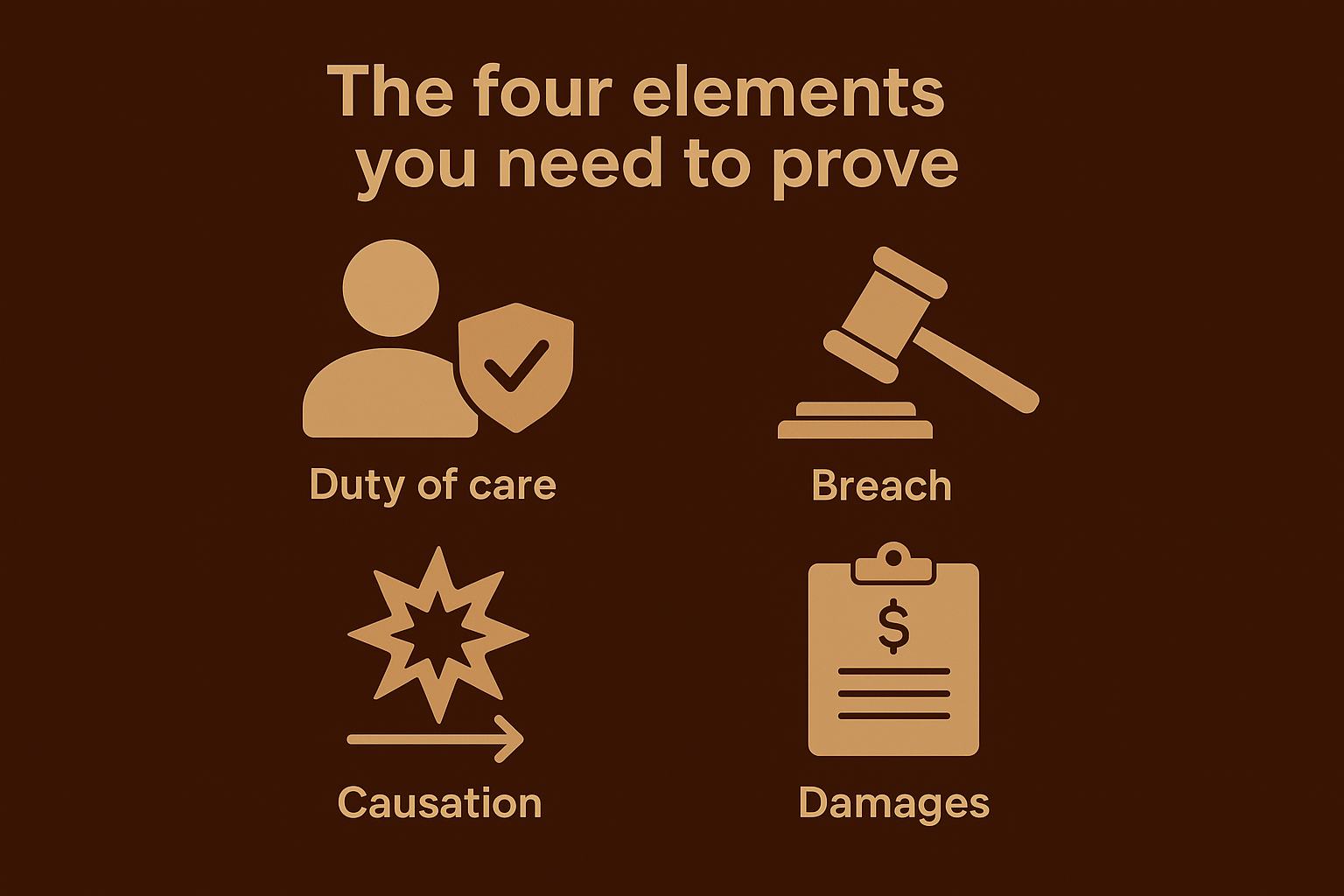
The four elements you need to prove
Every personal injury claim, no matter the category, rests on the same legal foundation. You and your attorney need to establish four things before an insurer or a court will take the claim seriously.
| Element | What it means | Example |
|---|---|---|
| Duty of care | The other party owed you a legal obligation to act safely | A driver must obey traffic laws |
| Breach | They failed to meet that obligation | Running a red light |
| Causation | Their breach directly caused your injury | The red-light violation caused the collision that broke your arm |
| Damages | You suffered actual harm, physical or financial | Medical bills, lost wages, pain and suffering |
A personal injury claim only holds up when you can connect someone else's careless action directly to your specific harm.
Missing any one of these four elements weakens your case significantly, which is why insurance adjusters spend so much time picking apart the causation and damages pieces. They know that if they can create doubt about whether your injury really came from the incident, they can justify a lower payout or deny the claim outright.
Why the category matters early on
Knowing which type of claim you're dealing with shapes almost everything that follows, including which insurance policy applies, how much time you have to act, and whether you're dealing with one insurer or several. Mississippi generally gives you three years from the date of injury to file a personal injury lawsuit, while Tennessee's statute of limitations runs just one year, so if you live near the state line or the accident happened while you were traveling, this distinction matters immediately. Medical malpractice and wrongful death cases sometimes carry different deadlines and notice requirements on top of that.
Understanding these basics now sets you up to handle the next steps correctly. Once you know your situation qualifies, the clock starts running on both your health and your legal options, which is exactly what the next section covers.
Step 1. Seek medical treatment right away
Getting checked out by a doctor is the single most important thing you do after any accident, and it matters just as much for your legal claim as it does for your health. Adrenaline masks pain, and injuries like concussions, soft tissue damage, and internal bleeding can take hours or days to show symptoms. If you wait, the insurance company will argue that something else caused your injury, not the accident, and that gap in your medical records becomes their strongest weapon.
The insurance company will use any gap between the accident and your first doctor visit as proof your injury wasn't serious.
Why timing changes your outcome
Insurers track the time between the incident and your first medical visit closely, and they use it to estimate how much your claim is worth. A visit within 24 to 48 hours signals a genuine, urgent injury. A visit two weeks later invites questions about whether you got hurt somewhere else entirely. Following through on every recommended treatment, from physical therapy to specialist referrals, also shows that your injury is real and ongoing rather than something you're exaggerating for a payout.
What to do in the first 48 hours
Follow these steps as soon as you're able, even if you feel fine at the scene:
- Go to an emergency room, urgent care, or your primary doctor the same day if possible
- Tell every provider exactly how the injury happened, not just what hurts
- Keep copies of discharge papers, imaging results, and prescriptions
- Attend every follow-up appointment, even ones that feel unnecessary
- Avoid posting about the accident or your recovery on social media
The Centers for Disease Control and Prevention notes that delayed treatment for traumatic injuries often leads to worse long-term outcomes, which is one more reason not to gamble with your health while you're also trying to protect a claim. Once you've started treatment, you're ready to move on to documenting exactly what happened.
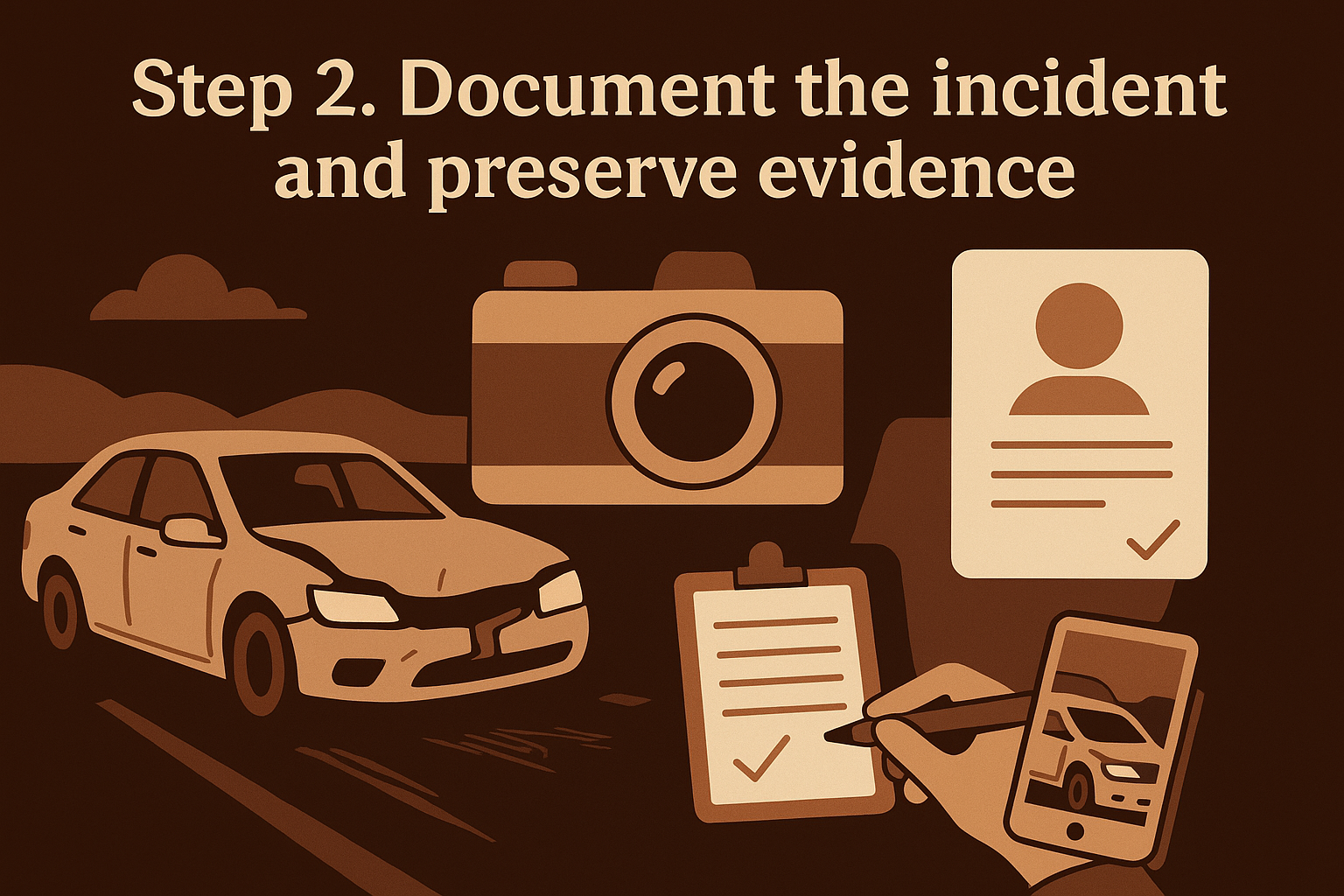
Step 2. Document the incident and preserve evidence
Evidence disappears fast. Skid marks fade, surveillance footage gets overwritten, and witnesses forget details within days. Documenting the incident thoroughly, starting the moment it's safe to do so, gives your attorney something concrete to work with instead of your memory alone. This is the step where most people leave money on the table simply because they didn't know what to collect or waited too long to collect it.
Gather evidence at the scene
Before anything moves, before you exchange information and drive away, capture as much of the scene as you safely can. Photos and video hold up far better than a written description months later. If you're too hurt to do this yourself, ask a passenger, a bystander, or a family member to handle it for you.
- Take photos of vehicle damage, road conditions, skid marks, and any visible injuries
- Get names and phone numbers of every witness, not just the other driver
- Request a copy of the police report or the report number
- Note the time, weather, and traffic signals at the scene
- Save the clothing or equipment you were wearing if it shows damage
Preserve evidence before it disappears
Given how quickly key evidence can vanish, don't assume it will still be available in a few weeks. Businesses near an accident site often keep surveillance footage for only 7 to 30 days before it's automatically deleted, so requesting it early matters. Your attorney can send a preservation letter to nearby businesses, employers, or property owners to legally require them to hold onto footage relevant to your case.
Evidence you don't collect in the first week rarely exists by the time your case goes to negotiation.
Hospitals and clinics also generate records that support your claim, so request itemized bills and full medical notes as you go rather than waiting until settlement talks begin. Keeping a simple folder, physical or digital, with every photo, receipt, and report in one place saves you and your lawyer significant time later. Once you've locked down this evidence, you're ready to bring in the insurance company and, if needed, an attorney.
Step 3. Notify the insurer and consult an attorney
Once you've documented the scene and started treatment, it's time to report the accident to the insurance companies involved. You need to notify your own insurer, and most policies require this within a specific window, sometimes as short as a few days. Skipping this step or delaying it can give the insurer grounds to deny coverage later, even if the accident wasn't your fault.
What to say (and not say) to adjusters
An adjuster's job is to settle your claim for as little as possible, and they're trained to get you talking. Keep your initial report short and factual.
- Give the date, time, and location of the accident
- State the basic facts without speculating about fault
- Avoid describing your injuries in detail or guessing how you'll recover
- Never accept a recorded statement without talking to a lawyer first
- Don't sign anything the insurer sends before your attorney reviews it
Never give a recorded statement to an insurance adjuster until a lawyer has reviewed your case.
Why you need a lawyer before things move further
Here's where a lot of people make an expensive mistake: they assume they can handle the claims process alone because the facts seem obvious. Insurance companies have entire departments dedicated to minimizing payouts, and they know the tactics that catch unrepresented claimants off guard, from quick lowball offers to requests for broad medical record releases that dig up unrelated history. A personal injury attorney levels that playing field immediately.
At Mayfield Law Firm, we offer a free consultation specifically so you can find out where you stand before you say anything else to an adjuster. Consulting an attorney early costs you nothing, and it means someone experienced is calculating your damages, tracking your state's filing deadlines, and handling every conversation with the insurer from that point forward. This matters even more when multiple parties or policies are involved, such as a commercial truck accident or a claim touching both Mississippi and Tennessee law, since the wrong move with one insurer can complicate your entire case.
Once your attorney is involved and the insurer has been formally notified, the case shifts into the phase most people picture when they think about filing a personal injury claim : negotiating for what you're actually owed, or preparing to take the matter to court.
Step 4. Negotiate a settlement or file suit
Once your attorney has calculated your damages and the insurer has made an opening offer, the real negotiation begins. Most personal injury claims settle before ever reaching a courtroom, but that only happens when both sides have enough information to agree on a number. Your lawyer will send a demand letter that lays out liability, medical costs, lost wages, and pain and suffering, then counter every lowball response the insurer sends back.
How the demand and counteroffer process works
Expect this stage to take weeks, sometimes months, depending on how complex your injuries are and how cooperative the insurer proves to be. A typical negotiation follows a predictable pattern:
- Your attorney sends a demand letter with supporting medical records and bills
- The insurer responds with an initial offer, usually well below the demand
- Your attorney counters with additional evidence or a revised figure
- Both sides go back and forth until you reach a number you're willing to accept
- You sign a release only after your attorney confirms the settlement covers all your damages
Never accept the first offer. Insurers build in room to negotiate because they expect you to counter.
When negotiation breaks down
Sometimes the insurer refuses to offer a fair number no matter how strong your evidence is. When that happens, filing a lawsuit becomes the next move, and Mississippi's three-year statute of limitations (Tennessee's is one year) puts a hard deadline on when your attorney can do this. Filing suit doesn't mean your case is heading to trial. It often pushes the insurer to negotiate seriously because litigation costs them money and exposes them to a jury verdict that could run higher than any settlement.
Throughout this stage, your attorney handles depositions, discovery requests, and any court filings while keeping you updated on realistic outcomes. Comparing a settlement offer against the risk and expense of trial is a judgment call that depends heavily on the strength of your evidence and how clear liability is. Reaching this point means you've already done the hard work of documenting your case, and now it's about making sure that work translates into full compensation rather than a rushed payout.
Protecting your right to compensation
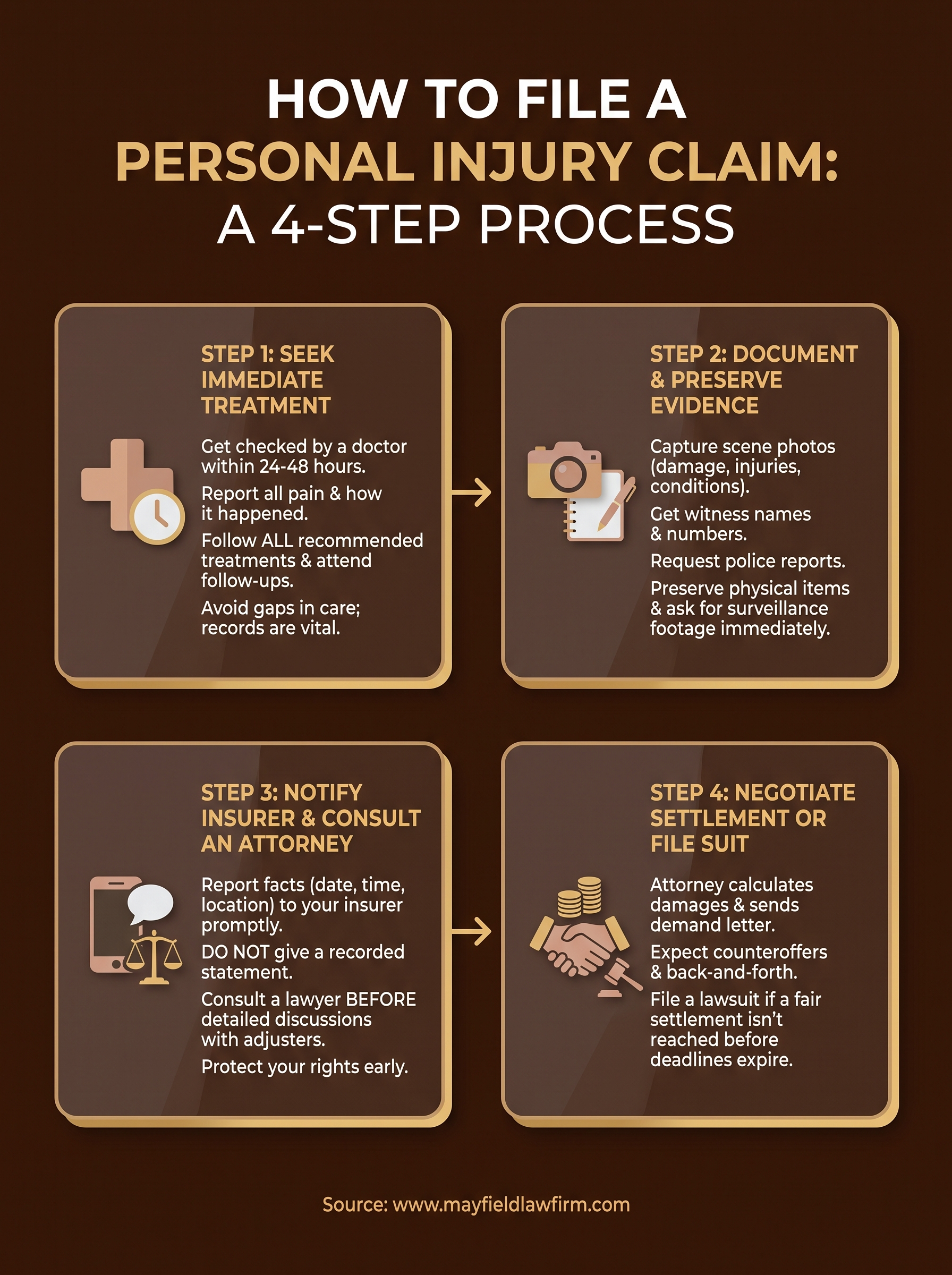
Filing a personal injury claim comes down to four things done in the right order: get treated, document everything, notify the insurer carefully, and negotiate from a position of strength. Skip a step or rush one, and you hand the insurance company an excuse to pay you less than you deserve. Deadlines and evidence don't wait for you to feel ready, so the sooner you act on each step, the stronger your case stays.
You don't have to figure this out alone, and honestly, you shouldn't try. A free consultation costs you nothing and gives you a clear read on where your case stands before you say another word to an adjuster. If you've been hurt in Northeast Mississippi or South Memphis, reach out to Mayfield Law Firm today and let us start protecting what you're owed.