
How to Find a Work Injury Attorney Near Me in 5 Steps
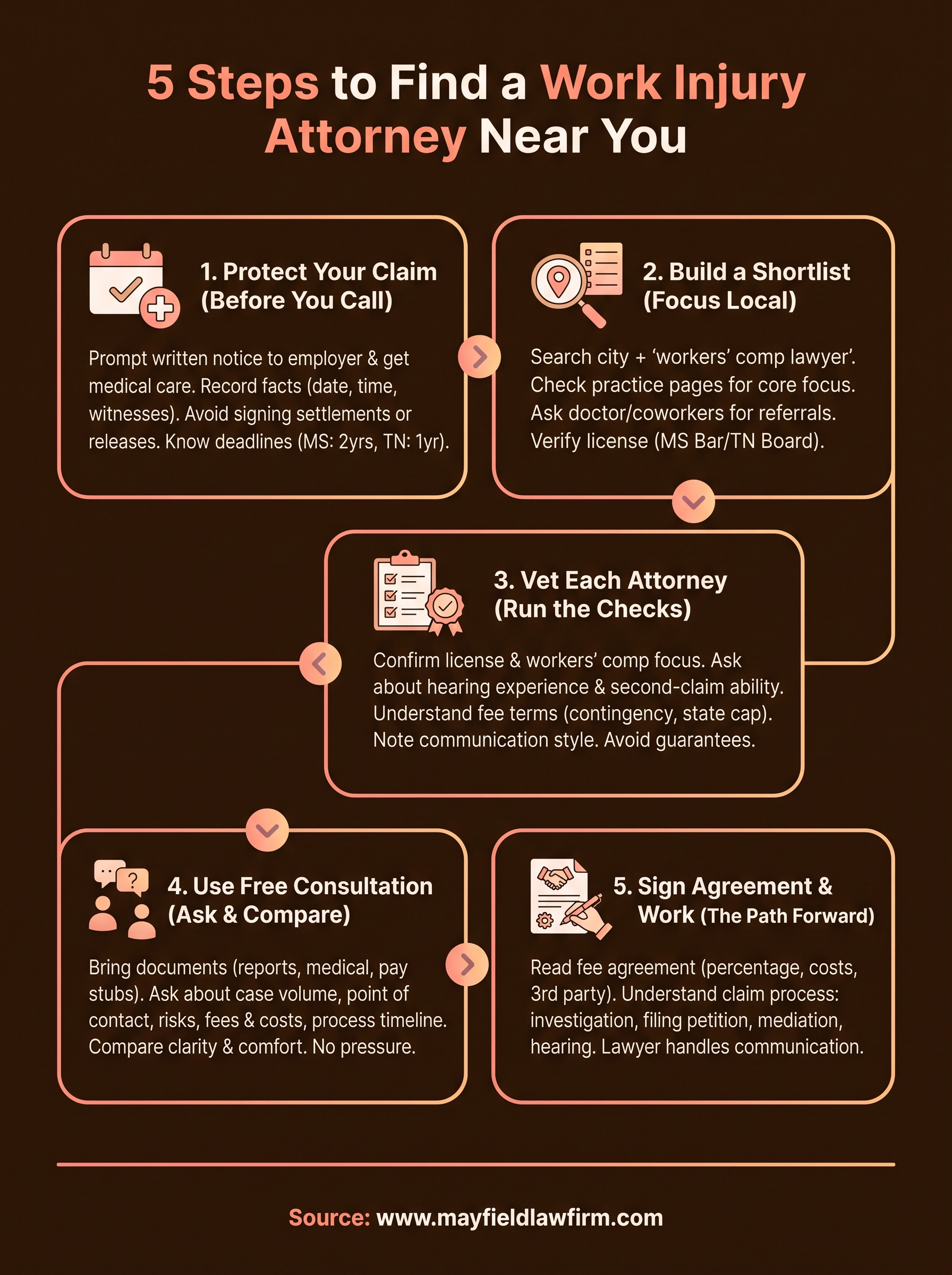
Finding a work injury attorney near me takes five steps. Protect your claim with prompt notice and medical care. Build a shortlist of lawyers who handle workers' compensation in the state where you were hurt. Vet each one. Use a free consultation to compare them. Then sign a fee agreement you understand. Do these in order and you can hire someone within a week or two, well before the deadlines start to bite.
The first days after a workplace injury are when people make costly mistakes. You are in pain, you are missing paychecks, and an insurance adjuster is already calling. A "near me" search returns a long list of firms that all promise results. None of them tells you how to tell them apart, or what you should do before the first call.
This guide covers all of it, with the rules that apply in Northeast Mississippi and across the line in Memphis. Mayfield Law Firm, P.A. has advocated for clients since 1974 and has offices in Tupelo, Southaven and Memphis, so the checks below come from the lawyer's side of the desk. Use them on any firm you are considering, including ours.
Why a local work injury attorney is worth it
You should hire a local attorney when your injury needs ongoing treatment, the insurer disputes your claim, or you cannot return to your old job at full capacity. Workers' compensation looks simple, but it runs on state-specific deadlines, forms, and medical evidence . The insurer handles these claims every day. You handle one, once. A lawyer closes that gap.
What the attorney does for you
Your attorney takes over the paperwork and the pressure. That includes confirming your employer reported the injury, filing a petition to controvert with the Mississippi Workers' Compensation Commission when a claim is denied or stalls, collecting medical records, and arguing your case at a hearing. When the insurer's doctor disagrees with yours, the lawyer builds the evidence to answer.
Beyond that, a good lawyer looks past your employer. If a negligent driver, a defective machine, or a subcontractor caused the injury, you may have a separate personal injury claim . Workers' comp pays for medical care and part of your lost wages. It does not pay for pain and suffering, and it usually bars a lawsuit against your own employer.
Workers' comp covers treatment and lost wages, and only a claim against a third party can cover pain and suffering.
What the lawyer costs you
Most work injury attorneys charge no fee upfront and take a percentage of what you recover. Mississippi law limits that percentage to 25% of the compensation awarded, and the Commission must approve the fee . Here is how it works for a worker who earns $900 a week and receives 20 weeks of disability benefits:
| Item | Amount |
|---|---|
| Average weekly wage | $900 |
| Weekly disability benefit (two-thirds) | $600 |
| 20 weeks of benefits | $12,000 |
| Maximum fee at 25% | $3,000 |
| What you keep | $9,000 |
Your weekly benefit is generally two-thirds of your average weekly wage, up to a state maximum, so higher earners may see a lower figure. Ask every firm which payments the percentage applies to and who covers case costs such as records and filing fees.
Why near you matters
A local lawyer knows the area's treating physicians, the insurers that handle claims here, and how hearings get scheduled. You can also sit down in person. If you live around Tupelo, Southaven, or South Memphis, that is a short drive instead of a phone tree.
Which state's law applies is also a location question. Mississippi and Tennessee set different clocks, and Southaven sits minutes from Memphis, so crossing the state line to work is common. Tell every lawyer where you were hired and where you were hurt, and confirm they are licensed in that state.
Step 1. Protect your claim before you call
Report the injury to your employer, get medical care, and learn your filing deadline before you sign anything or give a recorded statement. Everything a work injury attorney near you does later is easier when these basics are on the record.
Do these five things in the first days
Start with this list. It takes an hour, and it protects the facts that decide most claims.
- Tell your supervisor right away , then confirm in writing. An email or text works, and you should keep a copy.
- Get medical care and tell every provider the injury happened at work. Describe every symptom, even minor ones.
- Write down what happened : date, time, location, equipment involved, and the names of witnesses.
- Keep your paper trail : the incident report, medical records, pay stubs, and any messages with your employer or the insurer.
- Do not sign a settlement or release until a lawyer has read it.
Your employer is expected to report the injury to its insurance carrier. If days pass and no one gives you claim information or sends you to a doctor, treat that silence as a reason to call a lawyer sooner.
Know which deadline applies
Missing a deadline can end a valid claim, so check the clock for the state where you were hurt. These are the general rules, and exceptions exist, so do not rely on an exception.
| Mississippi | Tennessee | |
|---|---|---|
| Notify your employer | Written notice within 30 days | Within 15 days |
| File your claim | Within 2 years of the injury | Within 1 year of the injury |
Mississippi's two-year limit is the statute of limitations on a workplace injury claim. Payments from the insurer can change when the clock runs out in some cases, but you should never count on that.
Report in writing within days, and file well inside your state's limit, because the deadline is the one thing a lawyer cannot fix later.
What to say to the adjuster
You need to cooperate with your employer's insurer, but you can politely decline a recorded statement until you have talked to an attorney. Stick to facts: what happened, where it hurts, and what your doctor said.
Avoid phrases like "I'm fine" or "it's not that bad," and do not guess about causes. Be honest about prior injuries, because hidden history that surfaces later hurts more than the history itself. Stay off social media, where a photo of you lifting a box can be used against you.
Step 2. Build a shortlist of nearby attorneys
Aim for three to five attorneys who handle workers' compensation in the state where you were hurt and who offer a meeting option you can actually use. A short list you can fully vet beats a long one you cannot.
Search the right way
Searching "near me" is a start, but add a city and a practice term, such as " workers' comp lawyer Tupelo" or "work injury attorney Southaven." Open the profile and practice-area pages of each result. A firm that lists workplace injuries as a core practice is a better fit than one that lists fifteen unrelated areas.
Then widen the pool beyond ads. Ask your treating doctor's office, coworkers who went through a claim, and the state bar's lawyer referral service . Verify each name with the Mississippi Bar or the Tennessee Board of Professional Responsibility, which show whether a license is active and whether discipline exists.
Match the location to your situation
Pick offices you can reach while injured. Driving is hard with a back injury or a restricted arm, so ask whether a firm offers virtual meetings as well as in-person ones. Mayfield Law Firm, for example, meets clients at its downtown Tupelo, Southaven and Memphis offices and by video.
Then match the state. If you live in Mississippi but were hurt on a job site in Memphis, you may need a lawyer licensed in Tennessee. Our attorneys are licensed in both states, and any firm should be able to say clearly which state's cases it takes. Write each candidate down with its office, practice focus, and licensed states.
The right shortlist is short, local to where you can travel, and licensed in the state where your claim lives.
Step 3. Vet each attorney on the shortlist
Check license, workers' comp focus, trial experience, ability to pursue a second claim, fee terms, and communication habits. You can do most of this from websites and public records before you ever pick up the phone.

Run the checks
Use this table as a scorecard. A candidate who fails the first row is out, and the rest tell you who to call first.
| Check | How to verify | Good sign |
|---|---|---|
| License and discipline | State bar directory | Active license in the right state, no serious discipline |
| Workers' comp focus | Practice pages, direct question | Workplace injuries are a core practice |
| Hearing experience | Ask about contested cases | Has argued cases before the Commission, not only settled them |
| Second-claim ability | Check whether the firm handles car and truck cases | Can pursue a workers' comp claim and a third-party claim together |
| Fee terms | Ask for the percentage and who pays costs | Contingency, nothing upfront, fee inside the state cap |
| Communication | Ask who answers your calls | A named contact who responds within a business day |
Treat years of experience as a starting point. Our founding attorney, Kenneth Mayfield, has more than 40 years in civil litigation, but ask any firm what kinds of cases that experience covers .
Spot the warning signs
Walk away from a firm that guarantees an outcome or a dollar figure before it has seen your records. No honest lawyer can promise that. The same goes for pressure to sign on the spot, or a firm that reaches out to you unprompted right after your accident.
Be wary when nobody will say who actually handles your file. Large firms can still work well, but you should leave the first call knowing one person's name and how to reach them. If a firm cannot tell you that, expect to chase it later.
Step 4. Use the free consultation to decide
Book consultations with your top two or three picks within the same few days, bring your documents, and ask each lawyer the same questions. Comparing like with like is how you find the best fit. Most work injury attorneys offer a free consultation, and ours is free too.
What to bring
Bring everything you have. Missing pieces are fine, because a lawyer can request them.
- The incident report or your own notes about what happened
- Medical records, discharge papers, and work restrictions
- Recent pay stubs
- Any denial letter or insurer correspondence, plus the adjuster's name
- Photos of the scene or injury, and witness names
- Anything you signed for your employer or the insurer
Questions to ask every lawyer
Put these in the same order each time and write down the answers.
- How many workers' comp cases do you handle in a year?
- Who will work on my file, and who do I call with questions?
- What do you think is the biggest risk in my claim?
- Do I have a possible claim against anyone besides my employer?
- What is your fee, what does it apply to, and who pays case costs?
- How long do cases like mine usually take?
- Will you meet with me in person or by video?
- What should I do right now to protect my claim?
Judge the answers
Specific answers beat confident ones. A lawyer who names the likely dispute in your case , such as whether the doctor will tie your condition to work, understood your file. A lawyer who says "you have a great case" after ten minutes did not.
Confirm that "free" means no obligation. You should be able to leave without signing, think it over, and compare. Between two equally qualified firms, choose the one that explained the process most clearly , because that person will be explaining it to you for months.
A good consultation ends with specific risks, a clear fee, and no pressure to sign that day.
Step 5. Sign the agreement and work the case
Sign only after you have read the fee agreement in full, then expect a steady sequence: your lawyer takes over communication, builds the medical record, and goes to the Commission if the insurer will not pay. Knowing the path keeps you from guessing at every silence.
Read the fee agreement
Check that the percentage stays within the state cap and that the agreement says which payments it applies to. Look at how case costs are handled, such as medical records, filing fees, and expert reports. Some firms advance them and deduct them from your share, so know which.
Find out what happens if you end the relationship, and whether a third-party claim is covered by the same agreement or a separate one. A separate claim often carries its own terms. Ask for a copy to take home before you sign.
What happens after you hire
Most contested claims follow this path, though yours may resolve earlier.
- Your lawyer notifies the insurer and handles all communication.
- The legal team collects medical records and asks your doctors about work restrictions and any lasting impairment.
- The insurer accepts the claim, pays part of it, or denies it.
- If it is disputed, your lawyer files a petition to controvert with the Commission.
- The case goes to mediation or a hearing before an administrative judge.
- A losing party can appeal to the full Commission, then to the courts.
How hard is it to win
A well-documented claim is far easier than a messy one. Prompt notice, consistent treatment, and clear medical opinions tying the injury to work carry most cases . Denials usually come from late reporting, disputes over whether the condition is work-related, pre-existing conditions, gaps in treatment, and disagreements about restrictions. A denial is a starting point for a dispute, not a final answer.
If someone other than your employer caused the injury, watch that separate deadline . In Mississippi, general negligence claims have a three-year limit, and Tennessee's is one year. Your lawyer should flag it at the first meeting.
Strong claims rest on fast notice and steady treatment, and a denial usually starts a dispute rather than ending a claim.
Your next step after a work injury
Finding a work injury attorney near you comes down to a sequence. Protect your claim with written notice and medical care, shortlist lawyers licensed where you were hurt, vet them against the same checklist, use free consultations to compare answers, and read the fee agreement before you sign. Each step narrows the field and keeps you ahead of the deadlines that matter most.
You do not need to have every document or answer before you ask for help. If you were hurt at work in Northeast Mississippi or around Memphis, schedule a free consultation with Mayfield Law Firm and bring what you have. We will tell you where your claim stands and what to do next.