Personal Injury Lawyer: What They Do and How to Hire One
You got hurt because someone else was careless, and now you're stuck with medical bills, missed paychecks, and an insurance adjuster who keeps lowballing you. That's usually the moment people start searching for a lawyer personal injury lawyer and wonder what actually separates a good one from someone who just files paperwork and waits for a check.
A personal injury lawyer investigates your accident, deals with insurance companies, calculates what your claim is truly worth, and takes the case to trial if a fair settlement never comes. Hiring the right one means checking their track record with cases like yours and understanding how their fees actually work before you sign anything.
This article breaks down what these lawyers do day to day, when you genuinely need one versus when you can handle a claim yourself, and the specific questions to ask during a consultation. If you're in Northeast Mississippi or South Memphis dealing with a car accident, workplace injury, or wrongful death claim, you'll walk away knowing exactly how to find someone who'll fight for you instead of settling fast and moving on.
Why hiring a personal injury lawyer matters
Insurance adjusters aren't paid to be fair to you. Their job is to close claims for as little money as possible, and they're trained to use recorded statements, quick settlement offers, and confusing paperwork to do it. A personal injury attorney levels that playing field the moment they send a letter of representation, because adjusters know a represented claimant won't accept a lowball number without a fight.
The gap between DIY claims and represented claims
Studies from the Insurance Research Council have repeatedly found that people who hire attorneys after an accident recover significantly more money, even after legal fees, than people who negotiate on their own. That gap exists because insurance companies calculate settlement offers differently once they know a case might go to a courtroom instead of staying a phone call. Without representation, you're negotiating against a professional who does this full-time, while you're recovering from an injury and probably talking to them for the first time in your life.
A lawyer doesn't just file paperwork, they change how much the other side is willing to pay.
What a lawyer actually does for your claim
A qualified injury lawyer handles the duties a personal injury lawyer takes on that most people either don't know how to do or don't have time to do while healing. That includes:
- Investigating the accident scene, pulling police reports, and preserving evidence before it disappears
- Identifying every liable party, including ones you might not have considered, like a trucking company or property owner
- Calculating the full value of your claim, including future medical costs and lost earning capacity, not just current bills
- Negotiating directly with insurance adjusters so you're not pressured into a fast, low settlement
- Filing a lawsuit and preparing for trial if the insurance company refuses to offer a fair number
Each of those steps requires knowledge of Mississippi and Tennessee injury law that most claimants simply don't have, and mistakes early in a case are hard to fix later.
When you might not need one
Not every fender bender requires a lawyer. If you had a minor collision with no injuries, minimal vehicle damage, and the other driver's insurer is offering to cover your repair costs without argument, you can often handle that yourself. The calculation changes fast once you have an emergency room bill, missed work, ongoing physical therapy, or any dispute over who caused the accident. Genuine legal representation becomes worth the cost the moment liability is contested or your injuries require more than a few visits to urgent care, and there are clear signs it's time to call a lawyer now.
Why local experience matters in Mississippi and Tennessee
Filling out an insurance claim form looks the same everywhere, but the law behind it doesn't. Mississippi follows a pure comparative negligence rule, meaning your compensation gets reduced by your percentage of fault, even if you're 99% not at fault, which is one reason costs and claim rules for a Mississippi crash case deserve a closer look. Tennessee uses modified comparative fault, which can bar you from recovering anything if you're found 50% or more responsible. A lawyer who practices regularly in Tupelo, Southaven, and Memphis courts understands how local judges, insurance adjusters, and opposing counsel typically handle these rules, and that familiarity often shapes strategy from the first phone call.
| Situation | Handle it yourself | Hire a personal injury lawyer |
|---|---|---|
| Minor damage, no injury | Usually fine | Not necessary |
| ER visit or ongoing treatment | Risky | Recommended |
| Disputed fault | Very risky | Strongly recommended |
| Insurance denies or delays claim | Difficult | Recommended |
| Wrongful death or catastrophic injury | Not advisable | Essential |
Once you land in that bottom half of the table, waiting to call a lawyer usually costs you money and leverage. Evidence gets harder to gather, witnesses forget details, and insurance companies use every week you wait as a sign your injuries weren't serious. The firms that build a real track record with auto accident and personal injury claims in Northeast Mississippi and South Memphis, including cases involving car and truck accidents, workplace injuries, and wrongful death, tend to know exactly which adjusters negotiate in good faith and which ones need a lawsuit filed before they'll take a claim seriously. That kind of practical knowledge doesn't show up in a Google search, and it's usually the difference between a settlement that covers your bills and one that leaves you short.
How to hire the right personal injury lawyer
Finding a name online takes thirty seconds. Knowing how to find a personal injury lawyer for your specific situation takes a bit more homework, and skipping that step is how people end up with a lawyer who settles fast instead of fighting hard. The goal isn't just hiring "a lawyer," it's hiring someone whose experience, caseload, and communication style actually match what your case needs.
Look for experience with your type of case
A lawyer who mostly handles slip-and-fall claims isn't necessarily the right pick for a wrongful death case or a multi-vehicle truck accident, so it helps to know how to vet an injury lawyer's local experience first. Ask specifically how many cases like yours the attorney has handled in the last few years, and ask what the outcomes looked like. A firm that regularly works auto accidents, workplace injuries, and wrongful death claims across Northeast Mississippi and South Memphis will already know which insurance companies drag their feet and which judges expect certain paperwork filed a specific way.
Check their track record, not just their advertising
Billboards and TV ads don't tell you whether a lawyer wins cases or settles everything quietly for whatever the insurer offers first. Look at client reviews on the sites worth trusting, ask for case results during your consultation, and pay attention to whether the lawyer talks about trial experience or only mentions settlements. A personal injury law firm that's willing to take a case to trial usually negotiates from a stronger position, because insurance companies know bluffing won't work on them.
The lawyer who's willing to go to trial is usually the one who gets you the better settlement offer.
Pay attention to how they communicate
During your free consultation, notice whether the lawyer explains things in plain language or buries you in legal terms you don't understand. Ask who will actually handle your file day to day, since some firms hand cases off to junior staff after the initial meeting. You want someone who returns calls, answers your texts within a reasonable time, and treats your case like more than a number on a spreadsheet.
Watch for these red flags
Some warning signs show up before you ever sign a retainer agreement. Watch for:
- Pressure to sign immediately without reading the contract
- Vague answers about how contingency fees or case costs work
- A lawyer who won't discuss past case results or client references
- Promises of a specific settlement amount before investigating your case
- Difficulty reaching anyone at the firm after your first meeting
Any one of these should slow you down, and more than one is a reason to keep looking.
Use the free consultation to compare firms
Most reputable firms, including Mayfield Law Firm, offer a free consultation specifically so you can ask questions before committing to anyone, and it helps to know what actually happens in that first meeting. Bring your medical records, police report, and any correspondence from the insurance company, and use that meeting to gauge whether the lawyer actually listens to your situation instead of rushing through a script. Comparing two or three firms before you sign costs you nothing but time, and it's the single best way to avoid hiring a personal injury attorney who isn't the right fit for your case.
How personal injury lawyer fees and costs work
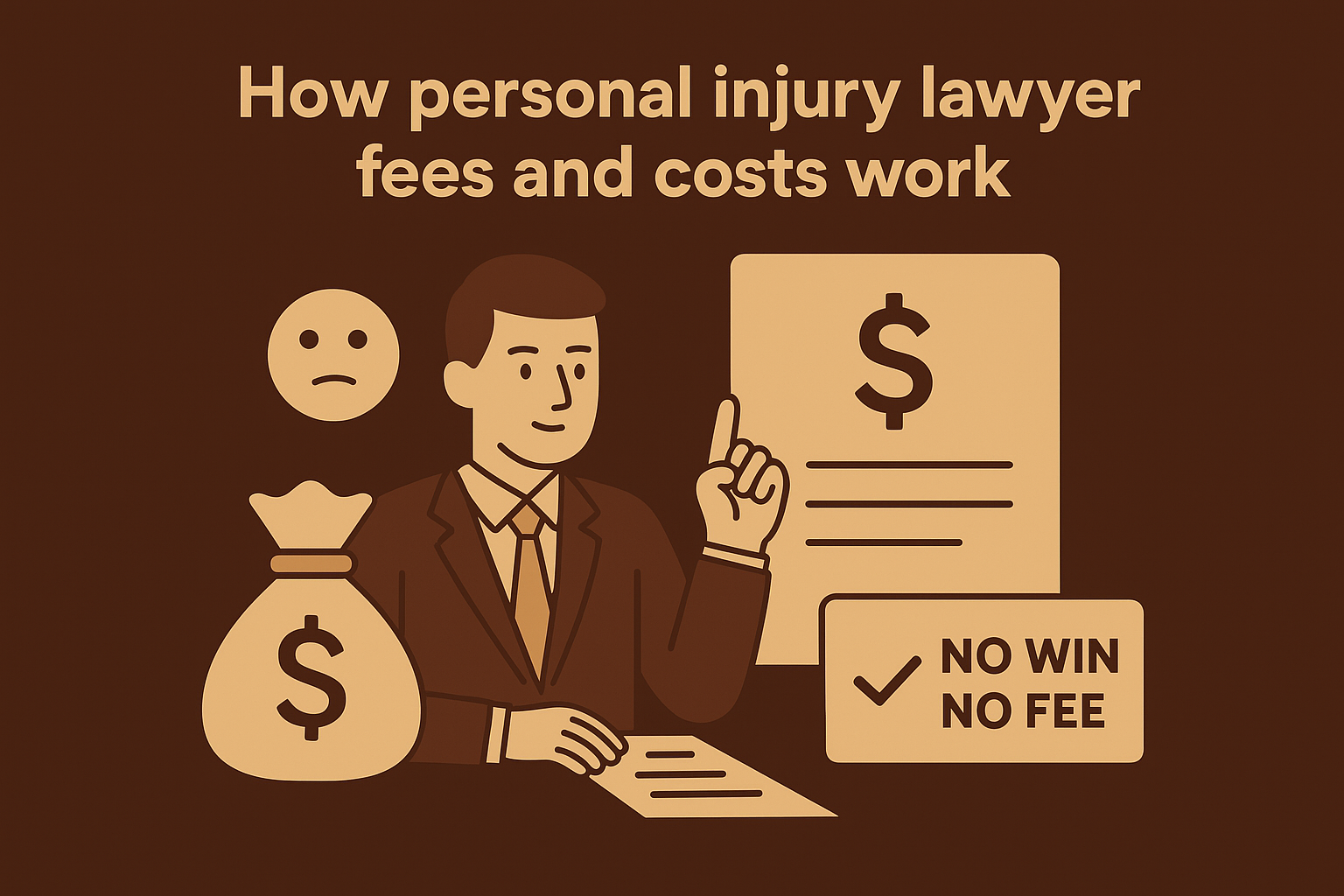
Money worries shouldn't stop you from calling a lawyer, and for most injury cases they don't have to. Nearly every personal injury lawyer works on a contingency fee basis, meaning you pay nothing unless the lawyer wins your case and nothing out of pocket along the way. That arrangement exists specifically so injured people with no income coming in can still afford quality representation, and it's one of the reasons free consultations are so common in this field.
How contingency fees actually work
Under a contingency agreement, the lawyer takes an agreed percentage of your final settlement or verdict, typically between 33% and 40%, and how those percentages and litigation costs add up often depends on whether the case settles early or goes to trial. Ask for that percentage in writing before you sign anything, and ask whether it changes if a lawsuit gets filed. A contingency fee arrangement means your lawyer only gets paid when you get paid, which lines up their incentive with yours from day one.
If your lawyer doesn't win, you don't owe an attorney's fee, period.
Case costs versus attorney fees
Fees and costs aren't the same thing, and mixing them up leads to confusion at settlement time. The attorney's fee is the percentage cut for legal work. Case costs are the actual expenses of building your claim, and they get deducted separately, usually from the settlement before your remaining share gets calculated. Typical case costs include:
- Filing fees for court documents
- Costs of obtaining medical records and police reports
- Expert witness fees, such as accident reconstructionists or medical specialists
- Court reporter and deposition costs if the case proceeds to litigation
- Postage, copying, and administrative expenses tied directly to your file
Ask upfront whether the firm advances these costs or expects reimbursement regardless of outcome. Most firms handling auto accident and personal injury claims front these expenses and only recover them if you win, but that's a detail worth confirming in your consultation rather than assuming.
What a typical fee breakdown looks like
Seeing the math helps most people understand where their settlement money actually goes. Here's a simplified example based on a $60,000 settlement with a 33% contingency fee:
| Item | Amount |
|---|---|
| Total settlement | $60,000 |
| Attorney's fee (33%) | $19,800 |
| Case costs (example) | $2,500 |
| Amount you receive | $37,700 |
Exact numbers shift based on your fee agreement and how much litigation the case required, but a transparent lawyer will walk through this math with you before you ever sign, not after the check arrives.
Questions worth asking about costs upfront
Getting cost details in writing protects you from surprises at the end of a case. Reasonable clients ask their personal injury attorney whether the percentage increases if a lawsuit is filed, whether they'll owe anything if the case is lost, and who pays for expert witnesses if the claim doesn't settle. A firm that answers these plainly, without vague language or discomfort, is generally one that respects clients enough to be straightforward about how the arrangement works from the very first meeting.
Common types of cases a personal injury lawyer handles
Personal injury covers a wider range of situations than most people assume, and the right lawyer for a rear-end collision isn't automatically the right lawyer for a mass tort claim involving a defective product. Case complexity varies enormously depending on how many parties are involved, how clear liability is, and how severe the injuries turn out to be. Understanding where your situation fits helps you ask better questions during a consultation and avoid hiring someone whose experience doesn't actually match your claim.
Auto, truck, and motorcycle accidents
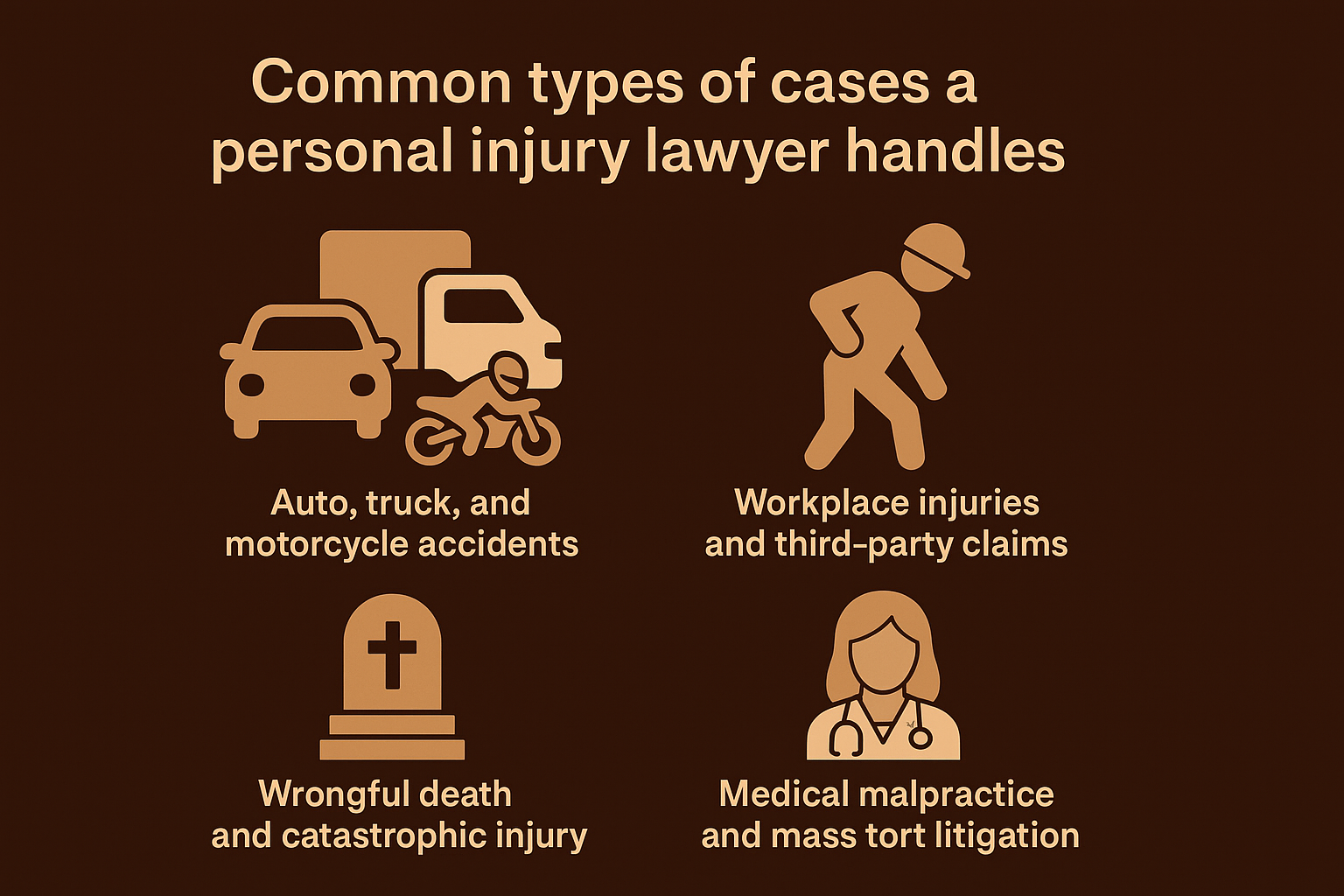
Car accidents make up the bulk of personal injury cases, but truck and motorcycle wrecks bring their own complications. Truck accident claims in Mississippi often involve a trucking company, a cargo loader, and sometimes a maintenance contractor in addition to the driver, which means more insurance policies and more parties pointing fingers at each other. Motorcycle cases carry a built-in bias problem, since juries and adjusters sometimes assume the rider was at fault before looking at the facts, which is exactly when a motorcycle accident attorney earns their keep. A firm handling auto accident and motor vehicle claims regularly across Northeast Mississippi and South Memphis knows how to pull commercial driving logs, black box data, and maintenance records before they disappear.
Workplace injuries and third-party claims
Getting hurt on the job usually means filing a workers' compensation claim first, but that's not always the end of the story, and choosing the right workplace injury lawyer matters more than most people expect. If a third party, like a subcontractor, equipment manufacturer, or property owner, contributed to the accident, you may also have a separate personal injury claim against them. These cases require sorting out which damages workers' comp covers and which ones a third-party lawsuit can recover, including pain and suffering that workers' comp doesn't pay for at all.
A workplace injury can trigger two separate claims, and missing the second one leaves real money on the table.
Wrongful death and catastrophic injury
Losing a family member because of someone else's negligence adds a legal layer on top of an already devastating loss. Filing a wrongful death claim in Mississippi and Tennessee allows surviving family members to recover funeral costs, lost future income, and loss of companionship, but the rules about who can file vary by state. Catastrophic injuries, like spinal cord damage or traumatic brain injury, follow a similar pattern, since future medical needs and lost earning capacity often dwarf the initial hospital bill.
Medical malpractice and mass tort litigation
Medical malpractice cases require proving a provider deviated from an accepted standard of care, which almost always means hiring a medical expert to testify, so know what to ask a malpractice lawyer about experts and strategy. Mass tort and class action litigation, like claims involving a defective drug or medical device, groups together many injured people with similar claims against the same company, though each person's damages get calculated individually. Both case types demand deep resources and specialized knowledge that a general practice attorney rarely has on hand.
| Case type | Typical liable parties | Common complicating factor |
|---|---|---|
| Car accident | Other driver, insurer | Disputed fault |
| Truck accident | Driver, trucking company | Multiple insurance policies |
| Workplace injury | Employer, third-party contractor | Workers' comp overlap |
| Wrongful death | At-fault party, employer | State-specific filing rules |
| Medical malpractice | Doctor, hospital, provider | Requires expert testimony |
Each case type above changes how a lawyer investigates, negotiates, and, if needed, litigates your claim, which is exactly why matching your lawyer's experience to your specific situation matters more than picking whoever answers the phone first.
Questions to ask before hiring a personal injury lawyer
Walking into a free consultation without a plan wastes the one chance you have to see how a personal injury lawyer actually operates before you sign anything. The right questions to ask before you hire cut through the sales pitch and show you whether this firm treats your case as a priority or just another file. Bring a notepad, write down the answers, and compare them across every firm you meet before making a decision.
Questions about experience and case results
Start with the lawyer's track record on cases that resemble yours, not their overall years in practice. A firm that's handled hundreds of slip-and-falls but only a handful of truck accidents may not know how to pull black box data or negotiate against a trucking company's insurer. Ask directly:
- How many cases like mine have you handled in the last two or three years?
- What were the typical settlement ranges for those cases?
- Have you taken a case like mine to trial, and what happened?
- Do you have references or reviews from past clients I can look at?
Vague or evasive answers here are a warning sign, not a coincidence.
Questions about who handles your case day to day
Many firms hand cases off to paralegals or junior associates after the initial meeting, which is fine as long as you know it's happening. Ask who will be your main point of contact, how quickly they typically return calls, and whether the attorney you're meeting with will personally review your file or just sign off on someone else's work. You deserve to know exactly who's managing your injury claim before you commit to working with them for months.
Questions about strategy, settlement, and trial
A lawyer's approach to negotiation tells you a lot about the outcome you can expect. Ask how they typically decide when to settle versus when to file a lawsuit, and ask what percentage of their cases actually go to trial. A firm that settles everything immediately may be avoiding the work and risk of litigation, even when a jury would likely award more.
Ask how a lawyer decides when to settle, because that answer predicts how your case will end.
Also ask how they calculate the value of a claim, since a lawyer who only counts current medical bills is leaving future costs and lost earning capacity off the table entirely.
Questions about costs, updates, and communication
Finally, nail down the practical details that affect your day-to-day experience as a client. Confirm the contingency fee percentage in writing, ask how often you'll receive case updates, and find out whether you can reach the lawyer directly or only through a receptionist. A firm handling auto accident and personal injury cases across Northeast Mississippi and South Memphis should be able to answer every one of these questions without hesitation, and if they can't, that tells you something important before you ever sign a retainer agreement.
How long you have to file a personal injury claim
Missing a filing deadline can end your case before it starts, no matter how strong your evidence is or how clearly the other driver caused the wreck. Every state sets a statute of limitations , a hard cutoff date by which you must file a lawsuit, and courts rarely make exceptions once that window closes. Knowing your deadline the day you get hurt, not the day you finally call a lawyer, protects your right to recover anything at all.
Mississippi's three-year window
Georgia gets shorter deadlines, but Mississippi's personal injury filing deadline gives injured people three years from the date of the accident to file a lawsuit under Miss. Code Ann. § 15-1-49. That covers most car accidents, slip-and-falls, and workplace third-party claims. Wrongful death claims also carry a three-year deadline, though the clock typically starts on the date of death rather than the date of the original injury. Claims against a government entity, like a city-owned vehicle or a county road defect, fall under the Mississippi Tort Claims Act, which requires written notice within one year, far shorter than the standard deadline.
Tennessee's one-year window
Tennessee moves much faster. Under Tenn. Code Ann. § 28-3-104, Tennessee's one-year injury filing deadline gives you just one year from the date of injury to file a personal injury lawsuit, and the same one-year clock applies to most wrongful death claims. That tighter deadline is exactly why South Memphis residents shouldn't wait to talk to a lawyer after an accident, since evidence and witness memory fade fast, and a year disappears quicker than most people expect once medical treatment and recovery take over daily life.
A missed filing deadline can erase a valid claim overnight, no matter how strong the evidence is.
| State | Personal injury deadline | Wrongful death deadline | Government claim notice |
|---|---|---|---|
| Mississippi | 3 years | 3 years | 1 year written notice |
| Tennessee | 1 year | 1 year | 1 year written notice |
Exceptions that can change your deadline
Several situations shift these standard deadlines, and knowing which one applies to your case matters just as much as knowing the general rule. Common exceptions include:
- Discovery rule : the clock may start when you reasonably discover an injury rather than the date it occurred, which matters most in medical malpractice cases
- Minors : the statute of limitations often pauses until the injured person turns 18, then restarts
- Defendant leaves the state : some states pause the clock while the at-fault party is out of state and can't be served
- Government defendants : shorter notice periods apply regardless of the standard deadline
Relying on these exceptions without a lawyer's confirmation is risky, since courts interpret them narrowly and inconsistently. Talking to a personal injury lawyer early, even before you're sure you'll file a lawsuit, means someone is tracking your deadline instead of you guessing at it while dealing with medical appointments and insurance calls. That single phone call often makes the difference between preserving your claim and losing it to a date you never realized had already passed.

Taking the next step after your injury
You've now got a real framework for hiring a personal injury lawyer , from checking their trial record to understanding contingency fees before you sign anything. The core takeaway hasn't changed: insurance companies negotiate differently once they know you have representation, and waiting to make that call only costs you evidence, leverage, and time you can't get back once a filing deadline passes.
Every case is different, but the pattern holds across car accidents, workplace injuries, and wrongful death claims alike. The lawyer willing to prepare for trial usually gets the better settlement offer, and the firm that answers your questions plainly is usually the one that treats your case like it matters.
If you're dealing with an injury in Northeast Mississippi or South Memphis, don't sit on a deadline hoping the insurance company plays fair. Reach out to Mayfield Law Firm for a free consultation and find out exactly where your claim stands.