Uber Personal Injury Lawyer: What They Do and When to Hire One
Getting hurt in an Uber crash puts you in a legal gray zone most people never expect to navigate. You're not dealing with one insurance company, you're dealing with three or four: the driver's personal policy, Uber's commercial coverage, and possibly the other vehicle's insurer too. That's exactly why people search for an uber personal injury lawyer instead of trying to handle the claim alone.
An Uber accident lawyer's job is straightforward: figure out which insurance policies apply based on whether the driver was logged into the app, waiting for a ride request, or actively transporting a passenger, then build a claim that holds the right party accountable. Timing matters too. Uber's insurance rules shift depending on the driver's status at the moment of the crash, and missing that detail can cost you thousands in a settlement.
This article breaks down what an Uber personal injury lawyer actually does day to day, walks through the coverage tiers that determine your payout, and lays out the signs that tell you it's time to stop negotiating on your own and bring in someone who knows how rideshare claims work in Mississippi and Tennessee.
Why you need an Uber personal injury lawyer after a crash
Most car accidents involve two drivers and two insurance companies. An Uber accident claim involves at least three parties fighting over who pays what, and each one has lawyers whose job is to pay you as little as possible. Uber classifies its drivers as independent contractors, not employees, which means the company tries to distance itself from liability every time a crash happens. That legal distance is exactly why a rideshare accident attorney who understands Uber's corporate structure matters more here than in a typical fender-bender.
The insurance maze you didn't sign up for
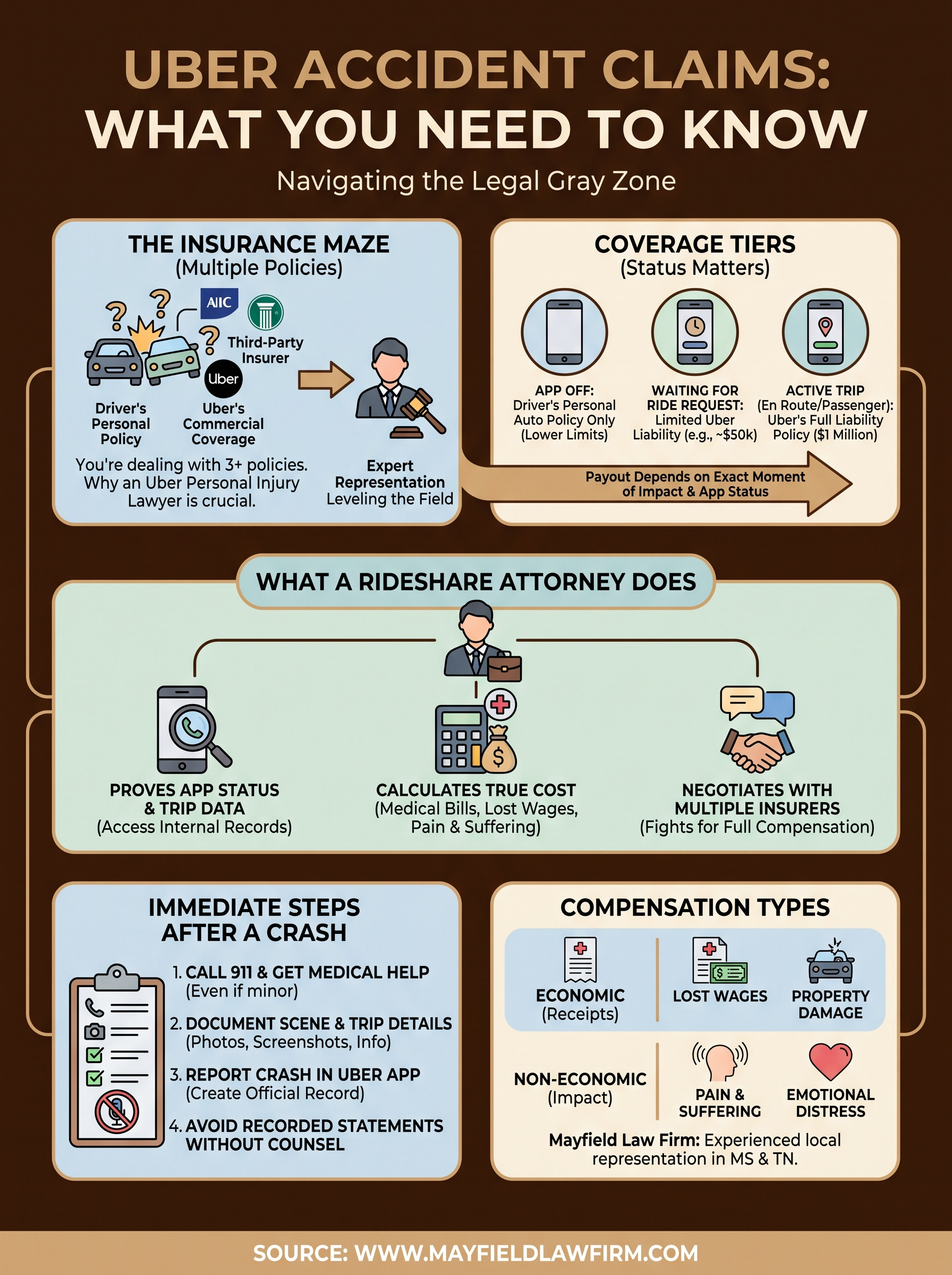
When you're hurt as a passenger, a pedestrian, or the driver of another vehicle, you're not just filing one claim. You're dealing with the Uber driver's personal auto policy, Uber's own commercial liability coverage, and sometimes a third insurer if another car caused the crash. Each policy has different coverage limits depending on whether the driver was offline, waiting for a ride request, or actively transporting a passenger at the time of impact. Insurance adjusters know these distinctions intimately. Most accident victims don't, and that gap gets exploited constantly.
The insurance company that pays your claim depends entirely on what the driver's app screen showed at the moment of the crash.
Uber's insurer isn't on your side
Once you file a claim, Uber's insurance carrier assigns an adjuster whose only goal is minimizing the payout. They'll ask you to give a recorded statement early, before you know the full extent of your injuries. They'll offer a quick settlement that sounds reasonable but rarely covers future medical care, lost wages, or long-term pain and suffering. Adjusters are trained negotiators working for a company with deep pockets and a legal team on retainer. Facing that alone puts you at a real disadvantage, and it's a big reason so many injured riders and drivers end up settling for far less than their claim is worth.
Signs it's time to call a lawyer
Some Uber accidents are minor enough to resolve without legal help. Others aren't, and knowing the difference early saves you money and stress. Consider hiring an Uber injury claim lawyer if any of the following apply to your situation:
- You suffered injuries requiring hospitalization, surgery, or ongoing physical therapy
- The Uber driver, another driver, or Uber's insurer disputes fault for the crash
- You're unsure whether the driver was logged into the app or on an active trip
- An adjuster has already contacted you about a settlement
- Your injuries are keeping you out of work for more than a few days
- You're dealing with injuries in Mississippi or Tennessee, where comparative negligence rules can reduce your payout if you're found partly at fault
Each of these situations involves legal or financial stakes that a lawyer is trained to handle, and waiting too long to bring one in can weaken your case before it even starts.
What a lawyer brings that you can't do alone
A good attorney doesn't just file paperwork. They pull the driver's trip data, request Uber's internal records showing the driver's app status, and calculate the true cost of your injury, including expenses most people forget like future medical treatment and diminished earning capacity. They also know how to communicate with insurers in a way that protects your statements from being twisted later. If you're weighing whether to hire an uber personal injury lawyer or handle the claim yourself, remember that insurance companies count on injured people not knowing their rights. Leveling that playing field is the entire point of bringing in representation, and it often makes the difference between a lowball offer and a settlement that actually covers what you've lost.
How to choose the right Uber accident lawyer for your case
Not every personal injury attorney has handled a rideshare claim before, and that gap shows up fast once negotiations start. Rideshare cases hinge on details like app logs, trip status, and layered insurance policies that a general practice lawyer may not touch regularly. Before you sign a retainer, ask direct questions about the attorney's track record with Uber and Lyft claims specifically, not just car accidents in general.
Ask about rideshare-specific experience
Start by asking how many Uber or Lyft cases the attorney has actually handled, not just car wrecks in general. Someone who's negotiated with Uber's insurance carrier before knows their tactics, their typical opening offers, and how long they'll stall before making a fair one.
- How many Uber or Lyft accident cases have you resolved in the past two years?
- Have you dealt with Uber's contracted insurance carrier before, and what was the outcome?
- Can you explain how driver status (offline, waiting, or en route) affects which policy applies?
- Do you have experience obtaining trip data and driver app records from Uber directly?
An attorney who can't explain Uber's coverage tiers off the top of their head probably hasn't handled enough of these cases to fight for you effectively.
Local knowledge matters more than you'd think
Mississippi and Tennessee handle comparative negligence differently, and that difference can shrink or protect your settlement depending on how your case gets argued. A local personal injury attorney who's tried cases in Tupelo, Southaven, or Memphis courts understands how local judges and juries tend to view fault in rideshare crashes, and that regional insight shapes case strategy in ways an out-of-state firm simply can't replicate. Firms with physical offices across Northeast Mississippi and South Memphis also make it easier to meet face to face, which matters when you're explaining injuries and financial losses that a phone call can't fully capture.
Understand the fee structure before you sign
Most personal injury attorneys work on contingency, meaning you pay nothing upfront and the fee comes out of your settlement or verdict. Before signing anything, confirm the percentage, ask whether it changes if the case goes to trial, and find out who covers costs like expert witnesses or medical record requests if the case doesn't win. A firm that explains this clearly upfront, without vague answers or pressure to sign quickly, is usually one that respects your position as the client, not just a case number.
Trust your first consultation
Mayfield Law Firm offers a free consultation specifically so you can ask these questions before committing to anything. Use that meeting to gauge how the attorney communicates, whether they listen to the specifics of your crash, and whether they give you a realistic read on your case instead of empty promises. If you leave that first conversation feeling informed rather than pressured, that's usually a strong sign you've found the right team for your Uber accident claim.
What compensation can you recover after an Uber accident
Compensation after an Uber crash typically falls into two buckets: economic losses you can document with receipts and pay stubs, and non-economic losses that cover the physical and emotional toll of the injury. An uber personal injury lawyer builds your claim around both, because insurers routinely undervalue the second category unless someone pushes back with evidence and a clear demand letter.
Economic damages you can prove with paperwork
Medical bills are the obvious starting point, but they're rarely the full picture. Lost wages stack up fast if your injury keeps you off the job for weeks or months, and future lost earning capacity matters even more if you can't return to the same work at all. Property damage, transportation costs to medical appointments, and out-of-pocket expenses for home care or modifications also belong on this list.
| Damage Type | Examples |
|---|---|
| Medical expenses | ER visits, surgery, physical therapy, prescriptions |
| Lost income | Missed paychecks, reduced hours, lost bonuses |
| Future earning loss | Reduced capacity to work in your prior role |
| Property damage | Vehicle repair or replacement |
| Out-of-pocket costs | Mileage to appointments, home care assistance |
Non-economic damages that insurers try to minimize
Pain and suffering doesn't come with a receipt, which is exactly why adjusters lowball it. A rideshare accident settlement should also account for emotional distress, loss of enjoyment of life, and, in relationships affected by the injury, loss of consortium. Mississippi and Tennessee both allow these damages, but proving them takes more than a doctor's note. It takes documented pain journals, testimony from people who've watched your daily life change, and sometimes expert input from a treating physician.
Insurance adjusters can calculate a medical bill in seconds, but they can't calculate what a permanent injury costs you unless someone forces them to look closer.
When punitive damages come into play
Punitive damages aren't standard in every case. They show up when a driver's conduct goes beyond ordinary negligence, think drunk driving, excessive speeding, or a driver ignoring a suspended license while still active on the app. Courts in both states reserve these for conduct that's reckless or intentional, not simple mistakes, so your attorney needs solid evidence before pursuing this category.
Recovering the full range of compensation requires more than adding up bills. It requires knowing which insurance tier applies to your specific injury and negotiating each category separately instead of accepting a lump-sum offer that quietly shortchanges your pain and suffering. That's the work a personal injury attorney puts into every Uber claim before a number ever gets discussed with the other side.
How Uber's insurance coverage affects your claim
The amount of coverage available after an Uber crash depends entirely on the driver's app status at the exact moment of impact. Uber structures its insurance coverage in tiers, and each tier carries a dramatically different payout ceiling. Get the tier wrong, or let an adjuster misclassify it, and you could be fighting for a fraction of what your claim is actually worth.
The three coverage periods explained
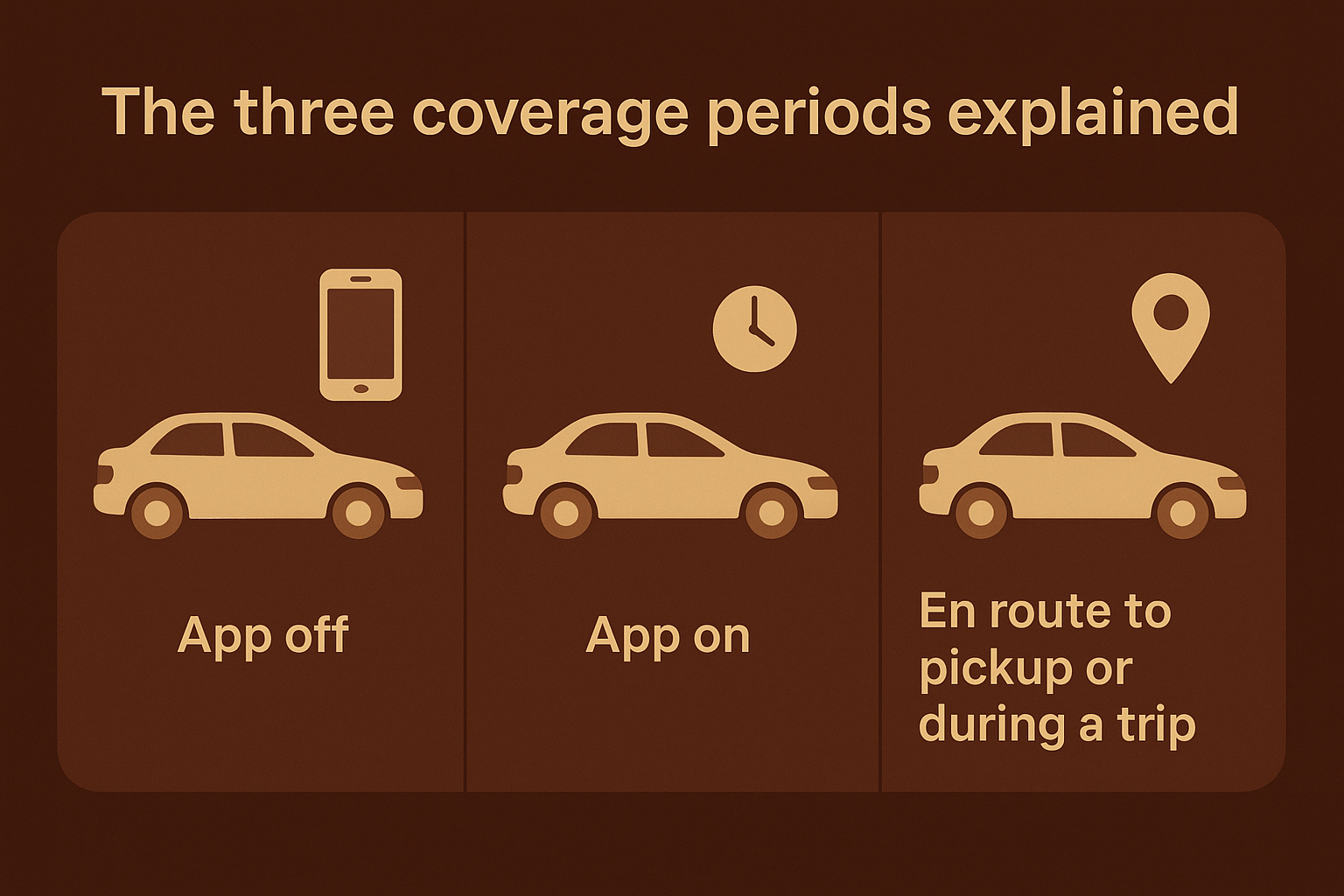
Before you file anything, you need to know which period applies to your crash. Uber's policy breaks down like this:
| Driver Status | Coverage Available |
|---|---|
| App off | Driver's personal auto policy only |
| App on, waiting for a ride request | Limited Uber liability coverage (typically up to $50,000 per person) |
| En route to pickup or during a trip | Uber's $1 million liability policy applies |
Notice the gap between tier two and tier three. A driver who's simply logged in but hasn't accepted a ride yet carries far less protection than one actively transporting a passenger. Uber's insurance rules hinge on that distinction, and it's often the first thing an adjuster tries to argue in the company's favor.
A driver being logged into the app isn't the same as being covered by Uber's full policy, and that gap is where a lot of claims fall apart without a lawyer pushing back.
Why the app status gets disputed constantly
Insurers know that proving app status requires access to Uber's internal trip data, records most accident victims can't get on their own. Adjusters sometimes claim a driver was offline or between rides when trip logs show otherwise. Requesting that data formally, often through a subpoena or a direct records request tied to a pending claim, is one of the first moves a rideshare accident attorney makes. Without that documentation, you're stuck taking the insurer's word for which tier applies, and that word usually favors the lowest possible payout.
Stacking coverage when multiple parties are at fault
Some crashes involve a negligent third-party driver in addition to the Uber vehicle, which means you may be able to pursue that driver's policy alongside Uber's coverage. Stacking claims like this requires careful sequencing so one settlement doesn't undercut your ability to pursue the other. Coordinating this correctly can substantially increase your total recovery, especially in cases involving serious injuries where a single policy limit wouldn't come close to covering medical costs and lost income. This is where experienced representation earns its fee, because most people don't realize multiple policies can apply to the same crash at all.
What to do immediately after an Uber accident
What you do in the first hour after a crash shapes the rest of your claim more than almost anything else. Evidence disappears, memories fade, and insurance adjusters start building their version of events before you've even left the scene. Following a clear sequence protects your health and your Uber accident claim at the same time.
Immediate safety and documentation steps
Safety comes first, but documentation has to happen right behind it, before the scene changes or the vehicles get towed. Use this checklist as your guide:
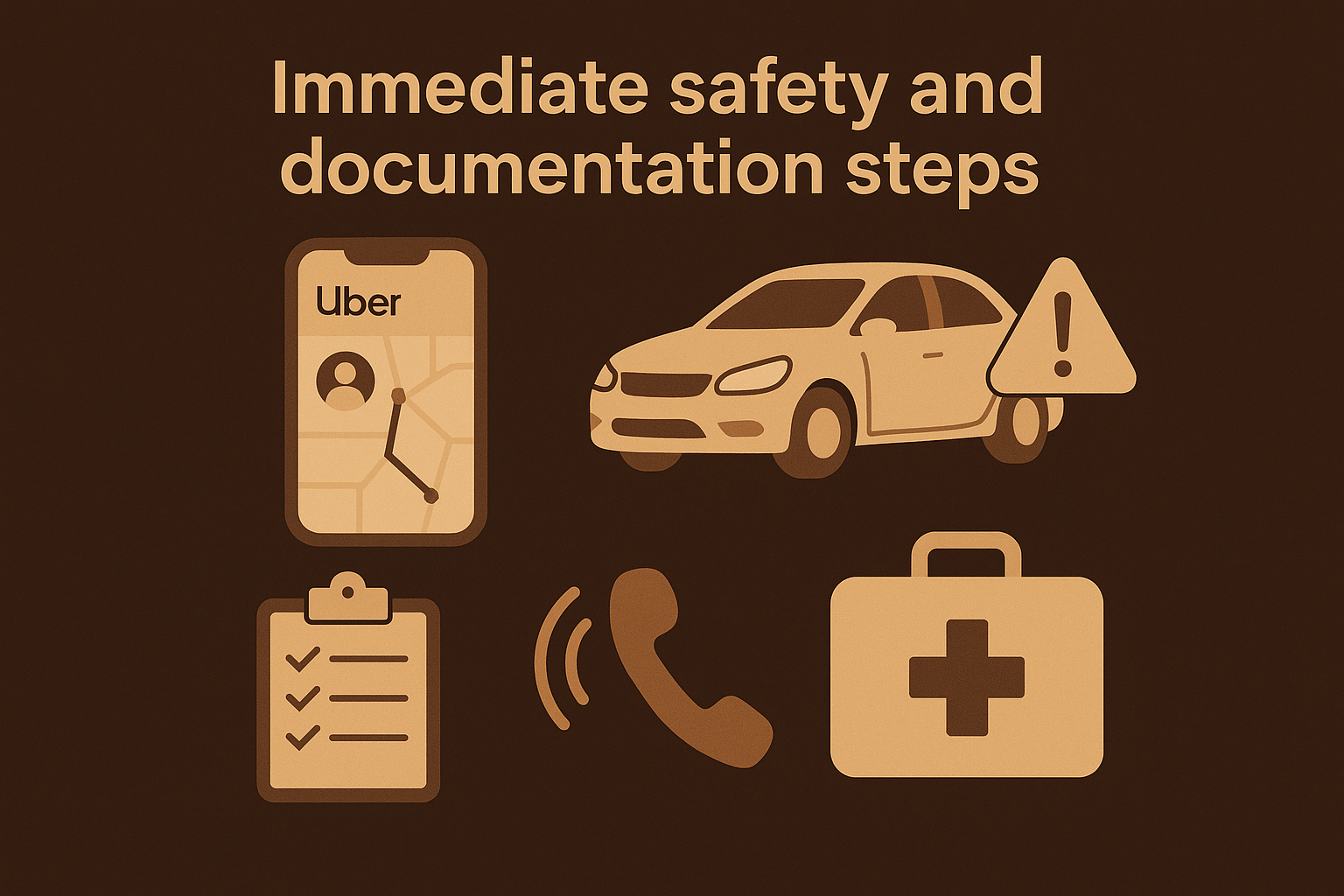
- Call 911 and request police and medical response, even if injuries seem minor at first
- Take photos of both vehicles, the road conditions, traffic signals, and any visible injuries
- Screenshot the Uber trip details from the app, including driver info, trip status, and timestamps
- Get contact and insurance information from every driver involved, not just the Uber driver
- Collect names and phone numbers from witnesses before they leave the scene
- Request a copy of the police report number for follow-up
Screenshots of the trip screen taken minutes after the crash often carry more weight than anything an adjuster says later about the driver's app status.
Seek medical care even if you feel fine
Adrenaline masks pain, and injuries like whiplash, concussions, or soft tissue damage sometimes don't show symptoms for days. Getting evaluated immediately creates a medical record that ties your injuries directly to the crash, which matters enormously once an insurer starts questioning whether your pain is related to something else entirely. Skipping this step, even for a day or two, gives adjusters an opening to argue your injuries came from somewhere unrelated to the accident.
Report the crash through the Uber app
Beyond calling police, report the accident directly through Uber's app under the trip history section. This creates an official company record separate from the police report, and it starts the clock on Uber's internal claims process. Keep a copy of whatever confirmation the app generates, since these records sometimes disappear or get harder to access later.
Avoid these common mistakes
Saying too much at the scene, or too little documentation, can quietly weaken a claim that otherwise would have been straightforward. Avoid these missteps:
- Don't admit fault or apologize at the scene, even out of instinct
- Don't give a recorded statement to Uber's insurer before speaking with a lawyer
- Don't accept a quick settlement offer before understanding the full scope of your injuries
- Don't post about the accident on social media while your claim is pending
Handling these steps correctly in the first 24 to 48 hours gives your rideshare accident attorney far more to work with once you decide to bring one in.
Protecting your rights after an Uber accident
An Uber crash puts you up against a corporate insurance structure built to limit payouts, not cover your losses. Knowing the coverage tiers , documenting the scene correctly, and getting medical care right away all protect your claim, but none of that replaces having someone fight for the full value of what you've lost. The gap between a lowball offer and a fair settlement often comes down to whether you had representation that knew how to push back.
Mayfield Law Firm has spent over 40 years handling injury claims across Northeast Mississippi and South Memphis, and that experience extends directly to the layered insurance disputes rideshare crashes create. Free consultations mean you can get a real answer about your case before deciding anything. If you've been hurt in an Uber accident, don't negotiate with an adjuster alone. Reach out to Mayfield Law Firm's personal injury attorneys today and find out what your claim is actually worth.