How to Find a Personal Injury Lawyer for Your Case
You're hurt, the bills are stacking up, and an insurance adjuster keeps calling with an offer that sounds too low to be real. Figuring out how to find a personal injury lawyer right now, while you're dealing with pain and paperwork, feels overwhelming. Most people have never hired an attorney before and don't know what separates a good fit from a bad one until it's too late.
This guide gives you a clear path forward. You'll learn exactly what to check before you sign anything, including case experience in your specific type of accident and how a firm actually communicates with clients once the retainer is signed. We'll also cover the questions to ask during a free consultation so you walk in prepared instead of guessing.
We've built this guide from what actually matters in Mississippi and Tennessee accident cases, whether you're dealing with a car wreck, a workplace injury, or a wrongful death claim. By the end, you'll know how to separate firms that talk a good game from ones with the track record and resources to actually fight for you.
Do you actually need a personal injury lawyer?
Not every accident calls for a lawyer. If you slipped in a parking lot with no injury beyond a bruised ego, or a fender-bender left your bumper scratched but nobody hurt, you can probably handle the claim yourself. Minor property damage claims with clear fault and cooperative insurance companies rarely justify attorney fees. But the moment injuries, disputed fault, or serious money enter the picture, the math changes fast.
When you can likely skip a lawyer
Self-representation works best in narrow situations. Consider handling your own claim only if all of these apply:
- No injuries requiring more than a single urgent care visit
- The other driver's insurance company has already accepted fault in writing
- Your medical bills total less than a few thousand dollars
- You have no lost wages or missed work
- The settlement offer covers your bills with room to spare
If even one of these doesn't fit your situation, that's your signal to start looking for representation.
When you need a lawyer, no question
Serious injuries change everything about a claim. Broken bones, surgery, permanent scarring, head trauma, or any injury that keeps you out of work for weeks puts you in territory where insurance companies fight hardest and pay the least without pressure. The same goes for wrongful death claims, workplace accidents involving third parties, and any crash where the other driver was uninsured, underinsured, or a commercial vehicle. Multi-vehicle pileups and cases with disputed liability also need an attorney, because proving fault gets complicated once more than two parties point fingers at each other.
If your injury changed how you work, sleep, or move through daily life, you need a lawyer negotiating on your behalf, not an adjuster deciding your value for you.
Insurance companies employ adjusters whose job is minimizing payouts. They're trained negotiators working against you from day one, and they know most unrepresented claimants don't understand the true value of pain and suffering, future medical care, or lost earning capacity. A Bureau of Labor Statistics report on workplace injuries shows how often serious accidents lead to extended time away from work, which is exactly the kind of damage adjusters try to lowball. Studies from the Insurance Research Council have repeatedly found that injured claimants who hire attorneys recover more money on average than those who negotiate alone, even after accounting for legal fees.
Think about the stakes honestly. If you're facing months of physical therapy, a permanent disability, or a claim worth tens of thousands of dollars, the cost of skipping a lawyer usually far exceeds the contingency fee you'd pay one. Consultations are free at most personal injury firms, so there's no financial risk in at least getting an opinion before you decide to go it alone.
Step 1. Gather your accident and medical records
Before you call a single attorney, spend an hour pulling together everything related to your accident. Firms decide fast whether a case is worth taking, and a disorganized pile of papers slows that decision down or gets your case passed over entirely. Organized documentation signals a serious client, and it also lets a lawyer give you a real answer during your first conversation instead of a vague "we'll see."
What to collect before you call anyone
Start with a folder, physical or digital, and drop in these items as you find them:
- Police report or incident report number
- Photos of the accident scene, vehicle damage, and visible injuries
- Names and contact info for witnesses
- All medical records and bills from every provider you've seen
- Your own written timeline of symptoms and missed workdays
- Insurance correspondence, including any settlement offers already made
- Pay stubs showing lost wages, if you missed work
Why this step protects your claim
Hospitals and clinics don't always release records quickly, so request them the same week as your accident if you can. Medical documentation with clear dates connects your treatment directly to the crash, which matters because insurance companies look for any gap they can use to argue your injuries came from something else. Request itemized bills, not just balance summaries, since attorneys need the breakdown to calculate damages accurately.
Insurance adjusters read files looking for holes. A thin file with missing dates or unexplained treatment gaps gives them exactly the excuse they need to undervalue your claim.
A well-documented file turns a lawyer's first impression of your case into a strong one, and it's the fastest way to find a personal injury lawyer who takes your claim seriously from day one.
Understand that this record-gathering never really stops. New bills and follow-up appointments keep arriving for months, so keep adding to that same folder as your treatment continues.
Step 2. Build a shortlist of candidate attorneys
Once your file is in order, start pulling together names. Aim for four to six firms before you narrow anything down, because comparing options is the only way to spot real differences in experience and communication style. Skipping this step and hiring the first name you see, whether from a billboard or a late-night commercial, is how people end up with an attorney who doesn't actually handle their type of case.
Where to look for candidates
Good sources for names tend to overlap with where you already trust information. Pull from a mix of these:
- Referrals from friends, family, or coworkers who've filed a similar claim
- Your state bar association's lawyer referral service
- Recommendations from a doctor or chiropractor who treats accident patients regularly
- Online reviews on Google and the Better Business Bureau, read carefully rather than skimmed
- Local firms with physical offices in your city, not just a call center
Mississippi and Tennessee both maintain active bar directories, and checking a lawyer's license status there takes five minutes and confirms they're in good standing before you invest any time.
Narrow the list to three or four
Once you have your initial names, cut the list down using a few quick filters. Drop any firm that doesn't handle your specific accident type, doesn't offer a free consultation , or has no local office you can visit in person. Location matters more than people expect, since a firm without a presence near the courthouse where your case would be filed may not know the local judges, adjusters, or opposing counsel.
A shortlist built on referrals, licensing checks, and local presence beats a random search result every time.
Rank your remaining three or four firms loosely, with your top pick based on gut instinct from initial phone calls or intake conversations. That ranking isn't final, it just gives you a logical order for the deeper vetting in the next step.
Step 3. Vet each lawyer's experience and track record
Narrowing your list to a name on a website isn't the same as knowing the person can win your case. Before you book a consultation, dig into each firm's actual history with cases like yours. Trial experience matters here more than most people realize, because a lawyer who's never taken a case past the negotiating table has less leverage when an insurance company refuses to budge.
What to check before you call
Run through this list for every firm still on your shortlist:
- How many years the attorney has practiced personal injury law specifically, not law in general
- Whether they've handled your exact accident type (auto, workplace, wrongful death, medical malpractice)
- Their trial history, not just settlement numbers
- Any published verdicts, settlements, or case results on their site
- Bar association standing and any disciplinary history
- Whether the same attorney handles your case start to finish, or if it gets passed to junior staff
Where to find this information
Most of this is public. Your state bar's website shows license status and any disciplinary actions in minutes. Court records, often searchable online through county clerk sites, show whether a firm actually files lawsuits or settles everything quietly, which tells you a lot about their willingness to fight. Case results posted on a firm's website deserve a skeptical read since they're marketing material, but a total absence of any verdict or settlement history is its own red flag.
A lawyer's past verdicts and settlements tell you more about your future than anything printed on their homepage.
Search the attorney's name alongside terms like "reviews" or "complaints" to catch anything a firm wouldn't volunteer. Testimonials on a firm's own site are useful but incomplete, so cross-reference them against independent review platforms. Firms with decades of combined experience across multiple practice areas, like auto accidents, workplace injuries, and wrongful death, tend to have systems in place for building strong cases rather than learning as they go.
Step 4. Ask the right questions during your consultation
Walking into a free consultation without a plan wastes the one chance you have to see how a firm actually operates. Most attorneys spend the first ten minutes talking about themselves, so you need specific questions ready to cut through the pitch and get real answers about how your case would be handled.
Questions that reveal how they'll handle your case
Bring this list and don't leave until you get direct answers to each one:
- Who will actually work on my case day to day, you or a paralegal?
- How many cases like mine have you handled in the past three years?
- What's your assessment of my case's strengths and weaknesses so far?
- How often will you update me, and through what method?
- Do you expect this to settle, or is trial realistic here?
- What's your estimate of my claim's value, and what's that based on?
The questions you ask in a consultation matter more than the answers you get, because vague or evasive responses tell you exactly how much attention you'd receive later.
Read the room, not just the résumé
Pay attention to how the attorney listens, not just what credentials they list. A lawyer who interrupts you to talk about case results from other clients, or who can't answer basic questions about your accident type, probably won't give your file the attention it needs once the retainer's signed. Communication style matters just as much as trial record, since you'll be dealing with this person for months, sometimes over a year for complicated claims.
Watch for pressure tactics too. Any firm pushing you to sign before you've had time to think, or refusing to put fee terms in writing, deserves a hard pass regardless of how impressive their intake staff sounds. The right attorney answers your questions plainly, explains realistic timelines without guaranteeing outcomes, and leaves you feeling informed rather than rushed.
Step 5. Compare fees and confirm the right fit
Most personal injury attorneys work on contingency fees , meaning you pay nothing upfront and the firm only collects if you win. That structure removes cost as a barrier, but the percentage they take and what counts as case expenses varies enough between firms that you need to compare terms side by side before signing anything.
Understand contingency fee structures
Fee percentages typically climb the longer a case runs, since more work and risk go into a trial than a quick settlement. Ask each firm for their exact breakdown before you commit.
| Case Stage | Typical Fee Range |
|---|---|
| Settled before filing suit | 25% to 33% |
| Settled after filing suit | 33% to 40% |
| Resolved through trial | 40% |
A contingency fee only protects you if the contract spells out exactly what happens to expenses when you lose.
Get the fee agreement in writing
Before you sign, confirm these details are written into your contract, not just explained verbally:
- Exact percentage at each stage of the case
- Who covers costs like expert witnesses, filing fees, and medical record requests
- Whether you owe anything if the case doesn't result in a recovery
- How costs get deducted, before or after the attorney's percentage is calculated
Deducting costs before the percentage split usually favors you slightly, so ask directly if that's unclear.
Trust your comparison, not just your first impression
Weigh the fee terms against everything you learned in Steps 3 and 4. The cheapest percentage doesn't matter if the firm lacks trial experience or ignores your calls. Choose the attorney whose track record, communication, and fee structure together give you the most confidence, because this is a relationship you're stuck with for months, not a single transaction you can undo easily.
Moving forward with your case
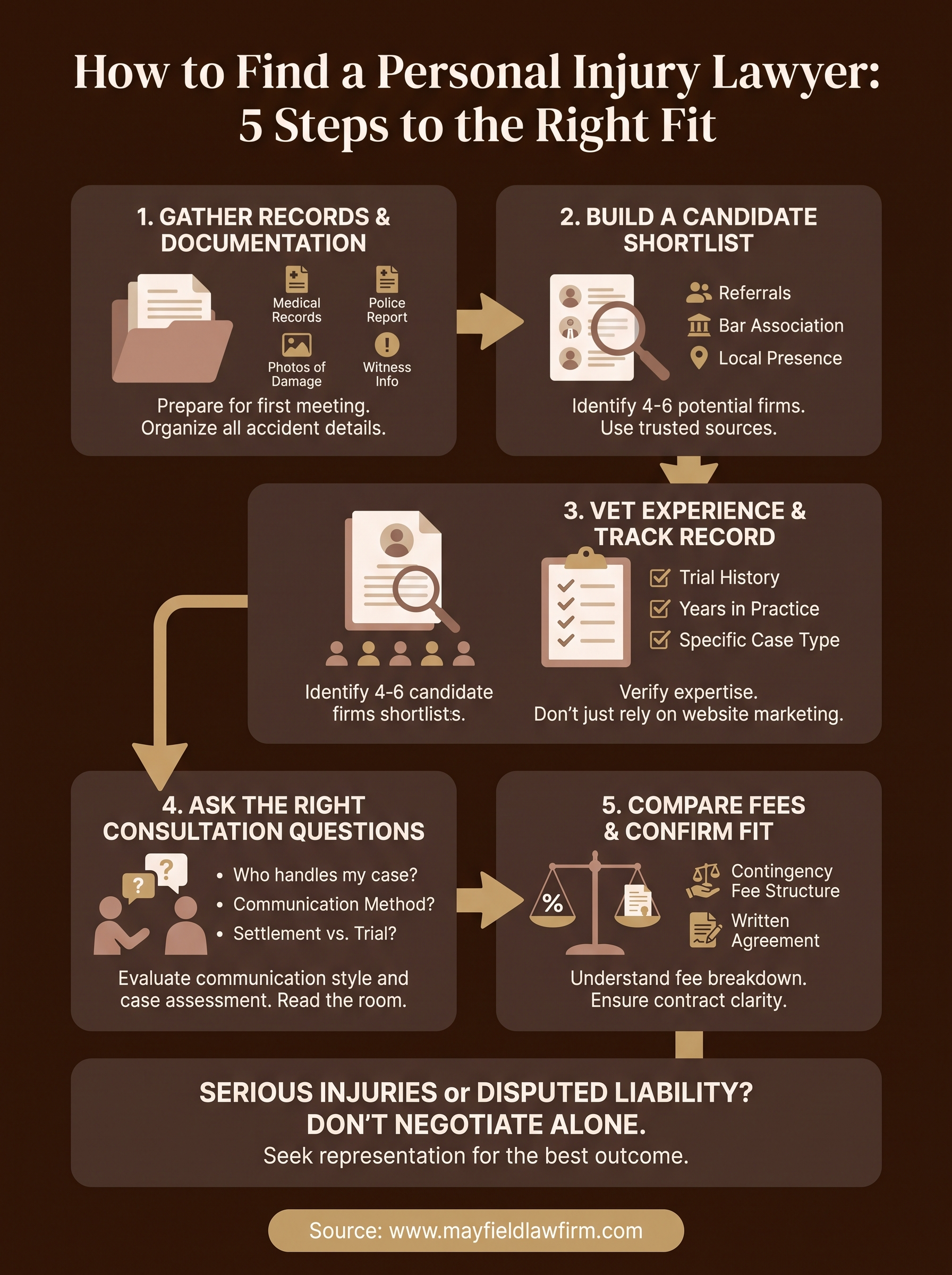
Finding the right attorney comes down to five habits: gather your documentation early, build a real shortlist instead of picking the first name you see, verify track record before you trust a pitch, ask direct questions in your consultation, and read the fee agreement line by line. Skip any of these steps and you risk signing with a firm that talks well but delivers little once the retainer's signed.
Getting this right matters more than most people realize, especially when serious injuries or disputed liability are on the table and an insurance company is counting on you to negotiate alone. You don't have to guess your way through this decision, and you don't have to accept the first offer that lands in your inbox.
If you're in Northeast Mississippi or South Memphis and ready to talk through your case with someone who's handled claims like yours for decades, schedule a free consultation with Mayfield Law Firm and get a straight answer about where you stand.