
Attorney for Medical Malpractice near Me: How to Choose One
Something went wrong during a medical procedure or hospital stay, and now you're stuck sorting out what happened and whether anyone should be held accountable. Searching for an attorney for medical malpractice near me usually starts here, after a diagnosis was missed, a surgery went sideways, or a loved one suffered harm that never should have happened. You want someone local who knows how these cases actually work, not a name you found on a billboard three states away.
The short answer: the right attorney combines medical malpractice experience with a track record of taking cases to trial, not just settling quickly for less than they're worth. You need someone who will pull medical records, consult with qualified experts, and tell you honestly whether your case holds up before you invest months into it.
This article walks through exactly what to look for when you're vetting medical malpractice lawyers , the questions to ask during a consultation, red flags that signal you should keep looking, and why firms like ours in Tupelo, Southaven, and Memphis approach these cases with the depth they demand.
Why hiring a local medical malpractice attorney matters
Medical malpractice law isn't uniform across the country. Every state sets its own statute of limitations , its own rules for notifying a healthcare provider before you file, and its own caps on what you can recover for pain and suffering. An attorney who mostly handles cases in another state, or who dabbles in malpractice alongside a dozen other practice areas, may not catch a filing deadline that's specific to Mississippi or Tennessee. That gap can sink your entire case before it ever reaches a courtroom.
A lawyer unfamiliar with your state's deadlines can lose your case before it even starts.
State laws and filing deadlines differ by location
Mississippi gives you two years from the date you discovered, or reasonably should have discovered, the injury to file a medical malpractice claim , and the broader Mississippi personal injury statute of limitations works much the same way. Tennessee's window is shorter, since the Tennessee personal injury statute of limitations runs just one year, and it comes with a pre-suit notice requirement that has to go out to every potential defendant at least 60 days before you file. Miss either the deadline or the notice, and a judge can dismiss your case regardless of how strong the underlying medical evidence actually is.

| Requirement | Mississippi | Tennessee |
|---|---|---|
| Statute of limitations | 2 years from discovery | 1 year, with pre-suit notice |
| Pre-suit notice | Not always required | Required 60 days before filing |
| Noneconomic damage caps | Yes, capped by statute | Yes, capped by statute |
Because our firm handles cases in both states from our Mississippi and Tennessee office locations in Tupelo, Southaven, and Memphis, we track these differences every day instead of looking them up when a new case walks through the door.
Local knowledge of hospitals, doctors, and courts
Attorneys who practice in your area day in and day out build relationships that matter once litigation starts. They know which local hospitals defend claims aggressively versus settling early, and they've worked with the same expert witnesses, radiologists, and nurse consultants who can review your chart and explain, in plain language a jury understands, exactly where the standard of care broke down.
Familiarity with local judges and court procedure also speeds things along. Filing deadlines, motion practice, and even how a particular judge prefers documents formatted vary from county to county across Northeast Mississippi. A firm that appears in these courthouses regularly avoids the procedural stumbles that can delay or derail a case filed by an out-of-town attorney who doesn't know local practice.
Accessibility and communication throughout your case
Meeting face to face still matters in cases this serious. You're often dealing with a permanent injury, a death in the family, or mounting medical bills, and you need to sit down with your attorney, hand over records, and ask questions without waiting weeks for a callback. A firm with physical offices in Tupelo, Southaven, and Memphis gives clients across the tri-state region that option instead of a call center hundreds of miles away.
Proximity also affects how quickly your case moves. Local counsel can drive to a deposition, walk into the courthouse to file an emergency motion, or visit your home if you're too injured to travel. That kind of hands-on presence isn't guaranteed when you hire a firm that treats your case as one more file in a national caseload rather than a neighbor's problem worth solving.
How to choose the right medical malpractice attorney near you
Finding the best medical malpractice attorneys near me takes more than a quick search and a phone call. You're hiring someone to go up against hospital defense teams, insurance adjusters, and sometimes a doctor's own malpractice carrier, all of whom have far more resources than you do. The attorney you pick needs a specific mix of experience, resources, and willingness to fight rather than settle for whatever the insurance company offers first.
The wrong attorney settles fast; the right one prepares for trial from day one.
Look for a track record in medical malpractice specifically
General practice attorneys who occasionally handle a malpractice case aren't the same as attorneys for medical malpractice near me who build their practice around this exact kind of litigation. Ask how many malpractice cases the attorney has handled in the past five years, how many went to trial, and what the outcomes looked like. A firm that can point to settlements and verdicts in cases similar to yours, whether that's a surgical error, a birth injury, or a missed cancer diagnosis, has already proven it knows how to build these cases from the ground up.
Confirm access to medical experts and resources
Every malpractice case lives or dies on expert testimony. Your attorney needs relationships with physicians willing to review your records and testify that the standard of care was breached. Ask directly:
- Does the firm retain its own expert network, or does it scramble to find one after taking your case?
- Has the attorney fronted litigation costs (expert fees, record retrieval, court costs) in past cases?
- Can they walk you through a similar case they've handled from intake to resolution?
A firm without ready answers to these questions likely lacks the infrastructure to carry a complex case through trial.
Weigh reputation, reviews, and comfort level
Online reviews tell you something, but a direct conversation tells you more. Pay attention to how the attorney explains your case during a free consultation. Do they talk in plain language, or do they bury you in jargon? Do they seem genuinely invested, or are they rushing you toward a signature? Our team at Mayfield Law Firm walks every client through what medical malpractice litigation actually involves before anyone signs an agreement, because a client who understands the process makes better decisions along the way.
Cost structure matters too. Reputable malpractice attorneys work on contingency, meaning you owe nothing unless they win or settle your case. Confirm this upfront, along with how case expenses get handled if you don't prevail.
Signs you may have a valid medical malpractice claim
Not every bad outcome in a hospital or doctor's office qualifies as malpractice. Medicine carries real risk, and even skilled providers sometimes lose a patient despite doing everything right. What separates a tragic outcome from a valid malpractice claim is whether a provider deviated from the accepted standard of care and that deviation caused measurable harm. If you're still searching for an attorney medical malpractice near me because something feels off about your treatment, these are the signs worth taking seriously.
The standard of care wasn't met
Start by asking whether a competent provider in the same specialty, facing the same situation, would have acted differently, since proving medical malpractice rests on four specific legal elements. A missed or delayed diagnosis on a condition like cancer, appendicitis, or a heart attack often points to this. So does a surgeon operating on the wrong site, a pharmacist filling the wrong dosage, or an anesthesiologist failing to monitor vital signs during a procedure. You don't need a medical degree to sense something went wrong; you just need documentation and a willingness to have it reviewed.
A bad outcome alone isn't malpractice; a deviation from accepted medical standards is.
You suffered real harm connected to the treatment
Harm has to trace back to the error itself, not just to the underlying illness you already had. A patient who develops a preventable infection after surgery due to poor sterilization, or who suffers permanent nerve damage from a botched procedure, has a much clearer path than someone whose condition simply worsened despite proper care. Courts look for a direct causal link, so keeping records of every appointment, test result, and follow-up visit strengthens that connection considerably.
Common examples that warrant a legal review
Some situations show up again and again in malpractice claims across Mississippi and Tennessee:
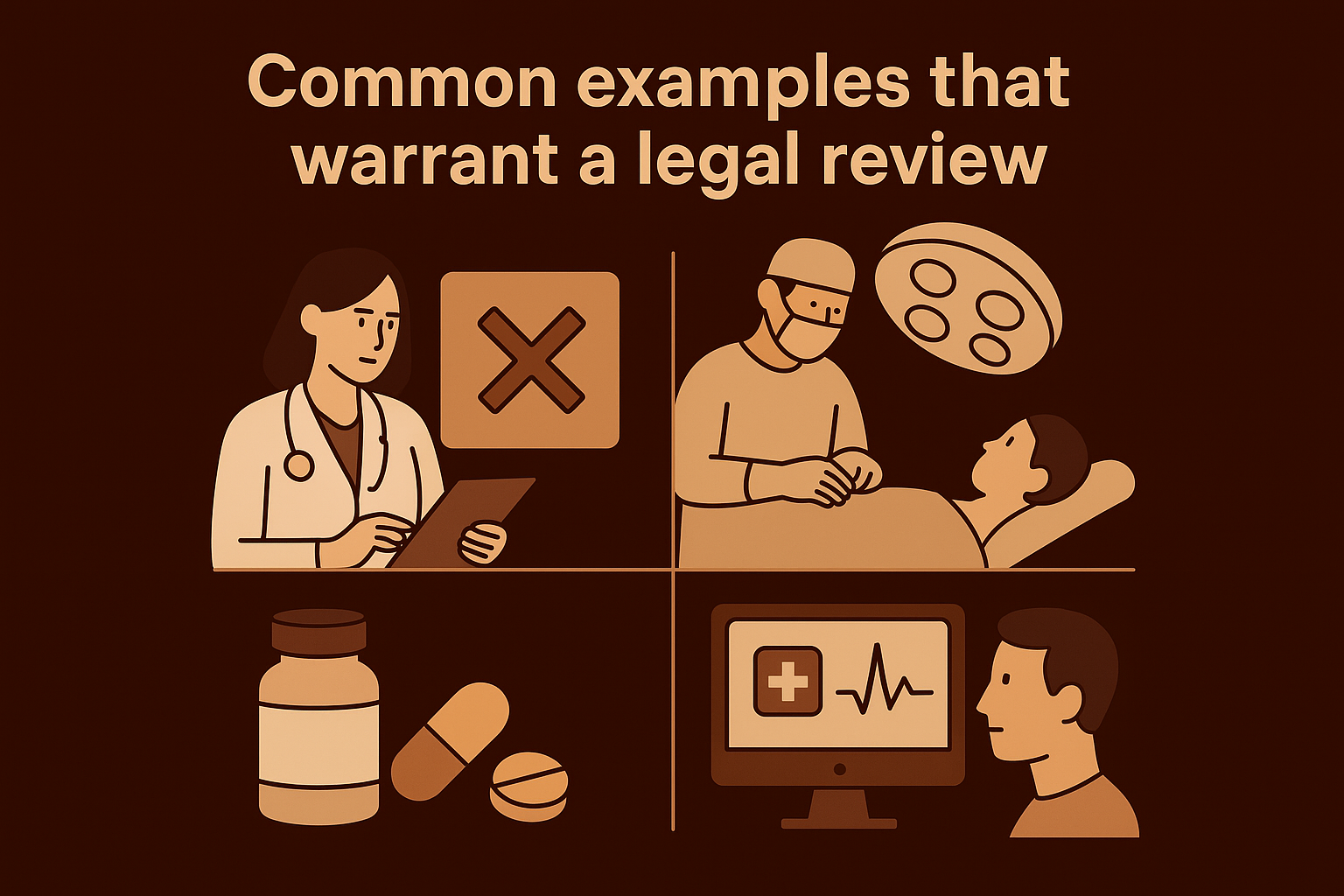
- Surgical errors, including wrong-site surgery or instruments left inside a patient
- Birth injuries caused by delayed C-sections or mishandled complications
- Medication errors involving wrong dosages or dangerous drug interactions
- Failure to diagnose conditions like stroke, sepsis, or cancer in time to treat them effectively
- Anesthesia mistakes that lead to brain damage or death
If any of these match your situation, get your medical records pulled together and review what to do after a medical error before too much time passes.
When in doubt, get a professional opinion
Uncertainty is normal here. Most people don't know enough about clinical standards to judge their own case, and that's fine. What matters is getting your records in front of someone who can arrange a review by a qualified medical expert early, since evidence and memories both fade the longer you wait. A short consultation costs you nothing and can settle the question one way or the other.
Questions to ask before hiring an attorney
A free consultation exists so you can interview the attorney as much as they evaluate your case. Walk in prepared with a short list of questions, because how someone answers on the spot tells you more about their approach than anything on a website. If you're comparing several medical malpractice lawyers before deciding, use the same questions across every meeting so you're judging apples to apples, including what to ask about experts, fees, and strategy.
Ask about experience and results
Start with the basics that reveal whether you're talking to a specialist or a generalist. Ask directly:
- How many medical malpractice cases have you handled in the last five years?
- How many of those went to trial versus settling?
- What were the outcomes in cases similar to mine?
- Do you personally handle the case, or does it get passed to a junior associate?
Vague or evasive answers here are a red flag. An attorney with genuine experience answers these questions without hesitation and can usually cite a comparable case from memory.
An attorney who can't name a comparable case probably hasn't handled one.
Ask how they handle costs and case strategy
Before signing anything, get clarity on money. Confirm the fee arrangement is contingency-based, meaning legal fees only come out of a settlement or verdict, ask what percentage they take, and understand how medical malpractice lawyer cost breaks down between fees and expenses. Then ask who fronts the cost of expert witnesses, medical record retrieval, and court filings while the case is pending, since these expenses can run into the thousands before a case ever settles. Finally, ask how they decide when to settle versus push toward trial. A firm that settles almost every case quickly may be prioritizing volume over your actual recovery.
Ask about communication expectations
How will you get updates, and how fast can you expect a response when you call with a question? Some firms hand every client off to a paralegal after the initial meeting, while others keep the attorney directly involved throughout. Neither approach is automatically wrong, but you deserve to know which one you're signing up for. Set the expectation upfront: ask how often you'll hear from the office, whether that's monthly updates or only when something significant happens, and get a name and direct line for whoever manages your file day to day.
Together, these questions cut through marketing language and get you real answers about how a firm actually operates once your case is underway. If you're ready to ask them in person, Mayfield Law Firm offers a free consultation to walk through your situation and give you a straight answer about whether a claim makes sense.
What to expect from the legal process and costs
Once you hire an attorney, the case moves through a fairly predictable sequence, even though the timeline varies with how complex your medical facts are. Knowing what's coming next helps you stay patient during the slow stretches and recognize progress when it happens. Most clients searching for attorneys for medical malpractice near me want a straight answer about how long this takes and what it costs, so here's the honest version.
How a medical malpractice case unfolds
Every case follows roughly the same stages, though the pace depends on how cooperative the defense is and how much expert review your records require.
- Investigation and expert review : Your attorney pulls every relevant medical record and sends them to a qualified expert who evaluates whether the standard of care was breached.
- Pre-suit notice (Tennessee) or direct filing (Mississippi): Depending on the state, formal notice goes out to potential defendants before the lawsuit itself is filed.
- Filing and discovery : Once the case is filed, both sides exchange records, take depositions, and build their arguments.
- Settlement negotiations : Most malpractice cases resolve here, once both sides understand the strength of the evidence.
- Trial , if negotiations stall and the defense won't offer a fair number.
Most malpractice cases settle, but the ones that don't need a lawyer ready to try them.
That willingness to go to trial changes how insurance adjusters negotiate. An attorney known for folding at the first offer gets lowball numbers; one known for trying cases gets taken seriously from the start.
What contingency fees actually cover
Reputable medical malpractice contingency lawyers work on this basis, meaning you pay nothing upfront and nothing at all unless your case settles or wins at trial. The firm typically fronts costs like expert witness fees, medical record retrieval, and court filing fees, then recoups them from the final settlement alongside their percentage. Ask for this breakdown in writing before you sign anything, so there's no confusion later about what comes out of your recovery.
Timeline: how long a claim takes
Simple cases with clear liability can resolve in twelve to eighteen months, though how long a medical malpractice case takes depends heavily on the facts. Cases involving disputed causation, multiple defendants, or a trial can stretch past two years. Patience matters here because rushing a settlement almost always means leaving money on the table that would have covered future medical care or lost income. If you're weighing whether to move forward, Mayfield Law Firm can walk you through a realistic timeline for your specific situation during a free consultation.
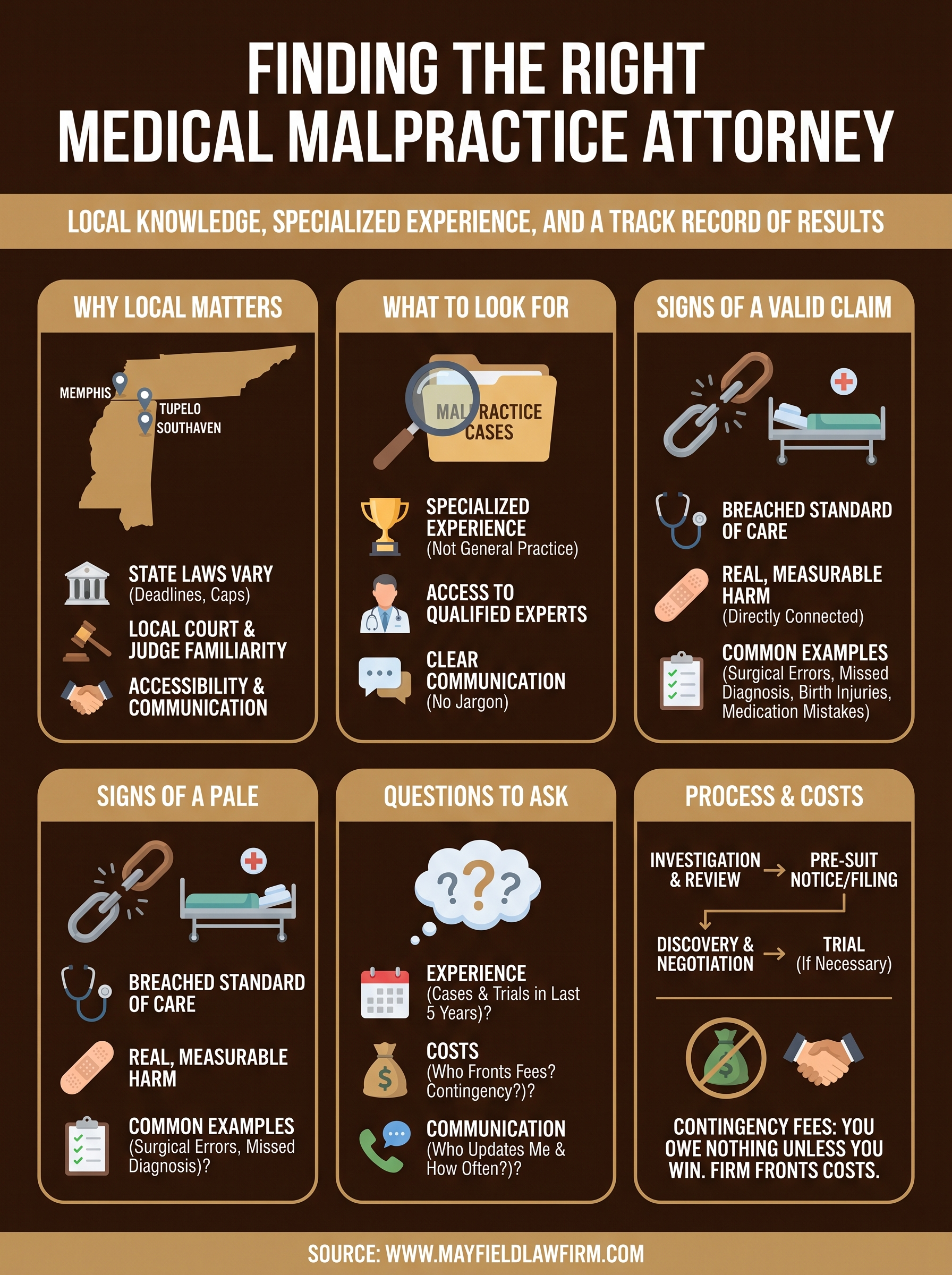
Finding the right advocate for your case
Medical malpractice cases reward preparation, not luck. The attorney you choose needs local knowledge of Mississippi and Tennessee deadlines, real relationships with medical experts, and the willingness to take a case to trial when the insurance company won't offer a fair number. Skip any firm that can't answer your questions clearly or seems eager to settle before fully investigating what happened to you.
None of this has to feel overwhelming. A free consultation gives you a straightforward read on whether your case has merit, without any pressure or upfront cost. Trust the process, ask the questions outlined above, and pick the firm that treats your case like it matters, because it does.
When you're ready to talk through what happened, reach out to our Tupelo medical malpractice attorneys for a free, no-obligation consultation with a team that's handled these cases across Northeast Mississippi and South Memphis for decades.