
Auto Accident Lawyer No Injury: Can You Still Sue?
You walked away from the wreck without a scratch, but your car didn't. Between the body shop estimate, the rental car bill, and the days you missed at work sorting out the mess, you're wondering if you actually need an auto accident lawyer no injury claims still qualify for. It's a fair question, and a lot of people assume no injury means no case worth pursuing.
Here's the short answer: yes, you can still sue or file a claim even without physical injuries. Property damage and financial losses count as real damages under Mississippi and Tennessee law, and the at-fault driver's insurance is on the hook for them regardless of whether anyone got hurt. The bigger question isn't whether you're allowed to pursue compensation, it's whether hiring a lawyer actually makes sense for your specific situation.
In this article, we'll walk through what counts as compensable loss when there's no injury, when insurance companies typically lowball these claims, and when it's worth bringing in legal help versus handling it yourself. If you're in Northeast Mississippi or South Memphis dealing with this exact situation, we'll also cover how our firm approaches these cases.
Why you can still sue after a no-injury car accident
Negligence law focuses on fault, not injury
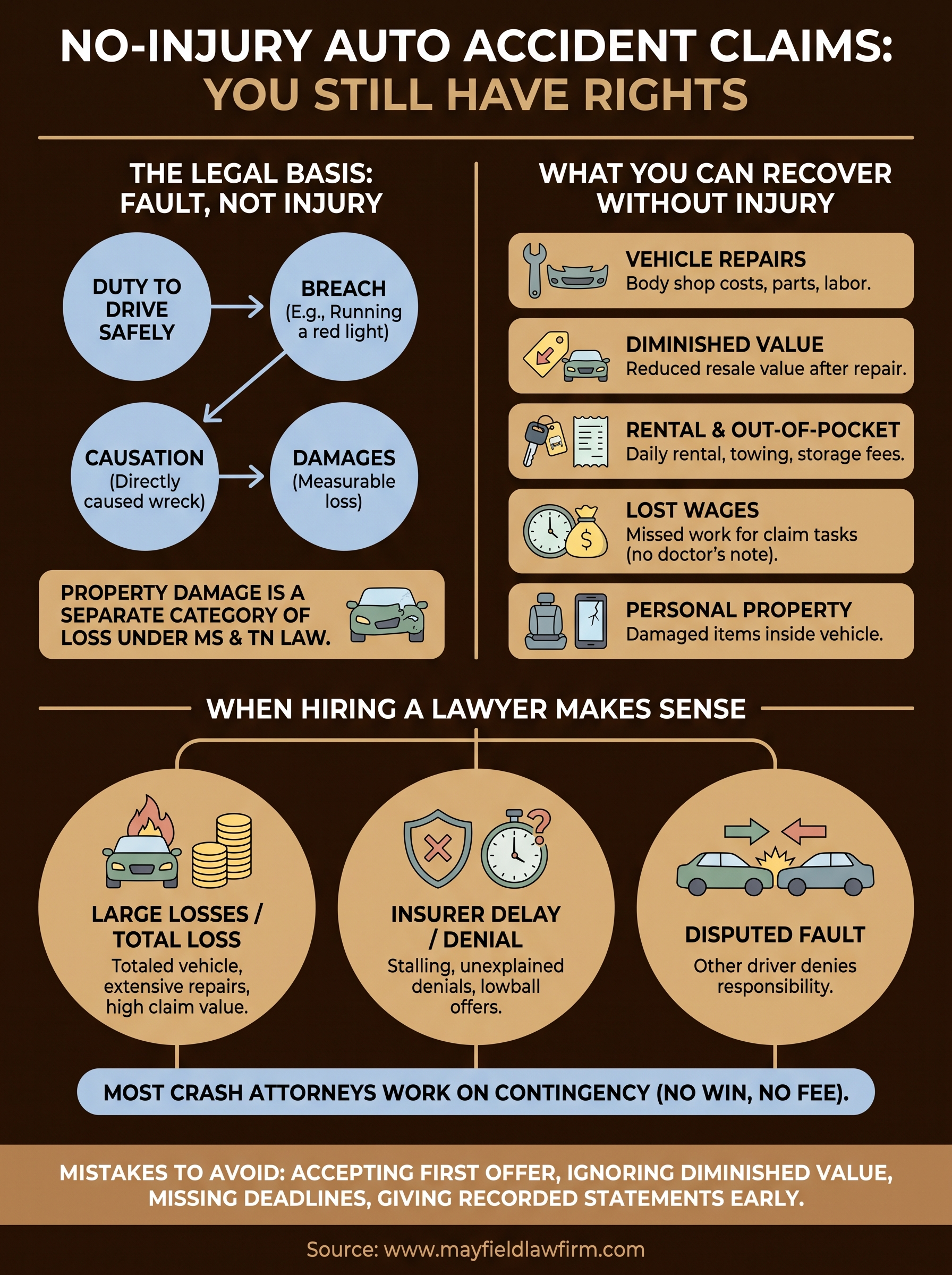
Mississippi and Tennessee both build their car accident laws around the concept of negligence, and negligence has nothing to do with whether you walked away unhurt. If another driver ran a red light, rear-ended you at a stoplight, or merged into your lane without checking their mirror, they breached a duty of care. That breach caused your damages. Whether those damages are a broken collarbone or a $6,000 repair bill and a week of lost wages, the legal theory is identical. Property damage claims are treated as their own category of recoverable loss, separate from bodily injury, and courts in both states have never required a plaintiff to prove physical harm to collect for a wrecked vehicle.
You don't need a scratch on your body to have a valid claim, you just need proof someone else caused the wreck.
The four elements you actually need to prove
Every negligence claim, injury or not, comes down to the same four building blocks. Skip one and your claim falls apart regardless of how much your car is worth.
- Duty : the other driver owed you a duty to drive safely and follow traffic laws.
- Breach : they violated that duty, whether through speeding, distraction, or running a light.
- Causation : their breach directly caused the collision and your resulting damages.
- Damages : you suffered a measurable loss, which can be property damage, lost income, or rental costs.
Notice that "physical injury" doesn't appear anywhere on that list. If you can show the other four elements with a police report, photos, and repair estimates, you have a case worth pursuing.
Why insurers push back on no-injury claims anyway
Despite the clear legal standing, adjusters often treat no-injury car accident claims as lower priority or easier to shrink. Without medical bills driving up the total value, some insurers assume you'll accept a quick, lowball settlement just to get your car fixed and move on. This is where a lot of people leave money on the table, accepting the first number offered instead of pushing for full diminished value, rental reimbursement, or lost wages tied to the time spent dealing with the claim.
Statute of limitations still applies, and it varies by state
Regardless of injury status, you have a limited window to file, and Mississippi's three-year filing deadline applies whether or not anyone was hurt. Waiting too long, even on a straightforward property damage matter, can bar you from recovering anything.
| State | Property Damage Claim Deadline | Personal Injury Claim Deadline |
|---|---|---|
| Mississippi | 3 years | 3 years |
| Tennessee | 3 years | 1 year |
These deadlines run from the date of the crash, not from when you finish repairs or settle with your insurer, and Tennessee's one-year deadline for injury cases is especially unforgiving. If you're in the tri-state region we serve and you're unsure where your case stands, our auto accident representation team can walk through the specifics with you at no cost, since the clock doesn't pause while you decide what to do next.
How to file a claim or lawsuit for vehicle damage
Filing a property damage claim after a no-injury wreck follows a more predictable path than an injury case, mostly because you're not waiting on medical treatment to finish before you know the full value of your loss. You already know what the repairs cost, or close to it, which means you can move through the process faster and with fewer moving parts.
Start with the other driver's insurance company
Getting the process started means contacting the at-fault driver's insurer directly, not just your own, and it helps to know how a car accident claim moves from crash to settlement. Report the accident, provide the police report number, and request an inspection or estimate for your vehicle. Most insurers will either send an adjuster to look at your car or direct you to an approved body shop for a damage assessment. Keep every email and claim number they give you, because these files have a way of getting lost when a claim is small enough that nobody's tracking it closely.
Document everything before repairs begin
Thoroughly documenting the damage before a single repair happens protects you if the insurer later disputes the scope of the work. Take wide shots and close-ups of every panel, get two independent repair estimates if the first one seems low, and hold onto your rental car receipts and any pay stubs showing missed work, the same step-by-step checklist for what to do after a car accident applies here.
- Photos of all four sides of the vehicle, plus interior damage
- The police report and crash report number
- At least two written repair estimates
- Rental car agreement and receipts
- Pay stubs or a letter from your employer showing lost hours
A no-injury claim lives or dies on paperwork, not on pain and suffering.
When a claim turns into a lawsuit
Sometimes the insurer refuses to pay a fair number, denies the claim outright, or drags out the process past your statute of limitations window. That's when filing a lawsuit becomes the next step instead of a threat you make on the phone. For smaller vehicle damage disputes, Mississippi and Tennessee both offer small claims court, which handles cases up to a set dollar limit without requiring a lawyer, though you'll still need your documentation in order to win.
Filing a formal lawsuit for larger losses
Larger losses, like a totaled vehicle worth well above the small claims cap, or a combination of property damage, lost wages, and rental costs that adds up quickly, usually call for a formal civil suit filed in the appropriate county or circuit court. This involves drafting a complaint, serving the other driver, and following court procedure for discovery and, if it comes to it, trial, which is the civil lawsuit process step by step. It's a heavier lift than a small claims filing, and it's the point where most people start weighing whether a lawyer is worth bringing in, which we'll cover next.
What compensation you can recover without physical injuries
Getting your car fixed is only the starting point. No-injury accident compensation covers a wider range of losses than most people realize, and insurers rarely volunteer the full list unless you ask for it by name.
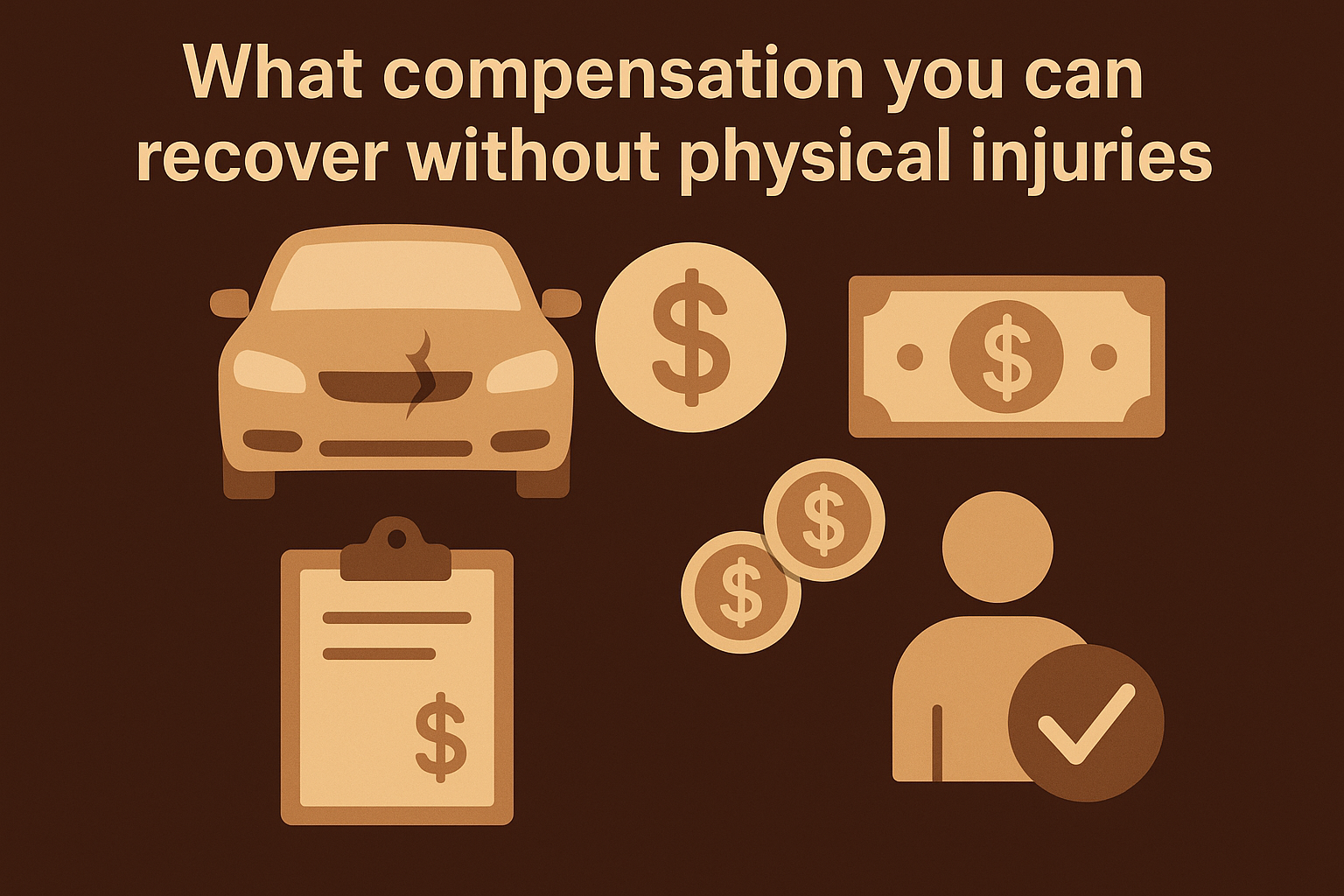
Vehicle repair costs and diminished value
Covering the repair bill is the obvious piece, but it's not the only property-related loss on the table. If your car is repaired correctly and still worth less on resale because it now has an accident on its history, that's called diminished value, and both Mississippi and Tennessee courts recognize it as a separate, recoverable claim. Adjusters almost never bring this up unprompted, so you have to request a diminished value assessment yourself, usually from an independent appraiser rather than the insurer's own shop.
The check for repairs isn't the full payout, it's just the first one.
Out-of-pocket and incidental expenses
Holding onto every receipt pays off here. Rental car fees while your vehicle sits in the shop, towing charges, storage fees at the impound lot, and even the cost of a rideshare to work count as legitimate, reimbursable expenses tied directly to the crash.
| Type of Loss | Example |
|---|---|
| Vehicle repair | Body shop invoice, parts, labor |
| Diminished value | Resale value drop after accident history |
| Rental reimbursement | Daily rental rate while car is in the shop |
| Towing and storage | Tow truck fee, impound lot charges |
| Lost wages | Missed shifts for repairs, adjuster meetings, claim paperwork |
| Personal property | Damaged car seat, phone mount, or belongings inside the vehicle |
Lost income even without a doctor's note
Losing income doesn't require a medical excuse. If you missed work to get estimates, sit through an inspection, or shuttle between the body shop and a rental counter, that time has a dollar value, and you can document it with pay stubs or a letter from your employer confirming the hours missed.
Personal property damaged in the crash
Items inside the car matter too. A child's car seat involved in any collision should be replaced regardless of visible damage, since manufacturers generally recommend replacement after an impact, and insurers typically cover this without much pushback once you provide the receipt.
What you generally can't claim without injury
Pain and suffering, emotional distress payouts, and future medical cost projections require proof of physical harm, so those categories stay off the table in a true no-injury case, though it's worth understanding how pain and suffering damages are valued if symptoms surface later. Sticking to the categories above keeps your demand credible and harder for an adjuster to dispute line by line.
When hiring a car accident lawyer makes sense
Plenty of no-injury claims settle fine without a lawyer, especially when the damage is minor and the insurer pays promptly. But certain situations tip the scale toward calling an auto accident lawyer before you sign anything, and knowing the times hiring a crash attorney pays off can save you real money.
When the dollar amount gets large
Watching a claim climb past a few thousand dollars changes the math. Once you're dealing with a totaled vehicle, months of rental costs, or lost wages stacking up while the insurer stalls, the stakes are high enough that a lawyer's cut of the recovery is worth it if it means the difference between a $4,000 settlement and a $9,000 one. Diminished value claims in particular tend to get shut down fast by adjusters unless someone with legal weight is pushing back on their behalf.
Once the numbers get big enough, the insurer stops treating you like a customer and starts treating you like a line item, so you need someone in your corner who does this daily.
When the insurer denies or delays without explanation
Delaying tactics are one of the clearest signs you need help. If the insurer keeps asking for documents you already sent, won't return calls, or issues a denial with no clear reasoning, that's often a negotiating strategy, not an oversight. A lawyer can send a demand letter that puts a firm deadline on the table and cites the specific statute or policy language the insurer is ignoring.
When fault gets disputed
Disputes over who caused the crash change everything. If the other driver's insurer claims you were partially at fault, even by a small percentage, it can reduce or wipe out your recovery under Mississippi's and Tennessee's comparative negligence rules. Sorting through conflicting accounts, traffic camera footage, or a police report that's vague on fault is exactly the kind of work a lawyer handles regularly and you likely haven't.
What it actually costs to hire one
Costs stay manageable because most personal injury and property damage attorneys, including our firm, work on contingency for these cases, meaning what a no win no fee arrangement really covers is simple: you pay nothing upfront and the fee comes out of the settlement only if you recover money. That structure removes the risk of paying out of pocket to fight a claim that might not pan out.
- No fault dispute and a fast, fair offer: handling it yourself is usually fine
- Denial, delay, or a fault dispute: worth a free consultation
- Total loss or costs exceeding a few thousand dollars: bring in help early
If any of these apply to your situation, our Southaven auto accident lawyers offer a free consultation to review the specifics before you decide anything.
Mistakes that can weaken your no-injury claim
Even a clean, well-documented no-injury car accident claim can lose value fast if you make one of a handful of common missteps. Adjusters know these patterns better than most claimants do, and they count on you not catching them until after you've signed a release.
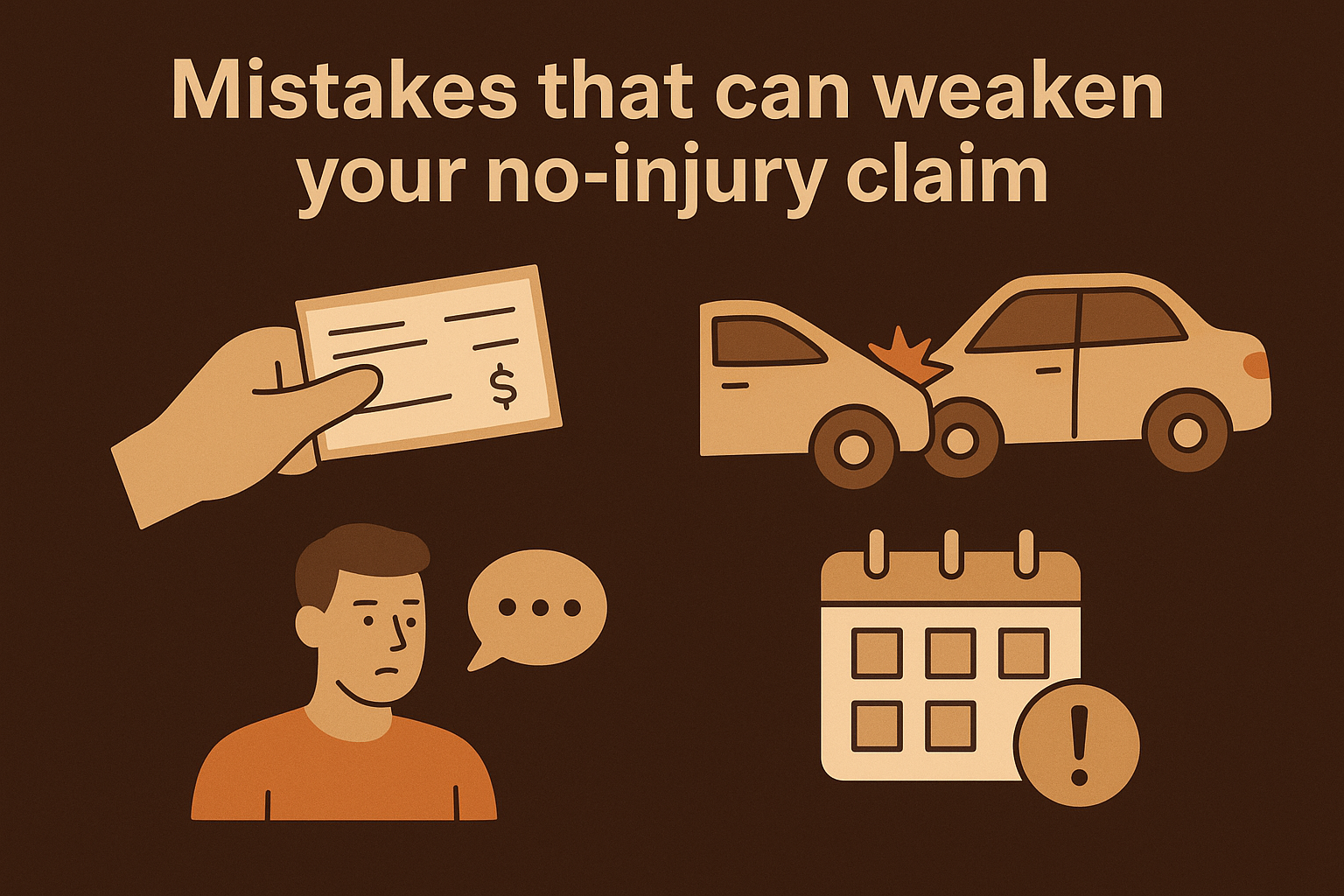
Accepting the first settlement offer
Accepting a quick check feels tempting when you just want the whole thing behind you, but insurers routinely open with a number well below what the claim is actually worth. Once you cash that check and sign a release, you typically waive the right to ask for more, even if you later discover diminished value or an unpaid rental bill.
The first offer is a starting point for negotiation, not a final answer.
Skipping documentation because nothing feels serious
Treating a fender bender as too minor to document is one of the fastest ways to shrink your own claim. Skipping photos, ignoring the need for a second repair estimate, or tossing rental receipts because "it's just property damage" leaves you with nothing to point to when an adjuster disputes the scope of the damage weeks later.
Giving a recorded statement without thinking it through
Providing a recorded statement to the other driver's insurer feels routine, but it's designed to get you talking before you've reviewed the full extent of your losses. A casual comment like "I'm fine" can later get used to argue you have no basis for lost wages or diminished value, even though those categories don't depend on physical injury at all.
Letting the deadline slip
Missing your statute of limitations window ends the claim entirely, regardless of how strong the underlying case was. This happens more often than you'd think in no-injury matters, since people assume property damage claims move slower or matter less than injury cases and let months pass without following up.
Forgetting to request diminished value
Overlooking diminished value is the quiet mistake that costs the most money. Since insurers almost never raise it on their own, failing to ask for a separate appraisal means leaving a legitimate, recoverable loss on the table simply because nobody mentioned it.
- Don't sign a release before confirming every category of loss is accounted for
- Don't give a recorded statement without reviewing your documentation first
- Don't assume property damage deadlines are flexible
- Don't skip the diminished value request just because the adjuster didn't bring it up
Deciding your next step
Walking away without a scratch doesn't mean walking away without a claim. Vehicle damage, rental costs, and lost wages are all real losses under Mississippi and Tennessee law, and the insurer's obligation to pay doesn't shrink just because nobody got hurt. What changes the outcome isn't whether you were injured, it's whether you document everything, know what diminished value is worth, and refuse to sign a release before every category of loss is on the table.
Small, straightforward claims often resolve fine on your own. But once an insurer stalls, disputes fault, or you're staring down a totaled vehicle, that's when a second set of eyes pays for itself. If you're in Northeast Mississippi or South Memphis and want someone to look at your numbers before you settle, reach out to the Memphis auto accident attorneys at Mayfield Law Firm for a free consultation. There's no cost to find out where you actually stand.

