
Motorcycle Accident Injury Lawyer: What They Do and Why It Matters
A motorcycle crash changes your life in seconds. You're dealing with broken bones, missed paychecks, and an insurance adjuster who calls before your stitches heal. That's exactly when most riders start searching for a motorcycle accident injury lawyer , and for good reason. Insurance companies already assume riders are reckless, and they use that bias to offer lowball settlements or deny claims outright. Having the right advocate from day one changes how your case gets valued.
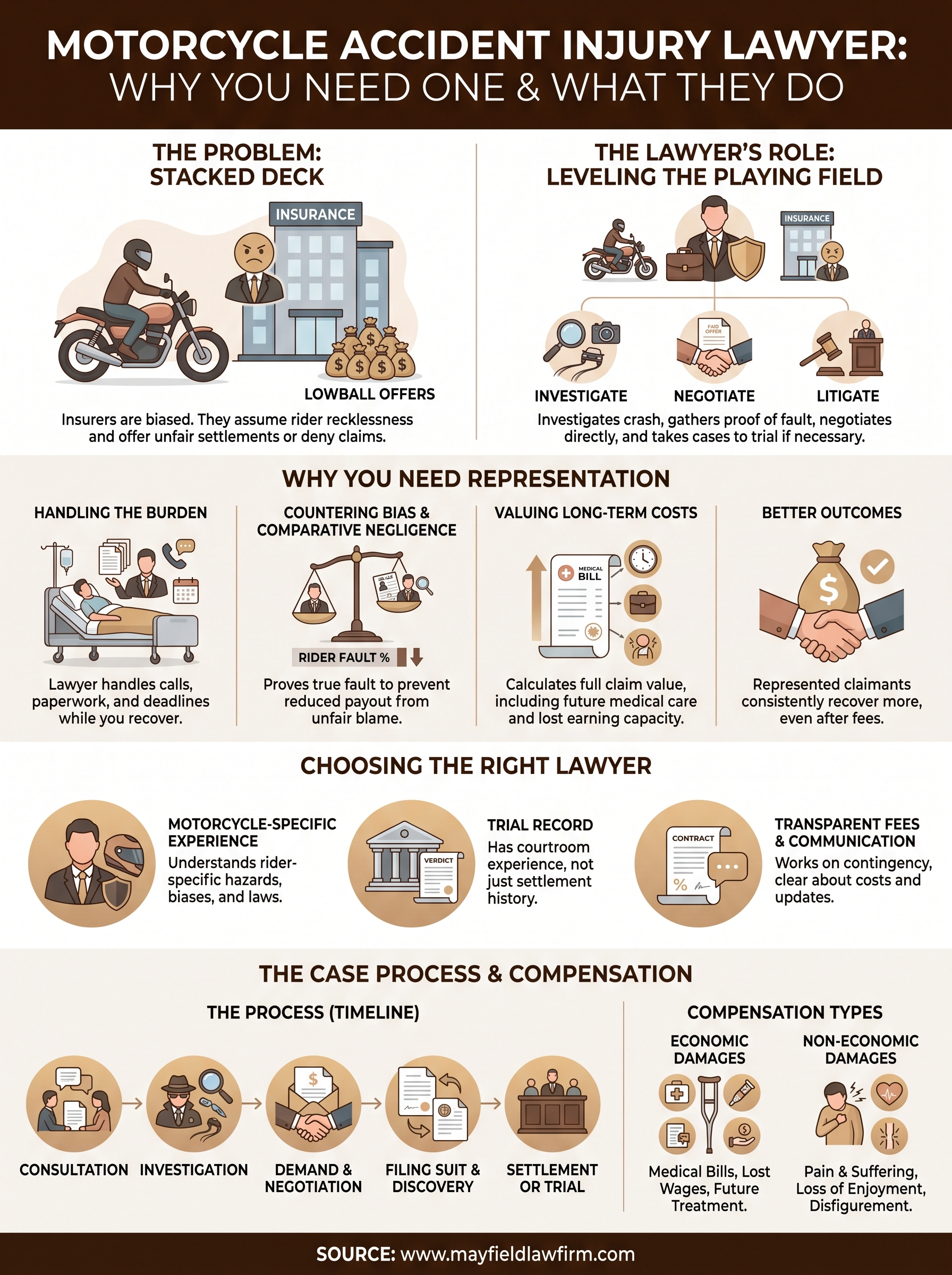
So what does this kind of lawyer actually do for you? They investigate the crash scene, pull traffic camera footage, work with accident reconstruction experts , and negotiate directly with insurers so you're not doing it while recovering. If a fair settlement isn't on the table, they take the case to trial. Their job is to build proof of fault and damages that holds up under pressure.
This article breaks down exactly what a motorcycle accident lawyer handles, when to hire a motorcycle accident attorney, and how their involvement affects your payout. At Mayfield Law Firm, we've represented injured riders across Mississippi and Tennessee for over 40 years, and we know what these cases require.
Why you need a motorcycle accident injury lawyer
Riders face a stacked deck the moment they file a claim. Insurance adjusters are trained to view motorcyclists as high-risk, careless, or partly to blame simply for being on two wheels. That bias shows up in lowball settlement offers within days of the crash, long before you know the full extent of your injuries. A motorcycle accident injury lawyer levels that imbalance by handling every conversation with the insurer and making sure your early statements don't get twisted into an admission of fault.
Insurance companies stack the deck against riders
Adjusters aren't on your side, no matter how friendly they sound on the phone. Their job is to close files for as little money as possible, and they know most unrepresented riders don't understand what a claim is actually worth. According to the National Highway Traffic Safety Administration, motorcyclists are far more likely to be killed in a crash than passenger car occupants per mile traveled, a statistic insurers quietly lean on to argue that riding itself was reckless. Experienced legal representation counters that framing with police reports, witness statements, and expert analysis that show exactly what happened and who caused it.
An insurance company's first offer is rarely their final offer, and it's almost never based on what your case is actually worth.
Comparative negligence laws can wipe out your claim
Mississippi and Tennessee both apply comparative negligence rules, meaning how comparative negligence affects a rider's compensation comes down to whatever percentage of fault gets assigned to you. If an adjuster convinces a claims examiner that you were 30% at fault for lane position or speed, your payout drops by that same 30%, even if the other driver ran a red light. This is where a motorcycle accident lawyer does the heaviest lifting, gathering the kind of documented proof that keeps blame where it belongs.
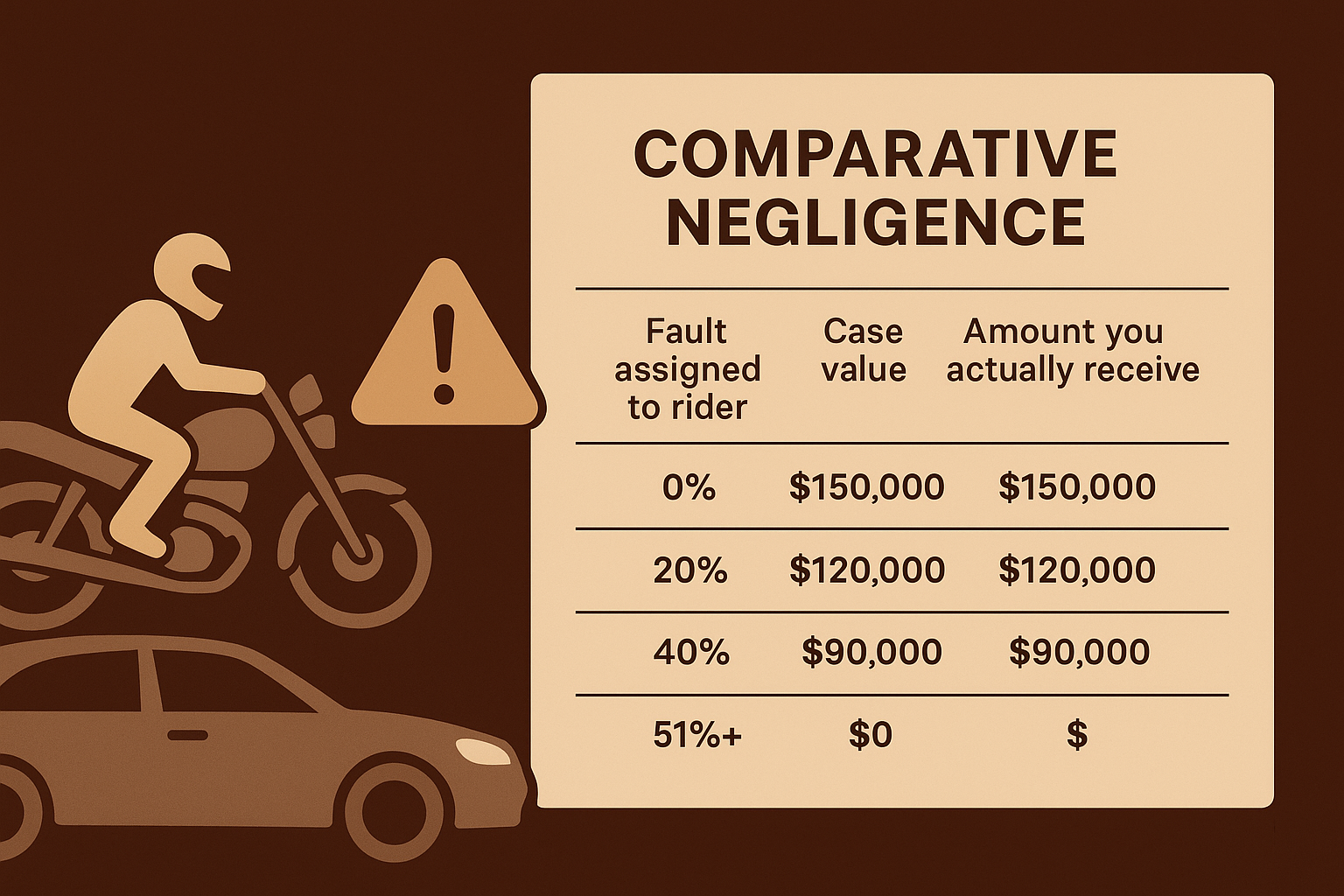
| Fault assigned to rider | Case value | Amount you actually receive |
|---|---|---|
| 0% | $150,000 | $150,000 |
| 20% | $150,000 | $120,000 |
| 40% | $150,000 | $90,000 |
| 51%+ | $150,000 | $0 in many states |
Numbers like these explain why insurers push so hard to shift even a small percentage of fault onto the rider. Every point they add to your side of the ledger is money that stays in their pocket instead of yours.
Medical bills pile up faster than settlements arrive
Bills don't wait for your case to resolve. Between emergency room visits, surgery, physical therapy, and lost wages, most injured riders face real financial pressure within weeks, and insurers count on that pressure to push a quick, undervalued settlement. Attorneys who handle these cases regularly know how to negotiate hospital liens and buy their clients time to hold out for a fair number instead of settling out of desperation.
What a lawyer does that you simply can't do while recovering
Handling a claim solo means juggling paperwork, deadlines, and insurance calls while you're still learning to walk again or waiting on a second surgery. A dedicated attorney takes that burden off your plate. Here's what that typically looks like in practice:
- Collecting and preserving evidence before it disappears (skid marks fade, footage gets overwritten, witnesses forget details)
- Calculating the full value of your claim, including future medical care and lost earning capacity, not just today's bills
- Filing suit before the statute of limitations runs out
- Negotiating directly with adjusters so you never have to
- Preparing the case for trial if the insurer won't offer a fair number
Simply put, the gap between handling a claim alone and having a lawyer in your corner usually shows up in the final check. Represented claimants consistently recover more, even after attorney fees, than those who negotiate on their own. That gap is the entire reason this kind of representation exists.
How to choose the right motorcycle accident lawyer
Finding a good general practice attorney isn't the same as finding a motorcycle accident injury lawyer who understands the specific bias riders face. The wrong choice can cost you thousands in a rushed settlement, so learn the factors that separate the best motorcycle accident attorneys and treat this decision the same way you'd treat picking a surgeon. Ask direct questions before you sign anything, and pay attention to how honestly the answers land.
Look for motorcycle-specific case experience
Not every personal injury lawyer has handled a motorcycle claim, and the differences matter more than most people expect. Riders deal with road hazards like potholes and gravel, blind-spot collisions, and jurors who arrive with preconceived notions about bikers. A lawyer who regularly works motorcycle crash cases already knows how to counter that bias with reconstruction experts and helmet-law nuances specific to your state.
Check their trial record, not just their settlement history
Insurers research the attorney on the other side before they ever make an offer. If a lawyer has a reputation for settling everything quickly regardless of value, adjusters lowball accordingly. A firm known for taking cases to trial when the number isn't fair gets treated differently from day one.
A lawyer who's never walked into a courtroom has no leverage at the negotiating table.
During your consultation, ask how many motorcycle cases the firm has taken to verdict versus settled, and what the outcomes looked like. Vague answers or a refusal to discuss specifics is a warning sign worth noting.
Ask about fees and communication before you sign
Most motorcycle accident attorneys work on contingency, meaning you pay nothing unless they recover money for you, though it helps to understand how contingency fee percentages and case costs work. Get the percentage in writing, and ask exactly what expenses come out of your share before the fee is calculated. Beyond cost, find out who will actually handle your file day to day, since some firms hand cases off to paralegals after the initial meeting.
Bring these questions to your first consultation, along with anything else worth asking a local motorcycle accident lawyer first:
- How many motorcycle-specific cases have you handled in the past five years?
- What percentage of those cases went to trial versus settled?
- Will you personally handle my case, or will it be passed to another attorney?
- What's your fee structure, and what happens if we don't win?
- How often will I get updates on my case?
A firm that answers plainly, without dodging the trial or fee questions, is usually one worth trusting. At Mayfield Law Firm, we walk every rider through these details before they commit to anything, because a client who understands the process makes better decisions along the way.
What happens during a motorcycle accident injury case
Every motorcycle claim follows a similar path, and the steps and timeline of a personal injury lawsuit look much the same even though the details differ from case to case. Understanding the stages ahead of time takes away some of the anxiety that comes with an unfamiliar legal process. A motorcycle accident injury lawyer manages each phase so you're not left guessing what comes next or missing a deadline that could sink your claim.
The free consultation and case evaluation
Most firms, including Mayfield Law Firm, start with a free consultation to review your accident and injuries before anything else happens, so it helps to know what to expect from a free case evaluation. You bring what you have, medical records, photos, the police report, and the attorney tells you honestly whether you have a viable claim and roughly what it might be worth. Nothing gets signed until you understand the fee structure and what the firm expects to do on your behalf.
Investigation and evidence gathering
Once you sign on, the real work starts immediately, often within days of the crash, building on whatever was preserved during the first 24 hours after a motorcycle accident. Your lawyer moves fast because evidence disappears quickly, so this stage typically includes:
- Securing the bike, gear, and any physical evidence before it's repaired or discarded
- Requesting traffic camera and dashcam footage before it gets overwritten
- Interviewing witnesses while their memory is still fresh
- Obtaining your full medical records and billing history
- Consulting accident reconstruction experts for disputed liability
Gathering this early protects you later, since insurers challenge weak documentation far more often than strong evidence.
Demand letter and negotiation
After your treatment stabilizes and your lawyer understands the full scope of your damages, they send a formal demand letter to the insurance company. This document lays out liability, medical costs, lost wages, and pain and suffering, backed by the evidence collected earlier. Negotiations usually follow, and this back-and-forth can stretch for weeks or months depending on how reasonable the insurer's counteroffers are.
A demand letter backed by real evidence gets taken seriously; one without it gets ignored.
Filing suit and discovery
If negotiations stall or the insurer refuses to offer a fair number, your attorney files a lawsuit before Mississippi's filing deadline for injury lawsuits expires. Discovery follows, where both sides exchange documents, take depositions, and sometimes bring in expert witnesses to testify about the crash mechanics or your long-term prognosis. Many cases settle during this phase once the insurer sees how strong the evidence actually is.
Settlement or trial
Finally, your case either resolves through settlement or proceeds to trial in front of a judge or jury. Settling avoids the uncertainty and delay of a trial, but it only makes sense when the number reflects the true value of your claim. Trial becomes necessary when the insurer won't budge, and a lawyer with real courtroom experience is the one who can credibly make that threat and follow through on it.
Common injuries and compensation in motorcycle claims
Motorcycle crashes produce injuries that car accidents rarely match in severity, because riders have no metal frame absorbing the impact. Understanding the typical injury patterns and what they're worth helps you recognize whether an insurance offer is fair or a lowball number designed to close your file cheap.
Catastrophic and long-term injuries riders face
Road rash and broken bones are common, but the injuries that drive real compensation tend to be far more severe. Riders regularly suffer traumatic brain injuries, spinal cord damage, degloving injuries, and severe fractures requiring multiple surgeries. Some of these injuries heal within months; others change how someone works, walks, or lives for the rest of their life. A motorcycle accident injury lawyer distinguishes between the two when calculating a demand, because permanent injuries carry future costs that a quick settlement almost never accounts for.
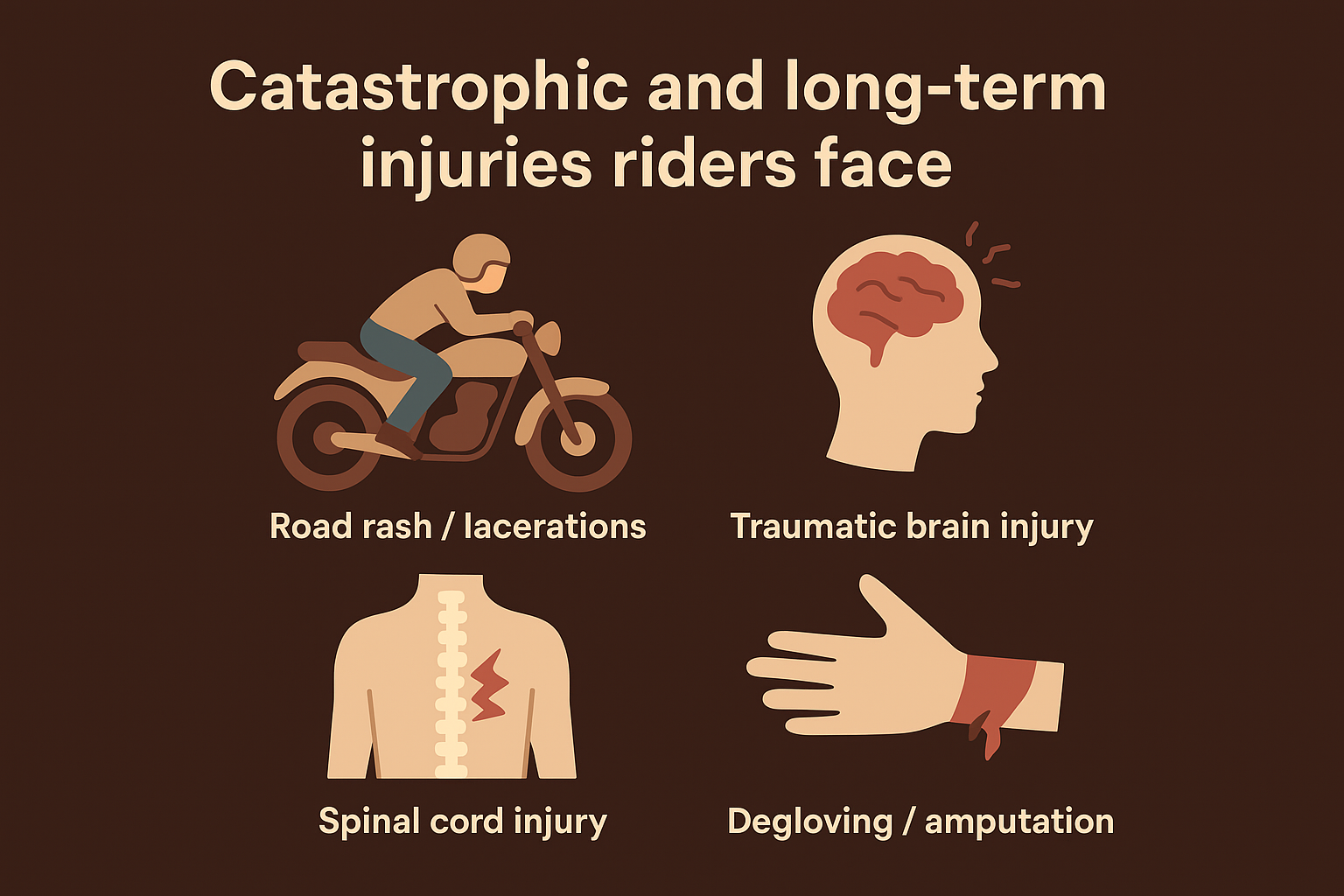
| Injury type | Typical treatment | Compensation impact |
|---|---|---|
| Road rash / lacerations | Wound care, possible skin grafts | Moderate, short recovery |
| Fractures (arm, leg, pelvis) | Surgery, hardware, physical therapy | Moderate to high, depends on permanence |
| Traumatic brain injury | Hospitalization, cognitive therapy | High, often lifelong care costs |
| Spinal cord injury | Surgery, rehabilitation, mobility aids | Highest, permanent disability likely |
| Degloving / amputation | Reconstructive surgery, prosthetics | Highest, ongoing medical needs |
What compensation actually covers
Economic damages are the easiest to calculate, since they come straight from bills and pay stubs. These include emergency care, surgery, physical therapy, lost wages, and any future medical treatment your doctors project you'll need. Non-economic damages cover pain and suffering, loss of enjoyment of life, and disfigurement, and they're harder to pin down because there's no invoice attached, which is why it pays to understand how insurers put a dollar figure on pain and suffering. Insurers routinely undervalue this second category unless your attorney documents it with medical testimony and a clear narrative of how the injury has changed your daily life.
The bills you've already paid are only half your claim; the harder half is proving what the injury costs you going forward.
How settlement value gets calculated
Attorneys typically build a claim's value using a multiplier applied to economic damages, adjusted up or down based on injury severity, fault percentage, and how strong the liability evidence is. Several factors move that number:
- Whether the injury is permanent or fully healed
- How clearly fault falls on the other driver
- The at-fault driver's insurance policy limits
- Lost future earning capacity, not just missed paychecks
- Documented pain and suffering, backed by medical records
Finally, remember that policy limits cap what most claims can recover, regardless of how severe the injury is. If the at-fault driver carries minimal coverage, your lawyer may need to pursue other liable parties or your own policy, so it's worth knowing how uninsured motorist coverage pays after a wreck to reach a number that actually covers your losses.
Taking the next step after your accident
A motorcycle crash puts you in a fight you didn't choose, against an insurance company that's already decided you're partly to blame just for riding. The right motorcycle accident injury lawyer changes that fight from the first phone call, preserving evidence, calculating what your claim is truly worth, and refusing to accept a number that doesn't cover your future. Waiting costs you leverage. Evidence disappears, deadlines pass, and adjusters bank on your silence to close the file cheap.
You don't have to sort through medical bills and insurance calls alone while you're still healing. Mississippi and Tennessee riders have trusted our team for over 40 years to handle exactly this kind of case, from the first consultation through trial if that's what it takes. If you or someone you love was hurt in a motorcycle crash, talk with the motorcycle accident attorneys serving Memphis and the Mid-South at Mayfield Law Firm today for a free consultation and find out what your case is actually worth.

