Free Car Accident Lawyer Consultation: What To Expect
You've been in a car accident, and now you're dealing with medical bills, insurance adjusters, and a lot of uncertainty. Before you make any decisions, or sign anything, a free car accident lawyer consultation gives you the chance to sit down with an attorney, explain what happened, and get a straight answer about whether you have a case. It costs you nothing, and it can prevent costly mistakes early in the process.
Still, most people don't know what actually happens during one of these consultations. They wonder what to bring, what questions to ask, and whether the attorney will pressure them into hiring on the spot. Those concerns are understandable , and they're exactly why we wrote this guide. At Mayfield Law Firm, P.A., we've spent over 40 years representing accident victims across Northeast Mississippi and South Memphis , and we know that an informed client makes better decisions from day one.
This article walks you through everything a free consultation involves, from the questions your attorney will ask, to the documents you should have ready, to how the attorney evaluates your claim . Whether you're recovering from a fender bender or a serious collision, you'll leave this page knowing exactly what to expect and how to get the most out of that first meeting .
Why a free consultation matters after a crash
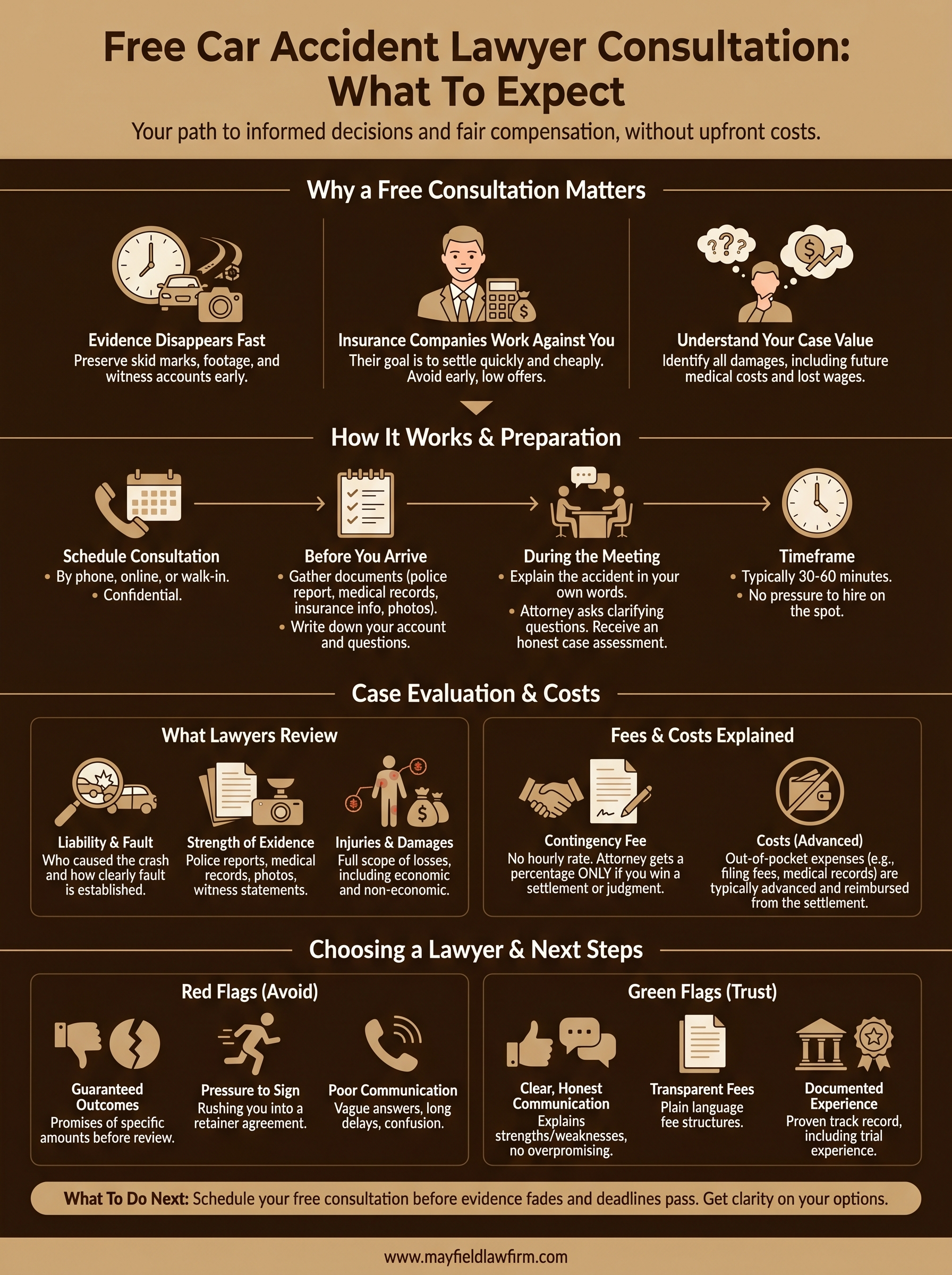
A car accident changes your situation immediately. One minute you're driving, and the next you're managing injuries, property damage, and a flood of calls from insurance adjusters. Getting legal advice early is not about being aggressive or lawsuit-happy. It's about understanding your rights before you make a decision that could cost you money you're legally owed. A free car accident lawyer consultation is often the most important step you can take in the days right after a crash, and the fact that it costs you nothing makes waiting even harder to justify.
The insurance company is already working against you
Insurance adjusters are trained professionals. Their job is to settle your claim as quickly and cheaply as possible , and they start working the moment your accident is reported. They may contact you within hours, sound friendly and sympathetic, and offer you a settlement before you've even finished your first doctor's visit. That offer is almost never in your best interest.
When you speak to an adjuster without legal guidance, you risk saying something that damages your claim or accepting a number that falls far short of covering your future medical costs. Adjusters are skilled at getting recorded statements that can later be used to minimize what they pay you. An attorney can tell you exactly what information you're required to share and what you should decline to discuss. The consultation costs you nothing, but the information you get from it can protect thousands of dollars in compensation you would otherwise leave behind.
Once you accept a settlement offer, you typically sign away your right to seek additional compensation, even if your injuries turn out to be significantly more serious than they appeared at first.
Evidence disappears faster than you expect
In the hours and days after a crash, critical evidence starts to disappear . Skid marks fade from the road, vehicles get repaired or sent to salvage, surveillance footage from nearby businesses gets recorded over, and witnesses forget the details they saw. The sooner an attorney knows about your case, the sooner steps can be taken to preserve that evidence before it's gone for good.

Attorneys know how to send legal preservation letters to businesses with camera systems, formally request police reports, and identify which witnesses should be contacted immediately. These are steps most people don't know to take on their own. If you wait several weeks before talking to a lawyer, some of that evidence may no longer exist in a usable form. Your consultation, even just one conversation, helps you understand what needs to be protected and how to do it before the window closes.
You may not realize how much your case is worth
Most accident victims think about their immediate medical bills and repair costs. Those are real expenses, but a serious injury claim often involves far more, including lost wages during recovery, reduced earning capacity if you can no longer work the same job, the cost of long-term treatment or physical therapy, and compensation for pain and suffering. Without an attorney to help you identify these categories, you may settle for a fraction of what you're legally owed.
Personal injury law also sets strict deadlines called statutes of limitations , which limit how long you have to file a claim. In Mississippi, for example, the general deadline for personal injury claims is three years from the date of the accident. Missing that deadline means losing your right to recover anything, regardless of how strong your case might be.
Your attorney can also assess liability factors you might not have considered , such as whether another driver was texting, whether road conditions contributed, or whether a vehicle defect played a role. These factors affect both the strength of your claim and the total amount you could recover. That full picture is exactly what an attorney starts building during your first meeting.
How a free consultation usually works
Most people imagine a consultation as a formal, intimidating experience with a lawyer behind a big desk asking rapid-fire questions. The reality is far more straightforward. A free car accident lawyer consultation is typically a structured but conversational meeting where the attorney listens to your account of the accident, asks clarifying questions, and gives you an honest assessment of your legal options. No decisions need to be made on the spot , and no money changes hands at any point during the process.
Before you arrive
Many firms let you schedule your consultation by phone, through an online form, or by walking in during business hours. Some also offer phone or video consultations if getting to the office is difficult because of your injuries. Before the meeting, the firm's staff may ask for basic details about the accident, such as the date, location, and whether a police report was filed. That information helps the attorney come prepared with focused questions , so your time together is productive from the start.
Here is what typically happens in the moments before you sit down with the attorney:
- A staff member collects your contact information and basic accident details
- You sign a standard intake form confirming the consultation is confidential
- The attorney reviews any documents you brought before the conversation begins
What happens during the meeting
Once you're with the attorney, they'll ask you to walk through the accident in your own words. Don't worry about telling it perfectly. The attorney is listening for key facts: how the crash happened, who was involved, what injuries you sustained, and what contact you've already had with insurance companies. They're not testing you; they're building a clear picture of what your claim involves.
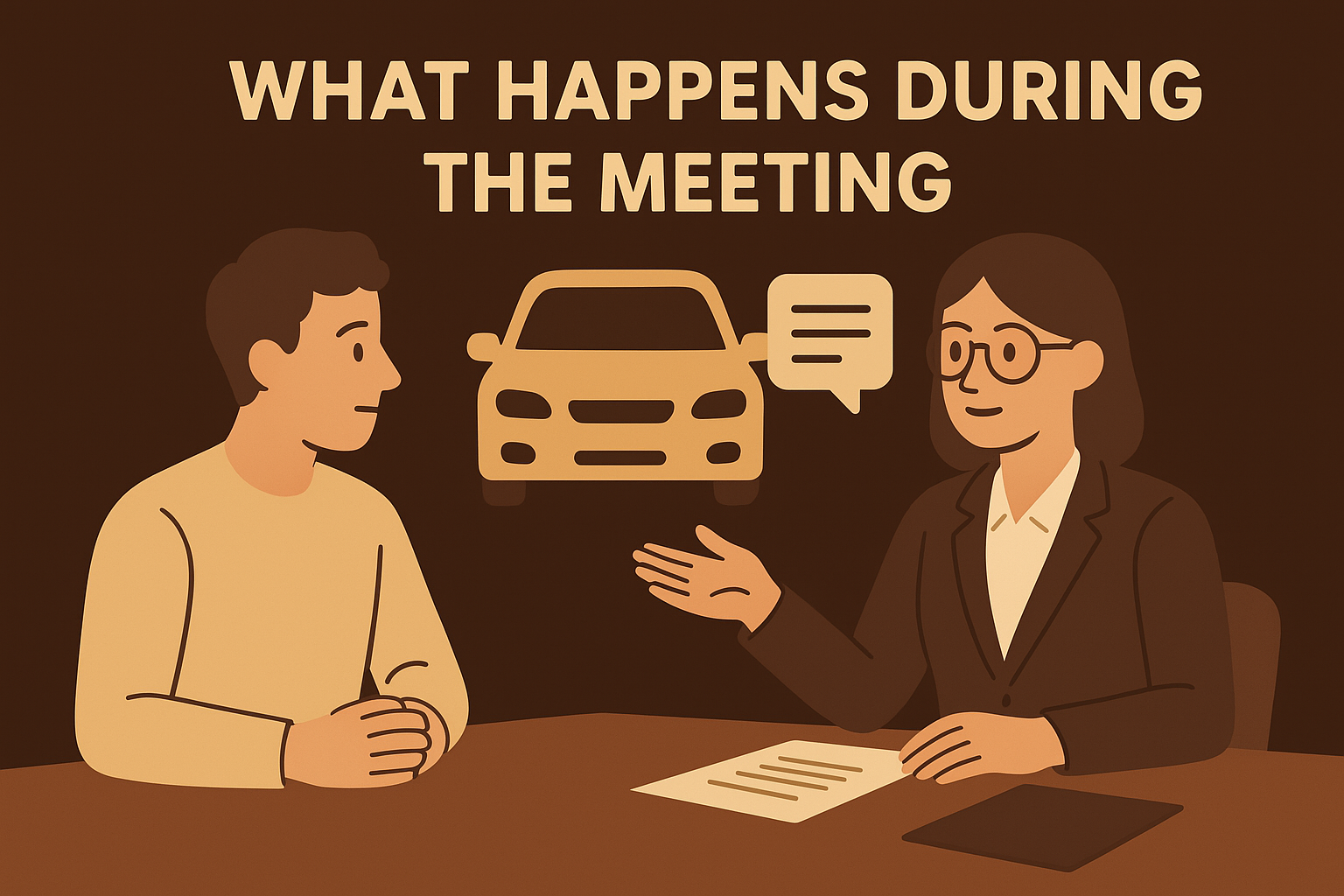
What you share during the consultation is protected by attorney-client privilege, even if you don't end up hiring the firm.
After you explain the situation, the attorney will give you a direct assessment of whether you have a viable claim, what the potential value might look like based on your description, and how their firm would approach your case. This portion of the meeting is your opportunity to ask questions and get straightforward answers before making any decisions about moving forward.
How long it takes
Most consultations run between 30 and 60 minutes , though more complex cases sometimes take longer depending on how many details need to be covered. You won't be rushed out the door before you're ready.
A good attorney will make sure you leave with a clear understanding of your situation and your options, not just a sales pitch for their services.
What lawyers review during your case evaluation
During your free car accident lawyer consultation , the attorney is not just listening to your story. They're actively evaluating specific legal elements that determine whether you have a strong claim and how much it might be worth. Understanding what they're looking at helps you follow the conversation more closely and give the attorney the information they actually need.
Liability and fault
The first thing an attorney examines is who caused the crash and how clearly fault can be established . Mississippi follows a pure comparative fault rule, which means your compensation can be reduced by the percentage of fault assigned to you. If another driver ran a red light, that's clear negligence. If the situation is more complicated, such as a multi-vehicle pileup or a crash involving a commercial truck, the attorney will identify every party who may share responsibility , including employers, vehicle owners, or even government entities if road conditions were a factor.
Fault isn't always obvious from the police report alone, which is why an attorney's evaluation often goes further than what the responding officer documented.
The strength of your evidence
Your attorney will also assess what evidence currently exists to support your claim . This includes the police report, photos of the scene, medical records, witness statements, and any traffic or surveillance footage. Stronger evidence means a more defensible case and often a better negotiating position with the insurance company. If gaps exist, the attorney will flag them early so steps can be taken to fill those gaps before evidence becomes unavailable.
Here's a breakdown of what attorneys typically look at in this area:
- Police report accuracy and whether it reflects what you described
- Medical documentation linking your injuries directly to the crash
- Photographic or video evidence of damage, road conditions, and positioning of vehicles
- Witness contact information and the reliability of their accounts
- Any electronic data available, such as dashcam footage or event data from the vehicles
Your injuries and damages
Beyond fault, the attorney reviews the full scope of your losses . Medical expenses are the starting point, but the evaluation also covers lost income, future treatment needs, and the impact your injuries have had on your daily life. Attorneys calculate economic and non-economic damages separately, because pain and suffering, emotional distress, and loss of enjoyment of life are real losses that deserve compensation even though they don't come with a receipt. This complete picture shapes the value of your claim from the very beginning.
What to bring and how to prepare
Walking into your free car accident lawyer consultation prepared makes a real difference in what you actually get out of the meeting. The more organized your information is, the more time the attorney can spend analyzing your specific situation rather than piecing together basic facts. You don't need everything perfectly sorted, but arriving with the right materials helps the attorney give you a sharper, more accurate assessment right away.
Documents to gather before your appointment
The most useful documents fall into a few clear categories. Accident-related records give the attorney a factual foundation to work from, while medical documentation shows the physical and financial toll your injuries have already taken on your life. If you haven't received everything yet, bring what you have. The attorney can tell you exactly what else to collect after the meeting.
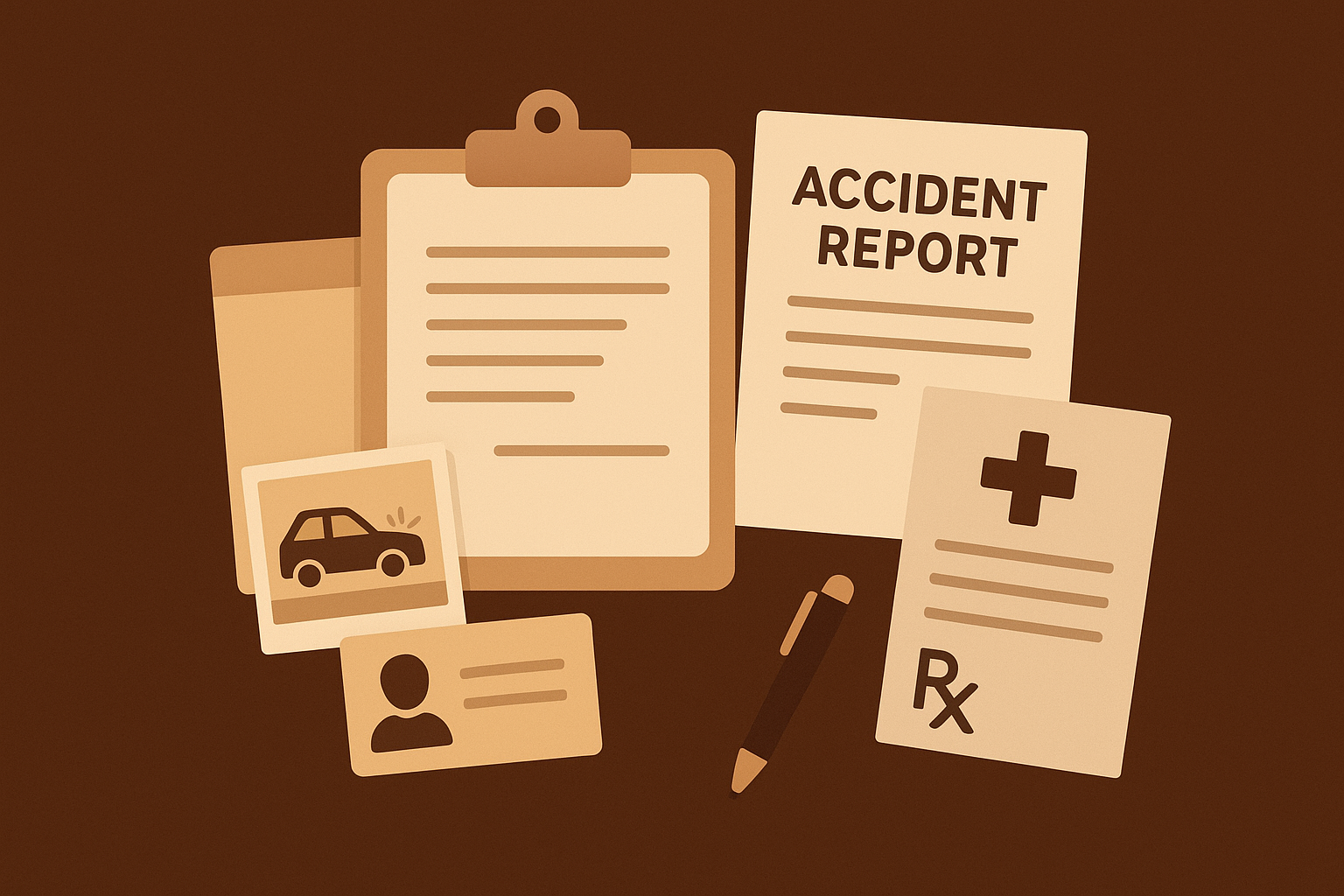
Here is what to pull together before you go:
- Police report or the report number if you haven't received the full document yet
- Photos of the accident scene, vehicle damage, and your visible injuries
- Contact and insurance information for all drivers involved
- Any correspondence from insurance companies, including written settlement offers
- Medical records, bills, and prescription receipts tied directly to the crash
- Pay stubs or other documentation showing missed work and lost income
- Names and contact information for any witnesses who saw the collision
How to prepare yourself mentally
Beyond paperwork, thinking through your account of the crash before you arrive helps you communicate clearly in what can feel like a high-pressure setting. Write down the sequence of events as you remember them, including road and weather conditions, what you were doing just before impact, and how the other driver behaved. Don't edit yourself or assume certain details don't matter; let the attorney decide what's relevant to your case.
You don't need to remember everything perfectly. Attorneys are used to working with incomplete or fragmented recollections, and they'll ask follow-up questions to close the gaps.
Writing down the questions you want answered before you walk in is also worth the effort. During the consultation, you'll receive a lot of new information at once, and it's easy to forget what you came in wanting to ask. A short list on your phone or a notepad keeps you focused and ensures you leave with the clarity you need to make a confident decision about your next step.
Questions to ask in your consultation
Coming into your free car accident lawyer consultation with a prepared list of questions does more than fill silence. It tells you whether this attorney is the right fit for your case and gives you concrete information to compare against what other firms might tell you. Most attorneys expect questions and welcome them, so don't hold back out of politeness or uncertainty. The consultation is your time, and using it well starts with knowing what to ask .
Questions about the attorney's experience
Your first set of questions should focus on what the attorney has actually done , not just what their website says. Ask directly how many car accident cases they've handled and what percentage of those cases they settled versus took to trial. You want an attorney who resolves cases efficiently but isn't afraid to go to court if the insurance company refuses to offer fair compensation.
Here are specific questions worth raising:
- How many car accident cases have you handled in Mississippi or Tennessee?
- What is your track record with cases similar to mine?
- Have you taken cases to trial, and how comfortable are you doing so?
Questions about your specific case
Once you've confirmed the attorney has relevant experience, shift your questions to the details of your situation . Ask what they see as the strongest and weakest parts of your claim. Ask whether they foresee any complications based on the facts you've shared. A good attorney gives you a direct, honest answer rather than telling you only what you want to hear.
If an attorney guarantees a specific outcome during the consultation, treat that as a warning sign, not a selling point.
Also ask how long they expect your case to take and what factors could extend or shorten that timeline. This gives you a realistic picture of the process ahead before you make any commitment. Knowing the timeline upfront also helps you plan for gaps in income if your injuries prevent you from returning to work quickly.
Questions about communication and the process
Find out who will handle your case day to day . In some firms, a senior attorney takes the consultation but then assigns your file to a junior associate or paralegal. Knowing who your primary contact will be and how often they'll update you on progress helps you set clear expectations before you sign anything. Also ask how you can reach them between updates, what a typical response time looks like for calls or emails, and whether they use a client portal or another system to share documents and case updates.
Fees, costs, and contingency agreements explained
Money is one of the first things people worry about when they consider hiring a personal injury attorney, and that concern makes complete sense when you're already dealing with unexpected medical bills and lost income . The good news is that your free car accident lawyer consultation costs you nothing, and most car accident attorneys continue working on exactly the same terms throughout the entire case.
How a contingency fee works
A contingency fee means the attorney only gets paid if you win a settlement or a court judgment . You don't pay any hourly rate, and you don't owe a retainer upfront. Instead, the attorney takes an agreed-upon percentage of your final recovery, typically between 33% and 40% depending on whether the case settles before or after a lawsuit is filed. If your case produces no recovery, you owe the attorney nothing for their time .
This arrangement allows you to access experienced legal representation regardless of your current financial situation, which levels the playing field against insurance companies that have their own lawyers on payroll.
The percentage is set in a written agreement before the attorney begins any work on your case. Read that agreement carefully, ask the attorney to explain any language that's unclear to you, and confirm exactly what the percentage will be at each stage of the process.
What costs you might still owe
Contingency fees and case costs are two separate things , and it's important you understand the difference before signing anything. Case costs are the out-of-pocket expenses required to pursue your claim, such as filing fees, medical record retrieval, expert witness fees, and deposition transcripts. These costs are typically advanced by the law firm during the case, then reimbursed out of your settlement at the end.
Ask during your consultation whether case costs are deducted before or after the attorney's percentage is calculated, because that distinction affects how much money you actually take home. For example, if your settlement is $50,000, costs of $3,000 deducted before the fee calculation leaves a different final number than costs deducted after. Most reputable firms clearly outline this structure in their fee agreement, but you should always ask the question directly so you have no surprises when the case resolves.
What happens after the consultation
Your free car accident lawyer consultation ends, but the process is far from over. At this point, you have two clear paths in front of you : you can move forward with the attorney you just met, or you can take more time before making a decision. Neither choice carries a penalty, and a good attorney will not pressure you to sign anything before you're ready.
If you decide to hire the attorney
Once you agree to move forward, the attorney will have you sign a retainer agreement and a contingency fee agreement before any work begins on your file. These are the documents that formally establish your attorney-client relationship and spell out exactly how fees and costs will be handled when your case resolves. Read both documents before you sign, and ask the attorney to walk you through any section that isn't immediately clear to you.
After signing, your attorney takes over all direct communication with the insurance company, which means you stop fielding calls from adjusters on your own.
From that point, your legal team will begin building your case by collecting records, preserving evidence, and identifying all liable parties. Here's what typically happens in the early weeks after you hire:
- Medical records are formally requested from every provider you've seen
- A demand letter is drafted once your treatment reaches a stable point
- The insurance company is notified that all communication must go through your attorney
- Your attorney begins calculating the full value of your claim based on current and projected losses
If you're not ready to commit
Taking time to think things over after a consultation is completely reasonable , and you don't owe the attorney an explanation. You might want to compare the firm against one or two others, review the fee agreement language more carefully, or simply discuss the situation with a family member before making a decision.
What you should avoid is letting time pass without a plan . Mississippi's three-year statute of limitations on personal injury claims may feel distant, but evidence degrades and witnesses become harder to reach the longer a case sits unaddressed. If you need more time, use it deliberately: write down what you liked and didn't like about the consultation, schedule a second opinion if that helps, and set a specific date by which you'll make your decision. Taking control of that timeline protects your case and gives you the mental clarity to move forward with confidence.
Red flags and green flags when choosing a lawyer
Not every attorney who offers a free car accident lawyer consultation is the right fit for your case. The quality of legal representation varies significantly from firm to firm, and knowing what to look for, and what to avoid, helps you make a confident, informed decision before you sign anything.
Red flags to watch for
Some warning signs are easy to miss when you're stressed and unfamiliar with the legal process. Guaranteed outcomes are one of the clearest signs that an attorney isn't being straight with you. No lawyer can promise a specific dollar amount or a guaranteed win before reviewing your full medical records, examining liability, and understanding the insurance policy limits involved. Any attorney who does that during the consultation is telling you what you want to hear rather than what you need to know.
If an attorney rushes you to sign a retainer agreement before you've had time to read it or ask questions, that pressure alone is a reason to slow down and reconsider.
Watch closely for poor communication from the very start , such as long delays returning your initial call, vague answers when you ask direct questions about fees, or confusion about who will actually handle your file day to day. You should also be cautious if the attorney can't point to any comparable cases they've handled in Mississippi or Tennessee, since local court experience and familiarity with regional insurance practices can matter significantly to your outcome.
Green flags that signal a trustworthy attorney
A strong attorney demonstrates clear, honest communication from the first conversation. They explain the strengths and weaknesses of your case without overpromising, give you a realistic timeline, and take time to answer your questions fully rather than steering you toward a signature before you're ready.

Additional positive indicators include transparent fee structures explained in plain language before you commit to anything, a clear explanation of who on the legal team will manage your case, and documented experience handling car accident cases in your specific jurisdiction. An attorney who has taken cases to trial and who isn't afraid to push back against a low settlement offer brings real leverage to your situation. When you leave the consultation feeling informed rather than sold to , you've likely found someone worth trusting with your case.
Common myths about free consultations
Several misconceptions keep accident victims from picking up the phone after a crash. These myths are understandable given how little most people know about the legal process before they need it, but believing them can cost you real money and time . Here's what's actually true.
A free consultation means the lawyer will pressure you to hire them
This is one of the most common concerns people have before scheduling a meeting, and it rarely reflects how reputable firms actually operate. A professional attorney understands that trust drives every client relationship , and pushing someone into a signing before they're ready accomplishes the opposite. During your free car accident lawyer consultation, the attorney's job is to evaluate your case and give you honest information, not to close a deal before you leave the room. You control what happens next, and any firm worth hiring will respect that.
If you ever feel genuinely pressured during a consultation, that behavior is a red flag about how the firm operates, not a standard part of the process.
Free consultations are only worth it for serious injuries
Many people assume that minor injuries don't justify getting legal advice , especially when the accident seemed straightforward. That thinking leads to a lot of undervalued settlements. Insurance companies don't adjust their negotiating tactics based on how cooperative you seem or how small the crash looked at first glance. Even cases involving what appear to be minor injuries can involve hidden medical complications, missed wages, or disputed liability that significantly change the value of your claim. An attorney can identify those factors in a single conversation at no cost to you.
Talking to a lawyer means you're filing a lawsuit
Consulting an attorney and filing a lawsuit are two completely separate actions . The vast majority of car accident claims resolve through negotiated settlements with the insurance company , never touching a courtroom. Speaking with a lawyer simply means you're gathering information so you can make a smart decision, not committing to any particular course of action. Many clients speak with an attorney, learn their options, and then decide how they want to proceed from there. Signing a retainer agreement is what starts the legal process, and that decision stays entirely in your hands throughout the consultation.
You can get better results by handling it yourself
Some accident victims believe that negotiating directly with the insurance company saves money by cutting out the attorney's fee. Studies consistently show the opposite. Attorneys typically recover settlements large enough that clients net more money even after legal fees are deducted than they would have received negotiating alone.
What to do next
You now know what a free car accident lawyer consultation involves, what to bring, what questions to ask, and how to spot a firm worth trusting. The next step is straightforward: schedule that first conversation before evidence fades and the insurance company gains more ground than it already has . You don't need a perfect account of the crash or a stack of organized documents to make that call. You need to start.
At Mayfield Law Firm, P.A., our attorneys have represented accident victims across Northeast Mississippi and South Memphis for over 40 years . We offer free consultations because we believe you deserve honest legal advice before you make any decisions. There is no pressure, no obligation, and no fee unless we recover compensation for you. Reach out today and let us give you a clear picture of where your case stands and what your options actually are.