
How To Rebuild Credit After Bankruptcy: Step-By-Step Plan
Filing for bankruptcy takes courage. It's a legal tool designed to give you a fresh start, and at Mayfield Law Firm, P.A., we've spent over 40 years helping clients in Northeast Mississippi and South Memphis use that tool to regain control of their finances . But once the case is closed, one question comes up almost every time: how to rebuild credit after bankruptcy ?
The good news is that bankruptcy doesn't permanently destroy your credit. Yes, it stays on your credit report for 7 to 10 years depending on the chapter you filed. But your credit score can start improving much sooner than most people expect, often within the first 12 to 18 months , if you take the right steps.
This guide lays out a clear, step-by-step plan to help you rebuild your credit after a Chapter 7 or Chapter 13 bankruptcy. We'll cover when to start , which financial tools actually work, common mistakes to avoid, and realistic timelines so you know what to expect along the way.
What to expect after bankruptcy
Before you take your first step toward rebuilding, you need a clear picture of where you stand . Chapter 7 and Chapter 13 bankruptcies affect your credit differently, and knowing which one you filed shapes every decision you make going forward.
Chapter 7 vs. Chapter 13: Key Differences for Rebuilding
Chapter 7 moves fast, typically wrapping up in 3 to 6 months, so you can start rebuilding almost immediately after discharge. Chapter 13 lasts 3 to 5 years because you repay a portion of your debts through a structured plan. During an active Chapter 13, you generally need court permission to take on new credit, which limits your options until the case closes. Once it does, you start from a cleaner position because you've already demonstrated repayment discipline to the courts and creditors.
How Long Bankruptcy Stays on Your Report
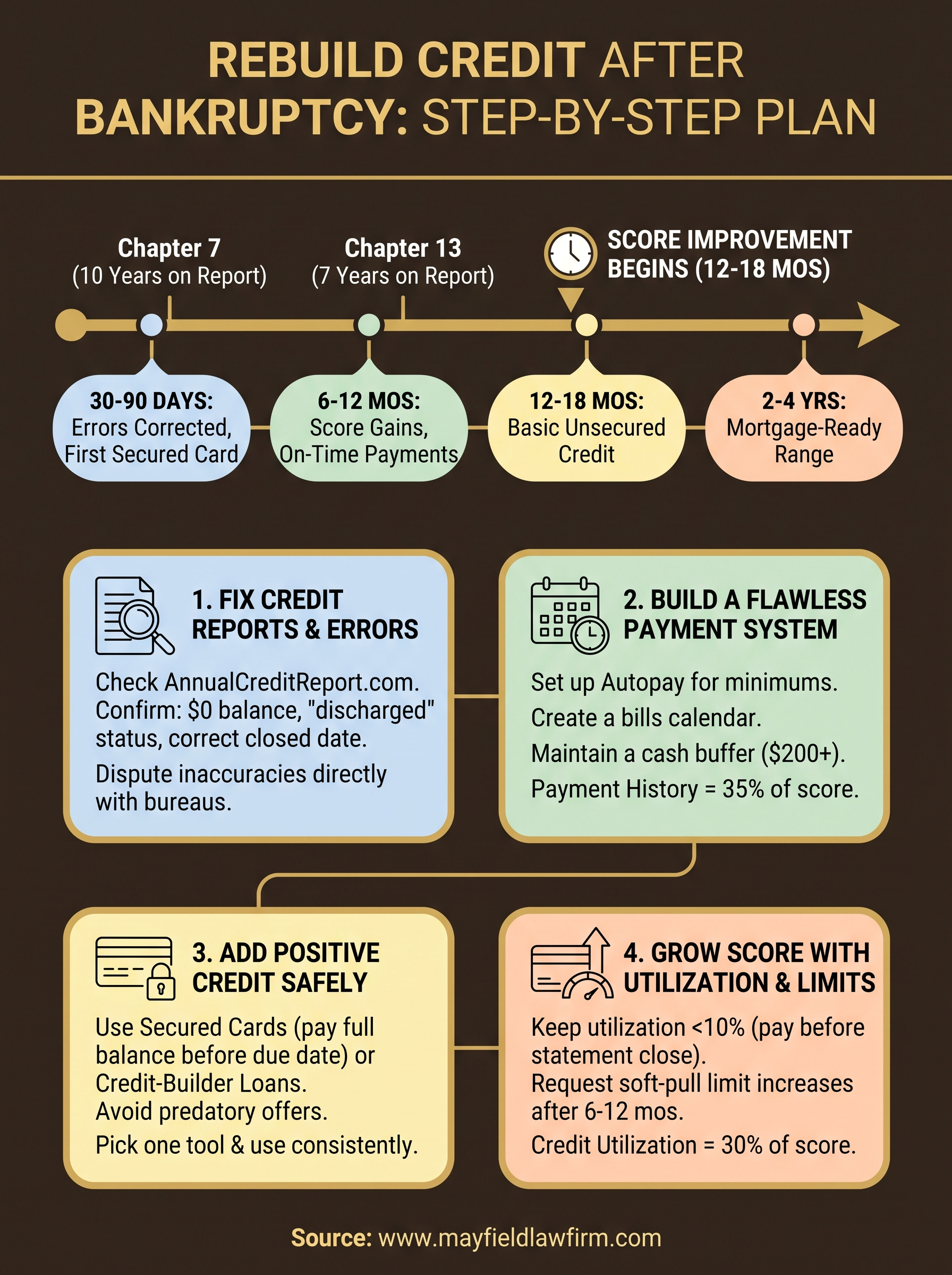
A Chapter 7 bankruptcy stays on your credit report for 10 years from the filing date. A Chapter 13 stays for 7 years. Those numbers sound heavy, but the impact shrinks significantly as you add positive history. Lenders and credit scoring models weigh recent behavior heavily, which means a solid 12 to 18 months of on-time payments begins to outweigh that old filing in a meaningful way.
The bankruptcy notation doesn't disappear overnight, but its influence on your score fades as new, positive account history replaces it over time.
What Actually Drives Your Score Now
Understanding the factors that control your score helps you focus your effort where it counts. Payment history carries the most weight at 35%, followed by credit utilization at 30%. The remaining 35% splits between the length of your credit history, your credit mix, and new credit inquiries. After bankruptcy, you have limited accounts and little recent history, so payment history and utilization are where you can make the fastest, most measurable gains.
Realistic Timelines and Red Flags
Setting benchmarks keeps you on track and prevents shortcuts when learning how to rebuild credit after bankruptcy. Here is what a consistent rebuilding path typically looks like:

| Timeframe | Realistic Milestone |
|---|---|
| 30 to 90 days | Errors corrected, first secured card opened |
| 6 to 12 months | Score gains of 50 to 100 points with on-time payments |
| 12 to 18 months | Eligible for basic unsecured credit |
| 2 to 4 years | Mortgage-ready range for many lenders |
Missed payments, high utilization, and too many credit applications in a short window are the three fastest ways to stall your progress. Each of these signals risk to lenders and pulls your score in the wrong direction right when you need momentum most.
Step 1. Fix your credit reports and clean up errors
Your first task in learning how to rebuild credit after bankruptcy is making sure your credit reports actually reflect the outcome of your case. Errors are more common than most people realize, and a single wrong entry can drag your score down for months while your rebuilding efforts produce no visible results.
What Correct Bankruptcy Reporting Looks Like
Pull your free reports from all three bureaus at AnnualCreditReport.com. Every account included in your bankruptcy should show one of the following statuses, depending on your chapter and the account type:
- "Included in bankruptcy" or "discharged in bankruptcy"
- $0 balance with no ongoing payment due
- An accurate closed date that matches your discharge date
- No duplicate tradelines for the same account
Common problems include balances still showing as owed, accounts marked "open" or "past due" that should be closed, and incorrect filing or discharge dates.
A single misreported account showing an active balance can suppress your score by dozens of points even after your case closes.
How to Dispute Errors and Track Your Progress
File disputes directly with each bureau (Equifax, Experian, and TransUnion) in writing, and also contact the original furnisher if the bureau does not correct the error on its own. Keep copies of every letter, every response, and your discharge paperwork in one dedicated folder so you have documentation ready if you need to escalate.
Check back after each dispute cycle closes. If you find accounts you never opened, that signals possible identity theft , which means you should place a credit freeze immediately through each bureau's website before continuing your rebuilding steps.
Step 2. Build a payment system that never misses
Payment history makes up 35% of your credit score , which makes it the single most powerful lever you control right now. When you're learning how to rebuild credit after bankruptcy, one late payment can undo months of progress, so you need a system that removes the risk of forgetting entirely.
Set Up Autopay and a Bills Calendar
Start by listing every account that reports to credit bureaus or could result in collections. Set up autopay for the minimum payment on each of those accounts immediately. Then build a monthly bills calendar so you can see exactly when each payment drafts from your account. Keep a minimum buffer of $200 to $300 in your checking account at all times to prevent overdrafts from triggering returned payments or bank fees.
Here is a simple template to organize your bills:
| Bill | Due Date | Autopay On? | Reports to Bureau? |
|---|---|---|---|
| Secured card | 15th | Yes | Yes |
| Rent | 1st | No | Optional |
| Utilities | 20th | Yes | Optional |
| Phone | 10th | Yes | Yes |
If a bill doesn't report to a bureau by default, Experian Boost lets you add on-time utility and phone payments to your Experian credit file at no cost.
Build an Emergency Fund and Handle Setbacks
An emergency fund covering one to three months of expenses is your best defense against future late payments. Aim to save $500 first, then grow from there. If you do fall behind, call the creditor before the payment hits 30 days late. Most lenders offer hardship programs that protect your credit during short-term financial gaps, but you have to ask before the damage shows up on your report.
Step 3. Add positive credit safely with the right tools
Once your reports are accurate and your payment system is running, you are ready to add new positive accounts . This is the phase where most people learning how to rebuild credit after bankruptcy either gain real momentum or make costly mistakes by moving too fast. Pick one primary tool , use it consistently for at least six months, and expand only after you have demonstrated a clear track record.
Secured Credit Cards and Credit-Builder Loans
Secured credit cards require a cash deposit, typically $200 to $500, which becomes your credit limit. Use the card for one or two small recurring purchases each month, pay the full balance before the due date , and the card reports on-time payments to all three bureaus. Look for cards with no annual fee or a low one, and avoid any card charging monthly maintenance fees that eat into your deposit.
A credit-builder loan works in reverse: the lender holds the loan amount in a savings account while you make monthly payments, and you receive the funds only after the loan term ends.
Credit unions and community banks typically offer credit-builder loans with the lowest fees. You can locate federally insured credit unions through the National Credit Union Administration locator.
Authorized Users and Predatory Traps
An authorized user arrangement lets a trusted person add you to their existing credit card account. If that account carries a long history, low utilization, and on-time payments, it can lift your score quickly. Set clear rules upfront about whether you will actually carry and use the card.
After bankruptcy, lenders will send you offers for payday loans, rent-to-own contracts, and guaranteed-approval cards carrying triple-digit interest rates. Reject all of them. Keep new applications spaced at least six months apart to limit hard inquiries on your report.
Step 4. Grow your score with utilization, limits, and timing
Once you have positive accounts reporting, credit utilization becomes your most precise control lever. Utilization measures how much of your available credit you're using at any given moment, and keeping that number below 10% produces the strongest scoring results. If your secured card carries a $300 limit, that means keeping your reported balance under $30.
Use Statement Dates to Control What Gets Reported
Most people pay by the due date and assume that's enough, but what matters for your score is the balance reported on your statement closing date , not what you owe when the payment clears. Pay your balance down before the statement closes, and the bureau sees a low utilization number. This single timing adjustment can move your score by 20 to 40 points without changing your spending.
Paying before the statement date, not just before the due date, is one of the fastest practical moves in how to rebuild credit after bankruptcy.
Request Limit Increases and Plan for Bigger Goals
After six to twelve months of on-time payments, call your card issuer and ask for a credit limit increase. Many issuers will grant a modest increase without running a hard inquiry if you ask specifically for a "soft pull review." A higher limit lowers your utilization ratio automatically, even if your spending stays the same.
When you're ready to target an auto loan or mortgage , give yourself at least two years of positive history first. Shop multiple lenders within a 14-day window so the credit bureaus count those inquiries as a single event. Track your score monthly using your bank or card issuer's free tools, and review your full credit reports quarterly to catch any new errors before they compound.
Next Steps for a Fresh Start
Rebuilding credit after bankruptcy is a process that rewards patience and consistency above everything else. The steps in this guide give you a clear path: clean up your reports, build a payment system that never fails , add the right credit tools, and manage utilization with precision. Each action compounds on the last , and within 12 to 18 months of disciplined effort, you will see meaningful score gains that open real financial doors.
Knowing how to rebuild credit after bankruptcy starts with understanding where you stand legally and financially. If you still have questions about your discharge, remaining obligations , or whether bankruptcy is the right move for your situation, speaking with an experienced attorney makes a real difference. Contact Mayfield Law Firm, P.A. for a free consultation and get the guidance you need to move forward on solid footing.