
Lawyer for Medical Malpractice in North Mississippi: 7 Steps
The best lawyer for medical malpractice is one who handles these cases regularly, holds a license in the state where your care happened, can fund expert review up front, and puts the fee terms in writing. A firm that works almost only on malpractice suits a complex birth injury or a catastrophic surgical error. A long-established injury firm with trial experience suits you if you want personal attention and one team for the whole claim. Either way, decide after a free consultation, not after an ad.
If you live around Tupelo, Southaven, or Memphis, choosing is harder than it looks. Many patients here get care on both sides of the state line, so Mississippi or Tennessee rules may set your deadline. Medical negligence cases also cost far more to investigate than a car wreck, so lawyers screen them hard and decline many.
This article gives you seven steps in order, from checking your deadline to leaving the consultation with a decision. Mayfield Law Firm, P.A. has represented clients in Northeast Mississippi and South Memphis since 1974, and medical malpractice is one of its services. You will see where a firm like ours fits and which questions to put to any firm, ours included.
1. Confirm the care failed and check your deadline
What this step involves
Medical malpractice is more than a bad result. It is harm caused when a licensed provider falls below the accepted standard of care . In Mississippi, an injured patient may bring a claim against a licensed health care provider for negligence, misconduct, errors or omissions, or breach of contract in providing health-related services. Typical examples are a missed or wrong diagnosis, a surgical error, a medication or dosage mistake, an anesthesia error, a premature discharge, and a misread lab result.
A lawyer has to prove four things: the provider owed you a duty, breached that duty , the breach caused your injury, and the injury produced losses. An unwelcome outcome without all four is not a malpractice case. Deadlines can end a valid case before you call anyone, so check them first.
| Mississippi | Tennessee | |
|---|---|---|
| Filing deadline | 2 years from when you knew, or should have known, of the harm | 1 year from the same point |
| Outer limit | Generally 7 years from the act | Generally 3 years from the act |
| Notice before suit | 60 days written notice | 60 days written notice |
| Cap on noneconomic damages | $500,000 | $750,000, or $1,000,000 for catastrophic injuries |
These are general summaries. Exceptions exist for foreign objects left in the body, minors, and concealment, so a lawyer should confirm which one applies to you.
The state where you received the care sets your deadline, so treat the shorter one as your working deadline until a lawyer says otherwise.
What to watch for
Where the care happened matters more than where you live. A Northeast Mississippi resident treated at a Memphis hospital may fall under Tennessee's one-year rule. Do not assume the longer Mississippi window applies. A firm whose attorneys are licensed in both states, as Mayfield's are, can sort this out in a first call.
If a patient died, a wrongful death claim may be involved, and the deadlines for it can differ from the malpractice deadlines. Do not assume the longer period governs. Call a lawyer within days, not months, and let the lawyer fix the deadline from your records.
2. Gather your records and write a timeline
What this step involves
A tidy file gets you a faster, more honest answer. Most lawyers decide within a short call whether a case deserves an expert review, so give them something to review. Collect these items:
- Medical records and imaging from every provider involved. Request them in writing, since you have a right to your own records under HIPAA.
- Itemized bills and insurance statements showing what was paid.
- A one-page timeline with dates, what you were told, and who said it.
- Names of the doctors, nurses, hospitals, and pharmacies involved.
- Photos, a symptom diary, and a list of missed work days.
- Any letters from the provider or its insurer.
If you wonder how to get a malpractice attorney to take your case, this is the answer. Lawyers accept cases where three things line up: clear harm , a provable departure from the standard of care, and losses large enough to justify the expert and filing costs, which can reach tens of thousands of dollars.
A lawyer takes your case when the harm is clear, the mistake is provable, and the losses justify the cost of proving it.
What to watch for
Do not sign a release or accept a "goodwill" payment from a hospital or insurer before you speak with a lawyer. Do not post about the case online, and do not send accusing letters to the provider. Never alter or "clean up" a record, because gaps and changes in the chart are exactly what an expert will look for.
Also, do not wait until your file is complete to make the first call. Call first and collect in parallel. A lawyer can tell you which records matter most, and the clock keeps running while you chase paperwork.
3. Build a shortlist of local firms
What this step involves
Aim for three firms. That is enough to compare and few enough to meet. Use several ways to find the best malpractice attorneys, because each has a blind spot:
| Source | What it gives you | Limit |
|---|---|---|
| Referral from a lawyer you trust | Names of lawyers who actually try these cases | Only as wide as that lawyer's network |
| Bar association referral service | Confirmation that the lawyer is licensed | Rarely ranks skill in malpractice |
| Online directories and ratings | Fast side-by-side comparison | Many listings are paid placements |
| Firm websites | Practice areas, offices, attorney bios | Marketing, so check for malpractice specifically |
Injury lawyers who decline a malpractice case often know who does take them, so ask for a name when someone says no.
Local presence still matters. A firm that works in your area knows the local courts and hospitals and can meet you face to face. Mayfield Law Firm, P.A. has offices in downtown Tupelo at 106 West Franklin Street, in Southaven at 910 E. Goodman Rd, Suite A, and in Memphis at 200 Jefferson Ave, Suite 713. Put any firm's offices next to your own commute before you rank it.
Three firms from three different sources give you a fair comparison and protect you from one firm's marketing.
What to watch for
Be careful with ads for "medical malpractice lawyers near me" that lead to a call center or a lead-generation page. Ask who would actually handle your file, name the lawyer , and confirm that person is licensed where your claim would be filed.
A "top rated" badge is also not proof of fit. Ask how the rating is earned, whether the firm paid for placement, and what the lawyer's own malpractice record looks like. Treat badges as one input among several.
4. Check real medical malpractice experience
What this step involves
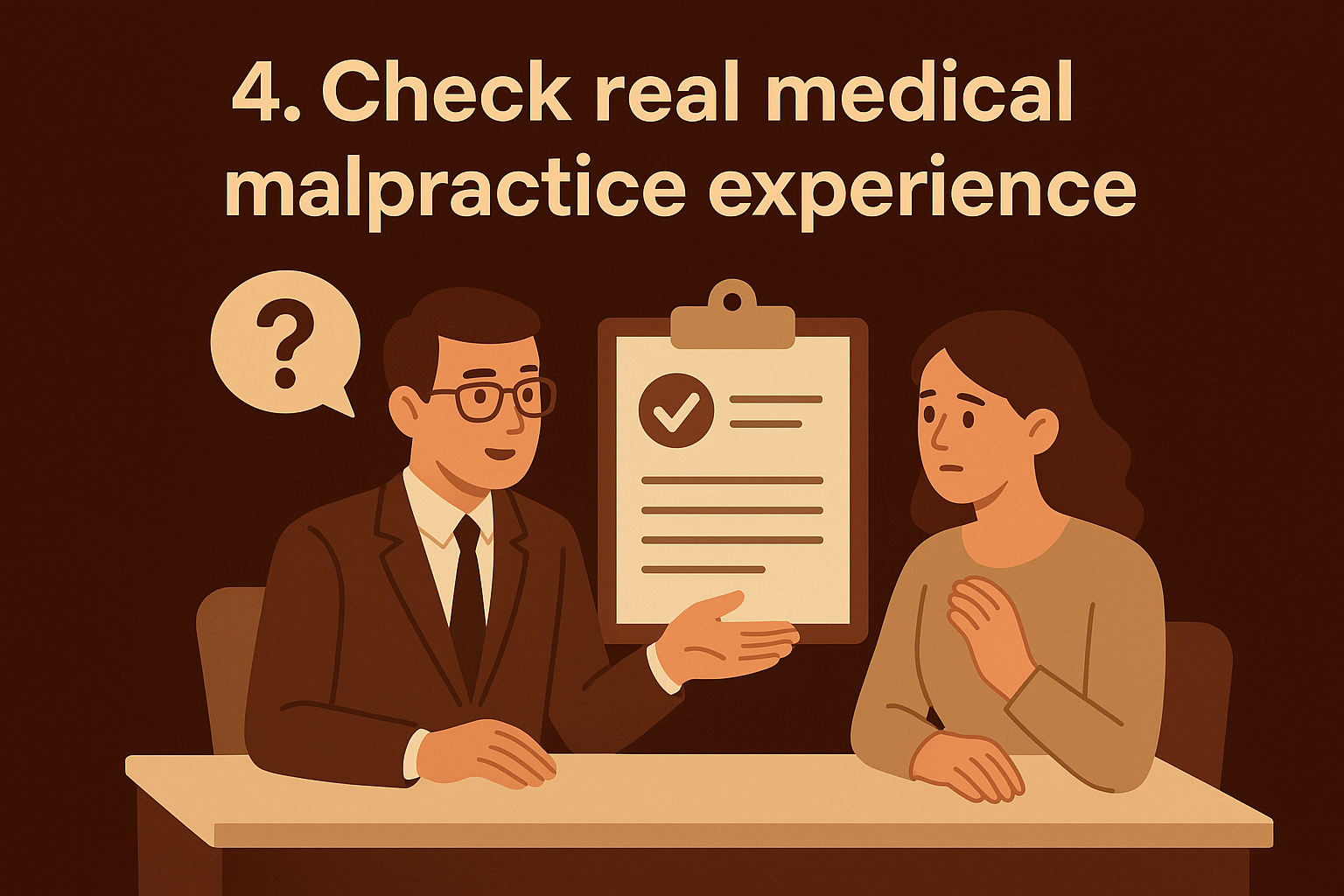
The useful question is not "do you handle medical malpractice?" Nearly every injury firm says yes. Ask how many cases they have taken as far as expert review , how many they have tried, and how they decide which cases to accept. Put these questions to every firm:
- What share of your caseload is medical malpractice?
- Which types of experts do you use for a case like mine?
- Have you tried a malpractice case to verdict? When?
- Who at the firm would do the work, and who would be my contact?
- Would you bring in co-counsel if my case needs it?
You will meet two models. A malpractice-focused firm offers a deep bench of experts and sharp case screening. A broader injury firm with a long trial record offers courtroom experience against insurers and one team across related claims. Mayfield is the second kind. Medical malpractice is one of its injury services, Kenneth Mayfield has more than 40 years of civil litigation experience, and the legal team has more than 47 years combined. Ask us what we have done in malpractice, just as you would ask anyone else.
Ask how many malpractice cases a lawyer has taken to trial, not whether the firm "handles" them.
What to watch for
Red flags are easy to spot once you know them. A lawyer who promises an outcome , cannot name the kinds of experts your case needs, or pushes a quick settlement before the records are reviewed is selling, not evaluating.
Complex cases, such as birth injuries or claims against several providers, may call for a specialist. A lawyer who says "I would bring in co-counsel for this" is being straight with you. Honesty about limits is a better sign than confidence about everything.
5. Verify the license and the track record
What this step involves
Confirm that the lawyer holds a current license in the state where your claim would be filed, and check the lawyer's disciplinary record. For Mississippi, use The Mississippi Bar's member lookup. For Tennessee, the Board of Professional Responsibility lists licensing and discipline. Both take minutes. Attorneys at Mayfield are licensed in Mississippi and Tennessee, which matters for Memphis care.
Then check the track record with care. Verdict and settlement figures in ads are not comparable. Ask four things about any number: what type of case it was, which year, which lawyer actually handled it , and what the client kept after fees, costs, and liens.
A verdict figure in an ad shows the case was big, not that this lawyer won it or that the client kept much of it.
What to watch for
Watch for firms that borrow credibility from a national "network" or a famous name while the day-to-day work goes elsewhere. Ask directly whether the lawyer you meet will be your lawyer. If a different attorney or a paralegal will carry the file, meet that person before you sign.
Your first contact also previews the relationship. If calls go unanswered for days while the firm is trying to win you, expect worse once you are a client. Response time is cheap evidence, so note it for every firm on your list.
6. Compare fee terms and case costs
What this step involves
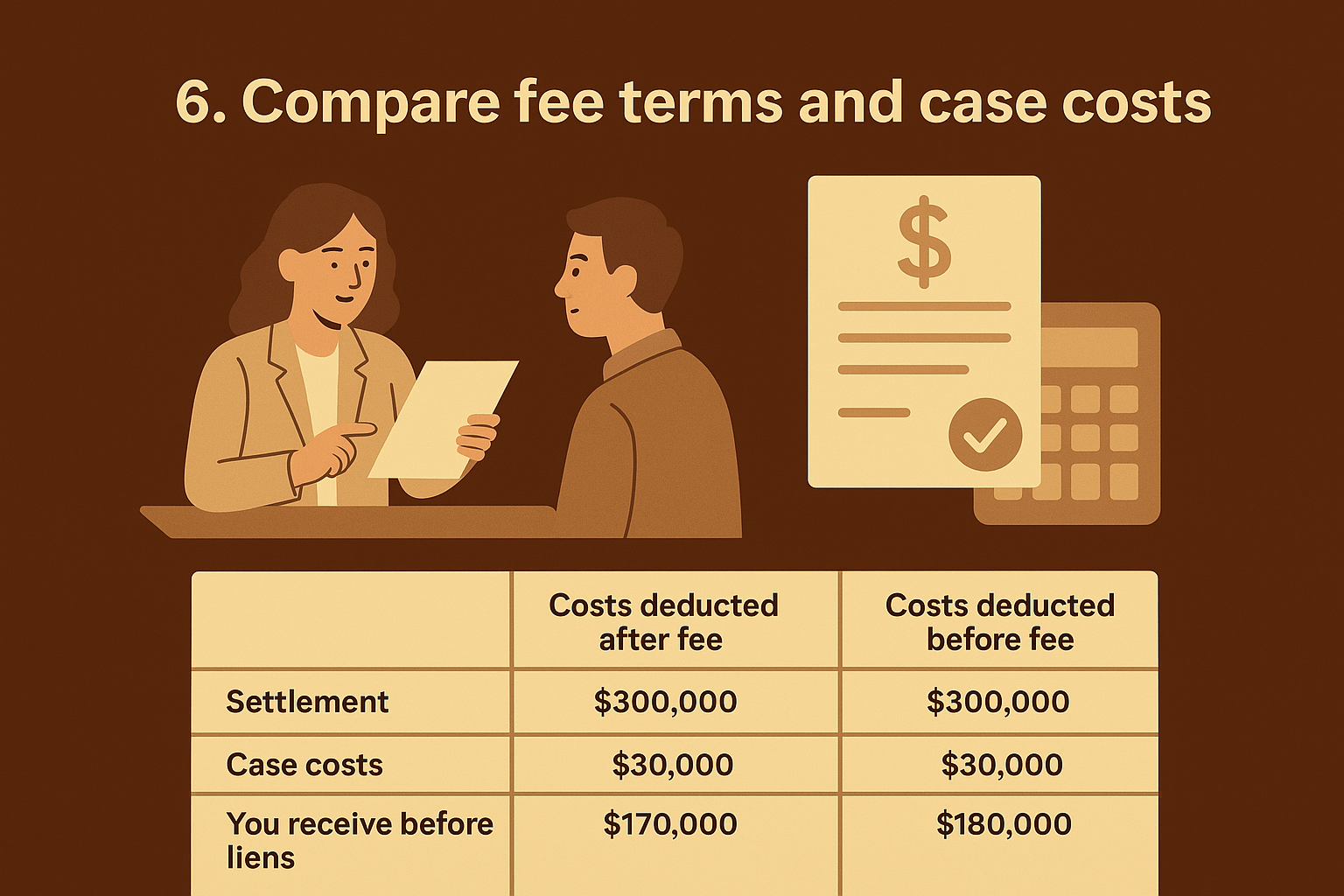
Most medical malpractice lawyers charge a contingency fee, meaning the fee is a percentage of what you recover, but never assume. Ask every firm for the fee agreement in writing before you decide, and ask at the consultation how our own terms work if you are considering us. Separate the attorney fee from case costs , which cover records, expert reviews, depositions, and filing fees. In malpractice these costs are heavy, and they are why firms decline modest cases, especially where a damages cap such as Mississippi's $500,000 limit on noneconomic damages narrows what a case can return.
How costs are deducted changes your net. Here is a hypothetical $300,000 settlement with a one-third fee and $30,000 in case costs. Real percentages and terms vary by firm and by whether the case settles or goes to trial.
| Costs deducted after fee | Costs deducted before fee | |
|---|---|---|
| Settlement | $300,000 | $300,000 |
| Case costs | $30,000 | $30,000 |
| Amount the fee is based on | $300,000 | $270,000 |
| Fee at one-third | $100,000 | $90,000 |
| You receive before liens | $170,000 | $180,000 |
The same settlement can put $10,000 more in your pocket depending on one sentence of the fee agreement.
What to watch for
Ask who pays the costs if you lose. Some agreements make the firm absorb them, and others make you repay them. Ask whether the percentage rises if the case goes to trial , and who decides whether to accept a settlement offer. The answer should be you.
Also ask about liens. Health insurers, Medicare, and Medicaid may claim reimbursement from your recovery, which lowers what you keep. A careful lawyer explains this at the start and negotiates liens at the end. A fee quote that ignores liens is incomplete.
7. Use the free consultation to decide
What this step involves
The free consultation is your interview of the lawyer, not the reverse. Mayfield Law Firm, P.A. offers a free consultation and welcomes in-person and virtual meetings. Prepare for the meeting by bringing your timeline, records, and bills, and ask the same set of questions at each firm so the answers are comparable:
- Do you see a viable case, and what is the main obstacle?
- Which deadline applies, and when does it run out?
- What would you do in the first 60 days?
- How will the case be funded, and what will I owe?
- How often will you update me, and who will answer my calls?
- What are the realistic outcomes, including losing?
After two or three meetings, compare the firms on five points: experience with cases like yours, candor about weaknesses , fee terms, communication, and how comfortable you felt. The right lawyer is usually the one who told you something you did not want to hear and still explained a path forward.
Choose the lawyer who was honest about your case's weak points, not the one who was most certain.
What to watch for
Pressure to sign the same day, a guaranteed result, or vague answers about costs are reasons to walk. You can take the agreement home and read it.
If a lawyer declines, ask whether the reason is the merits or the economics, because those are different answers. Also ask for a short letter confirming the firm is not representing you . It removes any confusion about who is handling the deadline, and it lets you move on to the next firm without losing time.
Where to go from here
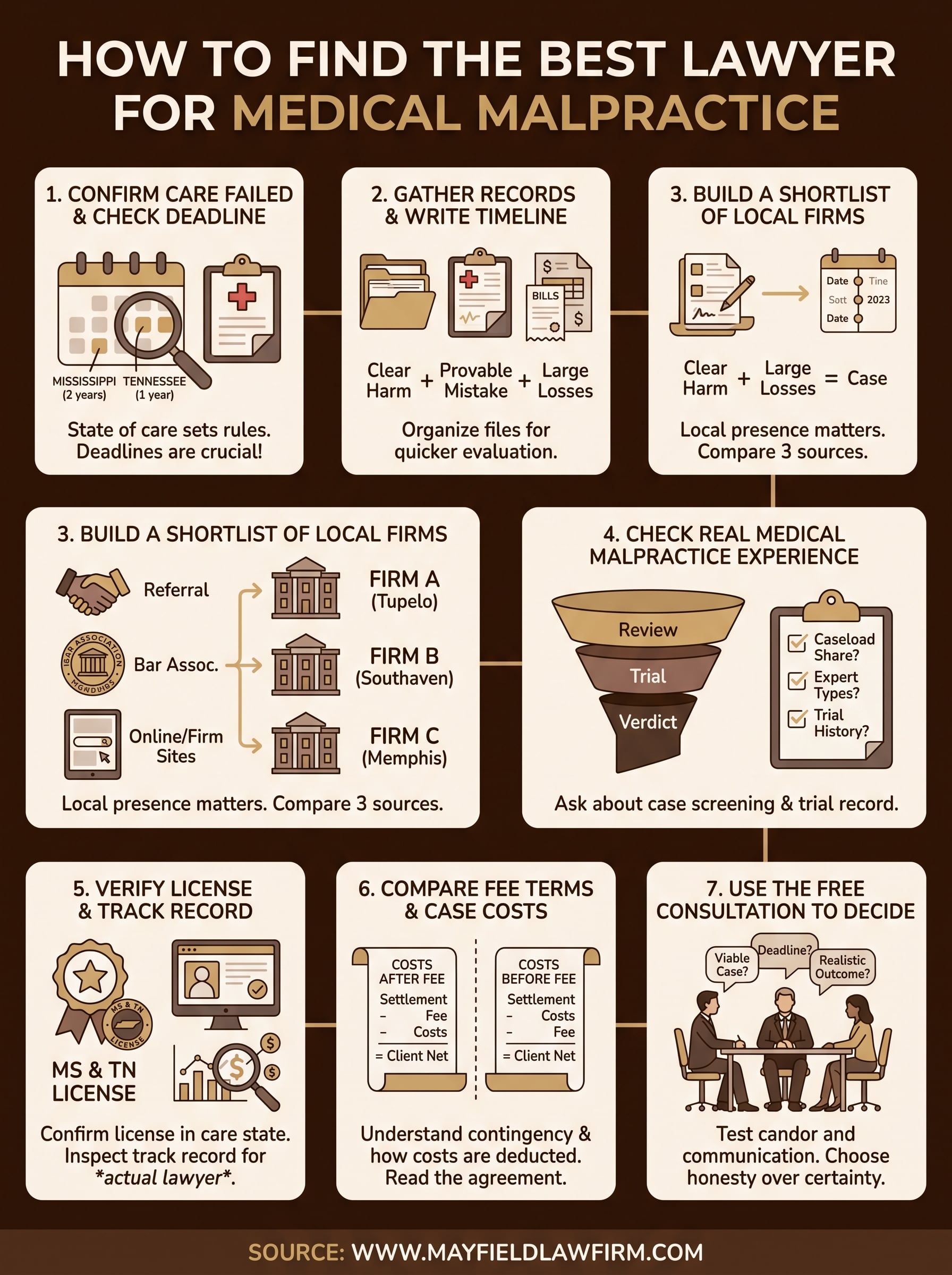
A good lawyer for medical malpractice is found, not guessed. Confirm that your injury fits the legal definition and check the deadline for the state where you were treated. Organize your records, shortlist three firms from different sources, test their real malpractice experience, verify licenses, and read the fee terms closely. Then use the consultations to compare candor and communication, not just credentials.
You do not have to do this alone or in the dark. If your care happened in Northeast Mississippi or Memphis, you can schedule a free consultation with Mayfield Law Firm, P.A. to talk through your timeline, your deadline, and whether we are the right fit for your claim.