
10 Questions to Ask a Malpractice Medical Attorney First
You think a doctor, nurse, or hospital hurt you through careless care. Now you are searching for a malpractice medical attorney , and every firm says it is the best. A short list of pointed questions will tell you more than any website. Most of these cases are expensive to bring, so the wrong lawyer can cost you months and money.
Here is the short answer. Before you hire anyone, ask about medical malpractice trial experience , how fees and case costs are handled, and who will actually work on your file. Ask how the lawyer will prove negligence with expert witnesses. Ask what deadlines apply to your claim. Mississippi and Tennessee both have strict filing rules, so waiting can end your case.
Below are 10 questions to ask in your first consultation, with notes on what a good answer sounds like. At Mayfield Law Firm, P.A., we have handled injury cases for over 40 years from our Tupelo, Southaven, and Memphis offices, and we offer free consultations. Use these questions with us or with any firm you meet, along with the other questions for a personal injury lawyer handling a malpractice claim.
1. How many medical malpractice cases have you handled?
Why this question matters
Medical malpractice is not a car wreck case with a different label, and it helps to know what a malpractice lawyer does and when to hire one. You must prove that a provider fell below the accepted standard of care, and that usually takes testimony from a qualified medical expert . Tennessee requires a certificate of good faith before you file, and Mississippi requires a certificate that an expert was consulted. A lawyer who has never handled these steps can lose months on procedure alone.
Insurers and hospital defense teams also know which plaintiff lawyers have actually tried these cases. They price their offers accordingly. A firm with real medical malpractice trial experience tends to get taken more seriously at the settlement table, because the defense knows the case can go to a jury.
Defense lawyers know who has tried malpractice cases, and they make their offers to match.
What a strong answer sounds like
Listen for specifics. A good malpractice medical attorney gives you a rough number of cases, the kinds of injuries involved, and general outcomes, all without breaking any client's confidentiality. Then ask follow-ups:
- How many of those cases went to trial, and how many settled?
- Which situations did they involve, such as surgical errors, misdiagnosis, medication mistakes, or birth injuries?
- How many malpractice cases is the firm handling right now?
Honest lawyers also admit their limits. If your injury involves a rare specialty, a candid attorney may bring in co-counsel who has handled that type of case. That is a sign of good judgment, not weakness. You want the person who tells you the truth about fit before you sign anything.
Red flags to watch for
Watch for answers that dodge the number. A lawyer who says "we handle all kinds of injury cases" without ever mentioning malpractice may be treating your case as a side line. Medical cases take far more time and money than a typical injury claim, so a lawyer new to this work can be a costly learning curve for you .
Be cautious if you hear any of the following:
- A guarantee of a win or a dollar amount in the first meeting
- No clear answer on trial history
- Pressure to sign a contract on the spot
- Big verdict claims with no detail about the facts or the lawyer's actual role
Past results never promise your result, but they do show whether the lawyer knows how these claims are built, so it is worth learning how to verify a firm's malpractice trial record.
2. Will you review my medical records before accepting the case?
Why this question matters
Your chart is the backbone of any malpractice claim. Progress notes, imaging, medication logs, and nurse entries show what happened and when. No lawyer can judge your case from a conversation alone , because your memory and the record often tell different stories. A firm that signs you up without reading the chart is guessing, and guessing gets expensive when expert reviews cost thousands.
You can also get a head start. Under HIPAA, providers generally must give you your records within 30 days of a written request, so you can begin collecting them today as part of the first steps after a suspected medical error.
A lawyer who accepts a malpractice case without reading the records is guessing with your money.
What a strong answer sounds like
A careful malpractice medical attorney says yes, then walks you through the process. Ask for these details:
- Who requests the records, and what authorization you need to sign
- Who reads them first, an attorney or a nurse reviewer
- How long the review takes, which is often several weeks
- Whether you will get a clear explanation if the firm declines
Good firms also tell you what a decline does and does not mean . One firm passing on your case does not prove no one did anything wrong. It may mean the damages are too small to cover the cost of proving it. Ask about the deadline, and seek a second opinion quickly.
Red flags to watch for
Beware of the instant yes. A lawyer who promises to take your case before seeing a single page is selling, not screening. An instant no is just as troubling , since it suggests the firm never looked at your chart.
Also ask whether any review costs come out of your pocket. Many firms screen cases at their own expense, so a surprise bill for a basic records review deserves a hard question.
3. Do you work with medical experts and nurse reviewers?
Why this question matters

Negligence in medicine is rarely obvious to a jury. You need a qualified expert in the same specialty to explain what the standard of care required and how your provider fell short. Courts can dismiss claims that lack this testimony, and both Tennessee and Mississippi require expert involvement before you file.
Nurse reviewers and legal nurse consultants do the early work. They read the chart, build a timeline, and flag gaps, so the firm learns whether your case justifies an expert's fee before spending thousands. A firm without this network is working blind.
A malpractice case without a credible expert is a case without a witness.
What a strong answer sounds like
A confident malpractice medical attorney explains how the firm finds experts and what happens at each stage. Ask these follow-ups:
- Do you use nurse reviewers for first-pass screening?
- How do you match an expert to my exact specialty?
- Do you rely on a few go-to experts, or search for the right fit each time?
- Who pays expert fees up front?
The best answers stress specialty matching and independence . An expert who treats the same kind of patients as the defendant carries more weight than a professional witness who testifies for a living.
Red flags to watch for
Be wary of vague claims like "we know some doctors." A lawyer who cannot explain how experts are chosen may not have a working system. Listen also for these warning signs:
- Plans to hire an expert only after the lawsuit is filed
- No nurse or medical review before the firm accepts your case
- Expert costs that are never explained until the contract is signed
4. Do I have a valid claim under the four elements of malpractice?
Why this question matters
Every malpractice claim rests on the four elements and the evidence that proves them, and you must prove all of them. Miss one and the case fails, no matter how upsetting your experience was. A bad outcome alone is not malpractice, because surgery can go wrong without anyone being careless.
| Element | What you must show |
|---|---|
| Duty | The provider had a treatment relationship with you |
| Breach | The care fell below the accepted standard |
| Causation | That breach, not your underlying illness, caused the harm |
| Damages | You suffered real losses, such as bills, lost wages, or lasting pain |
Causation and damages sink more cases than people expect. If you would have had the same result with perfect care, or your losses are small, the cost of proving the claim may exceed what it can recover .
A bad result is not malpractice unless careless care caused it.
What a strong answer sounds like
Expect a plain-language walk-through of your facts, not a yes or no. A good malpractice medical attorney tells you which elements look strong, which look shaky, and what evidence would settle the doubt . Ask for this:
- Which element is the hardest to prove in my case
- What the records must show on causation
- Whether my damages justify the expense of an expert review
Honest answers often include "it depends on what the expert says." That is accurate, and it beats false confidence.
Red flags to watch for
Distrust any lawyer who calls your case a winner after one phone call. Certainty before a records review is a sales tactic , not analysis. Also be wary if the lawyer talks only about how badly you were hurt and never mentions breach or causation.
- No mention of the standard of care
- Focus on your injuries but not on what the provider did wrong
- Dismissal of your claim without any explanation
5. What is the deadline for filing my claim?
Why this question matters

Malpractice deadlines are shorter than most people expect. In Tennessee, the general rule is one year from the date you discovered the injury , or should have, which matches the state's one-year window to sue for an injury. In Mississippi, you generally get two years from discovery , shorter than the state's usual deadline to sue for an injury in Mississippi. Both states also set an outer limit that runs from the negligent act, whatever you knew. Exceptions exist for minors, objects left inside the body, and fraud, so never assume one applies to you.
Miss the filing deadline and even the strongest malpractice case is gone.
| Tennessee | Mississippi | |
|---|---|---|
| Filing deadline | 1 year from discovery | 2 years from discovery |
| Outer limit | 3 years from the act | 7 years from the act |
| Pre-suit notice | 60 days, written | 60 days, written |
What a strong answer sounds like
A good malpractice medical attorney gives you a date, not a shrug. They explain when the clock started in your case and when it ends. They also account for the pre-suit notice period , since the notice must go out before you file.
Ask the lawyer to put the date in writing. Then confirm:
- Which state's law applies to your claim
- What event the firm treats as your discovery date
- Whether any exception could shorten or extend the deadline
Red flags to watch for
Be wary of a lawyer who says "you have plenty of time" without checking your dates. Vague answers about deadlines suggest the firm has not looked at your records or your state's rules.
Also watch for a firm that wants to "wait and see" for months before deciding. Slow screening eats into your window, so ask for a decision date and keep it. If the answer is no, start your second opinion right away.
6. How do you handle fees and case costs?
Why this question matters
Most malpractice lawyers work on contingency, so you pay no attorney fee unless you recover money , and it pays to understand how a contingency malpractice lawyer gets paid. But fees and costs are two separate bills. The fee is the lawyer's percentage. Costs cover records, filing fees, and experts, and expert fees alone can reach tens of thousands of dollars , which is a large part of what a malpractice case costs to bring.
Ask about the fee percentage and the case costs separately, because they are two different bills.
What a strong answer sounds like
A clear malpractice medical attorney explains the math in writing before you sign. Tennessee caps contingency fees in malpractice cases at one-third, while Mississippi sets no cap, so ask what percentage applies and whether it rises once the case is filed. Then ask:
- Is the fee calculated before or after costs come out?
- Who advances the costs, and do I owe them if we lose?
- Will you send itemized cost reports during the case?
Order matters more than most people expect. On a $300,000 settlement with a one-third fee and $40,000 in costs, you take home $173,333 if costs come off first. You take home $160,000 if the fee is figured first. That order alone is a $13,000 difference.
Red flags to watch for
Be wary of any fee terms that stay verbal. Insist on a written agreement and read it before you leave the office. Take your time, because a good firm will not rush you.
Watch for these warning signs:
- A request for an upfront retainer on a contingency case
- No explanation of who pays costs if you lose
- Refusal to say how the fee is calculated
- Vague answers like "we'll sort that out later"
7. What is my case realistically worth?
Why this question matters
Your decision to sue depends on this number, but no honest lawyer can price a case before reviewing the records and hearing from an expert. Value comes from economic losses, such as medical bills, future care, and lost income, plus pain and suffering.
A realistic value comes from your records and your losses, not from a lawyer's gut feeling.
Caps also shape the answer. Mississippi limits noneconomic damages in medical malpractice cases to $500,000. Tennessee generally sets the limit at $750,000, or $1 million for catastrophic injuries. These caps apply to pain and suffering, not to your bills or lost wages.
What a strong answer sounds like
A good malpractice medical attorney gives you a range, not a promise , and explains what could move it up or down. Ask these follow-ups:
- Which of my losses count as economic, and which do not?
- How does the state cap apply to my injury?
- After costs and fees, what would I keep at the low end and the high end?
- How does the cost of experts and a possible trial affect that math?
The lawyer should also tell you plainly if your damages are too small to justify the expense of proving the claim. That is hard to hear, but it saves you money and months.
Red flags to watch for
Walk away from anyone who quotes a specific dollar figure in the first meeting . Without records, that number is a sales pitch. Be just as cautious if the lawyer never mentions caps or costs , because you cannot judge a settlement without knowing what you would actually take home.
- Comparisons to a friend's big payout, with no facts about that case
- Talk of "easy money" or a quick settlement
- No discussion of how fees and costs reduce your share
8. Will you take my case to trial if needed?
Why this question matters
Most malpractice cases settle, but the threat of trial is what produces a fair settlement . Hospitals and their insurers fight these claims hard. They often refuse good offers until they believe your lawyer will actually pick a jury. A firm that settles everything quickly teaches the defense that it can lowball you.
A settlement offer is only as strong as the lawyer's willingness to try the case.
Trial also takes money. Expert testimony, depositions, and exhibits can add tens of thousands of dollars in costs, so the firm must be financially ready to carry them. Ask about this early, before the contract is signed.
What a strong answer sounds like
Expect a direct yes, followed by specifics. A good malpractice medical attorney tells you when they last tried a case, how it ended, and how they prepare every file as if it is headed to court . Then ask:
- When did you last try a malpractice case to verdict?
- Do you prepare all your cases for trial, or only some?
- How will you advise me if the defense makes a low offer?
A strong lawyer also respects your role. The decision to accept or reject a settlement belongs to you , and the lawyer's job is to explain the risks of each path honestly.
Red flags to watch for
Watch for a lawyer who talks only about settling. Phrases like "we almost never go to court" may mean the firm lacks the experience or the budget to try your case. A firm that cannot name a recent trial is probably not feared by the defense.
Also be cautious if you hear any of these:
- Pressure to accept the first offer to "avoid the risk"
- No discussion of trial costs or who pays them
- Vague claims such as "we have trial lawyers on call"
- Promises that your case will never see a courtroom
9. Who will actually work on my case?
Why this question matters
The attorney you meet at the consultation is not always the one who handles your file. Many firms pass day-to-day work to a paralegal or junior associate , and the senior lawyer shows up again at mediation or trial. That can work well. It fails when nobody can say who is responsible.
Malpractice files run to thousands of pages, so the people doing the work shape your outcome as much as the name on the door.
The lawyer who signs you up should be able to tell you exactly who will do the work.
What a strong answer sounds like
A good malpractice medical attorney names the people on your team and explains what each one does. You should leave knowing who your main contact is and who can answer a question when that person is in court. Ask these follow-ups:
- Which attorney will be responsible for my case from start to finish?
- Who will talk to the experts and the defense lawyers?
- Will a nurse reviewer or paralegal handle my records?
- How quickly will someone return my calls or emails?
Team-based firms are not a problem. A team can mean more hours on your file, as long as a licensed attorney supervises every step and you know that person by name.
Red flags to watch for
Be careful if you only meet a salesperson or intake coordinator and the lawyer stays out of sight. Vague answers like "the firm will handle it" usually mean no one in particular will. Also be wary of a firm that takes far more cases than its staff can carry. Watch for these signs:
- You cannot get the handling attorney on the phone before signing
- No direct line or email for anyone on your team
- Staff turnover mentioned casually, with no plan for continuity
- The lawyer who pitched you says a different attorney will "take over" later
10. How long will my case take, and how will you keep me updated?
Why this question matters

Most malpractice claims take two to four years from the first consultation to resolution, and cases that go to trial can run longer, as this stage-by-stage malpractice case timeline shows. Records review, expert opinions, the pre-suit notice period, discovery, and mediation each take months. A slow pace is normal.
Silence is the real problem. Clients who hear nothing for months start to assume the worst, and some drop good cases out of frustration. Regular updates show that someone is working on your file, and they help you plan your medical care, finances, and family life around a long process.
A slow case is normal, but a silent lawyer is not.
What a strong answer sounds like
A good malpractice medical attorney walks you through the stages and gives a realistic timeline with a range , not a promise. The lawyer should also explain what can speed up or slow down your case, such as expert availability, court schedules, and a defense that refuses to negotiate. Ask these follow-ups:
- How often will I hear from you, even when nothing has happened?
- Who will contact me, and by phone, email, or portal?
- Will you consult me before any major decision?
- Can I get copies of key filings and expert reports?
Red flags to watch for
Be wary of anyone who promises a fast settlement in a medical case. Speed usually means the firm plans to take a low offer. Watch for a lawyer who is vague about communication and says only "we'll be in touch."
- A timeline that sounds too short for a case needing expert review
- No set schedule for updates
- Reviews or past clients complaining about unreturned calls
- No named person to call with questions
Choosing the right attorney for your situation
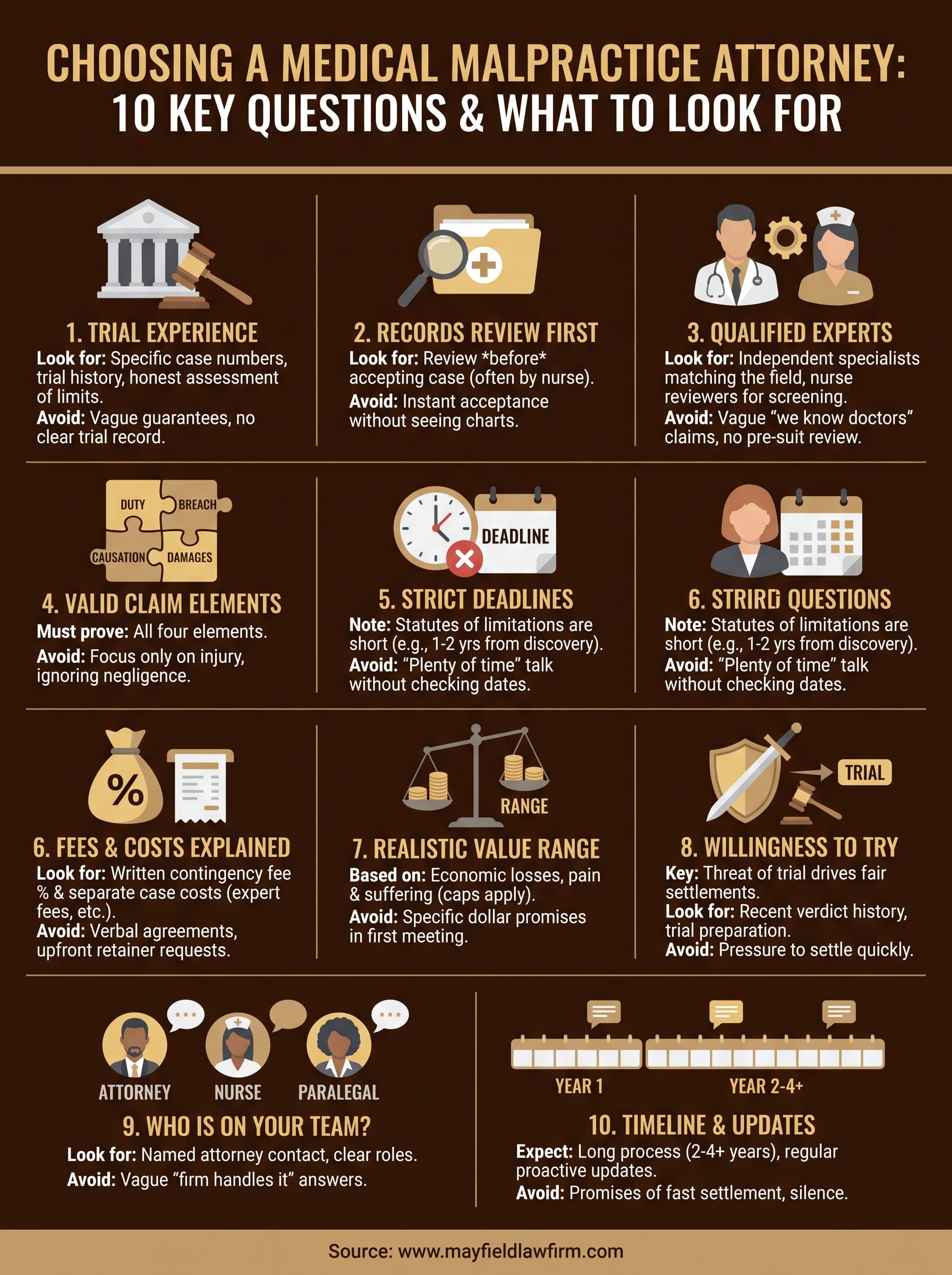
The right malpractice medical attorney answers these ten questions with specifics, not slogans. Look for real trial experience , a records review before any promise, a written fee agreement, and a named person who returns your calls. Watch the calendar too, because filing deadlines do not wait while you shop around.
Take this list to every consultation and compare the answers side by side. Two or three meetings are normal, and a good firm will never rush you. Trust the lawyer who tells you hard truths about your case, even when you hoped to hear something else. That honesty is what you will need during a case that can run for years.
If you were hurt by negligent care in Northeast Mississippi or the Memphis area, we are glad to walk through these questions with you. Schedule a free consultation with our medical malpractice lawyers serving Northeast Mississippi and bring your records and every question you have .