
Top Rated Medical Malpractice Lawyers near Me: 7 Key Traits
Searching for top rated medical malpractice lawyers near me usually happens after something has gone wrong. A missed diagnosis, a surgical error, or a medication mistake has changed your life, and now you need to choose a lawyer from a long list of star ratings and ads. Ratings alone will not tell you who can win your case.
Here is the short answer. The best medical malpractice lawyer is one who has real trial experience with medical negligence claims , works on contingency, and offers a free consultation so you can judge the fit before you commit. Reviews matter, but only when they describe how a lawyer communicates and handles complex cases.
Below are seven traits to check on any attorney's website, directory listing, or in a first meeting. Mayfield Law Firm, P.A. has handled personal injury and medical malpractice claims for Mississippi and Memphis families for over 40 years, so these are the standards we hold ourselves to. Use them to compare firms with confidence.
1. Proven experience with medical malpractice cases
What it means
Proven experience means a lawyer has handled medical malpractice claims from start to finish , not just car wrecks and slip-and-falls. Medical negligence is its own field of law. You must show that a provider breached the accepted standard of care and that the breach caused your harm. That takes medical records, expert opinions, and a working knowledge of how hospitals and insurers defend these claims.

Years in practice help, but they are only a starting point. A lawyer with 30 years of general practice may have closed three malpractice files. Look for a steady share of the caseload devoted to medical negligence, and for experience with your type of injury , whether that is a surgical error, a misdiagnosis, a birth injury, or a medication mistake.
Why it matters for your claim
These cases are harder and more expensive to build than most injury claims. In both Mississippi and Tennessee, you generally have to give the provider written notice before suing and support the complaint with an expert certificate . Deadlines are also short. Tennessee's limit is generally one year from when you discovered the injury, and Mississippi's is generally two. The exact date depends on your facts, so do not wait to have a lawyer review it.

Defense teams know all of this. Hospitals and their insurers hire attorneys who defend malpractice claims every week, and those attorneys quickly find out whether your lawyer understands the medicine. An inexperienced lawyer may miss a deadline, pick a weak expert, or accept a lowball offer because he cannot judge what the claim is really worth.
Medical malpractice is a specialty, and your lawyer should not be learning it on your case.
How to check it
Verify instead of assuming. When you search for top rated medical malpractice lawyers near me, the profile pages rarely show how many malpractice cases the lawyer has actually handled. Ask directly during the free consultation, and compare the answers against this table.
| Question to ask | Strong answer | Warning sign |
|---|---|---|
| How many medical malpractice cases have you handled? | A specific number, a time frame, and general outcomes | "We handle all kinds of injury cases" |
| Have you handled my type of injury? | Describes similar cases without breaking client confidentiality | Changes the subject to car accidents |
| Which medical experts have you worked with? | Names the specialties they typically consult | Cannot say how they find experts |
| How do you decide whether to take a case? | Explains a records review and expert consultation first | Promises a win on the first call |
| Who will actually work on my file? | Names the attorney and the support team | Vague about who handles what |
Cross-check what you hear. Look for dedicated malpractice pages on the firm's website, not just a line in a list of practice areas. Confirm the lawyer's license and disciplinary history with the state bar, such as the Mississippi Bar or the Tennessee Board of Professional Responsibility. A good lawyer will also tell you honestly when a claim is weak, and that candor is a strong sign of real experience.
2. A track record of verdicts and settlements
What it means
A track record is the documented history of results a lawyer has won for medical malpractice clients. It includes jury verdicts and negotiated settlements. Most claims settle before trial, so settlements matter as much as courtroom wins. What you want to see is a pattern of fair outcomes in cases like yours .
Be careful with big numbers on a website. A headline figure tells you little without context. Ask what the injury was, what the client's losses were, and whether the result came after months of hard negotiation or a quick offer.
Why it matters for your claim
Insurers and hospital defense teams keep notes on the lawyers they face. They know who prepares every case as if it is going to a jury and who is looking for a fast fee. A lawyer with a real history of strong results gets taken seriously, and that often leads to higher settlement offers without a fight.
A lawyer's past results show how the other side will treat your claim.
Past results never guarantee your outcome, and every case turns on its own facts. Damage caps also shape what a good result looks like. Mississippi and Tennessee both limit noneconomic damages in many malpractice cases, so a skilled lawyer knows how to build the economic side of your claim, such as future care and lost income. Ask how the lawyer's results were reached under those limits.
How to check it
Start with the firm's own results page, then look beyond it. Marketing pages show the best outcomes and leave out the rest. Use these steps to get a fuller picture:
- Ask for a range of outcomes , not just the biggest one. A candid lawyer will explain settlements, verdicts, and cases that were lost or dropped.
- Search public court records for the lawyer's name. Verdicts in malpractice cases are often reported in local court dockets and legal news.
- Match the results to your injury. A large auto accident settlement says little about a surgical error claim.
- Watch for guarantees. No honest attorney can promise a result, and bar rules require care in how past results are advertised.
Finally, listen to how the lawyer talks about results. Specific details about experts, damages, and strategy suggest real involvement. Vague bragging does not.
3. Willingness to take a case to trial
What it means
A lawyer who is willing to try cases will prepare every file as if a jury will decide it , even though most claims settle. That means building the case for the courtroom from day one. The lawyer gathers records, locks in expert opinions, and takes depositions of the doctors and nurses involved. It also means the lawyer has actually stood before a jury in a malpractice case, not just filed paperwork and negotiated.
Some firms refer trial-bound cases to other lawyers and keep a share of the fee. Others avoid trial because it costs more and takes longer. Neither approach serves you if your claim needs a courtroom.
Why it matters for your claim
Settlement value depends on leverage. Defense insurers estimate what would happen at trial, and they discount their offers for lawyers they believe will never get there. A lawyer who is ready to try the case gets better offers, because the risk to the defense is real.
Insurers pay more when they believe your lawyer will actually go to trial.
Trial also protects you when the other side refuses to be reasonable. Hospitals often deny fault and fight hard. If your lawyer is not prepared to go to court, your only choices are to accept a low offer or drop the claim. Trial is not always the right move, and a fair settlement can beat a risky verdict. The point is that the decision should be yours, not limited by your lawyer's comfort level.
How to check it
Ask pointed questions in the free consultation and listen for specifics:
- When did you last try a medical malpractice case to verdict? A recent, concrete answer is what you want.
- How many jury trials have you handled in total? Look for numbers, not general claims about being "trial ready."
- Will you try my case yourself, or refer it out? Know who will be in the courtroom.
- Would you go to trial if the offer is too low? A good lawyer explains the risks and leaves the choice to you.
Then verify. Read the attorney's biography for trial experience and courtroom results , and search local court records for cases the lawyer has tried. When you narrow a list of top rated medical malpractice lawyers near me, put the ones with recent jury experience at the top. Be wary of any firm whose materials never mention a trial.
4. Resources to hire medical experts and fund the case
What it means
Medical malpractice cases run on expert testimony. A well-resourced firm can hire qualified physicians in the same specialty as the provider you are accusing. It also has the cash to advance every cost until the case ends. Those costs include medical records, expert review fees, depositions, court reporters, and trial exhibits.
Experts bill by the hour, and one case may need several. You might need one for the standard of care, one for causation, and others for future care or lost earnings. Total costs can reach tens of thousands of dollars before a settlement or verdict. Most firms in this field pay them up front and recover them from the result.
Why it matters for your claim
Without a credible expert, you usually have no claim. A court can dismiss a case that lacks qualified testimony before a jury ever hears it, and the defense will challenge your expert's credentials and opinions. A lawyer with a trusted network of experts can find the right specialist quickly and know who holds up under cross-examination.
No qualified expert means no case, so ask who your lawyer will call.
Funding matters just as much. A firm stretched thin may push you to settle early because it cannot afford a long fight. Hospitals know this and wait it out. A lawyer who can carry the costs through trial negotiates from strength, and you avoid paying out of pocket while you are already dealing with medical bills.
How to check it
When you compare top rated medical malpractice lawyers near me, ask about money and experts directly. A good firm answers without hesitation, and the answers should match what the fee agreement says in writing.
- Who advances the case costs? The firm should, with repayment taken from any recovery.
- What happens to costs if we lose? Some firms waive them and others do not. Get the answer in writing.
- Which specialists do you usually consult? Look for named fields, such as surgery, obstetrics, or emergency medicine.
- Will an expert review my records before you accept the case? Careful firms do this first.
- Do you work with other firms on large cases? Co-counsel can add funding and depth.
Read the fee agreement before you sign. It should state how costs are handled and when they are deducted from a settlement. Vague wording about expenses is a reason to ask more questions or keep looking.
5. Strong peer ratings and professional standing
What it means
Peer ratings are evaluations of a lawyer by other lawyers and judges , the people who see the work up close. Directories such as Martindale-Hubbell, Super Lawyers, and Best Lawyers publish them. Professional standing is broader. It covers a clean disciplinary record , good standing with the state bar, and active membership in groups like the American Association for Justice or your state's trial lawyer association.
Client reviews tell you how it felt to work with someone. Peer ratings tell you whether colleagues respect the legal work. You want both, and neither one is enough alone.
Why it matters for your claim
Other lawyers know things you cannot see from outside. They have faced your candidate in negotiations and in court, and they know who prepares thoroughly and who plays fair. Respect from opposing counsel and judges carries real weight when a hospital's defense team decides how seriously to take your claim.
A strong reputation among lawyers is the closest thing to a reference from the other side of the table.
Be realistic about the limits, though. Some rating programs sell advertising alongside their lists, and a badge can be a marketing tool. The best highly rated lawyers have credentials that hold up when you read how the rating is earned. Treat a peer rating as one input, and never as a reason to skip the other six traits.
How to check it
When you compare top rated medical malpractice lawyers near me, spend ten minutes confirming that the ratings are real and the standing is clean.
- Read the methodology. Find out whether the rating comes from peer votes, independent research, or paid placement.
- Search the state bar. Confirm an active license and no public discipline with the Mississippi Bar or the Tennessee Board of Professional Responsibility.
- Look at the lawyer's biography. Trial lawyer association memberships, teaching, and published work show commitment to the field.
- Read reviews for patterns. Ignore the star average. Look for repeated comments about honesty, preparation, and results.
- Ask for references. A confident lawyer can connect you with a past client or a colleague who will speak candidly.
Finally, compare what you find across sources. A lawyer with consistent praise from peers, clients, and the bar record is a safer choice than one with a single impressive badge.
6. Clear communication and personal attention
What it means
Clear communication means you understand your case at every stage and hear from your legal team without having to chase them. Personal attention means a real attorney knows your file , not just a case manager who changes every few months. A medical malpractice claim can take two or three years, so this working relationship lasts a long time.
It also means plain language. A good lawyer explains the standard of care, causation, and damages in words you can follow. You should always know what happens next, what it may cost, and how long it could take.
Why it matters for your claim
You will face big decisions during the case, such as whether to accept a settlement offer. You can only decide well if you understand the facts , and a lawyer who goes quiet for months leaves you guessing. Some high-volume firms sign many clients and pass files to staff you never meet. Those cases can stall, and records requests can sit unanswered.
Your own input shapes the case too. You know your medical history, symptoms, and daily limits better than anyone. A lawyer who listens catches details the records miss, and those details can change the value of your damages.
A lawyer who cannot explain your case clearly is not ready to argue it.
How to check it
Judge communication before you hire anyone. How a firm treats you on the first call is a preview of the next two years. As you screen top rated medical malpractice lawyers near me, watch for these signals:
- Response time. Did someone return your call or message within one business day?
- Listening. Did the lawyer let you finish your story and ask follow-up questions?
- Plain explanations. Could you repeat the plan to a friend afterward?
- Named contacts. Do you know which attorney and paralegal will handle your file?
- Update schedule. Will the firm commit to regular updates, such as a monthly status call?
Then read the reviews for specifics. Phrases like "returned my calls" and "explained everything" are good signs. Complaints about being passed around or never reaching the attorney are a warning.
Local offices help as well. Being able to sit down with your lawyer in Tupelo, Southaven, or Memphis makes it easier to ask questions face to face and to review documents together , which email alone never replaces.
7. Free consultation and contingency fee pricing
What it means
A contingency fee means you pay no attorney fee unless your lawyer recovers money for you. The fee is a percentage of the settlement or verdict. A free consultation means the first meeting costs nothing and carries no obligation, so you can hear an honest assessment of your medical negligence claim before you decide anything.
Percentages vary by firm and by stage. One-third is common, and some firms raise it to around 40% if the case goes to trial. Tennessee law generally caps contingency fees in medical malpractice cases at one-third, so ask how your state's rules apply. Also keep fees and case costs separate . The fee pays the lawyer, while costs cover experts, records, and filing charges.
Why it matters for your claim
Money worries keep many injured patients from calling a lawyer at all. You may already be paying for corrective surgery, therapy, or lost work. Contingency pricing removes that barrier , and the firm only gets paid if it wins, so its incentives line up with yours.
You should never pay a lawyer anything upfront just to hear whether you have a case.
Pricing also shows how a firm operates. A lawyer who works on contingency has already judged your claim worth the risk. If you meet someone who asks for a large retainer or hourly billing on a malpractice claim, treat that as a red flag and compare other firms.
How to check it
Use the consultation to get every number in plain terms. When you screen top rated medical malpractice lawyers near me, ask these questions and request the answers in writing:
- What percentage do you charge , and does it change if the case goes to trial or an appeal?
- Is the fee calculated before or after costs are deducted? The order changes your net payout.
- Who pays costs if we lose? Some firms absorb them, and others bill you.
- Are there any fees for the consultation or case review? The answer should be no.
- Can I see a sample fee agreement? Take it home and read it before signing.
Then compare the agreements side by side. Clear, written terms with no vague language about expenses signal an honest firm. If a lawyer rushes you to sign on the first call, slow down. A good firm will give you time to think it over, and that patience tells you a lot about how the next two years will go.
Choosing the right lawyer for your claim
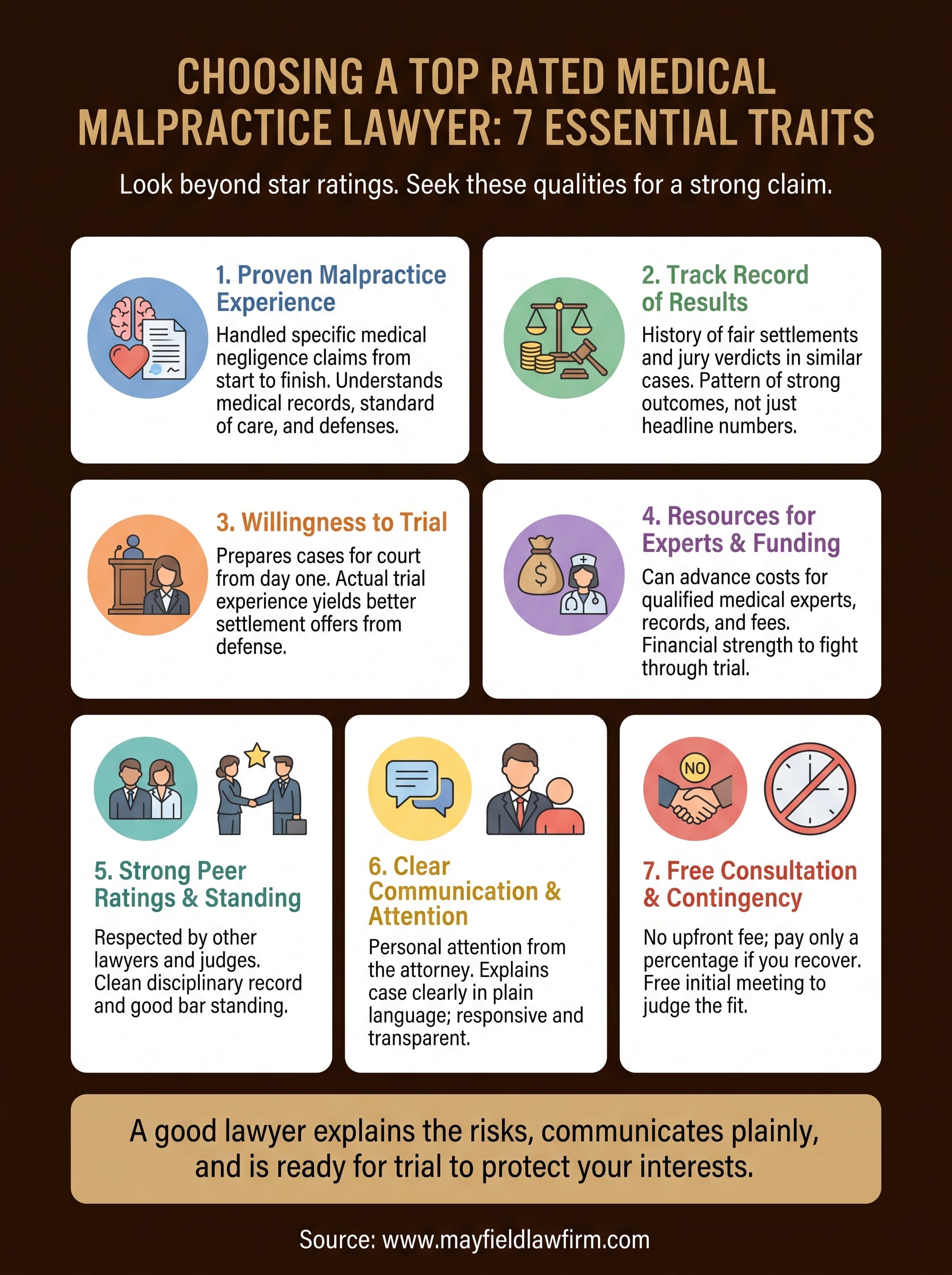
The best of the top rated medical malpractice lawyers near me share the same seven traits: proven malpractice experience , a real record of results, trial readiness, expert and funding resources, respected standing, clear communication, and contingency pricing. No single badge covers all of them, so check each trait yourself before you decide.
Deadlines in Mississippi and Tennessee are short, and evidence is easier to gather early. Use the questions in this article on your first call, compare at least two or three firms , and trust the lawyer who answers plainly about risks and costs.
If a medical mistake has harmed you or someone you love in Northeast Mississippi or Memphis, talk to the medical malpractice attorneys at Mayfield Law Firm, P.A. about a free consultation. We will tell you where your claim stands , and you pay no fee unless we recover for you.