Personal Injury Lawyer for Slip and Fall: What They Do
You slipped on a wet floor with no warning sign, or tripped on a broken step someone should have fixed months ago. Now you're dealing with medical bills, missed work, and an insurance adjuster who keeps lowballing you or ignoring your calls. A personal injury lawyer slip and fall cases require someone who knows how to prove the property owner knew about the hazard and did nothing about it, because that's the piece most people can't build on their own.
So what does that lawyer actually do for you? They investigate the scene, pull maintenance records, track down witnesses, and calculate the full value of your claim, including future medical costs and lost wages you haven't even tallied yet. Then they negotiate with the insurance company or take the case to court if the offer doesn't cover what you're owed.
This article breaks down exactly what a slip and fall attorney handles at each stage, from the first consultation through settlement or trial. You'll see why premises liability cases hinge on proof, how fault gets determined in Mississippi and Tennessee, and what to expect when you bring your case to a firm like Mayfield Law Firm.
Why you need a lawyer after a slip and fall accident
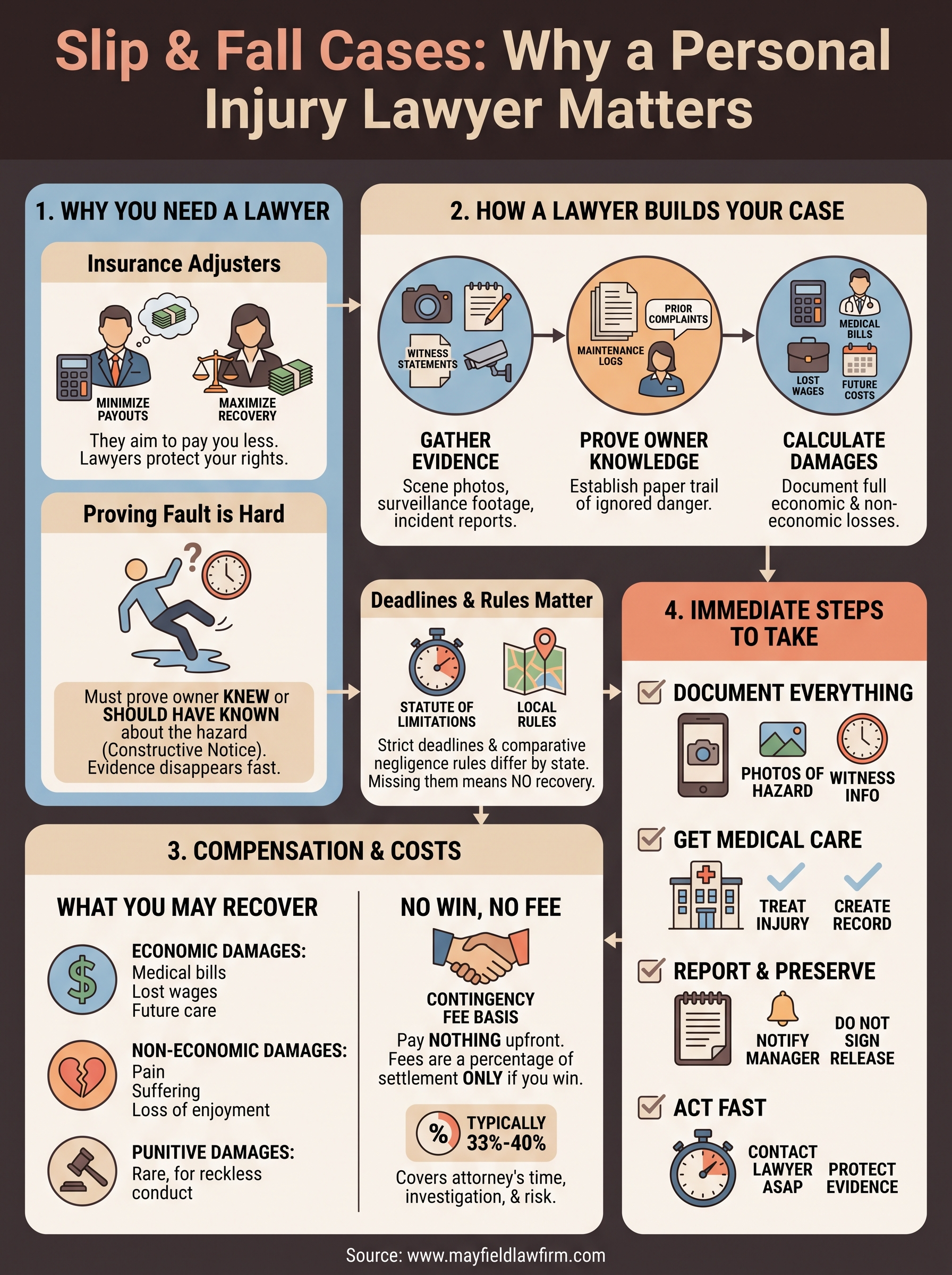
Insurance adjusters have one job: pay out as little as possible. That's not opinion, it's how the business model works. The moment you file a claim after a fall, you're negotiating against a trained professional whose entire career is built on minimizing payouts and finding reasons to deny or discount claims. Without a personal injury lawyer slip and fall victims often accept the first offer just to stop the phone calls, not realizing that offer might cover a fraction of what their medical care and lost income actually cost.
Insurance companies count on you not knowing your rights
Adjusters use recorded statements, quick settlement offers, and confusing paperwork to limit what they pay. They might ask leading questions designed to get you to admit partial fault, or push you to sign a release before you know the full extent of your injuries. A lawyer steps between you and that pressure. Once you have representation, the insurance company has to negotiate through your attorney, not you directly, which changes the entire dynamic of the conversation.
An insurance adjuster's job is to protect the company's money, not to protect your recovery.
Proving fault takes more than a fall
Slip and fall claims fall under premises liability law , and that area of law is more complicated than most people expect. You don't win just by showing you got hurt on someone else's property. You have to prove the property owner or manager knew about the hazard, or should have known about it through reasonable inspection, and failed to fix it or warn you. That's called establishing constructive or actual notice, and it's the single biggest reason slip and fall claims get denied. A lawyer knows what evidence courts and insurers expect to see, and how to gather it before it disappears.
Deadlines and local rules matter more than people think
Mississippi and Tennessee each set strict statutes of limitations for personal injury claims, and missing that window means losing your right to sue entirely, no matter how strong your case is. Local courts also apply comparative negligence rules differently, meaning how much you were partly at fault can reduce or eliminate your compensation depending on the state and the specific facts. A lawyer familiar with courts in Tupelo, Southaven, and Memphis knows how judges and juries in these jurisdictions tend to view these cases, and adjusts strategy accordingly.
What you lose by handling it alone
Here's what typically goes wrong when accident victims try to negotiate their own slip and fall claim:
- They accept a settlement before knowing the full cost of ongoing treatment or surgery.
- They give a recorded statement that gets used against them later.
- They miss the filing deadline because they didn't know it applied to their situation.
- They fail to document the hazard properly, leaving no proof it existed.
- They underestimate lost future wages, especially with injuries that limit long-term work capacity.
Each of these mistakes can cost thousands of dollars, sometimes far more. Firms like Mayfield Law Firm build cases specifically to avoid these pitfalls, working the claim from day one instead of jumping in after the damage is done. Getting a lawyer involved early, ideally before you talk to any insurance representative, protects the value of your claim and gives you a much stronger position at the negotiating table.
How a slip and fall lawyer builds and proves your case
Building a winning claim starts long before a courtroom is ever mentioned. Your personal injury lawyer slip and fall cases require moves fast to preserve evidence, because floors get mopped, mats get replaced, and surveillance footage gets erased within days if nobody asks for it. The lawyer's job is to lock down proof while it still exists and turn a messy incident into a documented, provable case.
Gathering evidence at the scene
Attorneys send investigators or return to the property themselves to photograph the hazard, measure lighting conditions, and pull incident reports the business is required to keep. They request surveillance footage before it gets overwritten, often within 24 to 72 hours of the fall. Witness statements get collected while memories are fresh, not months later when details fade. This is also when your lawyer requests maintenance logs, cleaning schedules, and any prior complaints about the same hazard, records that most property owners won't hand over voluntarily.
Proving the property owner knew about the hazard
Every slip and fall case comes down to one question: did the owner know, or should they have known, about the danger? Lawyers build this proof through inspection logs, employee testimony, and expert witnesses who can speak to industry standards for maintenance and hazard response. If a spill sat unattended for 40 minutes before you fell, that timeline becomes central to the case.
A slip and fall case isn't won by the fall itself, it's won by the paper trail proving someone ignored the danger.
Calculating the full value of your damages
Once fault is established, the lawyer shifts to documenting economic damages and non-economic losses. This means gathering:
- Medical bills, imaging, and treatment records
- Pay stubs or tax records showing lost wages
- Expert projections for future care if injuries are long-term
- Statements from doctors linking your injuries directly to the fall
Each piece supports a specific number in your demand letter, so the insurance company can't dismiss your claim as speculation.
Common causes and locations of slip and fall accidents
Not every fall happens the same way, but most trace back to a handful of preventable hazards. A slip and fall accident lawyer sees the same patterns over and over: wet floors without warning signs, torn carpeting, uneven pavement, and poor lighting in stairwells. Recognizing these patterns matters because it helps you and your attorney identify exactly what went wrong and who had the duty to fix it.
Hazards that cause the most falls
Spills, leaks, and weather-related moisture cause a huge share of these accidents, especially in grocery stores and restaurants where liquids end up on tile floors within minutes of mopping or a dropped drink. Broken or uneven flooring, loose floor mats, and cracked sidewalks trip people who have no reason to expect a hazard underfoot. Cluttered walkways, exposed wiring, and missing handrails on stairs round out the list of conditions that property owners are legally required to address once they know about them.
Most slip and fall injuries trace back to a hazard someone had time to fix and didn't.
Where these accidents happen most often
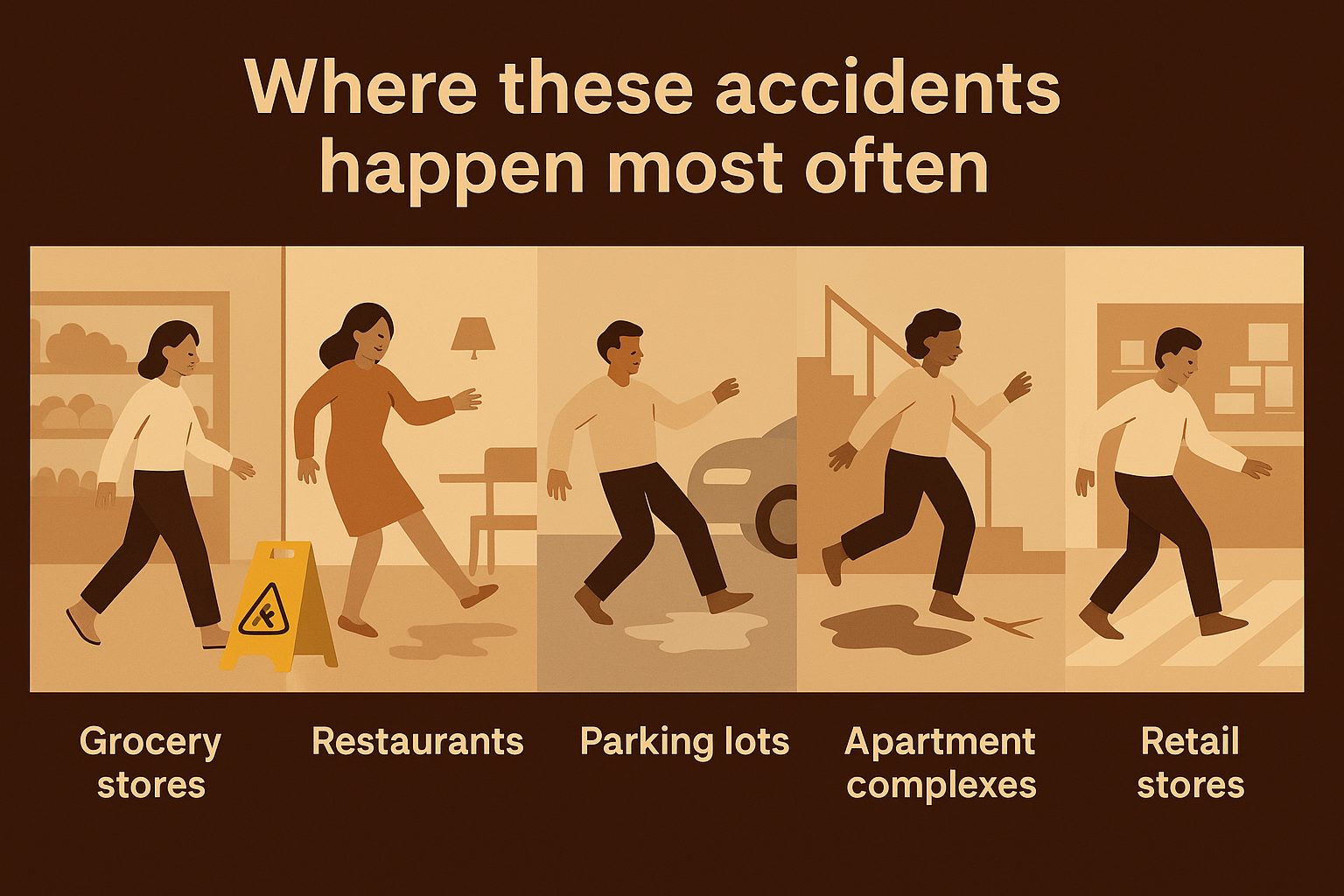
Location matters because it affects who's responsible and what records exist to prove it. The table below breaks down where these accidents happen and what typically causes them.
| Location | Common Hazard |
|---|---|
| Grocery stores | Spilled liquids, wet produce sections |
| Restaurants | Grease on kitchen or dining floors |
| Parking lots | Potholes, ice, poor lighting |
| Apartment complexes | Broken stairs, worn carpeting |
| Retail stores | Cluttered aisles, unmarked wet floors |
| Office buildings | Loose cords, uneven flooring transitions |
Owners of commercial properties carry a higher legal standard than private homeowners because they invite the public in for business purposes. That distinction shapes how a premises liability claim gets built against a store versus a landlord or a homeowner. Seasonal conditions also play a role across our region: ice on parking lots during Mississippi and Tennessee cold snaps, or sudden downpours that track water into entryways faster than staff can mop it up. Documenting the specific location and cause early gives your lawyer the details needed to identify every party who might share responsibility, including property owners, maintenance contractors, and management companies.
What compensation you may recover after a slip and fall
Money doesn't undo a broken hip or a torn rotator cuff, but it does cover the bills that pile up while you heal. A slip and fall injury lawyer works to recover every category of loss you're entitled to, not just the emergency room bill. That means looking at what you've already spent, what you'll spend down the road, and what the fall took from your daily life. Skipping any of these categories leaves real money on the table.
Economic damages cover your financial losses
Economic damages are the easiest to prove because they come with paperwork attached. These include your medical expenses (ambulance rides, surgery, physical therapy, medication) plus lost wages for every day you couldn't work. If your injury limits your ability to return to your old job or reduces your future earning capacity, a lawyer brings in an economist or vocational expert to project that loss over your working years.
Non-economic damages cover what the fall took from your life
Pain and suffering, emotional distress, and loss of enjoyment of daily activities fall under non-economic damages , and juries in Mississippi and Tennessee do award for these losses when the evidence supports it. A shattered ankle that keeps you off your feet for six months affects more than your paycheck; it affects your ability to play with your kids or get through a normal day without pain. Documenting this loss usually means keeping a journal of your limitations and getting statements from family members who've watched the recovery firsthand.
The full value of a slip and fall claim almost always includes more than the medical bill sitting on your kitchen table.
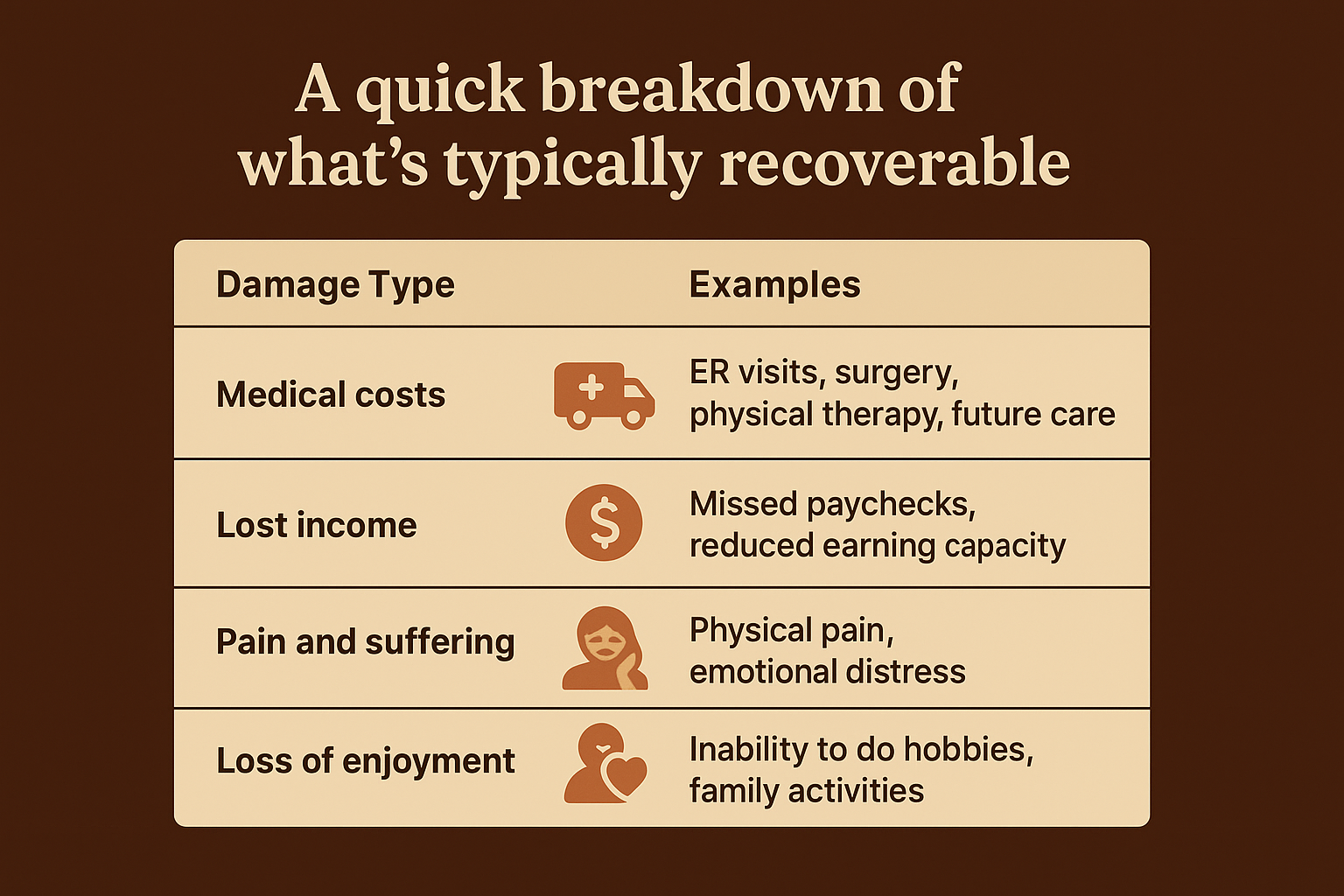
A quick breakdown of what's typically recoverable
| Damage Type | Examples |
|---|---|
| Medical costs | ER visits, surgery, physical therapy, future care |
| Lost income | Missed paychecks, reduced earning capacity |
| Pain and suffering | Physical pain, emotional distress |
| Loss of enjoyment | Inability to do hobbies, family activities |
| Punitive damages | Rare, awarded when conduct was reckless |
Punitive damages rarely apply in slip and fall cases, but they come into play when a property owner ignored repeated warnings about a dangerous condition. Reviewing your case with a firm like Mayfield Law Firm helps you understand which of these categories apply to your specific injury and how much they're realistically worth, and typical slip and fall settlement amounts give you a benchmark to start from.
Steps to take immediately after a slip and fall
What you do after a slip and fall accident in the first hour shapes the entire case that follows. Evidence disappears fast, and memories fade faster, so acting quickly protects your right to compensation before you ever talk to a personal injury lawyer slip and fall cases depend on that early documentation more than almost anything else. Treat the scene like a crime scene, because in a legal sense, that's exactly what it is.
Document everything before you leave
Your phone is the most useful tool you have right after a fall. Photograph the hazard from multiple angles, capture any wet floor signs (or lack of them), and note the time and lighting conditions. Ask any witnesses for their names and phone numbers before they walk away, since most people won't come back later if you don't get their contact information on the spot.
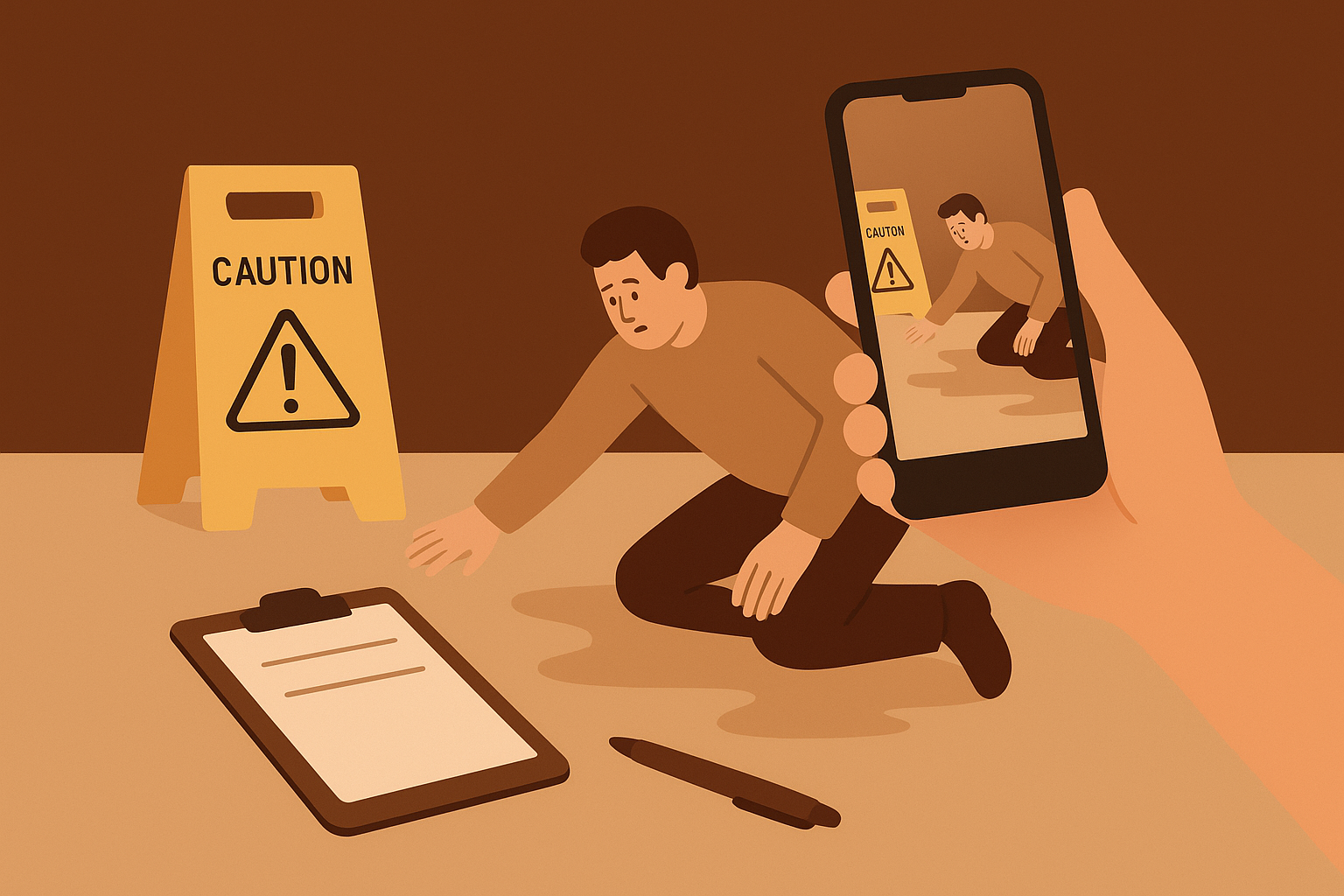
- Photograph the exact spot where you fell, including surrounding conditions
- Write down the date, time, and weather if outdoors
- Get names and numbers from anyone who saw the fall
- Ask for a copy of the incident report if staff fill one out
- Avoid discussing fault with employees or managers on-site
The evidence you collect in the first ten minutes often matters more than anything gathered weeks later.
Get medical care right away
Seeing a doctor does two things at once: it treats your injury and it creates a medical record tying your condition directly to the fall. Delaying treatment gives insurance adjusters an opening to argue your injury happened somewhere else or wasn't serious. Even if you feel fine, adrenaline masks pain, and some injuries like concussions or soft tissue damage don't show symptoms for a day or two.
Report the fall and preserve your claim
Notify the property manager or business owner before you leave, and get their contact information along with any insurance details they can provide. Avoid signing anything or giving a recorded statement to an insurance representative without talking to an attorney first, since those statements often get used to shrink your claim later. Save your clothes and shoes exactly as they were, since they sometimes become evidence showing the surface condition. Reaching out to a firm like Mayfield Law Firm within the first few days gives an investigator time to secure surveillance footage before it's erased.
How much does a slip and fall lawyer cost
Money worries shouldn't stop you from calling a lawyer, and that's the whole point of how these firms structure their fees. Most personal injury lawyer slip and fall attorneys work on a contingency fee basis , meaning you pay nothing upfront and nothing out of pocket while your case moves forward. The lawyer only gets paid if you win or settle, which lines up their interest with yours from day one.
How contingency fees actually work
Under a contingency arrangement, the attorney takes an agreed percentage of your final settlement or verdict, typically between 33% and 40% depending on when the case resolves. That percentage covers the attorney's time, investigation costs, and the risk they take on by fronting expenses like expert witness fees, medical record requests, and court filing costs. If you recover nothing, you owe nothing for legal fees, though some agreements still require repayment of case expenses in rare situations.
You don't pay a slip and fall lawyer unless they put money in your pocket first.
What affects the final percentage
Several factors shape what percentage ends up in your fee agreement, and it's worth asking about each one before you sign anything.
| Factor | How It Affects Cost |
|---|---|
| Case complexity | More investigation or expert testimony can raise the fee |
| Settlement timing | Early settlements often carry a lower percentage than trial |
| Case expenses | Filing fees, records, and experts are usually deducted from your share |
| Firm policy | Some firms cap fees or adjust based on case size |
Reading your fee agreement closely matters here, since some firms deduct expenses before calculating the percentage while others deduct after, and that difference changes what you actually keep.
Why the free consultation matters
Before any fee discussion even happens, a free consultation lets you find out whether you have a viable case without spending a dime. This first meeting with an injury attorney is where you learn what the attorney thinks your claim is worth, what evidence still needs collecting, and how the fee structure applies to your specific situation. Firms like Mayfield Law Firm offer this upfront review so you can make an informed decision before committing to anything, and you walk away with a clear picture of your options whether you hire them or not.
Deciding your next step after a fall
A slip and fall accident can knock you off your feet financially just as hard as it did physically. You've seen what's involved: proving the property owner knew about the hazard, documenting every dollar of loss, and standing firm against an adjuster trained to pay you less than you deserve. None of that gets easier by waiting, and evidence only gets harder to find as days pass.
The most important decision you make after a fall isn't whether you have a case, it's how quickly you get someone investigating it. Waiting costs you leverage, and sometimes it costs you the deadline entirely. Acting fast protects the evidence and the value of your claim.
If you're dealing with medical bills and an insurance company that won't return your calls, see what to look for in the best slip and fall lawyer near you and talk to someone who handles these cases every week. Contact Mayfield Law Firm for a free consultation and find out what your claim is actually worth.