
Medical Malpractice Lawyers: What They Do and How to Choose
If a doctor, nurse, or hospital hurt you or someone you love, you probably have two questions. Was it actually malpractice, and who can help you prove it? The right lawyers medical malpractice victims turn to do more than file paperwork. They investigate your care, line up medical experts, and take on insurers and hospital legal teams that have far more resources than you do.
Here is the short answer. A medical malpractice lawyer proves that a provider departed from accepted standards of care and that the departure caused your harm. To choose one, look for direct experience with malpractice cases , a willingness to go to trial, and a contingency fee, so you pay nothing unless you recover compensation.
This article explains what these lawyers do from the first consultation through settlement or trial. It also covers how to compare firms and which questions to ask. At Mayfield Law Firm, P.A., we have handled personal injury cases for more than 40 years, including medical malpractice, and we offer free consultations so you can get answers before you commit.
Why medical malpractice lawyers matter after a medical error
Medical malpractice is one of the hardest areas of injury law to handle on your own. Providers rarely admit fault, and your records are written in medical shorthand. A medical malpractice lawyer levels the field by doing the investigative work you cannot do while you recover.
The gap between you and the other side
Hospitals and doctors carry malpractice insurance, and those insurers hire defense lawyers who handle these cases every week. Their goal is to minimize or deny your claim . They will argue that your injury came from your underlying illness, not from the treatment you received.
Without a lawyer, you face that team alone. You also face a rule many people do not expect. In most cases, expert testimony is required to win. A judge will not take your word that the care was wrong. A qualified physician has to say so, and finding and preparing that physician is part of your lawyer's job.
A malpractice claim is won with medical records and expert opinions, not with good intentions or a sympathetic story.
What a lawyer does for your case
Your lawyer manages the case from the first call to the final payment, so you can focus on your recovery instead of paperwork. The work usually includes:
- Collecting complete medical records, billing statements, and imaging
- Having independent physicians review whether the care fell below the accepted standard
- Calculating your full losses, including future treatment and lost income
- Negotiating with the insurer and filing suit if the offer is too low
- Preparing for trial when no fair settlement is offered
That last item matters more than it seems. Insurers study which lawyers actually try cases. A firm that is ready to go to court tends to get taken more seriously at the negotiating table.
Why acting early protects your claim
Waiting costs you. Records get misplaced, witnesses forget details, and strict filing deadlines apply to these claims. You do not need to be certain it was malpractice before you call. At Mayfield Law Firm, P.A., a free consultation lets you describe what happened and learn whether your case is worth pursuing before you spend a dollar.
How to choose a medical malpractice lawyer
Searching for lawyers medical malpractice cases demand can feel overwhelming, so hold every firm to the same checklist. Judge them on track record , resources, and how they treat you on the first call.
What to look for
Prioritize malpractice-specific experience , since these cases work differently from car wreck claims. Expert reviews and records analysis are expensive, so confirm the firm can front the costs of a case that may take years.
- How many malpractice cases they have handled, and how they ended
- The last time they tried a case to verdict
- Which medical specialists they use to review the care
- Familiarity with the courts where your case would be filed
Questions to ask at the consultation
Treat the free consultation as an interview, and arrive with questions to put to a malpractice attorney ready. A good lawyer listens, asks detailed questions about your records, and gives an honest assessment , even if that means saying the case is weak.
- Who will handle my case day to day?
- What percentage do you take, and are costs deducted before or after?
- How long do you expect this to take?
- What will you need from me?
The best lawyer is the one who tells you the truth about your case and is still ready to try it.
Red flags to avoid
Walk away from anyone who guarantees a result or pressures you to sign on the spot. Be wary of firms that never go to trial , because insurers know which lawyers will not follow through and lowball their offers accordingly.
What a medical malpractice case requires you to prove
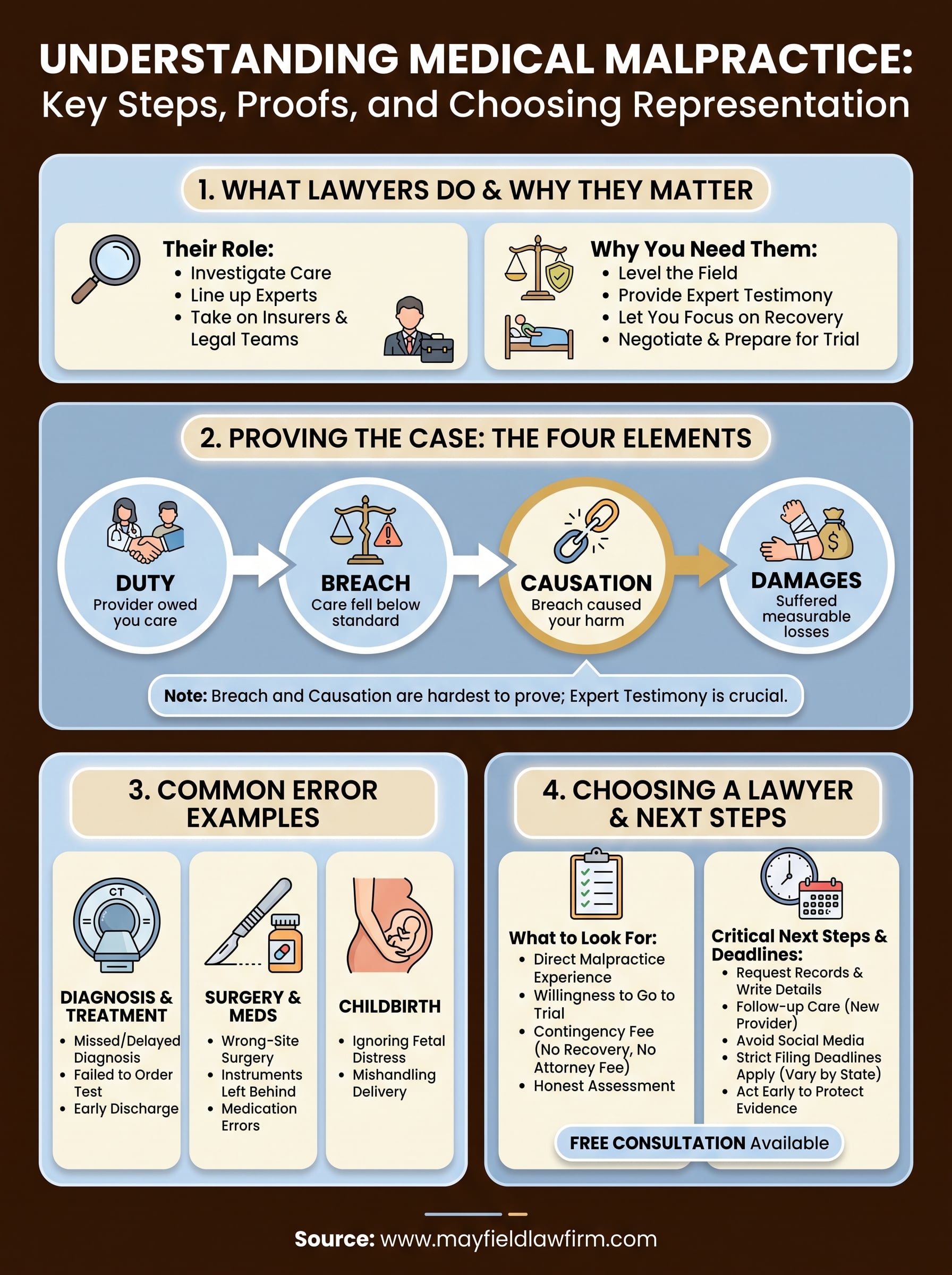
Every claim rests on four elements. Lawyers who handle medical malpractice cases must prove all of them, and missing even one can end the case. A bad outcome alone is not enough, because medicine carries risk even when everyone does their job correctly.
The four elements you must prove
| Element | What it means | Example |
|---|---|---|
| Duty | The provider owed you care | A doctor accepted you as a patient |
| Breach | The care fell below the accepted standard | A radiologist missed a tumor that a reasonable colleague would have seen |
| Causation | The breach caused your harm | The delay let the cancer spread |
| Damages | You suffered measurable losses | Extra surgery, lost wages, ongoing pain |
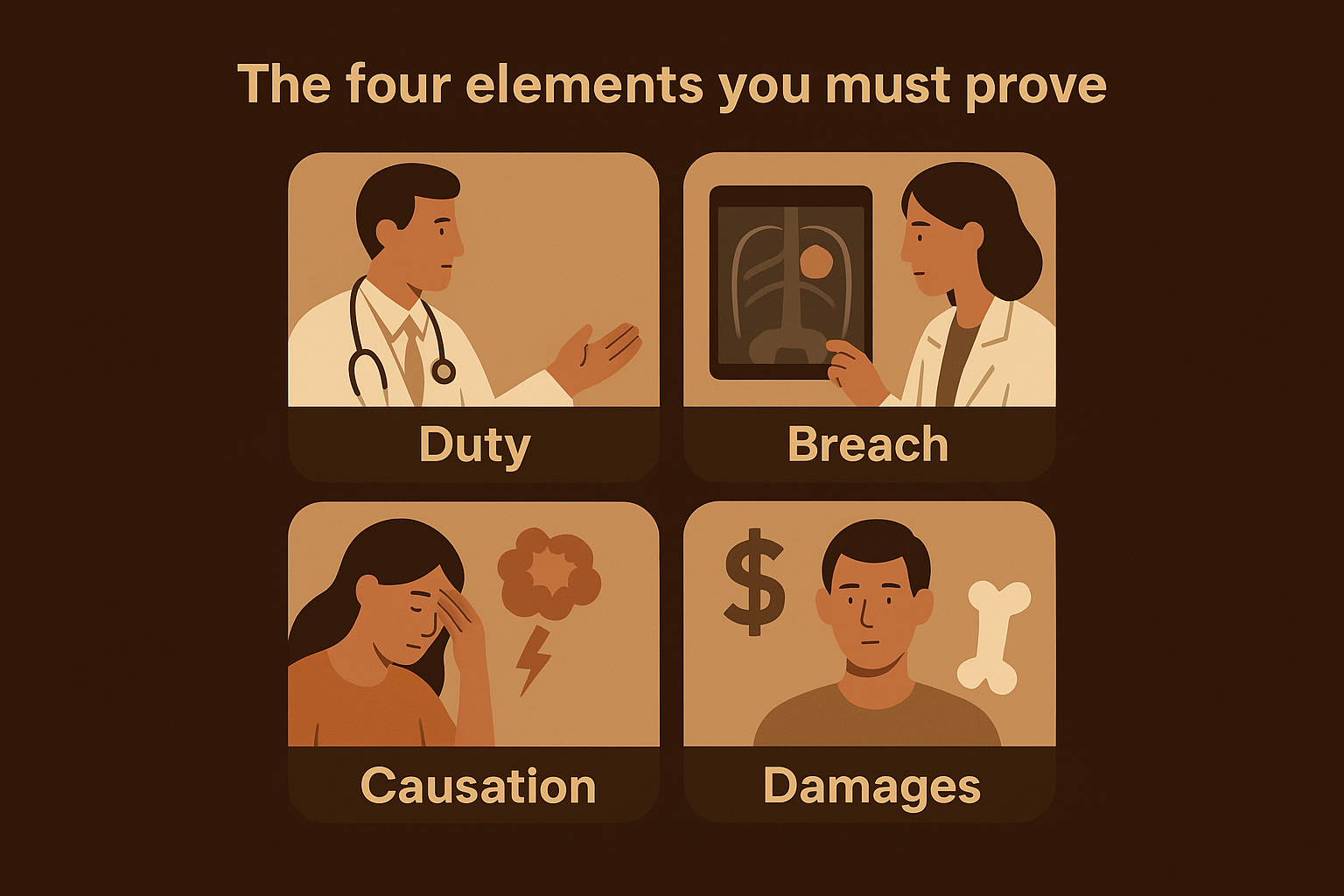
Duty is usually the simple part. Breach and causation are where cases get fought, because both depend on expert testimony and a clear link between the error and your injury.
Why causation is the hardest element
Causation trips up more claims than any other element. Say a doctor was slow to diagnose your cancer. You must show that an earlier diagnosis would have changed your outcome , not just that the doctor was late. The defense will argue the disease would have progressed no matter what they did.
A mistake is not malpractice unless it caused harm that proper care would have prevented.
Documentation closes that gap. Your lawyer ties together records, imaging timelines, and physician opinions, then tracks every loss , from added surgeries to lost income , so your damages are proven with numbers instead of estimates.
Common examples of medical malpractice claims
Not every bad outcome is malpractice, but certain errors appear again and again in the cases that lawyers medical malpractice clients hire actually take. Knowing the patterns helps you recognize a possible claim and gather the right records before you call.
Errors in diagnosis and treatment
Diagnostic mistakes are among the most frequent claims. A provider may miss or delay a diagnosis , misread a scan, or ignore abnormal lab results. Treatment errors follow a similar pattern, such as failing to order a needed test or discharging a patient too early.
- A cancer missed on a mammogram or CT scan
- A heart attack or stroke sent home as indigestion or a migraine
- An infection left untreated until it became sepsis
Many malpractice claims come down to what a provider failed to catch, and how much that delay cost you.
Errors in surgery, medication, and childbirth
Surgery carries its own risks, but wrong-site surgery , instruments left inside the body, and anesthesia mistakes are rarely excusable. Medication errors also cause serious harm, like a wrong dose or a dangerous drug interaction that a doctor or pharmacist should have flagged.
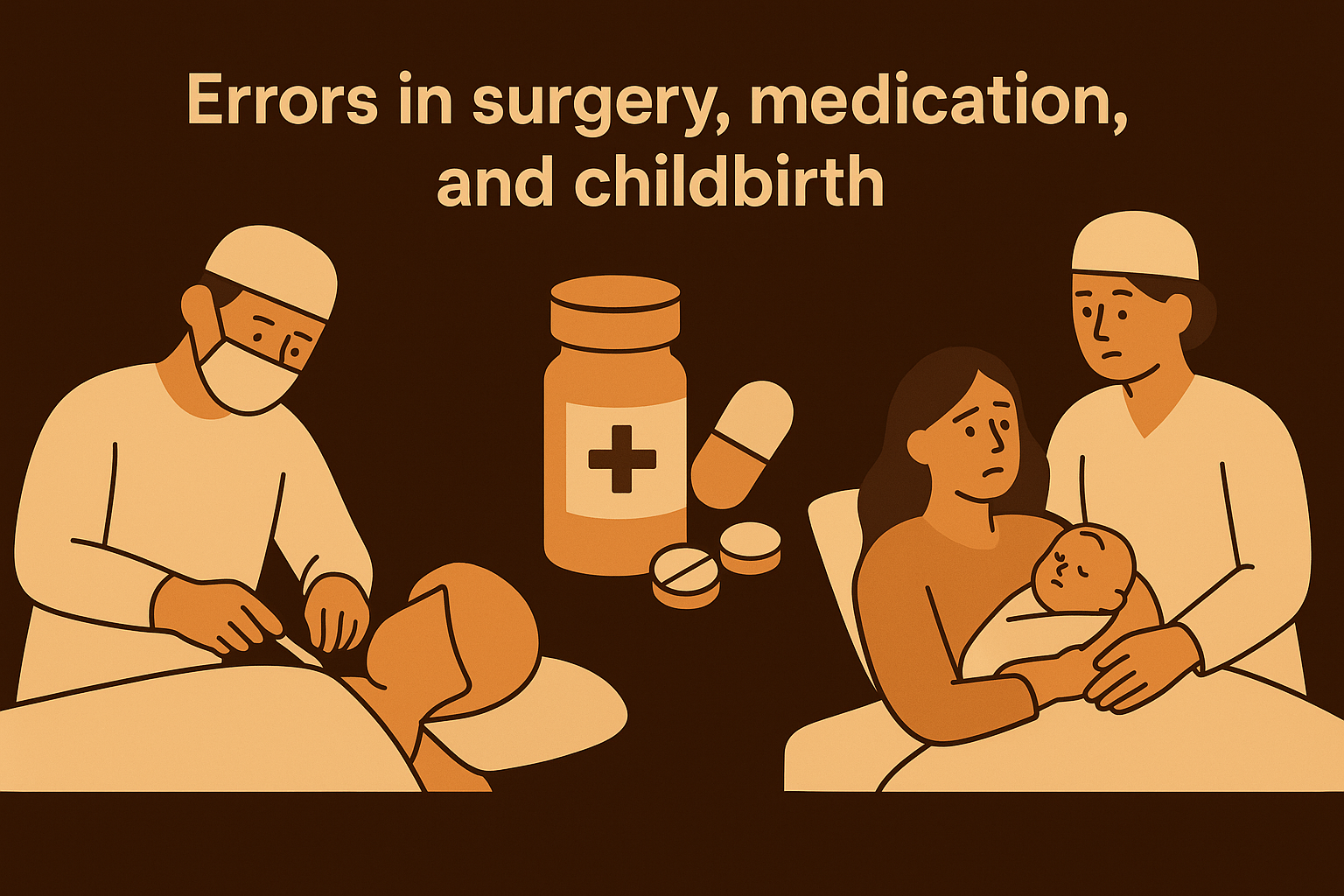
Birth injuries form another category. Ignoring signs of fetal distress or mishandling a delivery can leave a child with lasting harm, such as cerebral palsy. These claims often involve lifetime care costs , so careful damage calculations and expert support matter a great deal.
Your situation may not match any of these examples. Bring it to a consultation anyway, because each case turns on its own records and the details of your care.
What to do now and how fees and deadlines work
Steps to take now
Your first priority is follow-up care , ideally with a different provider, because your health comes before any claim. Then take these steps after a medical error to protect the evidence while it is fresh:
- Request your full medical records and billing statements in writing
- Write down dates, names, symptoms, and what each provider told you
- Keep receipts, pay stubs, and photos of your injuries
- Stay off social media when it comes to your care and recovery
- Sign nothing from the hospital's insurer before talking to a lawyer
How contingency fees work
Most lawyers medical malpractice clients hire work on contingency . The firm takes a percentage of what you recover, often around one-third, and you owe no attorney fee if the case is lost. Get the percentage in writing, including whether it rises if the case goes to trial.
Costs are a separate question. Expert reviews, records, and filing fees can reach tens of thousands of dollars . Ask whether costs come out before or after the percentage, and whether you repay them if you lose.
Deadlines that can end your claim
Time limits for these claims are short, and they vary by state. These are the general rules, and exceptions exist:
| State | General filing deadline |
|---|---|
| Mississippi | 2 years from when you discovered, or should have discovered, the harm |
| Tennessee | 1 year from the injury or its discovery |
| New York | 2 years and 6 months from the error |
Mississippi and Tennessee also require written notice to the provider before you file suit. Miss the deadline and a court will almost always dismiss your case , no matter how strong the evidence is.
Call a lawyer long before the deadline, because the filing date is the one thing in a malpractice case that cannot be fixed later.
Taking the next step after medical harm
Medical errors leave you with pain, bills, and doubt about what went wrong. The right lawyer turns that confusion into a plan. When you compare lawyers medical malpractice victims can trust, look for real malpractice experience, a firm that will try your case, and a contingency fee that keeps cost out of the decision.
Remember what your claim needs. You must prove duty, breach, causation, and damages, and you need expert testimony to do it. You also need to move quickly, because filing deadlines can be as short as one year, and a missed date usually ends the case.
You do not have to sort this out alone. Mayfield Law Firm, P.A. has more than 40 years of experience , and we can review your records and explain your options. Schedule a free consultation with Mayfield Law Firm and find out where your case stands.