Lawyer for Personal Injury: How to Choose the Best One
You got hurt because someone else made a mistake, and now you're stuck sorting through medical bills, insurance calls, and a stack of forms while trying to heal. Finding the right lawyer for personal injury shouldn't add to that stress, but with so many firms advertising on billboards and late-night TV, picking one feels like guesswork. Most people don't know what actually separates a strong attorney from one who will settle fast just to close the file.
The short answer: you need someone with real trial experience, a track record in cases like yours, and a firm that treats you like a person, not a file number. This article breaks down exactly what to look for, from case experience to how a firm handles settlement negotiations , so you can walk into a consultation asking the right questions instead of hoping for the best.
Below, you'll find a practical checklist covering credentials, communication style, fee structures, and red flags that signal you should keep looking, along with the basics of choosing a personal injury lawyer for your case. Whether you're dealing with a car accident, an on-the-job injury that needs a workplace injury lawyer, or a wrongful death claim, we'll show you how firms like Mayfield Law Firm approach these cases and what that means for your free consultation .
1. Proven experience handling cases like yours
Not every personal injury case looks the same, and a lawyer who's spent years on slip and fall injury claims isn't automatically ready to handle a semi-truck collision or a medical malpractice suit. When you're searching for a personal injury lawyer attorney , the first thing to check is whether they've actually handled your type of case before, not just personal injury in general. A firm that says "we do everything" sometimes means they don't specialize in anything, and that gap can cost you real money when the insurance company's own lawyers know the specific rules that apply to your injury.
Why it matters
Courts and insurance companies treat different injury types differently. A workplace injury claim might involve workers' compensation overlap, a trucking accident brings federal safety regulations into play, and a wrongful death case has its own filing deadlines and damage calculations under Mississippi and Tennessee law. Case-specific experience means your lawyer already knows which experts to call, which arguments insurance adjusters try first, and how much your type of injury typically settles for. Without that background, you're paying someone to learn on your case, and that learning curve often shows up as a lower settlement offer or a missed deadline.
A lawyer who's handled fifty cases just like yours will spot the insurance company's tactics before they even try them.
How to evaluate it
Don't just take a firm's word for it. Ask direct questions and expect specific numbers, not vague reassurances. Here's what to look for during your research:
- Years practicing personal injury law specifically , not just law in general
- Number of cases handled in your exact category, such as motorcycle accidents or medical malpractice claims near you
- Whether the attorney who consults with you is the same one who'll manage your case day to day
- Bar association standing and any disciplinary history, which you can usually check through your state bar's website
- Whether the firm has courtroom experience or mostly settles cases through negotiation
At Mayfield Law Firm, the practice spans auto accidents , workplace injuries, wrongful death representation, and mass tort litigation, backed by more than 40 years of combined legal practice. That range matters less than the depth behind each category, so ask for specifics rather than a general pitch.
Questions to ask before you hire
Bring these questions to your consultation and pay attention to how quickly and specifically the attorney answers. Vague answers here are a warning sign.
- How many cases like mine have you personally handled in the last five years?
- What was the outcome of your three most recent similar cases?
- Will you be the attorney working my case, or will it get handed to someone else?
- Have you taken a case like mine to trial, or do you typically settle?
- What's unique about my type of injury that I should understand going in?
A lawyer who answers these without hesitation, and who can point to real numbers rather than general claims, is showing you they've actually done the work. That's the foundation everything else on this list builds on.
2. A strong track record of settlements and verdicts
Experience tells you a lawyer knows the process, but a track record of settlements and verdicts tells you whether that experience actually pays off for clients. Anyone can say they've handled hundreds of cases, but the real question is what those cases were worth when they closed. A lawyer for personal injury who consistently brings home fair settlements, and who wins when insurance companies force a trial, has proven something a resume alone can't show.
Why it matters
Insurance adjusters research the attorneys they're negotiating against. If your lawyer has a reputation for accepting the first lowball offer, that reputation follows them into every negotiation, and adjusters price their offers accordingly. On the other hand, a firm known for pushing hard and winning at trial tends to get better offers from the start, because the insurance company knows a cheap settlement isn't guaranteed. Your outcome depends heavily on the reputation your attorney already carries into the room.
Insurance companies negotiate differently with lawyers who've proven they'll go the distance.
How to evaluate it
Past results aren't always advertised loudly, so you may need to dig a little. Look for:
- Settlement and verdict amounts published on the firm's website, broken down by case type
- Independent reviews or testimonials that mention specific outcomes, not just general satisfaction
- Whether the firm publishes results for cases similar to yours, such as auto accidents or workplace injuries
- Confirmation that quoted results are net figures or gross, since attorney fees and costs change what you actually keep
Keep in mind that past results don't guarantee your outcome, since every case has different facts, injuries, and available insurance coverage. But a consistent pattern of strong results still tells you how a firm approaches negotiation and litigation.
Questions to ask before you hire
Use your consultation to get specifics instead of general reassurance:
- What's the average settlement value for cases like mine that you've handled?
- Can you share results from recent cases with similar injuries?
- How often do your cases go to trial versus settle?
- Were those settlement figures before or after fees and expenses?
- What made the difference in your strongest results?
A lawyer who can answer with real numbers, not just confidence, is showing you exactly what kind of negotiator you're hiring.
3. Contingency fees with no upfront costs
Money worries shouldn't decide whether you get legal help after an accident. A contingency fee arrangement means you pay nothing out of pocket to hire a lawyer, and your attorney only gets paid if they win your case. This setup removes the biggest barrier people face when they're already dealing with medical bills and lost wages, and it's become the standard way most personal injury firms operate.
Why it matters
Without contingency fees, plenty of injured people would never get a lawyer at all, simply because they can't afford hourly rates while they're out of work and buried in bills. This fee structure also aligns your interests with your attorney's, since the firm only gets paid when you get paid, and the more they recover for you, the more they earn. That alignment pushes a good lawyer to fight for the highest possible settlement rather than rushing to close the file. According to the Federal Trade Commission, contingency arrangements are common and legal across the country, but the exact percentage and what counts as a deductible expense varies by firm.
If your lawyer doesn't win, you shouldn't owe a dime for their time.
How to evaluate it
Don't assume every contingency agreement works the same way. Compare firms on these points:
- The percentage a personal injury lawyer takes from your settlement, typically between 33% and 40%
- Whether the percentage increases if the case goes to trial
- How case costs like filing fees, expert witnesses, and medical record requests get handled
- Whether those costs come out before or after the attorney's percentage is calculated
- What happens to those costs if you lose the case
Mayfield Law Firm offers no win, no fee representation on personal injury cases, so you keep your savings intact while your case moves forward.
Questions to ask before you hire
Get the fee structure in writing before you sign anything, and ask these questions first:
- What percentage do you take if my case settles versus goes to trial?
- Who covers upfront costs like expert witnesses and court filings?
- Do I owe anything if we lose the case?
- Is the percentage calculated before or after expenses are deducted?
- Can I see a sample fee agreement before my consultation ends?
A lawyer who explains this clearly, without dodging the math, is one you can trust with the rest of your case.
4. A free, no-obligation consultation
A free consultation is your chance to size up a lawyer before you owe anyone anything, and every reputable personal injury lawyer offers one. What to expect at a free injury consultation is a real read on your case's strength, an honest estimate of what it might be worth, and a clear sense of whether this firm actually listens or just wants a signature. If a firm pressures you to sign on the spot or charges a fee just to talk, that's a sign to walk away.
Why it matters
Because you're not paying for this meeting, there's no reason to settle for the first firm that answers the phone. A good consultation gives you room to compare attorneys, ask hard questions, and gauge how a lawyer treats you before you're locked into an agreement. Firms that rush you through this step, or dodge specific questions about your case, are often more focused on volume than on your outcome.
A consultation that feels rushed or vague is a preview of how your whole case will be handled.
How to evaluate it
Pay attention to more than just whether the meeting is free. Look at:
- Whether the attorney reviews your medical records and accident details before giving an opinion
- How much time they spend actually listening versus talking
- Whether they give you a realistic range for your case, not just optimistic promises
- If the consultation happens in person, by phone, or by video, and which fits your situation best
Mayfield Law Firm offers free consultations across its Tupelo, Southaven, and Memphis offices, so you can sit down with someone local who knows the courts you'll be dealing with.
Questions to ask before you hire
Treat this meeting like an interview, because it is one:
- What's your honest first impression of my case?
- What information do you still need to evaluate it fully?
- How long do cases like mine typically take, and what stretches an injury case timeline?
- Will I get a straight answer if my case isn't strong?
- What happens after this meeting if I decide to hire you?
A firm that answers plainly, even when the news isn't great, is one worth trusting with the rest of your case.
5. Readiness to take your case to trial
Most personal injury cases settle before ever reaching a courtroom, but that only happens because the insurance company believes your lawyer is genuinely willing to go to trial if the offer isn't fair. A lawyer for personal injury who has never actually tried a case in front of a jury has a weaker hand at the negotiating table, even if they don't realize it. You want someone who prepares every case as if it's headed to trial, then settles only when the number actually reflects what you're owed.

Why it matters
Insurance adjusters know which firms settle everything and which ones show up in court. A firm known for backing down tends to get squeezed on every offer, because the adjuster knows a lawsuit isn't a real threat. Trial readiness flips that dynamic, since it forces the other side to negotiate as if losing in court is a real possibility, not an empty bluff. This doesn't mean every case should go to trial, but your lawyer's willingness to file suit and prepare for a jury changes the math on every offer you receive.
A lawyer who's afraid of the courtroom will always negotiate from a position of weakness.
How to evaluate it
Ask directly about courtroom history rather than assuming a firm's website tells the whole story, since hiring an injury lawyer you can trust starts with a verifiable trial record.
- Number of cases the attorney has actually tried in front of a jury , not just filed
- Whether the firm has trial lawyers on staff or refers cases out when negotiations stall
- How the firm decides when to recommend settling versus pushing toward trial
- Recent examples where the firm filed suit and pushed a case past the initial offer
Mayfield Law Firm's attorneys prepare every case for the possibility of trial from day one, which shapes how insurance companies respond during settlement negotiations .
Questions to ask before you hire
- How many cases have you personally taken to a jury verdict?
- At what point do you decide to file a lawsuit instead of continuing negotiations?
- What happens to my case if the insurance company refuses a fair offer?
- Do you have trial experience specific to my type of injury?
- Will you tell me honestly if my case is better settled than tried?
A lawyer who answers these with real cases and clear reasoning is one who won't fold under pressure when it counts.
6. Clear communication and easy access to your lawyer
Getting your calls returned shouldn't feel like a favor. When you hire a lawyer for personal injury , you're paying for someone to keep you informed, not to disappear for weeks while your case sits on a desk. A firm that treats communication as an afterthought often treats your case the same way, and that shows up as missed deadlines, stale settlement offers, and clients who find out about major decisions after they've already been made.
Why it matters
The personal injury lawsuit process moves through stages, from medical treatment to demand letters to negotiation, and each stage brings decisions that affect your outcome. Regular updates let you weigh in before your lawyer accepts an offer or files paperwork on your behalf. Without that access, you're trusting a stranger with choices that shape how much money you actually recover. Firms with heavy caseloads sometimes let communication slip because paralegals handle client contact while attorneys focus elsewhere, leaving you guessing about your case's status.
If you can't reach your lawyer when it matters, you don't really have one.
How to evaluate it
Test this before you sign anything, not after. Watch for these signs during your first interactions:
- How fast the firm returns your initial call or consultation request
- Whether you get a direct phone number or email for your attorney, not just a general office line
- If updates come on a set schedule or only when you chase them down
- Whether the attorney explains legal steps in plain language instead of jargon
Mayfield Law Firm keeps clients informed through each stage of a case, from the initial consultation through settlement negotiations, so you're never left wondering what happens next.
Questions to ask before you hire
- Who will be my main point of contact throughout my case?
- How often should I expect updates, and through what method?
- What's your typical response time for calls or emails?
- Will I be consulted before any settlement offer is accepted?
- What happens if I need to reach you outside office hours?
Answers here tell you whether you're a priority or a file number.
7. Familiarity with local courts and insurance companies
Every courthouse runs a little differently, and every insurance company has its own habits when it comes to settling claims. A lawyer for personal injury who's worked cases in Tupelo, Southaven, or Memphis knows the judges, the clerks, and the filing quirks that can slow down a case if you're not prepared for them. That local knowledge doesn't show up on a résumé, but it shapes how smoothly your case moves and how seriously the other side takes your claim from the start.

Why it matters
Local courts often have their own scheduling practices, preferred mediators, and unwritten expectations that outside firms simply don't know. Local court experience means your attorney isn't learning these rules while your case is on the clock. The same goes for insurance companies: adjusters who work Mississippi and Tennessee claims regularly recognize firms with a real presence in the area, and they negotiate differently with attorneys they've dealt with before versus a name they've never seen.
A lawyer who knows the local courthouse and the adjusters across the table starts every negotiation a step ahead.
How to evaluate it
Look past the marketing and check for actual regional roots:
- Physical office locations in the area where your case will be filed
- Attorneys who are licensed and active in your state's specific courts
- A history of cases filed in the same county or district as yours
- Familiarity with the specific insurance carriers common in your area
Mayfield Law Firm operates law offices across Northeast Mississippi and Memphis, which means the firm regularly appears before the same judges and negotiates with the same regional insurance adjusters your case will involve.
Questions to ask before you hire
- How many cases have you filed in this specific county or court?
- Do you have experience negotiating with the insurance company involved in my claim?
- Are you licensed to practice in every state my case might touch?
- How does local court scheduling typically affect a case like mine?
- Have you worked with the specific adjuster or carrier handling my claim before?
A firm rooted in your area brings more than convenience. It brings relationships and knowledge that can move your case forward faster.
8. Positive reviews and a solid reputation
A firm's reputation tells you what actual clients experienced, not just what the marketing promises. Before you hire a lawyer for personal injury , spend time reading what past clients say about how they were treated, not just whether they won money. Online reviews and referrals reveal patterns that a polished website never will, like whether a firm returns calls, explains decisions clearly, or disappears after the initial consultation. A single bad review isn't a dealbreaker, but a pattern of complaints about communication or pressure to settle quickly should make you pause.
Why it matters
Outcomes matter, but so does how a firm treats you along the way. Clients who felt ignored, rushed, or misled tend to say so publicly, and those patterns predict how your own case might go. Client reputation also reflects how a firm is viewed by other attorneys and judges in the community, which can quietly influence how negotiations and even court proceedings unfold. Reputation is earned case by case, and a firm that's built trust over decades has usually done so by treating people fairly, not just by winning.
A firm's reputation is really just a record of how it treats people when no one's forcing it to.
How to evaluate it
Check more than star ratings. Look for:
- Reviews on Google Business Profile and independent legal directories, not just testimonials on the firm's own site, plus a sense of which lawyer review sites are worth reading
- Whether responses to negative reviews are professional and specific, not defensive
- Bar association standing, which most state bars publish online
- How long the firm has served your specific community, since longevity often reflects consistent client satisfaction
Mayfield Law Firm has built its reputation over more than 40 years serving Northeast Mississippi and South Memphis , with client reviews of the firm that often describe relationships spanning years, not just a single case.
Questions to ask before you hire
- Can you point me to reviews from clients with cases like mine?
- How does your firm typically respond to negative feedback?
- What's your standing with the state bar association?
- How long has your firm served this community?
- Can I speak with a past client as a reference?
A firm confident in its reputation will welcome these questions instead of deflecting them.
9. Enough resources to build a strong case
Building a strong personal injury case costs money before it earns you a dime. Expert witnesses, accident reconstructionists, medical record retrieval, and court filing fees add up fast, and a small firm stretched thin sometimes can't front those costs the way a well-resourced one can. When you're choosing a lawyer for personal injury , ask directly whether the firm has the financial and staffing capacity to actually build your case, not just file paperwork and wait for an offer.
Why it matters
Insurance companies have teams of adjusters, investigators, and defense attorneys working against your claim from day one. Case resources level that playing field, since your lawyer needs the same access to medical experts, economists, and investigators to prove the full extent of your injury and losses. A firm without the funds to hire an expert witness for a complex injury, or without enough staff to manage discovery deadlines, often ends up recommending a lower settlement simply because they can't afford to keep pushing. That's a decision driven by the firm's limits, not what your case is actually worth.
A firm that can't afford to fight for you will always tell you to settle sooner than you should.
How to evaluate it
During your consultation, ask about the practical side of case preparation:
- Whether the firm has relationships with expert witnesses in fields relevant to your injury, like orthopedic specialists or accident reconstructionists
- How many support staff and paralegals work alongside the attorneys
- Whether the firm has advanced costs on similar cases before, and how large those cases were
- If the firm handles investigation in-house or outsources it, and how that affects timelines
Mayfield Law Firm's team-based approach means multiple people work each case from consultation through settlement negotiations , which keeps things moving even when a case requires outside experts or extended litigation.
Questions to ask before you hire
- What experts have you used on cases similar to mine?
- How many staff members will actually work on my file?
- Have you advanced costs on a case this size before?
- What happens if my case needs more resources than expected?
- How do you decide when a case needs outside investigation?
A firm that answers with specifics, not generalities, has the backing to actually fight for what your case is worth.
10. Transparent, straightforward fee agreements
A fee agreement should read like plain English, not a maze of legal terms designed to confuse you. Before you sign with any lawyer for personal injury , you deserve a document that spells out exactly what you'll pay, when you'll pay it, and what happens under every possible outcome. A firm that hesitates to put its fee structure in writing, or buries the details in fine print, is telling you something about how it treats clients once the case gets underway.
Why it matters
Disputes over fees rank among the most common complaints clients file against attorneys, and most of those disputes trace back to vague agreements signed too quickly. Fee transparency protects you from surprise deductions after your settlement arrives, when you're least prepared to negotiate. A contract that spells out percentages, expense handling, and what happens if you fire the attorney partway through gives you leverage and peace of mind from day one.
A fee agreement you can't explain to a friend isn't one you should sign.
How to evaluate it
Read the agreement line by line before your consultation ends, and don't be shy about asking for plain-language explanations or working through what to ask before hiring an injury lawyer. Check for:
- A clear breakdown of the percentage owed at each stage, from settlement to trial
- Language covering what happens if you switch lawyers mid-case
- Whether expenses are itemized or lumped together as a flat estimate
- A written explanation of what counts as a reimbursable cost versus a firm expense
Mayfield Law Firm puts its fee terms in writing before any work begins, so clients know exactly what to expect once a settlement comes through.
Questions to ask before you hire
- Can I take this agreement home to read before signing?
- What happens to the fee if I switch attorneys mid-case?
- Are there any hidden charges not listed in this document?
- How are disputes over fees typically resolved?
- Will you walk me through this agreement line by line right now?
A lawyer willing to slow down and explain every clause has nothing to hide, and that's exactly who should handle your case.
Finding the right lawyer for your situation
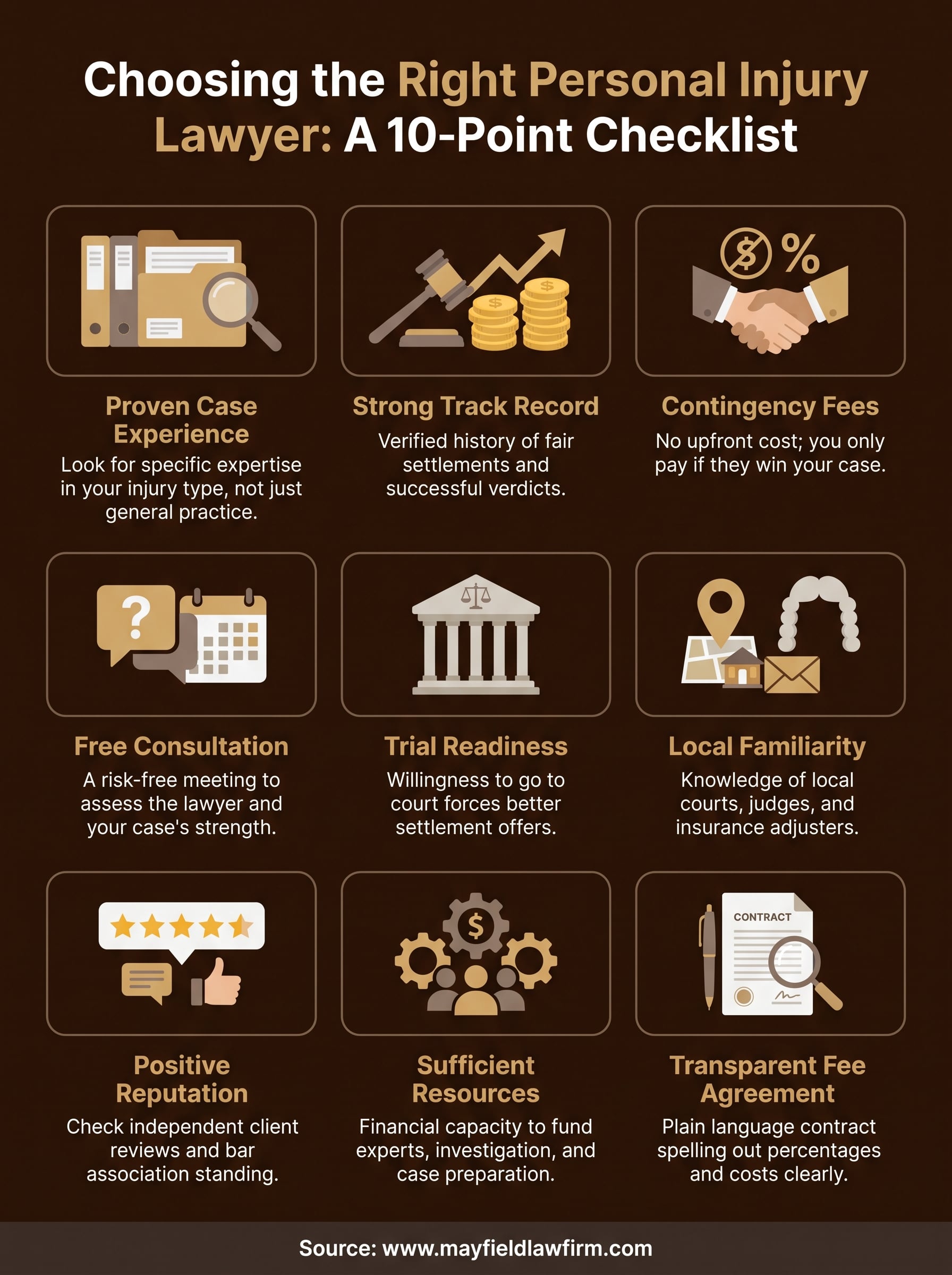
Choosing a lawyer for personal injury comes down to ten things: real experience with your type of case, a track record you can verify, fair fees, honest communication, and a willingness to fight past the first lowball offer. None of these traits are hidden. You just have to ask the right questions and pay attention to how a firm answers them during your consultation.
Trust your instincts once you've done the homework. If a firm dodges specifics, rushes you toward a signature, or can't explain its fee structure in plain terms, keep looking. The right attorney will welcome your questions, not deflect them.
If you're dealing with an auto accident, workplace injury, or wrongful death claim in Northeast Mississippi or South Memphis, contact Mayfield Law Firm for a free case consultation and see how these ten factors show up in your own case.