
Medical Malpractice Lawyer near Me: 7 Tips to Choose
Something went wrong during a medical procedure, and now you're left with more pain, more bills, and more questions than answers. Typing medical malpractice lawyer near me into a search bar is usually the first real step toward getting answers, but not every attorney who shows up in those results has the experience to handle a case against a hospital or physician. You need someone who knows how to prove negligence in a medical malpractice case, not just file paperwork.
Finding the right fit means looking past flashy ads and checking for specific trial experience , a track record with medical negligence claims , and a willingness to explain your case in plain language during a free consultation. The best attorneys will tell you honestly whether you have a viable claim before they ever ask you to sign anything.
This guide walks through seven practical tips for choosing a medical malpractice attorney , whether you're in Tupelo, Southaven, or the Memphis area. Our team at Mayfield Law Firm has built cases involving surgical errors, misdiagnosis, and birth injuries for over 40 years, and we know what separates a qualified lawyer from one who's just chasing a settlement.
1. Confirm proven experience in medical malpractice cases
Medical malpractice cases are a different animal from a typical car accident claim, and it helps to understand what a medical malpractice lawyer actually does before you start calling firms. You're not just proving someone was careless behind the wheel. You're proving a doctor, nurse, or hospital deviated from the accepted standard of care, and that deviation caused real harm. Many general personal injury lawyers will take these cases because the potential payout looks attractive, but they don't have the depth of medical negligence experience needed to build a winning case. Before you hire anyone, find out how many malpractice claims they've actually handled, not just personal injury cases in general.
Why it matters
Standing up to a hospital's legal team requires more than confidence. It requires knowing how to read medical records, depose expert witnesses, and counter the defense's version of events line by line. A lawyer who has spent years on surgical error cases , misdiagnosis claims, or birth injury litigation already knows the common defense tactics insurance companies use to minimize payouts. They've seen the playbook before. A lawyer new to this practice area is learning on your dime, and that inexperience can cost you thousands of dollars, or worse, cost you the case entirely.
A lawyer's medical malpractice experience matters more than their overall years in practice.
Experience also shapes how a case gets valued from day one. Attorneys who've handled dozens of these claims can spot red flags in your medical file that a newer lawyer might miss entirely, like a missed lab result buried in a chart or an inconsistency between a doctor's notes and the actual treatment given. That kind of pattern recognition comes only from repetition. At Mayfield Law Firm, our team has represented clients across Northeast Mississippi and the Memphis area for over four decades, and that history gives us a working knowledge of how local hospitals, insurers, and defense firms typically respond to a claim. If you're comparing firms, ask directly how many malpractice cases they've resolved and what types of medical errors those cases involved.
Regional knowledge counts too. Every state, and sometimes every county, has its own quirks in how malpractice claims move through the court system. An attorney practicing in Tupelo or Southaven understands the local judges, the hospital systems in the region, and the medical experts willing to testify in Mississippi and Tennessee cases. That local footprint often matters as much as national name recognition when it's time to actually build your case.
Questions to ask the lawyer
Don't rely on a firm's website alone to judge their experience. Use your free consultation to ask pointed questions and listen for direct, specific answers rather than vague reassurances.
- How many medical malpractice cases have you personally handled, and how many went to trial versus settled?
- What types of malpractice claims do you focus on (surgical errors, birth injuries, misdiagnosis, medication mistakes)?
- Have you handled cases against the specific hospital or provider involved in my situation?
- What percentage of your practice is dedicated to medical malpractice versus other types of personal injury work?
- Who on your team will actually work my case, and what's their background in these claims?
Questions like these separate a firm that dabbles in malpractice from one that's built a real practice around it. If a lawyer hesitates or gives you a generic answer about "years of experience" without specifics, treat that as a warning sign. A firm confident in its track record will happily walk you through past cases, general outcomes, and the reasoning behind their approach. That transparency during your first conversation tells you a lot about how they'll communicate once your case is underway.
2. Review their track record of settlements and verdicts
A lawyer's résumé only tells you so much. What actually matters is how their past cases turned out. Ask any medical malpractice attorney you're considering for specific numbers: settlement amounts, jury verdicts, and how those results compare to the initial demand. A firm that can point to concrete outcomes, not just "successful representation," gives you a much clearer picture of what to expect from your own case.
Why it matters
Past results won't guarantee a specific outcome for you, since every case turns on its own facts, but they reveal how a lawyer negotiates and whether they're willing to take a case to trial when the insurance company lowballs an offer. Insurance defense attorneys research opposing counsel before negotiations even start. If they know a lawyer settles every case rather than risk a courtroom, they'll offer less money because they know the pressure works. A firm with verified trial experience and a history of strong verdicts sends the opposite message: that they're prepared to fight for full value if a fair settlement isn't on the table.
A lawyer who's willing to go to trial usually negotiates a better settlement than one who never does.
Track record also shows you how a firm handles different injury types. A birth injury case demands different expertise than a surgical error or a missed cancer diagnosis. Look for outcomes that match your specific situation rather than a general list of big numbers. Mayfield Law Firm has secured settlements and verdicts across a range of medical negligence claims throughout Northeast Mississippi and the Memphis area, and we're upfront with clients about what similar cases have resolved for and why.
Questions to ask the lawyer
During your consultation, push past generic marketing language and get specific numbers and case details. A firm confident in its results will answer these without hesitation:
- What were the outcomes of your three most recent malpractice cases similar to mine?
- What percentage of your cases settle before trial versus go before a jury?
- Have you obtained verdicts or settlements against the specific type of provider involved in my case (hospital, surgeon, specialist)?
- What was the highest and lowest settlement you've secured for a case like mine?
- How do you decide whether to recommend accepting a settlement or proceeding to trial?
Straight answers here tell you whether a firm has the substance to back up its claims. Vague responses about "millions recovered" without case-specific context usually mean the lawyer is leaning on marketing rather than a genuine track record you can verify.
3. Ask about access to medical experts and case resources
Every medical malpractice case hinges on expert witness testimony . You can't prove a doctor deviated from the standard of care without a qualified physician willing to say so under oath, and that expert has to be credible enough to survive cross-examination. Before you hire a medical malpractice lawyer near you , find out whether they already have relationships with practicing physicians in the relevant specialty or whether they'll be starting from scratch after signing you as a client. The answer says a lot about how prepared the firm actually is to build your case.

Why it matters
Building a malpractice case costs real money before a settlement ever arrives, and the fees and expenses behind a malpractice claim add up quickly. Expert witnesses charge for record review, depositions, and trial testimony, and those fees can run into the tens of thousands of dollars depending on the complexity of the case. Firms without the financial resources to front these costs sometimes settle early just to avoid the expense, even when a case is worth pursuing further. Ask whether the firm covers these costs upfront and only recoups them from a settlement or verdict.
A malpractice case is only as strong as the expert testimony backing it up.
Case resources go beyond just hiring experts, too. Investigating a claim often means requesting complete medical records, hospital protocols, and sometimes internal incident reports that hospitals aren't eager to hand over. A firm with established case-building capacity knows how to subpoena these records efficiently and has staff dedicated to organizing thousands of pages of medical documentation into a coherent timeline. That groundwork often determines whether an expert can even form a solid opinion in your favor.
Questions to ask the lawyer
Use your consultation to find out exactly what resources a firm can bring to your case, not just what they say in general terms, and cover the questions about expert witnesses and case strategy while you have their attention:
- Do you have existing relationships with medical experts in the specialty relevant to my case?
- Who covers the cost of expert witnesses, record retrieval, and investigation, and how does that get repaid?
- Do you have in-house staff who handle medical record review, or is that outsourced?
- How do you typically obtain hospital records or internal reports when a provider is uncooperative?
- Can you estimate the total cost of building a case like mine before it goes to trial?
A firm that answers these questions with specific numbers and named processes has clearly done this before. If you hear a lot of hedging about "we'll figure that out later," that's a sign the firm may not have the infrastructure to take your case as far as it needs to go.
4. Verify knowledge of your state's malpractice laws and deadlines
Every state sets its own rules for how a medical malpractice claim has to be filed, and Mississippi is no exception. Mississippi law gives you a two-year window from the date of injury (or the date you reasonably should have discovered it) to file a claim, which is shorter than the filing deadline for most Mississippi injury cases, and you also have to send the healthcare provider a formal 60-day notice of intent before you can even file suit. Miss either of these steps and a valid claim can get thrown out before a judge ever hears the facts. A medical malpractice lawyer near me search should lead you to someone who already knows these deadlines cold, not one who has to look them up after you've signed on.
Why it matters comes down to timing and technical requirements that don't bend for good intentions. Mississippi also requires a certificate of consultation confirming that a qualified expert reviewed your case and believes it has merit, and that certificate typically has to accompany your notice of intent. Tennessee, where the firm also handles cases out of Memphis, has its own separate pre-suit notice rule and a slightly different statute of limitations, so a lawyer working across both states needs a firm grip on which rules apply to your specific situation. Get this wrong, and a technicality can end a legitimate claim regardless of how strong the underlying facts are.
Missing a filing deadline can end a valid malpractice claim before the facts are ever heard.
Deadlines aren't the only state-specific detail that matters here. Mississippi caps non-economic damages in malpractice cases, which affects how a lawyer values and negotiates your claim from the start. A firm unfamiliar with these caps might set expectations that don't match what's actually recoverable, leaving you disappointed later in the process. Verifying that your attorney practices regularly in the state where your injury occurred, rather than dabbling across multiple jurisdictions without real depth in any of them, protects you from these costly surprises.
Questions to ask the lawyer
Don't assume every attorney who takes your call has current, state-specific knowledge. Ask directly:
- What is the statute of limitations for my case, and has the clock already started running?
- Do you know the pre-suit notice requirements for Mississippi and Tennessee, and have you filed them before?
- Is a certificate of consultation from a medical expert required in my situation, and do you already have one lined up?
- How do Mississippi's damage caps affect the value of a case like mine?
- Have you filed malpractice claims in the specific county where my treatment occurred?
Clear, confident answers here show a lawyer who treats deadlines as more than fine print.
5. Prioritize clear communication and free consultations
A free consultation is your first real test of how a firm treats clients, not just a sales pitch to get you in the door. Pay attention to how the lawyer explains your legal options during that first meeting. Do they use plain language, or do they bury you in jargon and vague promises about "maximizing your recovery"? A medical malpractice attorney near you should walk you through the strengths and weaknesses of your case honestly, even if that means telling you the claim isn't as strong as you hoped. That kind of straight talk from the start tells you a lot about what working with them will actually feel like over the months, sometimes years, a malpractice case can take.
Why it matters
Malpractice cases move slowly. Medical records take weeks to gather, experts need time to review files, and insurance companies drag out negotiations on purpose. Throughout that process, you need a lawyer who returns calls, sends updates without you having to chase them down, and explains each development in terms you understand. Firms that go quiet for months at a time leave clients anxious and in the dark about whether their case is even progressing.
The way a lawyer communicates during your free consultation predicts how they'll communicate for the rest of your case.
Beyond responsiveness, consider who you'll actually be talking to. Some firms hand your case off to a junior associate or paralegal after the initial meeting, and you rarely hear from the lead attorney again. Others, like Mayfield Law Firm, keep clients informed directly through the team handling the case, so you're not left guessing who to call with questions. Since a free consultation costs you nothing, use it to gauge whether the firm's communication style matches what you need, and know what a first meeting with an attorney should cover before you walk in. If a lawyer seems rushed or dismissive before you've even signed anything, that pattern rarely improves once your case is underway.
Questions to ask the lawyer
Bring these questions to your consultation and pay close attention to how directly they're answered:
- Who will be my main point of contact throughout the case, and how quickly do you typically respond to calls or emails?
- How often should I expect updates, and in what format (phone, email, in-person meetings)?
- Will the attorney I meet today personally handle my case, or will it be passed to someone else?
- What does your free consultation actually include, and is there any obligation afterward?
- How do you handle questions or concerns that come up between scheduled updates?
Consistent, specific answers signal a firm built around client communication rather than one that treats consultations as a formality before moving on to the next lead.
6. Understand the fee structure before you sign
Most medical malpractice attorneys work on a contingency fee basis , meaning you don't pay anything upfront and the lawyer only gets paid if you win. That said, contingency percentages and how costs get handled can vary a lot between firms, and the fine print matters more than most people realize when they're signing paperwork during an already stressful time. Before you commit to any medical malpractice lawyer near me , get the fee agreement in writing and read it line by line, not just the summary the attorney gives you verbally.

Why it matters
A contingency fee typically runs between 33% and 40% of your final settlement or verdict, but that percentage often increases if the case goes to trial versus settling early. Some firms also deduct case expenses like expert witness fees and court costs from your recovery before calculating the attorney's cut, while others take their percentage first and then subtract expenses, which can leave you with noticeably less money in your pocket depending on the order of operations.
Two lawyers charging the same contingency percentage can leave you with very different amounts in your pocket depending on how expenses get calculated.
Here's a quick breakdown of how fee structures commonly differ:
| Fee Element | What to Ask |
|---|---|
| Contingency percentage | Does it increase if the case goes to trial or appeal? |
| Case expenses | Are they deducted before or after the attorney's percentage? |
| Unsuccessful outcome | Do you owe anything if the case is lost? |
| Payment timing | When is the fee actually collected, at settlement or after appeals? |
A firm willing to walk through this table-style breakdown in plain terms, rather than a one-line mention of "standard contingency," is one that respects your right to understand where your money goes. At Mayfield Law Firm, we lay out our fee structure clearly during the free consultation so there are no surprises once your case resolves. You can read more about how contingency fee malpractice lawyers get paid before you ever sign anything.
Questions to ask the lawyer
Get specific answers to these questions before you agree to representation:
- What percentage do you charge, and does it change if the case goes to trial?
- Are case expenses deducted before or after your fee is calculated?
- Do I owe anything out of pocket if we don't win?
- Who covers costs like expert witnesses and court filing fees while the case is pending?
- Can I get the fee agreement in writing before our next meeting?
A lawyer who answers these questions without hesitation is one who's confident their fee structure holds up to scrutiny, and that confidence usually reflects how they'll handle the rest of your case too.
7. Check reviews, ratings, and disciplinary history
Online reviews only tell part of the story, but they're still worth reading before you hire a local medical malpractice attorney . Look past the star rating and read what former clients actually say about communication, honesty, and how the firm handled setbacks. A pattern of complaints about ignored calls or surprise fees tells you more than a glowing five-star average ever could. Pair those reviews with a quick check of the attorney's standing with the state bar association, since that record shows whether the lawyer has faced formal complaints or sanctions.
Why it matters
Google reviews, Avvo, and Martindale-Hubbell each offer a different angle on a firm's reputation, and knowing which lawyer review sites to trust and what red flags look like helps you avoid getting swayed by a handful of cherry-picked testimonials. Beyond reviews, every state bar maintains public records of attorney discipline, and the Mississippi Bar lets you search an attorney's license status and any past disciplinary action in seconds. Skipping this step means hiring blind on the one thing that matters most: whether this lawyer has a clean, trustworthy history of representing clients honestly.
A clean disciplinary record and consistent, detailed reviews matter more than a firm's advertising budget.
Ratings also reveal something advertising can't fake: consistency over time. A firm with hundreds of detailed reviews spanning several years shows a sustained track record, while a handful of recent five-star reviews with little detail can be a red flag for manufactured feedback. Cross-reference what you read online with peer-rating services like Martindale-Hubbell, which rank attorneys based on evaluations from other lawyers and judges rather than client sentiment alone. Combining both sources gives you a fuller picture before you commit to representation in a case this serious.
Questions to ask the lawyer
Don't be afraid to raise reputation questions directly during your consultation. A confident, established firm won't flinch at these:
- Have you ever faced a disciplinary complaint or sanction from the state bar, and if so, what was the outcome?
- Can you provide references from past malpractice clients I could speak with?
- How do you handle a client complaint or dispute if one comes up during a case?
- Are you in good standing with the Mississippi and Tennessee bar associations?
- What do your online reviews typically say about your communication style?
Transparent answers here, paired with your own independent research, round out a complete picture of whether a firm deserves your trust with a case this personal.
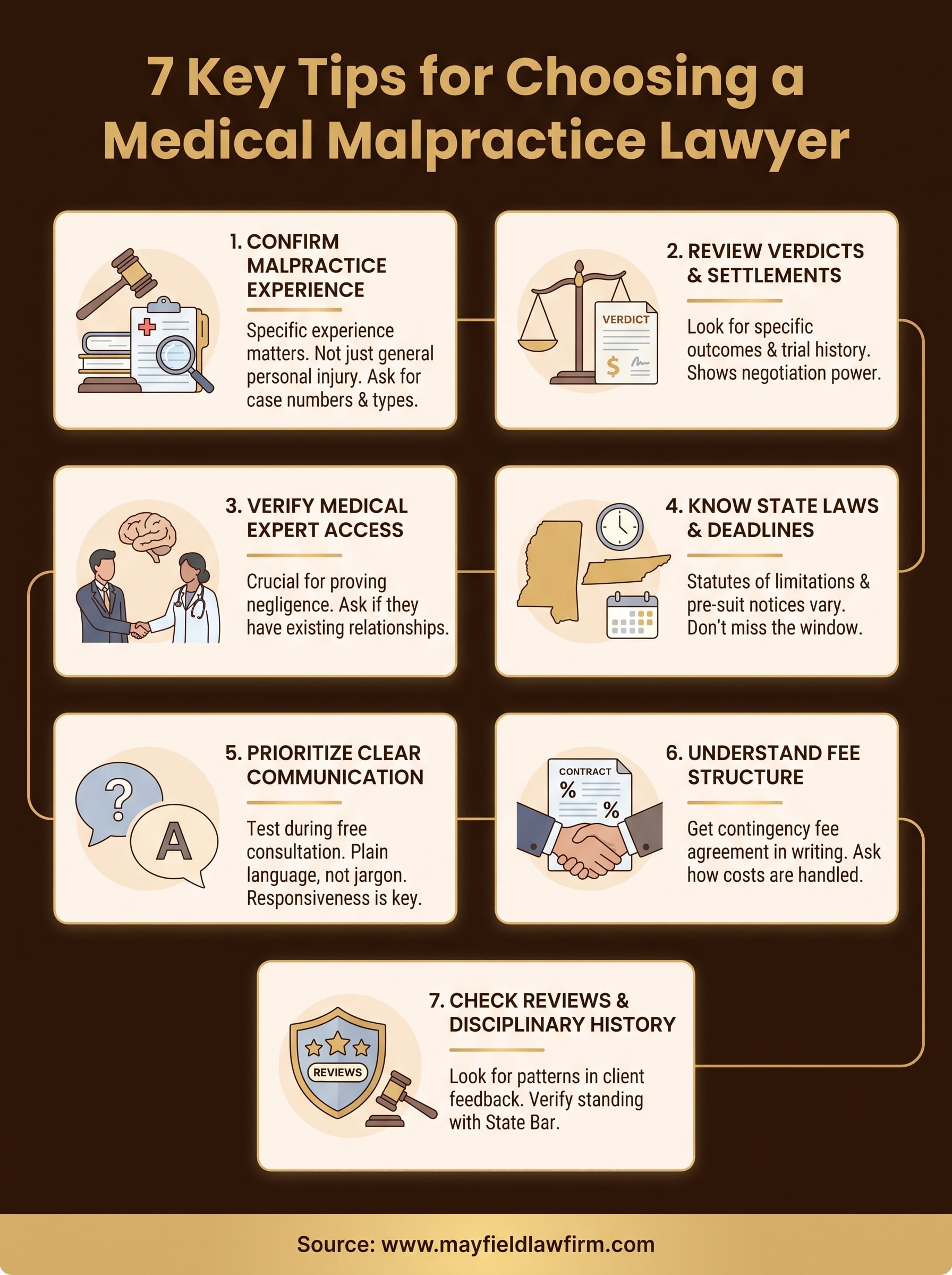
Finding the right attorney for your case
Choosing a medical malpractice lawyer near me shouldn't come down to whichever firm shows up first in a search. Weigh proven case experience, a real track record, access to medical experts, and a fee agreement you actually understand before you sign anything. The right attorney treats your first call as the start of a real conversation, not a sales pitch, and answers hard questions about deadlines, costs, and past results without flinching.
Getting hurt because a doctor or hospital fell short of the standard of care is stressful enough without adding a mismatched legal team to the mix. Take your time, ask the questions outlined above, and trust your gut when something feels rushed or vague. If you're in Tupelo, Southaven, or the Memphis area and ready to talk through what happened, schedule a free consultation with our medical malpractice and negligence lawyers in Tupelo, MS and get straight answers about your case.